
CALA DE SANT VICENT PROPERTY GUIDE
A hidden gem tucked away in the Northern Ibiza
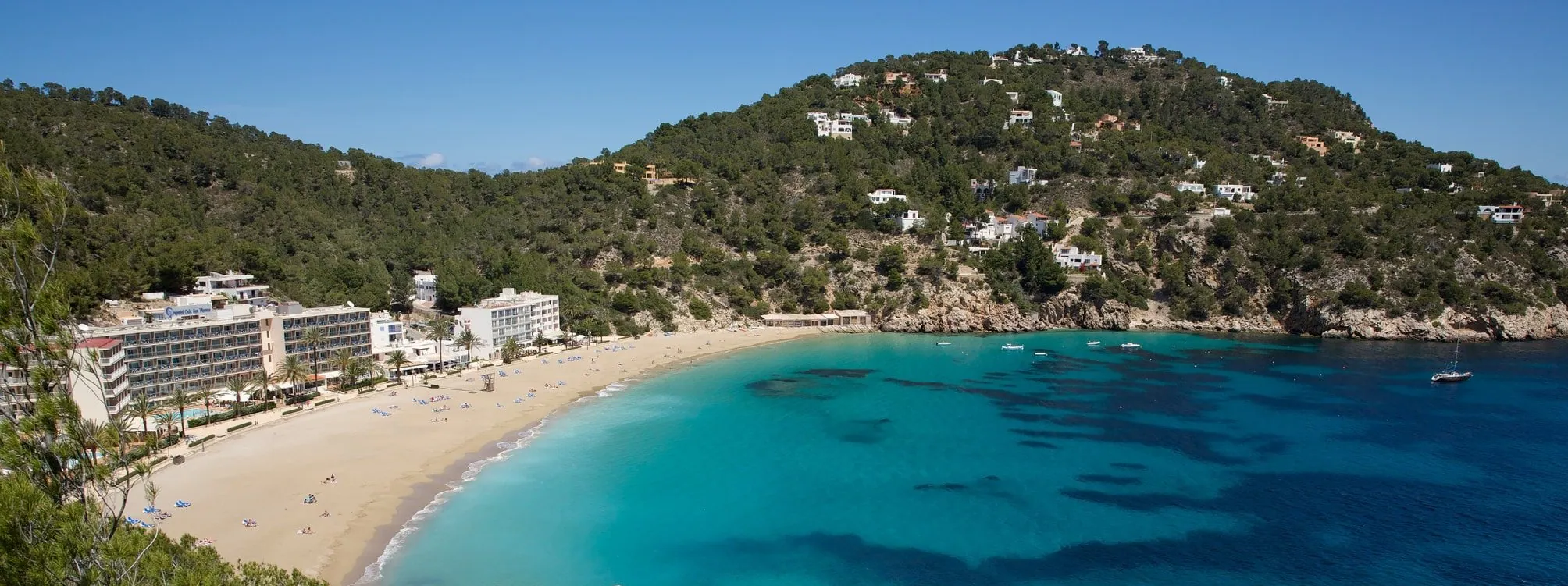
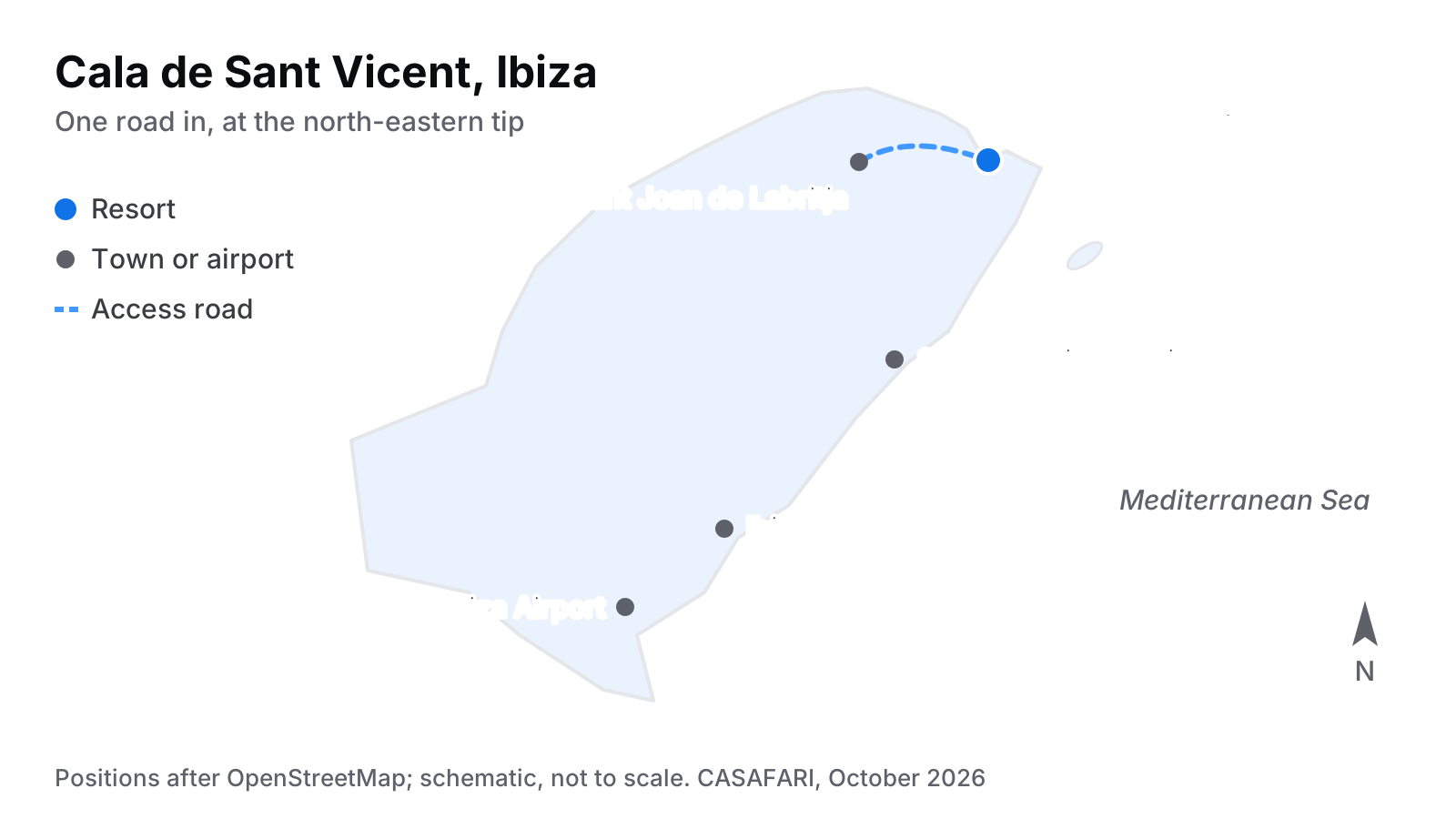
Cala de Sant Vicent, also written Cala San Vicente, is a 400-metre crescent bay at the north-eastern tip of Ibiza in the municipality of Sant Joan de Labritja (7,046 inhabitants on 1 January 2025, according to INE municipal population figures for the Balearic Islands). The market consists almost entirely of detached villas and fincas above the bay. Tourist letting is permitted only in licensed detached homes, never in flats.
Where Cala de Sant Vicent is and what the market looks like
Cala de Sant Vicent sits in a sheltered, east-facing cove framed by steep wooded cliffs. A short distance inland lies the small hamlet of Sant Vicent de sa Cala, centered around its traditional church and a single local shop. Historically isolated from the rest of the island, the area only gained a direct tarmac road in the mid-twentieth century, an era recorded in Norwegian author Leif Borthen’s travel book The Road to San Vicente.
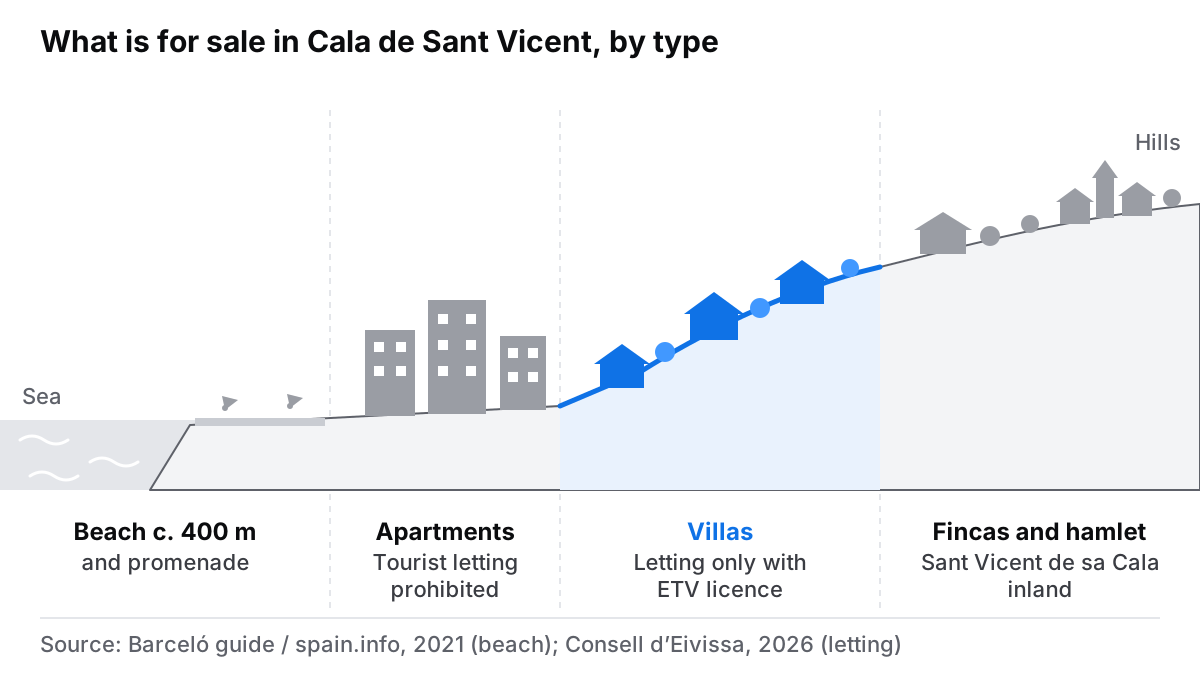
Because the municipality of Sant Joan de Labritja remains the least built-up regional division on the island, strict planning protections restrict new construction. The local housing stock consists primarily of detached Ibizan fincas and modern private villas scattered across the surrounding hillsides, alongside a small selection of mid-rise apartment blocks constructed along the beach during the 1970s and 1980s.
Buyers in Cala de Sant Vicent are overwhelmingly international lifestyle investors and second-home purchasers seeking privacy and natural surroundings over nightlife. Buyers considering broader regional trends across the island can explore whether now is the time to invest in Ibiza to benchmark the north-east against other municipal districts.
Why buyers choose Cala de Sant Vicent over the south of the island
Unlike the busier southern resorts, Cala de Sant Vicent offers a calm environment free from nightclub developments. The bay features a curve of golden sand measuring approximately 400 metres long by 30 metres wide, offering clear, shallow waters, a seasonal lifeguard service, and a sheltered anchorage for leisure craft.
A small palm-lined promenade runs behind the beach, accommodating a modest selection of traditional restaurants, cafés, and local amenities. Coastal walking trails lead along the pine-forested cliffs towards scenic vantage points, including the elevated headland overlooking the private island of Tagomago to the east.
The primary trade-off for this tranquility is geographical remoteness. Situated at the end of the access road, everyday errands require a short drive inland, making a personal vehicle essential for residents and visitors alike. Readers planning a purchase anywhere in the country can review how buying property in Spain works, step by step for guidance on legal procedures and conveyance.
Can you let a Cala de Sant Vicent property to tourists?
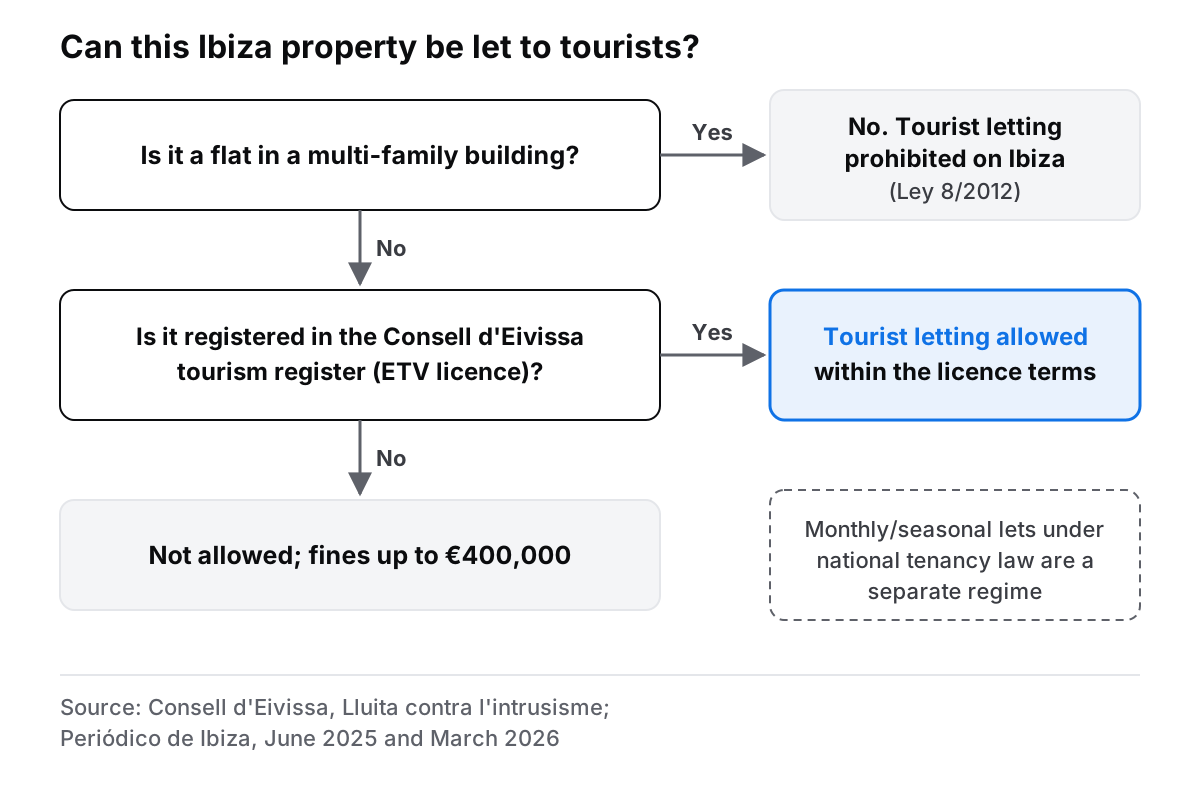
For property owners considering holiday rental income, strict regulations apply across Ibiza. Under Balearic Tourism Law (Ley 8/2012), tourist letting in multi-family residential buildings, such as apartments and flats, is strictly prohibited island-wide. In March 2026, the Consell d’Eivissa reaffirmed its commitment to a total ban on tourist flats to safeguard permanent residential housing stock.
Holiday letting is permitted exclusively in detached single-family homes that hold an official licence registered with the island tourism authority (an ETV licence). Unlicensed tourist letting is actively policed by the Consell d’Eivissa’s inspection unit, with statutory penalties reaching up to 400,000 euros under the Consell d’Eivissa’s rules on illegal tourist flats.
Investors should note that long-term or seasonal rentals (rentals by the month under national tenancy law, or LAU) operate under a completely distinct legal framework and do not fall under tourist letting restrictions. For a wider perspective on yield and regulations, see our guide on owning a rental property in Mallorca and Ibiza.
What a purchase here costs in tax: the Balearic ITP ladder
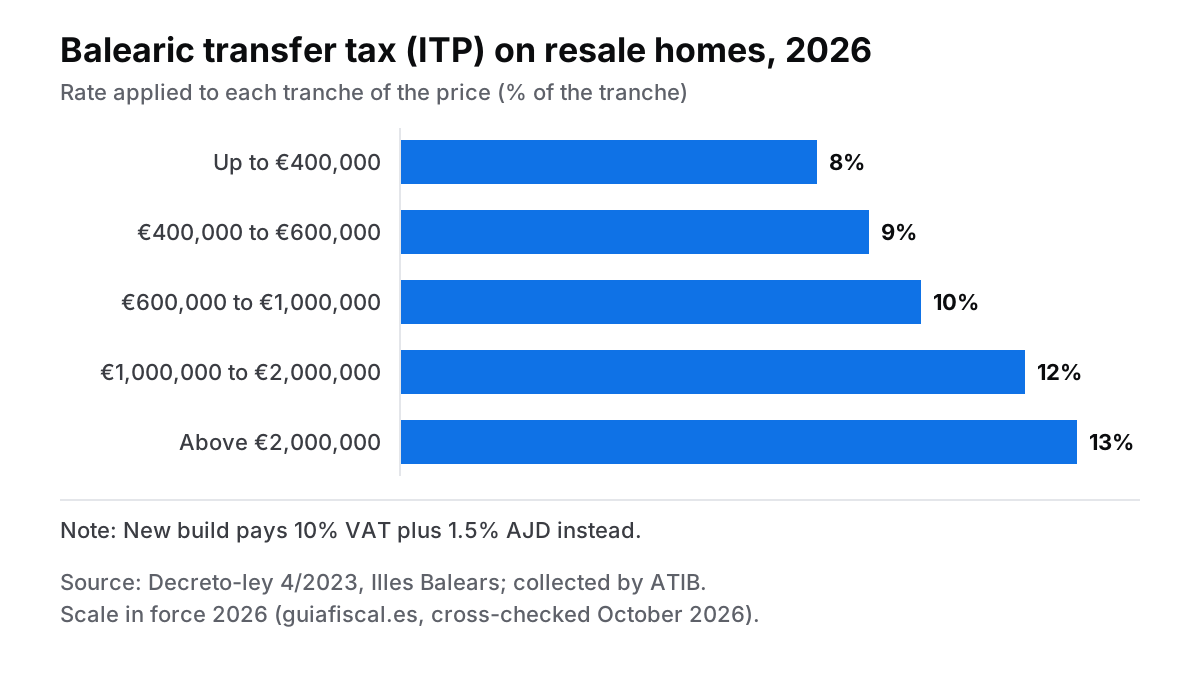
When purchasing a resale villa or apartment in Cala de Sant Vicent, buyers must budget for Property Transfer Tax (Impuesto sobre Transmisiones Patrimoniales, or ITP). Administered by the Tax Agency of the Balearic Islands (ATIB) under Decreto-ley 4/2023, the progressive scale in force for 2026 applies higher tax brackets as property values rise, detailed in the Balearic ITP scale for 2026:
- Up to 400,000 euros: 8%
- From 400,000 to 600,000 euros: 9%
- From 600,000 to 1,000,000 euros: 10%
- From 1,000,000 to 2,000,000 euros: 12%
- Above 2,000,000 euros: 13%
As an illustrative arithmetic example, purchasing a resale villa for 1.5 million euros incurs a total ITP liability of 150,000 euros. This is calculated as 32,000 euros on the first 400,000 euros (8%), 18,000 euros on the next 200,000 euros (9%), 40,000 euros on the next 400,000 euros (10%), and 60,000 euros on the final 500,000 euros (12%).
Purchasing a newly constructed home incurs 10% Value Added Tax (VAT/IVA) plus 1.5% Documented Legal Acts stamp duty (AJD) rather than ITP. On all transactions, buyers should budget an additional 1% to 2% for notary fees, land registry fees, and independent legal advice from a qualified Spanish lawyer (abogado).
Getting there, and living there year-round
Cala de Sant Vicent is reached via a single scenic road winding through the hills. Year-round essential services, including primary schools, medical centers, pharmacies, and large supermarkets, are located in the neighboring administrative center of Sant Joan de Labritja and the town of Santa Eulària des Riu. For broader municipal context, consult the Sant Joan de Labritja area guide. International schools on the island are situated further south towards Santa Eulària and Ibiza Town.
For buyers from non-EU countries, including the United Kingdom, property ownership does not confer automatic residence rights in Spain. Under standard Schengen area regulations, non-EU nationals may stay up to 90 days in any 180-day period without a long-stay visa, as outlined in the official UK Government entry requirements for Spain. Longer stays require applying for an appropriate residence visa, such as a non-lucrative visa.
During the winter months, most tourist-oriented beachfront businesses close for the season. This seasonal quiet makes the area ideal for buyers seeking seclusion, though residents rely on nearby towns for mid-winter services.
How CASAFARI Area Insights reads Cala de Sant Vicent
Real estate professionals, buyers, and valuation experts use CASAFARI to track real-time property market activity across the Balearic Islands. CASAFARI aggregates market data from thousands of portal and agency listings to provide clean, deduplicated market intelligence.
Through Area Insights for Cala de Sant Vicent, agents and investors can evaluate live asking prices, average time on market, stock breakdown by property type, and historical price movements for north-eastern Ibiza. Developers and technical teams can explore the platform’s schema and capabilities directly in the Area Insights developer documentation (in English).
Cala de Sant Vicent offers a rare balance of coastal beauty and legal preservation. To evaluate current real estate listings and pricing trends across Sant Joan de Labritja, professionals can open CASAFARI and look at the area yourself to make informed investment decisions.
Frequently asked questions
Can I rent out a villa in Cala de Sant Vicent to tourists?
Only if the property is a detached home registered in the Consell d’Eivissa tourism register with a valid licence. Tourist letting in multi-family residential buildings, such as flats, is prohibited across Ibiza under Ley 8/2012, as confirmed by the Consell in March 2026. Unlicensed tourist letting carries fines of up to 400,000 euros. Buyers should inspect the licence documentation in the tourism register prior to submitting an offer.
How far is Cala de Sant Vicent from Ibiza airport?
Cala de Sant Vicent is located at the far north-eastern tip of Ibiza, positioned roughly at the opposite end of the island from the airport. Access is via a single road leading through Sant Joan de Labritja or Sant Carles. The nearest urban centres for daily supplies and municipal services are Sant Joan de Labritja and Santa Eulària des Riu.
What tax do you pay when buying a house in Ibiza?
On a resale property, buyers pay Balearic transfer tax (ITP) on a progressive scale set by Decreto-ley 4/2023 and collected by ATIB in 2026: 8% up to 400,000 euros, rising incrementally to 13% above 2,000,000 euros. Purchasing a new-build home incurs 10% VAT plus 1.5% stamp duty (AJD). Additional costs include notary, land registry, and legal fees.
Can British citizens still buy property in Ibiza?
Yes, British citizens face no legal restrictions when purchasing real estate in Spain. Buyers must obtain a Spanish NIE tax number and typically set up a local bank account. Ownership alone does not grant residency; non-EU citizens remain subject to the Schengen rule permitting stays of up to 90 days in any 180-day period under UK Government entry requirements for Spain.