SANT JOAN DE LABRITJA PROPERTY GUIDE
Northern gem of Ibiza & gateway to the most idyllic bays
Sant Joan de Labritja is Ibiza’s least densely populated municipality, holding 7,046 residents across 121.66 square kilometres according to 2025 municipal population figures from the Instituto Nacional de Estadística (INE). Structured around four historic parishes and strictly regulated by a minimum plot requirement of 15,000 square metres on common rustic land, the northern territory offers high privacy, protected landscapes, and enduring real estate scarcity.
Why does Sant Joan de Labritja attract low-density property buyers?
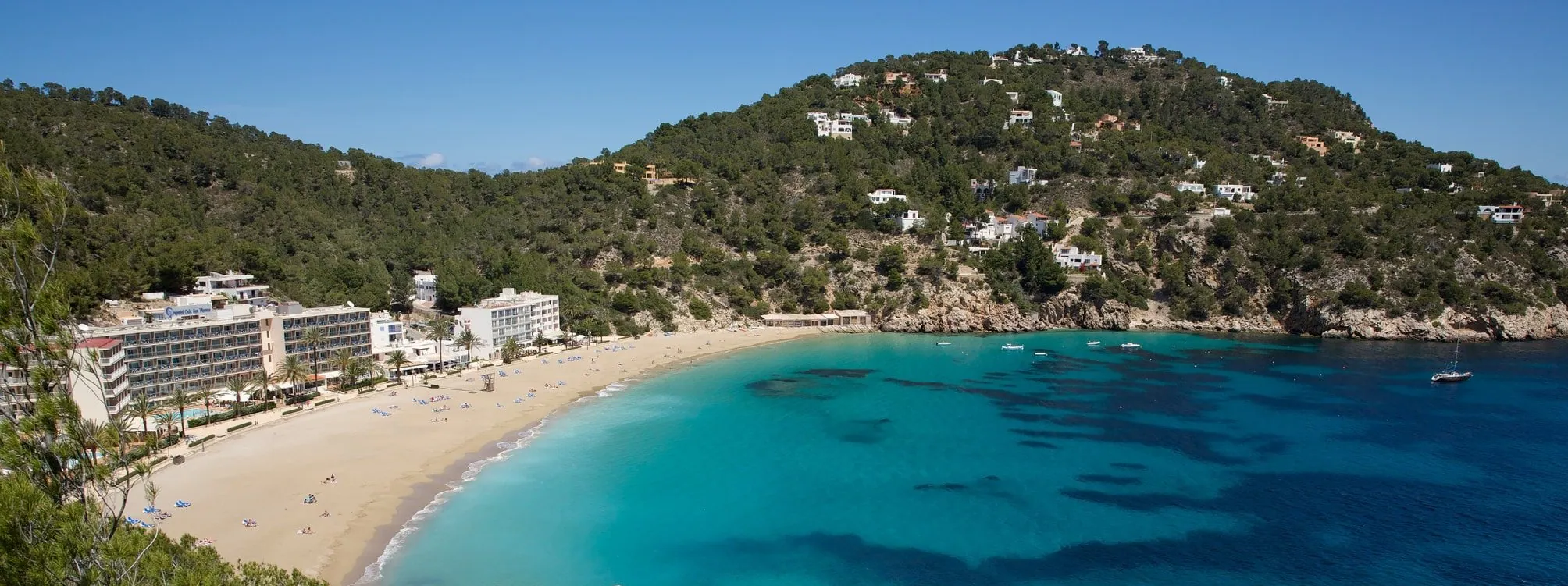
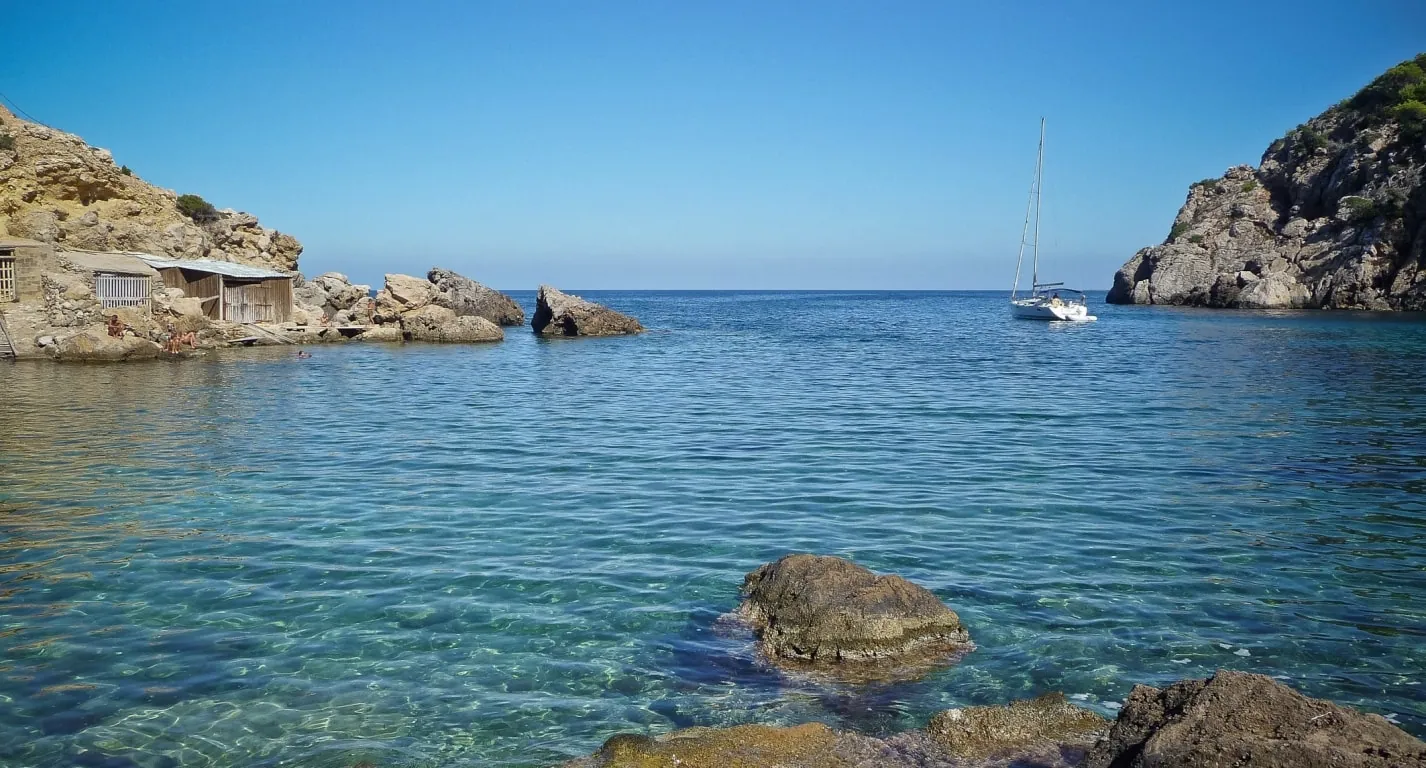
Occupying the entire northern tip of Ibiza, Sant Joan de Labritja stands apart from the island’s urbanised southern coastline. Pine-covered hillsides, agricultural valleys, and steep sea cliffs dominate the region, creating a secluded living environment favoured by international buyers seeking discretion and space.
Unlike the more built-up districts surrounding Eivissa or Sant Antoni, northern Ibiza enforces rigorous territorial protections. Structural limitations on new residential development prevent suburban sprawl, ensuring that farmland and forest reserves remain largely intact. For property investors, this legal framework establishes permanent physical scarcity: because open land cannot be subdivided into small residential lots, existing homes and valid rustic plots retain intrinsic long-term capital stability.
Towns, parishes and coastal villages of the Sant Joan de Labritja region
According to the Govern de les Illes Balears (CAIB), the municipality is administrative home to four historic parishes encompassing seven distinct population and tourist nuclei. Understanding how these settlements differ is essential for matching buyer requirements with the correct micro-location.
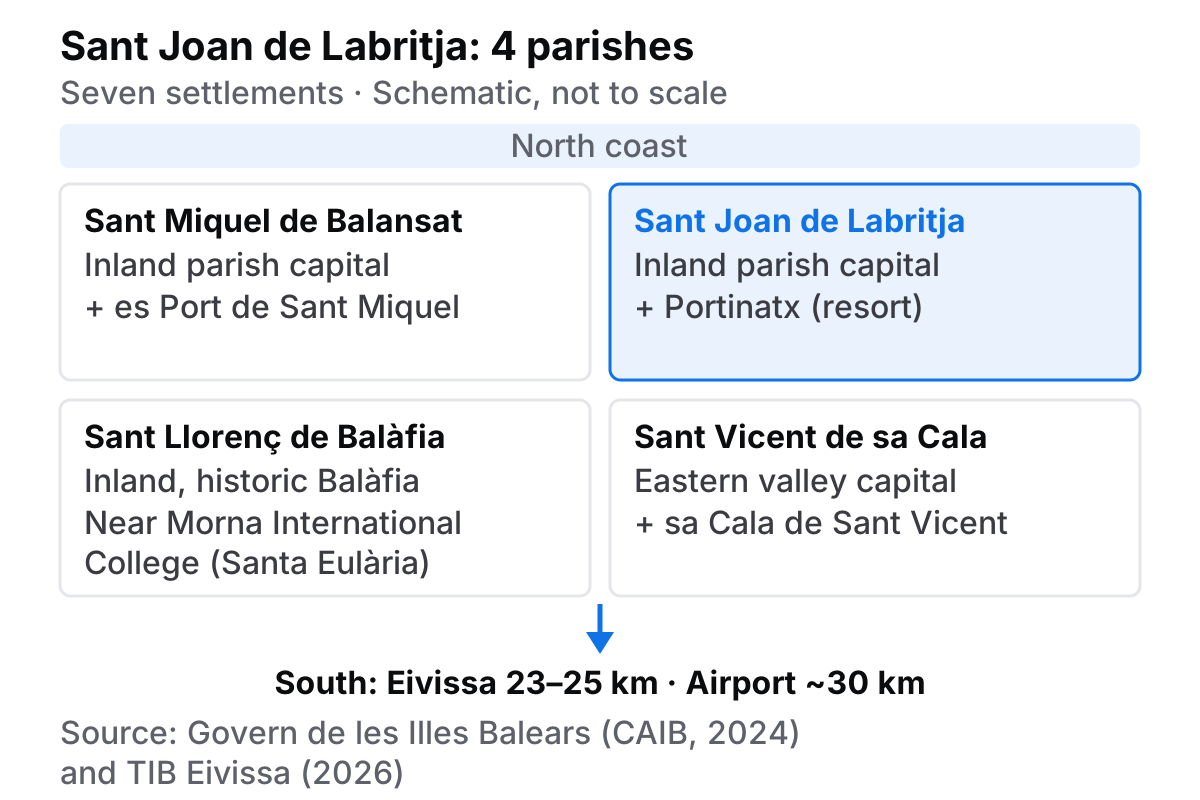
- Sant Joan de Labritja: The municipal seat functions as a traditional inland village defined by stone townhouses, local cafes, and its weekly Sunday artisan market. Traditional fincas populate the surrounding valley, attracting buyers who value architectural authenticity.
- Sant Miquel de Balansat and es Port de Sant Miquel: Sant Miquel is the municipality’s largest inland service centre, offering year-round commerce, banks, and primary health facilities. Two kilometres north down the valley lies es Port de Sant Miquel, a sheltered northern bay featuring coastal apartments and hillside villas overlooking the harbour.
- Sant Vicent de sa Cala and sa Cala de Sant Vicent: Positioned in the tranquil north-eastern corner, this region consists of a secluded farming valley leading down to a wide, sandy cove. Its distance from main transit routes makes it a primary choice for second-home buyers prioritizing total solitude.
- Sant Llorenç de Balàfia and Portinatx: Sant Llorenç is an inland agricultural parish featuring the historic fortified settlement of Balàfia and sought-after rural plots. By contrast, Portinatx anchors the northernmost tip of Ibiza, operating as a self-contained resort town with sea-view apartments, coves, and seasonal commercial amenities.
Transport, schools and year-round living in northern Ibiza
Despite its peaceful atmosphere, Sant Joan de Labritja remains well integrated into the island’s infrastructure. The main village sits between 23 and 25 kilometres from Eivissa (Ibiza Town) and approximately 30 kilometres from Ibiza Airport, representing a driving time of 25 to 30 minutes outside peak seasonal conditions.
Public transit is coordinated by the Consell d’Eivissa through the TIB regional bus network. Route L20A and the N20 night bus link Portinatx, Sant Joan, and Sant Llorenç directly to the central CETIS terminal in Eivissa, enabling straightforward connections to lines L10 or L10E for airport access. Full schedule details are published on the TIB Eivissa L20A bus route timetable. Additional feeder lines—including the L20B to Cala Sant Vicent, the L21 to Santa Eulària, and the L25/L25A connecting Sant Miquel—provide coverage across neighboring communes.
For families establishing a primary residence, the local educational system includes three public primary schools (CEIP Labritja in Sant Joan, CEIP Balansat in Sant Miquel, and CEIP Torres de Balàfia in Sant Llorenç) alongside one secondary school (IES Balàfia in Sant Llorenç), listed in the official CAIB school catchment directory for Ibiza. International buyers often note that Morna International College, which teaches the English national curriculum, is situated just outside the municipal border at Carretera de Sant Miquel km 3.5 in Santa Gertrudis (municipality of Santa Eulària des Riu), putting Sant Llorenç and Sant Miquel within comfortable daily commuting distance.
Planning rules on rustic land (PTI) and ETV tourist licences
Navigating real estate transactions in northern Ibiza requires precise familiarity with regional planning legislation. Development parameters on rural land are set by the Consell d’Eivissa Plan Territorial Insular (PTI).
To construct a new single-family home on common rustic land (classified as SRC-SRG or SRC-AT), buyers must acquire a minimum plot size of 15,000 square metres. On land classified as forestry rustic (SRC-F), the minimum requirement increases to 25,000 square metres. Residential construction is strictly restricted to a single detached dwelling per plot, capped at a maximum buildable footprint of 320 square metres and a maximum volume of 900 cubic metres. New construction is prohibited on protected natural areas designated as ANEI (Área Natural de Especial Interés) or ARIP (Área Rural de Interés Paisajístico).
When purchasing existing rustic properties, legal verification is paramount. Under Balearic Decree-Law 3/2024 (consolidated via Law 7/2024), an extraordinary three-year framework allows property owners to legalise historical, time-barred structures that do not conform to current planning rules, provided specific conditions and financial penalties are met. Reviewing these title particulars forms a core component of any thorough guide to the Spanish property purchase contract and escritura.
Short-term holiday letting is similarly regulated. According to Balearic Government (CAIB) tourist rental regulations, a total moratorium on issuing new tourist rental licences (ETV) has been in place since February 2022 and was further reinforced by Decree-Law 4/2025. Multi-family apartment blocks cannot host commercial holiday lets. Investors targeting short-term rental yields must acquire a detached home that already retains a fully consolidated, active ETV licence.
Property purchase taxes (ITP and AJD) and residency rules in 2026
Acquiring real estate in Sant Joan de Labritja involves specific regional tax obligations administered by the tax authorities.
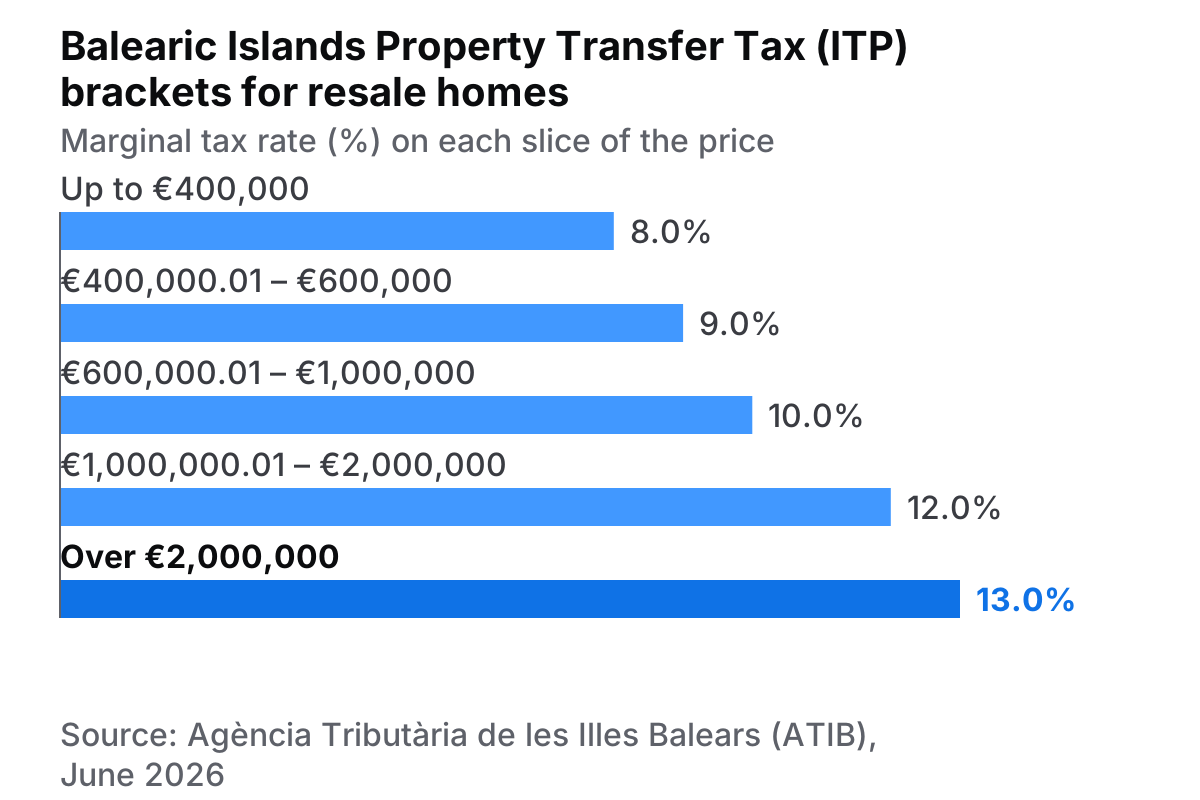
When purchasing a resale home, buyers incur Property Transfer Tax (Impuesto sobre Transmisiones Patrimoniales or ITP). The Agència Tributària de les Illes Balears (ATIB) ITP and AJD tax brackets set out a progressive scale based on the property value:
For new-build developments, buyers pay 10% VAT (IVA) plus 1.5% Stamp Duty (Actos Jurídicos Documentados or AJD). Relief measures exist for young buyers: individuals under 30 purchasing a primary residence valued under €378,211.68 in Ibiza may access reduced ITP rates between 2% and 4%, or full 100% exemption depending on income criteria.
Non-EU purchasers must also note changes to Spanish immigration policies. Following the publication of Organic Law 1/2025 in the Boletín Oficial del Estado (BOE), Spain formally repealed Articles 63 to 67 of Law 14/2013, terminating the real estate Golden Visa option on 3 April 2025. International buyers seeking long-term residency now utilise alternative options, such as the Non-Lucrative Residency Visa or Digital Nomad Visa.
Real estate professionals, valuation specialists, and private investors monitor this evolving market using specialised tools. Platform subscribers rely on CASAFARI Area Insights to evaluate supply concentration across parishes, run the property valuation and market study tool to benchmark rustic estate valuations, and employ CASAFARI Property Sourcing to locate off-market and multi-listed properties across Ibiza. To review wider regional trends, consult our comprehensive Ibiza property market insights, or sign in to the CASAFARI platform to access live inventory data.
Frequently asked questions
What is the minimum plot size to build a house on rustic land in Sant Joan de Labritja?
Under Ibiza’s Plan Territorial Insular (PTI), constructing a detached single-family house on common rustic land requires a minimum plot size of 15,000 square metres, which increases to 25,000 square metres on forestry rustic land. Total construction is strictly capped at a maximum buildable footprint of 320 square metres and 900 cubic metres of volume. Residential development remains entirely prohibited on protected ANEI and ARIP land.
Can I get a new tourist rental licence (ETV) for a property in Sant Joan de Labritja?
No, new ETV tourist rental licences are currently not being issued anywhere in Ibiza. The moratorium introduced in February 2022 and reinforced by Decree-Law 4/2025 freezes the creation of new tourist beds across the island and prohibits holiday rentals in multi-family residential buildings. Buyers seeking short-term rental opportunities must purchase a property that already possesses an existing, consolidated ETV licence.
How much is Property Transfer Tax (ITP) when buying a resale home in Ibiza?
The Balearic Islands apply a progressive Property Transfer Tax (ITP) schedule on resale property purchases. Rates start at 8% for the first €400,000, rising to 9% for amounts between €400,000.01 and €600,000, 10% between €600,000.01 and €1,000,000, 12% between €1,000,000.01 and €2,000,000, and 13% on any portion exceeding €2,000,000. For new-build properties, standard Stamp Duty (AJD) is 1.5%.
Does buying a property in Ibiza still qualify for the Spanish Golden Visa?
No, buying real estate in Spain no longer qualifies foreign investors for a Golden Visa residency permit. Organic Law 1/2025 repealed the real estate residency scheme with effect from 3 April 2025. Non-EU citizens looking to live in Ibiza must now apply through standard residency channels, such as the Non-Lucrative Visa or the Digital Nomad Visa.