
El Born and La Ribera, officially part of the barri of Sant Pere, Santa Caterina i la Ribera in Barcelona’s Ciutat Vella district, consist predominantly of historical flats in pre-1900 buildings. Key regulatory shifts apply: Spain’s investor residence permit ended on 3 April 2025 under Ley Orgánica 1/2025, all tourist-flat licences in Barcelona lapse by November 2028, and Catalonia’s transfer tax on resales operates on tiered rates from 10% to 13% since June 2025.
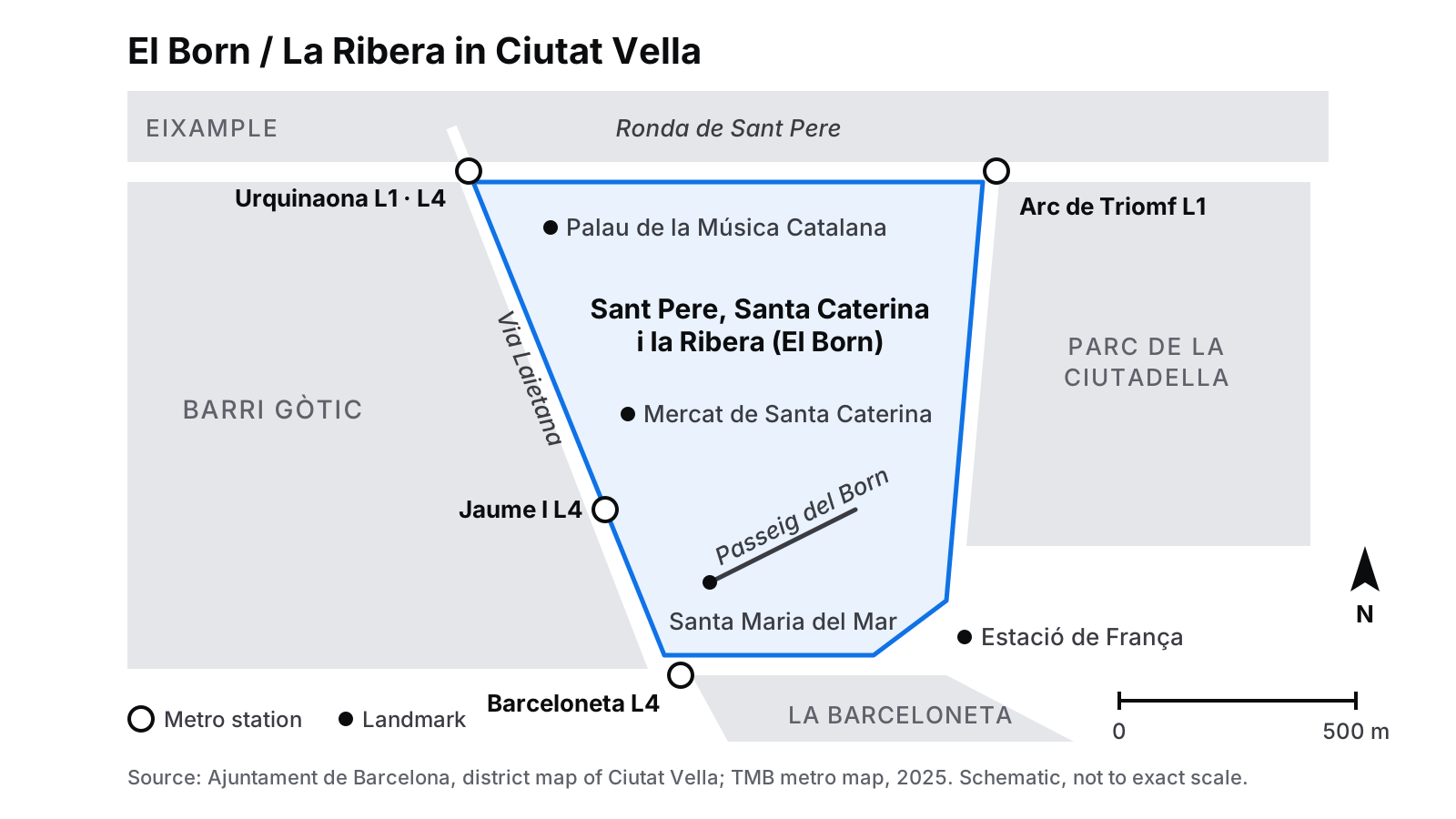
Where exactly is El Born, and what counts as ‘La Ribera’?
Understanding the geography of El Born requires stepping past informal estate agency naming. According to the Ajuntament de Barcelona, the official administrative unit is Sant Pere, Santa Caterina i la Ribera—one of the four barris of Ciutat Vella alongside el Raval, el Barri Gòtic, and la Barceloneta.
The boundary runs along Via Laietana to the west, Ronda de Sant Pere to the north, Parc de la Ciutadella to the east, and Passeig d’Isabel II alongside Estació de França to the south. Property professionals generally divide the quarter into three distinct micro-markets:
- Sant Pere: The northern zone around Palau de la Música Catalana. It features narrower streets, fewer crowds, and a predominantly residential character.
- Santa Caterina: Centred on the historic food market, offering a mix of long-standing local trades and modern housing developments.
- La Ribera and El Born: The southern area surrounding Carrer de Montcada, Passeig del Born, and Carrer del Rec. This is the busiest commercial and nightlife hub of the neighbourhood.
Walking to Plaça de Catalunya takes roughly five minutes (500 metres) from the northern edge at Urquinaona, while reaching the plaza from Passeig del Born requires a 15-minute walk of approximately one kilometre.
What kind of property is on offer?
The housing stock in El Born consists almost entirely of apartments situated in 18th- and 19th-century buildings. Standard features include exposed timber beams, brickwork, high ceilings, and traditional volta catalana (Catalan vaulted ceilings). Modern new builds are exceptionally rare due to heritage protections.
Prospective buyers should assess building infrastructure carefully. Lifts are absent in many historic walk-ups, and lower-floor apartments on narrow streets often receive limited natural light. Top-floor apartments (áticos) with private terraces offer views towards Montjuïc or Tibidabo, but command a premium.
When evaluating a flat in Ciutat Vella, buyers should review the building’s Inspección Técnica de Edificios (ITE) report and the community of owners (comunidad) financial balance sheet. Live valuation figures, current listing stock, and average days on market can be analyzed using Area Insights, CASAFARI’s neighbourhood market data.
Can I rent out my flat to tourists? The 2028 rule, explained
Short-term holiday lets in Barcelona face strict legal limits. Ciutat Vella has been subject to a freeze on new tourist flat (Habitatge d’Ús Turístic or HUT) licences since 2014, reinforced city-wide under the PEUAT urban planning policy in 2017.
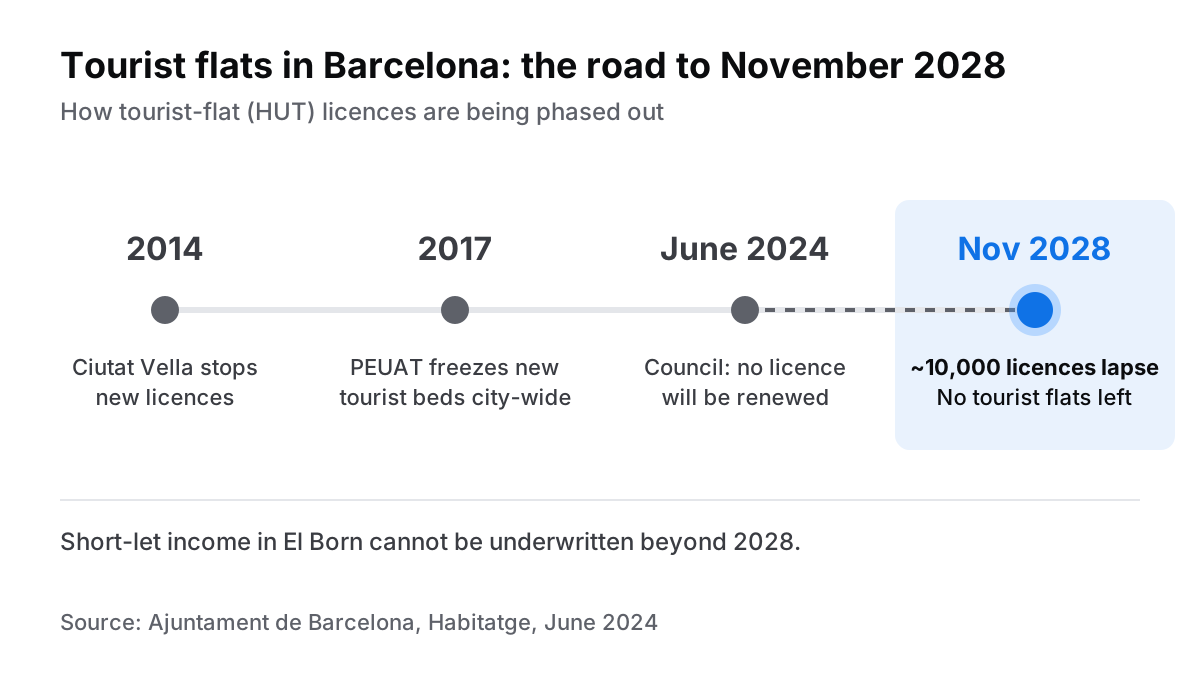
On 21 June 2024, Barcelona City Council announced that none of the city’s roughly 10,000 existing tourist flat licences will be renewed upon expiration. Consequently, all HUT licences across Barcelona will lapse by November 2028, after which short-term holiday letting in residential buildings will be entirely prohibited.
Investors evaluating property in El Born should model yields strictly on long-term residential leases. Furthermore, Barcelona was declared a tensioned residential market under Ley 12/2023 in March 2024, meaning rents on new long-term contracts are subject to statutory caps. Landlords can review what Spain’s 2023 Housing Act changed for landlords before structuring residential lease agreements.
What does buying cost in taxes and fees?
Buying real estate in Catalonia involves property transfer taxes, legal expenses, and administrative procedures. For resale properties, the property transfer tax (Impuesto sobre Transmisiones Patrimoniales, ITP) has operated under a tiered structure set by the Agència Tributària de Catalunya since 27 June 2025:
- Up to EUR 600,000: 10%
- EUR 600,000 to EUR 900,000: 11%
- EUR 900,000 to EUR 1,500,000: 12%
- Above EUR 1,500,000: 13%
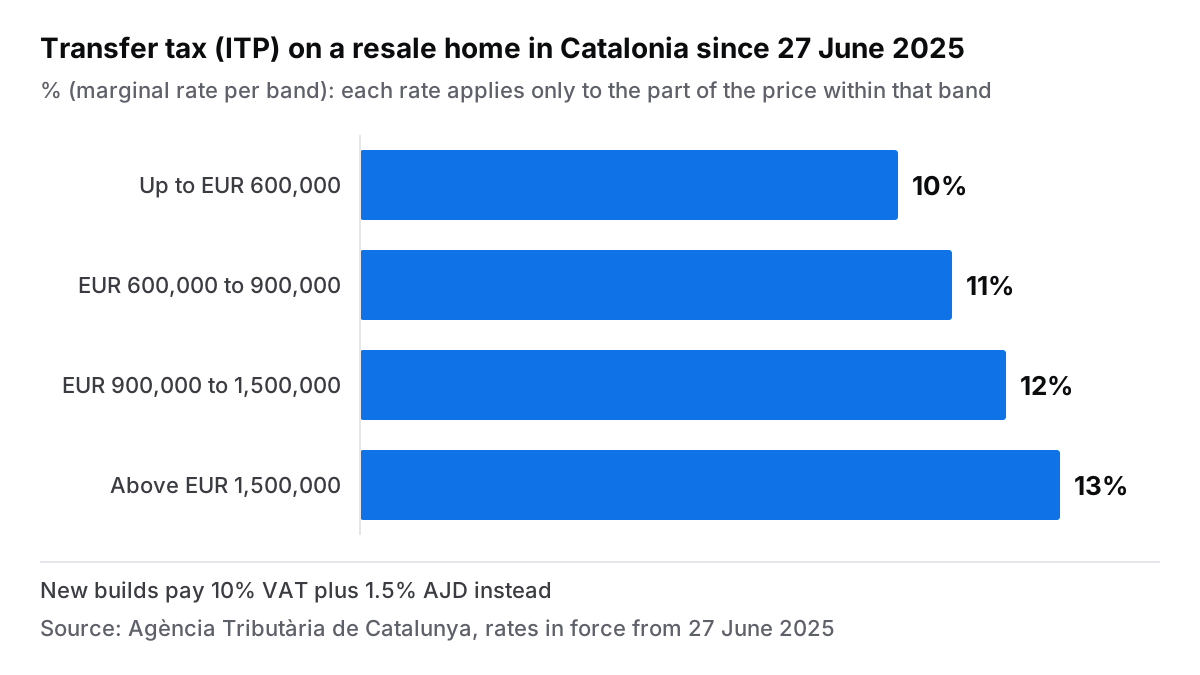
For new-build residential acquisitions, buyers pay 10% VAT (IVA) plus 1.5% Stamp Duty (Actos Jurídicos Documentados, AJD). Notary, land registry, and legal fees typically add an extra 1% to 2% to total closing costs.
All foreign purchasers, whether EU or non-EU nationals, must obtain a Número de Identidad de Extranjero (NIE) prior to signing the deed of purchase (escritura). For complete steps on administrative filings, consult our guide to buying property in Spain and the contract and the escritura, step by step.
UK buyers should note that Spain’s real estate investor residence permit (the ‘Golden Visa’) was formally abolished by Ley Orgánica 1/2025, with no new applications accepted after 3 April 2025. Standard Schengen entry rules permit UK citizens to stay up to 90 days in any 180-day period without a residence visa, as detailed by UK Government entry requirements.
Getting around: metro, trains and the airport
El Born offers strong public transport connections across Barcelona:
- Metro: Jaume I (L4) on Via Laietana provides direct access to the beach and Passeig de Gràcia. Urquinaona (L1, L4) and Arc de Triomf (L1) serve the northern perimeter. See the TMB metro map for routes.
- Rail: Arc de Triomf connects to Rodalies suburban services (R1, R3, R4), while Estació de França serves regional lines along the coast.
- Airport access: The official Aerobús operates from Plaça de Catalunya directly to Josep Tarradellas Barcelona-El Prat Terminals 1 and 2, taking approximately 35 minutes to T1. Passengers preferring rail can catch the Rodalies R2 Nord line from Passeig de Gràcia station, reaching Terminal 2 in around 25 minutes.
Pedestrianised streets dominate much of El Born. Residential vehicle access requires authorization, and street parking is strictly regulated under the municipal Àrea Verda scheme.
Daily life: markets, culture, the park and the sea
Daily amenities are heavily concentrated within the quarter. Fresh produce shopping centers on the Mercat de Santa Caterina, originally opened in 1848 and redesigned in 2005 by Enric Miralles and Benedetta Tagliabue with its distinctive ceramic roof.
Cultural landmarks are embedded directly into the street grid:
- Palau de la Música Catalana: Designed by Lluís Domènech i Montaner, opened in 1908 and designated a UNESCO World Heritage site in 1997.
- Museu Picasso: Established in 1963 across five 13th- and 14th-century palaces on Carrer de Montcada.
- Santa Maria del Mar: A 14th-century Gothic basilica built between 1329 and 1383.
- El Born Centre de Cultura i Memòria: Housed in a restored 1876 cast-iron market hall, showcasing archaeological remains uncovered in 2013.
To the east lies Parc de la Ciutadella, housing the Parlament de Catalunya and Barcelona Zoo. The seafront promenade and Barceloneta beach sit roughly 15 minutes away on foot.
Families researching local education should note that state and subsidized (concertada) school allocations are managed by the Consorci d’Educació de Barcelona. International schools serving the city are located outside Ciutat Vella, requiring commute arrangements via car or private bus.
Evenings in El Born: what to expect, and what it means for buyers
El Born retains a high concentration of dining establishments and cocktail bars, including international venues such as Paradiso on Carrer de Rera Palau (ranked No. 1 by The World’s 50 Best Bars in 2022) alongside long-standing local establishments along Carrer de Montcada.
Street noise levels vary considerably depending on location. Thoroughfares such as Passeig del Born, Carrer del Rec, and Carrer dels Flassaders experience significant evening footfall. Buyers seeking quiet residential environments generally focus on the interior streets of Sant Pere or properties equipped with double glazing and acoustic insulation. Conducting evening site visits at various hours helps evaluate sound conditions prior to submitting an offer.
How to research El Born before you buy or list
Navigating Ciutat Vella’s real estate market requires granular data rather than subjective estimates. Estate agents and institutional investors use CASAFARI to track real-time asking prices, stock volumes, time on market, and transaction histories across specific neighborhood boundaries.
To price or source property accurately in Sant Pere, Santa Caterina i la Ribera, professionals can request a valuation and market study for a specific flat or try Area Insights on the CASAFARI platform. Software engineering teams building custom analytics can consult the Area Insights developer documentation (in English).
Frequently asked questions
Can a UK citizen buy a flat in El Born after Brexit?
Yes, foreign nationals face no legal restrictions when purchasing real estate in Spain regardless of citizenship. Buyers require a Spanish tax identification number (NIE) and a local bank account to pay property taxes and utility bills. Owning property does not grant residence rights; UK nationals are permitted to stay up to 90 days in any 180-day period within the Schengen area without a visa. Following the abolition of Spain’s Golden Visa on 3 April 2025 under Ley Orgánica 1/2025, buyers planning longer stays must apply for an appropriate residence visa, such as a non-lucrative visa.
Can I rent out an El Born flat on Airbnb?
Short-term tourist lets are strictly limited and being phased out completely. Ciutat Vella has issued no new tourist flat (HUT) licences since 2014, and Barcelona City Council announced on 21 June 2024 that no existing licences will be renewed, meaning all roughly 10,000 licences city-wide will lapse by November 2028. Unlicensed short-term letting is illegal and subject to heavy municipal fines. Long-term residential letting is permitted, but new leases in Barcelona are subject to statutory rent caps under Ley 12/2023 because the city is designated a tensioned housing area.
What taxes do I pay when buying a resale flat in Barcelona?
Buyers of resale properties in Catalonia pay Property Transfer Tax (ITP), which follows a marginal tiered scale introduced on 27 June 2025: 10% on the portion up to EUR 600,000; 11% between EUR 600,000 and EUR 900,000; 12% between EUR 900,000 and EUR 1,500,000; and 13% on amounts above EUR 1,500,000. New-build homes attract 10% VAT plus 1.5% Stamp Duty (AJD) instead of ITP. Additional closing costs for notary, land registry, and legal fees typically add 1% to 2% to the transaction total.
Is El Born a good place to live, or is it too noisy?
El Born offers central living with pedestrianised streets, rich historic architecture, proximity to Santa Caterina market, Ciutadella park, and the beach within 15 minutes’ walk. However, night noise can be significant along major entertainment strips such as Passeig del Born, Carrer del Rec, and Carrer dels Flassaders, and historic buildings may lack lifts or abundant natural light on lower floors. Quieter residential areas are found in the northern Sant Pere quarter near Palau de la Música. Prospective buyers should visit the neighbourhood at night and review the building’s ITE inspection report before purchasing.