
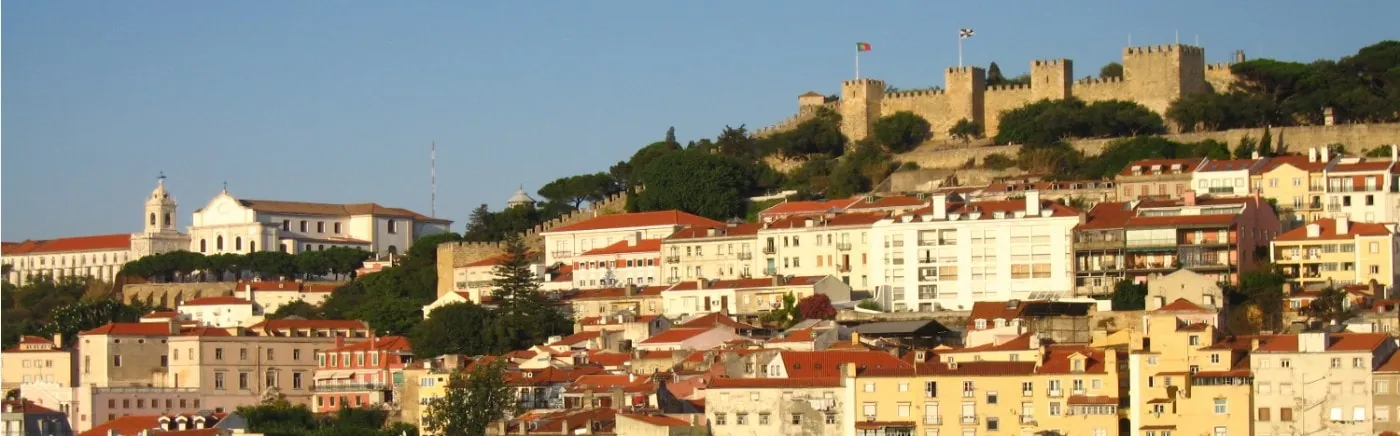
Alfama is the historic medieval quarter of Lisbon set between São Jorge Castle and the Tagus, within the civil parish of Santa Maria Maior. Buying here means acquiring pre-1755 building stock where lifts are rare and street access is largely pedestrian. Short-let licences are subject to municipal containment rules, while the Blue line metro at Santa Apolónia provides direct rapid transit across the capital.
Where Alfama sits in Lisbon and what the quarter is like
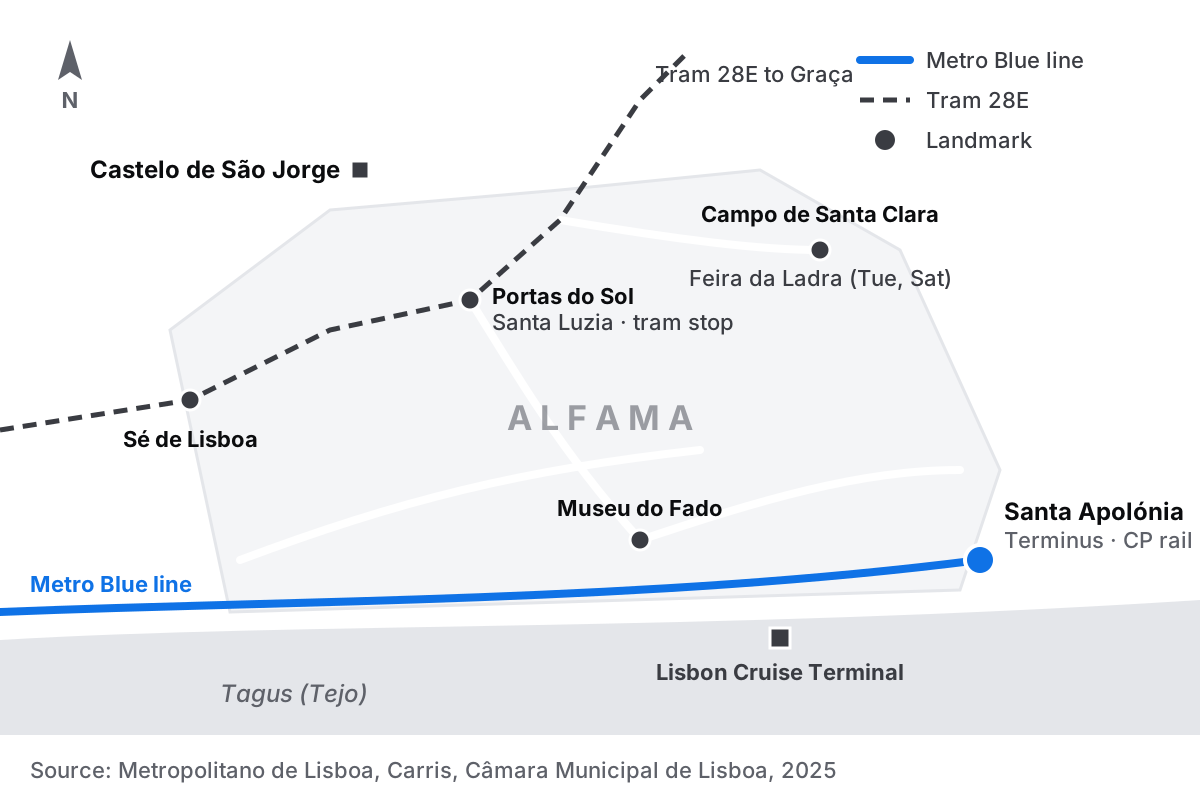
Alfama stretches down the slope from the walls of Castelo de São Jorge down to the Tagus (Tejo) riverbank. To the west, it borders the historic cathedral area of Sé and the Baixa grid; to the east, it extends towards Campo de Santa Clara. Since the municipal parish reorganisation under Lei n.º 56/2012, Alfama forms part of the central civil parish (freguesia) of Santa Maria Maior.
Unlike the neighbouring Baixa, which was rebuilt on a orthogonal grid after the 1755 earthquake, Alfama retained its medieval street plan. Its narrow alleys (becos), stepped paths (escadinhas), and tile-clad (azulejo) façades give the neighbourhood its distinct architectural feel. Many residential buildings feature 18th- and 19th-century construction erected over earlier medieval foundations.
Daily life in Alfama combines traditional neighbourhood commerce with prominent cultural landmarks. The Museu do Fado anchors Largo do Chafariz de Dentro, while the Feira da Ladra flea market takes place every Tuesday and Saturday at Campo de Santa Clara beside the Panteão Nacional. Every June, the neighbourhood hosts the city’s Santo António festivities, filling the streets with local arraiais. Panoramic viewpoints at Miradouro de Santa Luzia and Largo das Portas do Sol offer clear vistas across the terracotta rooftops to the river.
What kind of property is for sale in Alfama?
Property in Alfama consists primarily of small residential units inside historic multi-storey buildings. Typical layouts range from studio (T0) to two-bedroom (T2) flats set across three to five floors. Structural lifts are rare due to narrow building footprints, and private parking is exceptionally scarce. Properties featuring original tilework, internal courtyards, or open river views command a distinct premium among buyers.
Renovating property in Alfama requires working within historic conservation guidelines enforced by Câmara Municipal de Lisboa. Exterior modifications to façades, window frames, and roofs face strict regulatory oversight. While urban rehabilitation incentives exist within Lisbon’s designated Área de Reabilitação Urbana (ARU)—such as reduced VAT rates on eligible works—investors must verify specific property eligibility before planning works.
Current market values per square metre and price trends fluctuate across micro-locations within the quarter. Professional buyers and estate agencies use Area Insights for Santa Maria Maior to assess available housing stock, average days on market, and asking price movements across the parish. When evaluating an individual unit, agents rely on a valuation and market study for a specific flat to establish comparable transaction benchmarks.
Can you let a flat in Alfama as a short-term rental?
Short-term holiday letting in Portugal operates under the Alojamento Local (AL) licensing regime. Because Alfama experienced heavy tourism activity, Lisbon City Council designated Santa Maria Maior as an area of absolute containment (zona de contenção) under municipal regulations in 2019, restricting new AL licence issuances.
Regulatory frameworks for short-term lets have shifted significantly over recent years:
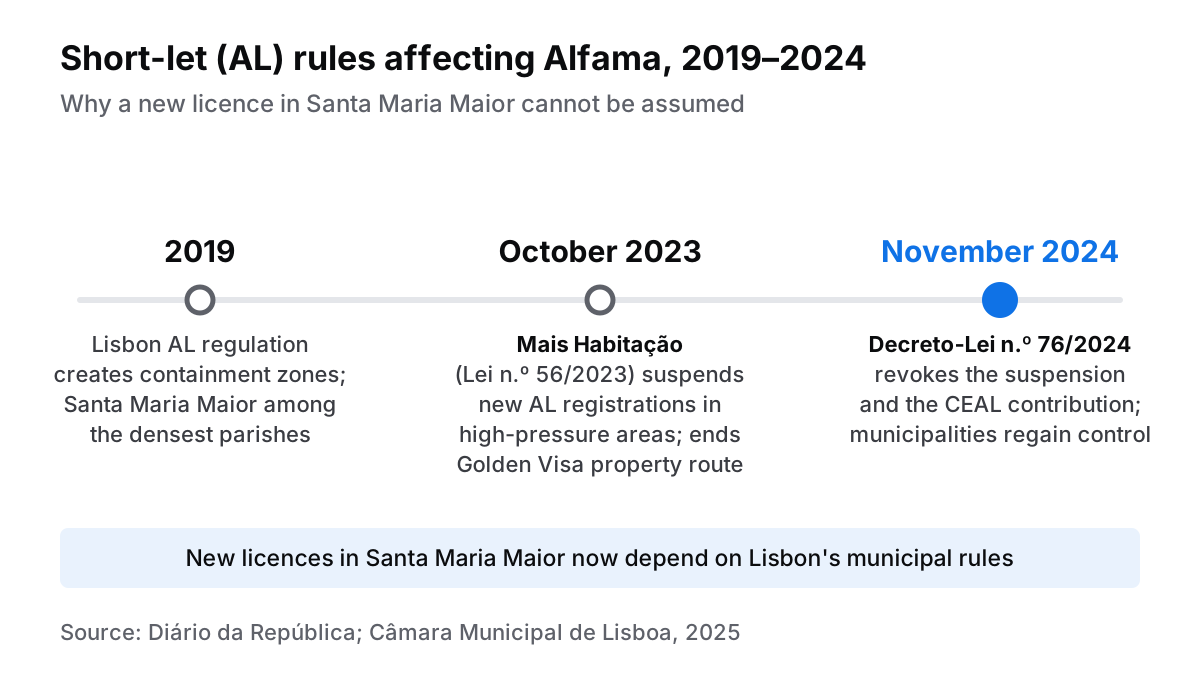
In October 2023, the Mais Habitação law (Lei n.º 56/2023) introduced a nationwide suspension on new short-let registrations in high-density coastal areas. Subsequent legislation via Decreto-Lei n.º 76/2024 on Alojamento Local in late 2024 revoked the national suspension and the extraordinary CEAL contribution, returning decision-making authority over short-let capacity directly to local municipalities.
Buyers intending to operate short-term rentals in Alfama must inspect the current municipal regulation implemented by Lisbon City Council. Existing AL registrations do not automatically transfer to new owners upon purchase, and condominium assemblies (condomínio) possess statutory rights to object to short-let operations within residential buildings. For long-term residential lettings (arrendamento), investors can review historical rental benchmarks in how Lisbon rents have moved since 2018.
Taxes and costs when buying in Alfama
Acquiring residential property in Lisbon involves several statutory taxes and administrative fees. The primary transfer tax is Municipal Property Transfer Tax (IMT), calculated on a progressive scale updated annually in the State Budget. In addition, buyers pay a flat Stamp Duty (Imposto do Selo) of 0.8% on the contract price or taxable value (VPT), whichever is higher, alongside notary and land registry charges.
Annual property ownership incurs Municipal Property Tax (IMI), which local councils set within a statutory framework. An Additional Municipal Property Tax (AIMI) applies to individuals holding residential property portfolios in Portugal with a combined taxable value exceeding €600,000. Official tax bands and submission guidelines are available directly on Portal das Finanças.
Foreign buyers enjoy the same real estate acquisition rights as Portuguese citizens. However, real estate purchases no longer qualify foreign investors for residency under Portugal’s Golden Visa program, following amendments under Lei n.º 56/2023 in October 2023. Similarly, the Non-Habitual Resident (NHR) tax status closed to new applicants in 2024. Non-EU citizens purchasing property in Alfama who wish to establish Portuguese residency must apply through independent visa pathways, such as the D7 passive income visa or D8 digital nomad visa managed by AIMA. Step-by-step transaction guidance is detailed in our guide to buying property in Portugal.
Getting around: metro, trams and the hill
Transport access in Alfama reflects its steep topography. At the foot of the hill along the Tagus riverfront sits Santa Apolónia, the eastern terminus of the Lisbon Metro Blue line operated by Metropolitano de Lisboa. Santa Apolónia also functions as a primary CP terminal for regional and intercity rail lines. Immediately adjacent at Jardim do Tabaco is the Lisbon Cruise Terminal, operational since 2017.
Upper Alfama is served by Carris tram and bus routes, including the historic Tram 28E and Tram 12E, which climb through Largo das Portas do Sol. Most inner streets are strictly pedestrian or restricted to emergency and resident service vehicles, requiring small municipal trucks for refuse collection and deliveries.
Living in Alfama requires navigating steep staircases, cobbles, and limited vehicular accessibility. While the area offers rich cultural appeal, buyers requiring private garages, step-free access, or immediate proximity to large international school campuses often compare central historic quarters with surrounding districts, as explored in Lisbon compared with other southern European capitals.
How CASAFARI tracks the Alfama market
CASAFARI aggregates and de-duplicates real estate property listings from over 30,000 sources across Portugal. By matching listing histories with transaction records, the platform provides clear market visibility across Santa Maria Maior.
Real estate agencies, institutional investors, and valuers use Area Insights to monitor supply trends, average price per square metre, and listing duration across Alfama’s micro-markets.
Developers and data analysts can explore available data schemas via the Area Insights documentation on developers.casafari.com (in English) or try CASAFARI on platform.casafari.com to analyze real-time market metrics.
Frequently asked questions
Is Alfama a good place to buy property in Lisbon?
Alfama offers unique historic character, river view potential, and high demand in central Lisbon, making it attractive to buyers who appreciate traditional architecture and central living. However, purchasing here requires managing steep streets, limited parking, and historic building maintenance. Investors should evaluate local municipal renting rules and inspect individual building conditions before committing.
Can I rent out a flat in Alfama on Airbnb?
Short-term holiday letting in Portugal requires an Alojamento Local (AL) licence. Lisbon City Council placed Santa Maria Maior under strict containment rules due to high short-let density, and although national rules were revised under Decreto-Lei n.º 76/2024, local municipal regulations determine whether new licences are issued. Buyers should verify if an existing licence transfers with the property and confirm condominium consent before relying on short-term rental income.
What taxes do I pay when buying a flat in Alfama?
Buyers in Portugal pay Municipal Property Transfer Tax (IMT) based on a progressive scale set in the national budget, alongside a flat Stamp Duty of 0.8% on the purchase price or taxable value. Additional upfront costs include notary and land registration fees. Property owners are also subject to annual municipal property tax (IMI) and Additional IMI (AIMI) if individual residential property taxable holdings exceed €600,000, with details published on Portal das Finanças.
Does Alfama have a metro station?
Yes, Santa Apolónia station sits at the foot of Alfama along the riverfront, serving as the eastern terminus for the Lisbon Metro Blue line as well as national rail services. Upper parts of the neighbourhood are served by Carris tram routes 28E and 12E, alongside local bus services. Because much of historic Alfama consists of pedestrian alleys, proximity to Santa Apolónia or key tram stops is a key consideration when selecting a flat.