
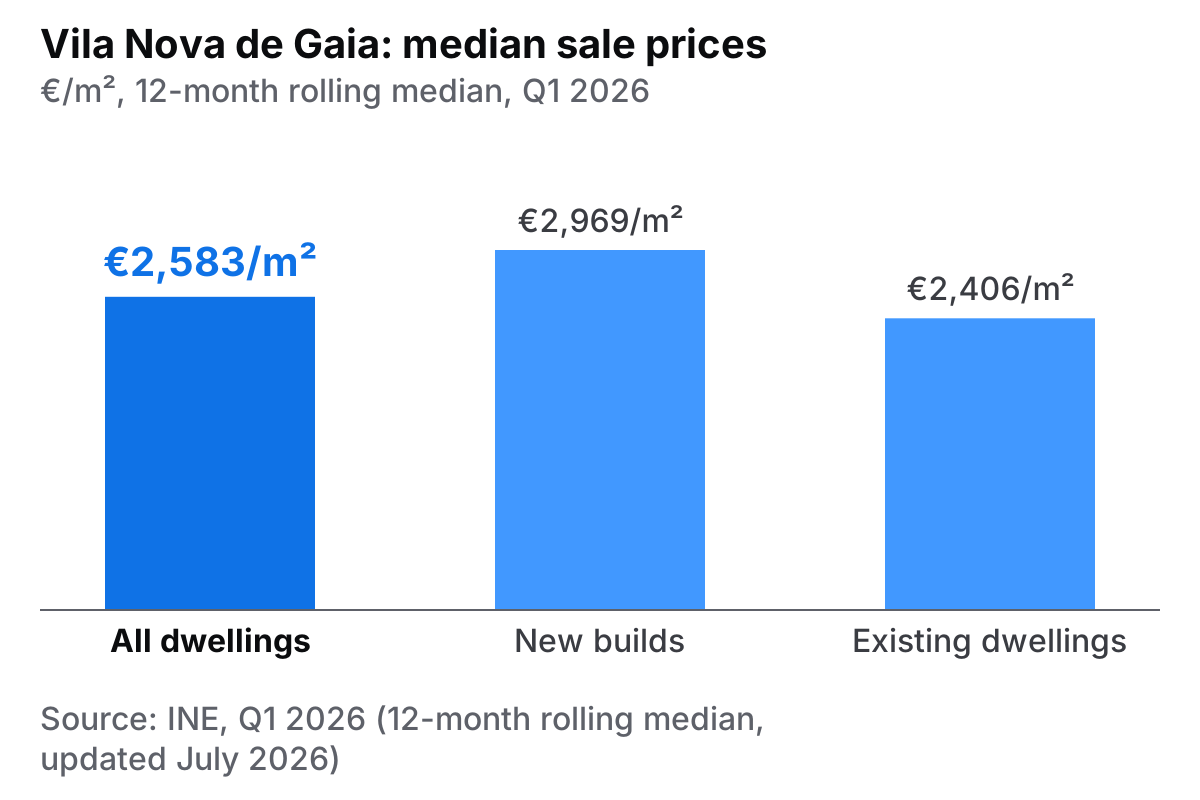
Vila Nova de Gaia sits directly across the River Douro from central Porto, accommodating 323,202 residents as of 2025 according to the Instituto Nacional de Estatística (INE). According to official INE data from Q1 2026, the median residential transaction price in Gaia reached €2,583 per square metre (€2,969/m² for new builds and €2,406/m² for existing dwellings), offering strong connectivity across 10 operating Metro Line D stations and 19 coastal Blue Flag beaches.
Where is Vila Nova de Gaia and why are buyers looking south of the Douro?
Situated on the southern bank of the River Douro in Northern Portugal, Vila Nova de Gaia is often perceived by visitors as an extension of Porto. However, it is a major municipality in its own right within the Porto district, combining industrial heritage, expanding urban infrastructure, and an extensive Atlantic coastline. Data published by the Instituto Nacional de Estatística (INE) indicates that Gaia’s resident population reached 323,202 inhabitants in 2025 (an increase of 5.4% compared to the 303,824 recorded in the 2021 Census), giving the municipality a population density of 1,919 inhabitants per square kilometre.
From an investment perspective, Gaia offers a competitive price point compared to the northern bank. Based on INE local housing price statistics (Q1 2026), the 12-month rolling median transaction price for residential property in Vila Nova de Gaia stood at €2,583 per square metre. The market shows clear segmentation between property types:
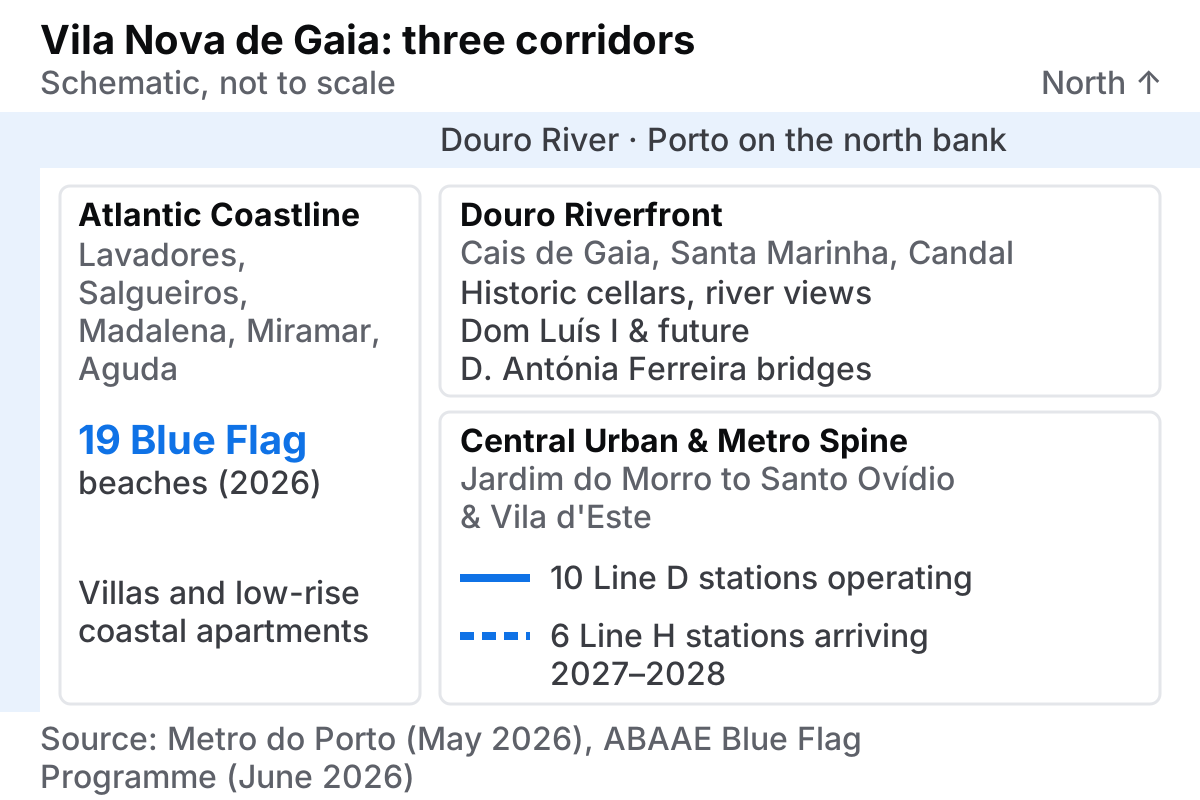
Public transport infrastructure has played a central role in driving real estate demand along specific transit axes. The Metro do Porto Yellow Line (Line D) operates 10 stations within Gaia, following a three-station extension opened on 28 June 2024 that connects Manuel Leão, Hospital Santos Silva, and Vila d’Este. Accessibility is set to expand further with the construction of the Ruby Line (Line H). Scheduled for completion between 2027 and late 2028, Line H will add six stations in Gaia—Arrábida, Candal, Rotunda, Devesas, Soares dos Reis, and Santo Ovídio—alongside the new D. Antónia Ferreira bridge crossing the Douro. Professionals and investors seeking detailed market trends can examine hyper-local statistics through CASAFARI Area Insights or consult our broader guide to buying property in Portugal.
How have residency, tax and short-let rules changed for foreign buyers in Gaia?
International buyers evaluating property in Vila Nova de Gaia must navigate a legal and tax landscape that has undergone significant reform. Previous assumptions regarding real estate residency programmes and historic tax incentives no longer apply.
First, real estate purchases no longer grant eligibility for Portuguese residency via the Golden Visa (ARI). Under Law no. 56/2023 (Mais Habitação), effective from 7 October 2023, all direct and indirect real estate investment routes were permanently abolished. Non-EU/EFTA investors seeking residency can still utilize non-property investment routes, such as committing a minimum of €500,000 to eligible non-real-estate investment funds, allocating €250,000 to artistic or cultural heritage projects, or creating 10 local jobs.
Second, the tax framework for new foreign residents has transitioned away from the original Non-Habitual Resident (NHR) scheme. The classic NHR regime closed to new applicants on 1 January 2024 pursuant to Law no. 82/2023. It was replaced by the Tax Incentive for Scientific Research and Innovation (IFICI), regulated under Portaria n.º 352/2024/1. IFICI provides a 20% flat tax rate on eligible Portuguese Category A (employment) and Category B (self-employment) income for 10 years. However, this incentive is restricted to highly qualified professionals in certified organizations who were not Portuguese tax residents in the preceding five years, and it excludes exemptions for foreign pension income.
For ongoing property ownership and short-term letting in Gaia, the local tax and municipal frameworks are structured as follows:
| Tax / Regulation | Applied Rate & Status in Vila Nova de Gaia (2025–2026) |
|---|---|
| Urban Municipal Property Tax (IMI) | Set at 0.36% by the Gaia municipal council for 2025 and 2026. |
| Property Transfer Tax (IMT - Primary Residence) | 0% up to €101,917; progressive rates of 2% to 8% up to €633,453; flat 6% up to €1,102,920; flat 7.5% above €1,102,920. |
| Property Transfer Tax (IMT - Secondary Residence) | First bracket (€0 to €101,917) taxed at 1%; progressive rates apply thereafter. |
| Short-Term Rental Framework (Alojamento Local) | Decree-Law no. 76/2024 (effective late 2024 into 2025–2026) revoked national licensing bans, returning regulatory authority over containment zones directly to the Gaia municipality. |
Investors and real estate professionals calculating project valuations and long-term rental yields can utilise a property valuation and market study to benchmark pricing against historical transactions. Broader market context on these structural shifts is available in our analysis of the evolution of the Portuguese property market. To evaluate live listing data, agents can sign in to CASAFARI to explore property data in Vila Nova de Gaia, while software engineering teams can consult the Area Insights API documentation for direct data integration.
Why are the port wine cellars on the Gaia side of the River Douro?
The concentration of historic Port wine cellars (caves) along the Gaia waterfront is the result of medieval economic policy and specific microclimate conditions. In 1255, King D. Afonso III granted a royal charter (foral) to Gaia. This decree required merchant ships navigating the Douro to unload their cargoes on the southern bank, enabling traders to bypass the costly Portagem da Terra tolls imposed on goods entering the city of Porto by the Bishop and Cathedral Chapter.
Beyond tax avoidance, the geography of Gaia provided ideal conditions for wine maturation. The north-facing slope overlooking the Douro receives less direct sunlight and is sheltered from strong ocean winds. Combined with natural groundwater springs along the hillside, this environment produced the consistent, cool temperatures needed to age wine in oak casks without excessive evaporation.
Historic shipping houses such as Sandeman and Cálem established their warehouse operations along the Cais de Gaia riverfront. Today, this historic riverfront contrasts with contemporary residential developments situated in elevated parishes such as Santa Marinha and Candal.
Which Blue Flag beaches define Vila Nova de Gaia’s Atlantic coast?
In addition to its river frontage, Vila Nova de Gaia features an extensive Atlantic oceanfront. According to the Blue Flag beaches in Vila Nova de Gaia (2026) published by ABAAE and the Gaia Municipality, the district holds 19 coastal Blue Flag beaches covering its entire coastline from Lavadores down to S. Félix da Marinha.
Key coastal locations include:
- Aguda Beach: Located 15 to 17 km (approximately 20 minutes by car) from central Gaia, Aguda retains its traditional fishing community atmosphere alongside coastal residential properties.
- Miramar: Home to the landmark Senhor da Pedra chapel built on the rocks, featuring period villas and low-rise modern apartments.
- Sereias Beach: Situated 12 to 19 km from central Gaia, popular for water sports and surfing.
- Canidelo and Salgueiros: Coastal areas close to the Douro estuary featuring contemporary apartment buildings overlooking the ocean.
Estate agents and buyers searching across coastal and urban parishes can leverage CASAFARI Property Sourcing to compare beachfront properties in Miramar or Francelos against urban apartments along the Metro corridor.
Vila Nova de Gaia offers a balance of urban transport links, coastal amenities, and commercial history. To analyze market availability, track inventory, or review comparable transactions across Gaia’s parishes, log in to the CASAFARI platform to access real-time real estate analytics.
Frequently asked questions
Can you still get a Portuguese Golden Visa by buying property in Vila Nova de Gaia?
Since 7 October 2023, under Law no. 56/2023 (Mais Habitação), purchasing residential or commercial property in Portugal no longer qualifies for a Golden Visa. Non-EU and non-EFTA citizens may still access residency through non-real-estate pathways, including funds investing at least €500,000 in non-property collective assets or €250,000 in cultural heritage projects. Buying property in Vila Nova de Gaia remains completely unrestricted for foreign buyers acquiring real estate outside the Golden Visa scheme.
What replaced the NHR tax regime for foreign buyers moving to Gaia?
The classic Non-Habitual Resident (NHR) regime closed to new applicants on 1 January 2024 under Law no. 82/2023 and was replaced by the Tax Incentive for Scientific Research and Innovation (IFICI). Governed by Portaria n.º 352/2024/1, IFICI grants a 20% flat tax rate on eligible Portuguese employment and self-employment income for 10 years to qualifying professionals who were not tax resident in Portugal during the preceding five years. Unlike the original NHR framework, IFICI does not offer tax exemptions for foreign-source pension income.
What are the property taxes and short-term rental rules in Vila Nova de Gaia?
Urban municipal property tax (IMI) in Vila Nova de Gaia is set at 0.36% for 2025 and 2026. Property transfer tax (IMT) for primary residences in 2026 features a 0% rate up to €101,917 (1% for secondary homes) and progressive rates up to 7.5% for property values exceeding €1,102,920. For short-term rentals (Alojamento Local), Decree-Law no. 76/2024 repealed the nationwide ban on new registrations, placing regulatory authority back with the Gaia municipal council.
How well connected is Vila Nova de Gaia to central Porto by public transport?
Vila Nova de Gaia is connected to central Porto via Metro do Porto’s Yellow Line (Line D), which runs across the upper deck of the Dom Luís I Bridge and serves 10 stations in Gaia following its June 2024 extension to Vila d’Este. Public transit options will further expand with the Ruby Line (Line H), currently under construction for completion between 2027 and late 2028. This new line will add six stations in Gaia—including Arrábida, Candal, and Devesas—along with the new D. Antónia Ferreira bridge crossing.