
VILA REAL DE SANTO ANTÓNIO PROPERTY GUIDE
A peaceful and relaxing area
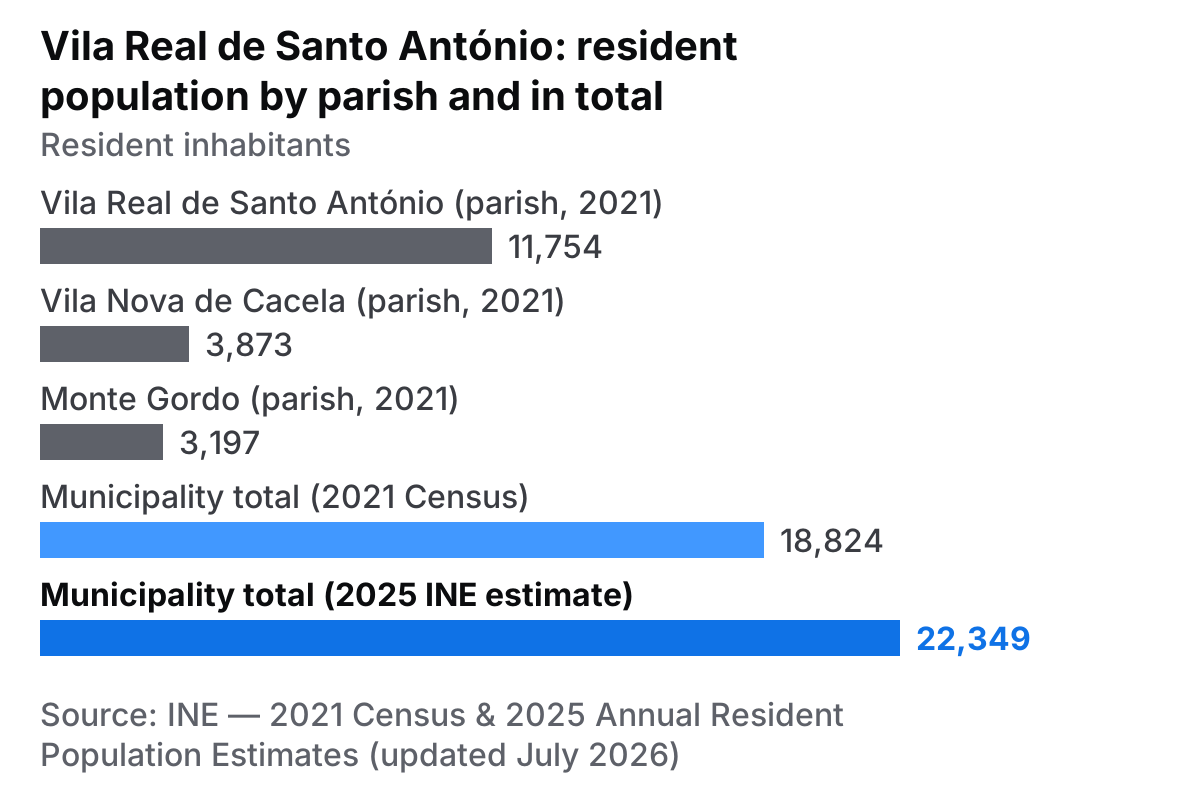
Situated on the Guadiana river across from Spain, Vila Real de Santo António is home to 22,349 residents across three distinct parishes: the historic Pombaline town, beachside Monte Gordo, and coastal Vila Nova de Cacela. Located 45 minutes from Faro Airport via the toll-free A22 motorway, it offers flat walkability, rich nature, and attractive Eastern Algarve property values under updated 2026 short-let and tax rules.
Why choose a property in Vila Real de Santo António?
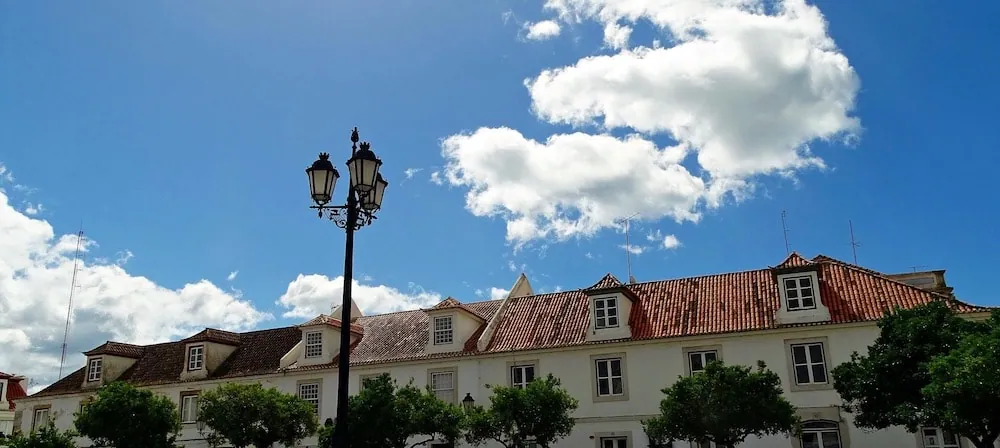
Positioned in the far south-eastern corner of Portugal, the municipality of Vila Real de Santo António is bounded by Tavira to the west, Castro Marim to the north, the Atlantic Ocean to the south, and the Guadiana river to the east. Founded in 1774 by order of the Marquis of Pombal and constructed between 1774 and 1776 following an Enlightenment grid plan, the main town features wide, grand avenues and flat walking routes that set it apart from the steeper, winding coastal towns elsewhere in the Algarve.
The municipality comprises three distinct micro-markets. Vila Real de Santo António parish (11,754 inhabitants in the 2021 Census) forms the administrative and commercial heart, filled with traditional townhouses and riverfront apartments. To the west lies Monte Gordo (3,197 inhabitants in 2021), a high-density coastal resort famous for its long, wide beach, casino, and modern apartment complexes. Further west, Vila Nova de Cacela (3,873 inhabitants in 2021) encompasses low-density detached villas and historic hamlets, including Manta Rota and the cliffside village of Cacela Velha overlooking the Ria Formosa. According to official municipal demographic data (Portal Mais Transparência / INE), the total resident population rose to 22,349 in the 2025 INE estimates.
Natural surroundings add significant appeal for buyers. The Castro Marim and Vila Real de Santo António Marsh Natural Reserve (ICNF), established on 27 March 1975 as mainland Portugal’s first nature reserve, protects vast saltpans, marshes, and bird habitats along the river. To compare micro-market metrics and pricing across these three parishes, buyers and estate agents rely on CASAFARI Area Insights and property valuation and market study datasets to evaluate realistic market trends.
How well connected is Vila Real de Santo António to Faro, Lisbon and Spain?
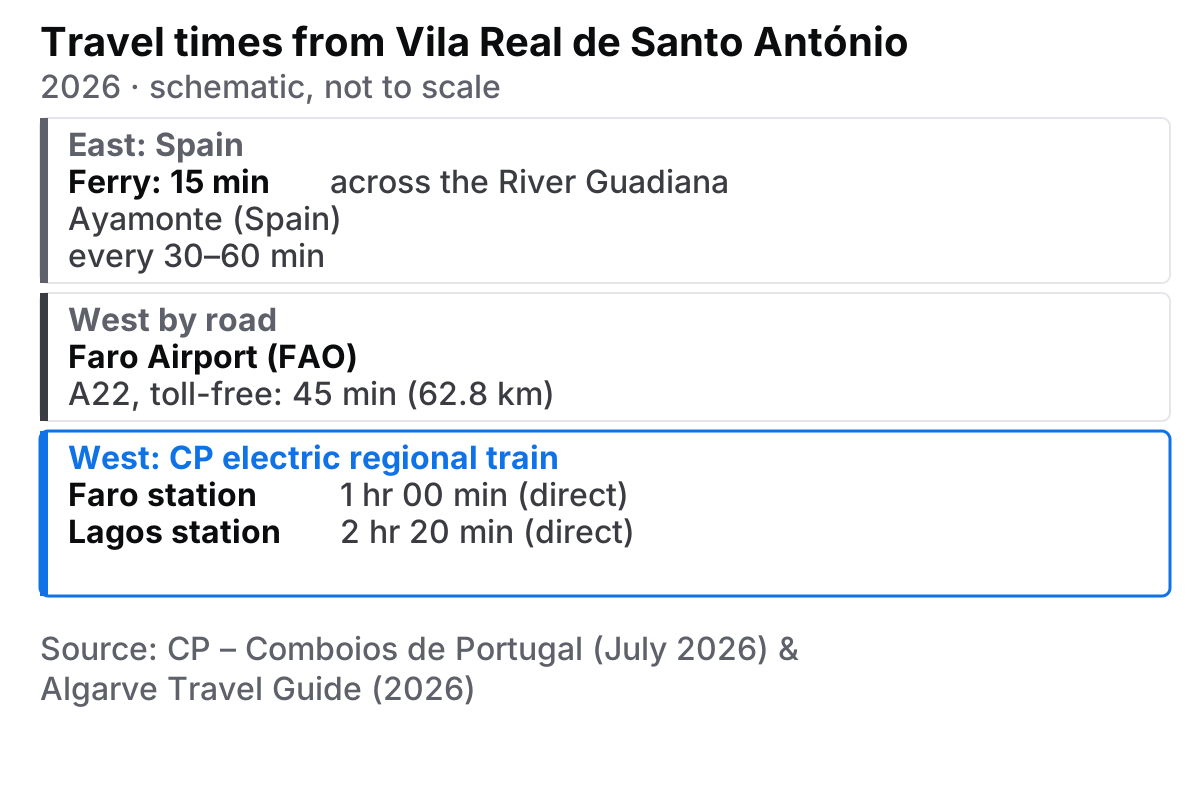
Road infrastructure in the Eastern Algarve underwent a major change on 1 January 2025, when tolls on the A22 motorway (Via do Infante) were completely abolished. Motorists can drive the 62.8 km from Vila Real de Santo António to Faro Airport in approximately 45 minutes without toll charges. Crossing into Spain is equally straightforward, either via the Guadiana International Bridge into Andalusia for direct motorway routes to Huelva and Seville, or via the traditional passenger and car ferry across the Guadiana to Ayamonte, which takes 15 minutes and costs around €2 for foot passengers and €5 for cars.
Public transport received a substantial upgrade following the complete electrification of the Algarve Line in July 2026. Electric train operations commenced on 19 July 2026 using UTE 2240 units, establishing direct regional rail links without changing trains at Faro. Passengers can travel directly from Vila Real de Santo António to Faro in 1 hour, or onward to Lagos in 2 hours 20 minutes, with convenient connections to high-speed Alfa Pendular and Intercidades services heading north to Lisbon.
Where to play golf and spend time outdoors in the Eastern Algarve
The coastal corridor between Castro Marim, Vila Real de Santo António, and Tavira is widely regarded as one of Portugal’s premier golfing destinations. Within the municipality’s own Vila Nova de Cacela parish lies Monte Rei Golf & Country Club, featuring an 18-hole Jack Nicklaus Signature course. Also in Vila Nova de Cacela are the 36 holes of Quinta da Ria and Quinta de Cima, set directly against the lagoon borders of the Ria Formosa. Nearby options in Castro Marim include the 27-hole Castro Marim Golfe & Country Club and the 18-hole Quinta do Vale Golf Resort, designed by Seve Ballesteros, while Benamor Golf offers 18 holes near Tavira.
Outdoor activities extend well beyond golf course fairways. The flat topography along the coast and nature reserve provides kilometres of uninterrupted cycling and walking paths. River cruises depart regularly from the harbour up the Guadiana river to the historical town of Alcoutim. Thrill-seekers visiting Alcoutim can experience Limite Zero, a 720-metre cross-border zip wire that launches from Sanlúcar de Guadiana in Spain and crosses the river to Portugal at speeds of 70 to 80 km/h, traversing a time zone mid-flight.
Daily life, dining, healthcare and schools in and around Vila Real de Santo António
Daily life in Vila Real de Santo António combines relaxed Portuguese riverside living with immediate access to Spanish gastronomy across the river in Ayamonte. Local dining ranges from seafood taverns along Manta Rota beach to traditional tavernas in Cacela Velha. For fine dining, the Michelin Guide Portugal 2026 selection for the Algarve highlights seven starred establishments across the region: the one-star A Ver Tavira in nearby Tavira represents the closest Michelin-starred venue, joined by Alameda in Faro, Gusto by Heinz Beck in Almancil, Bon Bon in Carvoeiro, Vista in Portimão, and two-star flagships Ocean in Porches and Vila Joya in Albufeira.
Healthcare services are well distributed across public and private providers. Public primary care and a 24-hour Basic Emergency Service (SUB) operate at the Centro de Saúde de Vila Real de Santo António, supported by the main regional hospital, Hospital de Faro (ULS Algarve). Private healthcare in town is delivered at Clínica CUF Vila Real de Santo António (following CUF’s 2026 integration of Grupo HPA Saúde), backed by larger hospital facilities at Hospital CUF Faro and Hospital Lusíadas Faro.
Families researching education options have access to Portuguese state schools throughout the municipality. For international schooling, Colégio Santiago Internacional in neighbouring Tavira offers a bilingual British curriculum, while central Algarve options include the Almancil campus of Nobel Algarve British International School, Eupheus International School in Loulé, and Colégio Internacional de Vilamoura (CIV).
What buyers and investors need to know about taxes, Alojamento Local and residency in 2026
Property acquisitions in Vila Real de Santo António carry standard Portuguese transaction taxes, including Stamp Duty (Imposto do Selo) at 0.8% of the deed value, plus 0.6% on mortgages with terms of 5 years or more. Under Law No. 73-A/2025, progressive IMT transfer tax brackets for 2026 exempt primary residences up to €106,346, or up to €330,539 for first-time buyers aged 35 or under. Secondary residences start at 1% on the lowest bracket. A key local metric is the annual urban property tax (IMI): Vila Real de Santo António sets its urban IMI rate at 0.45% in 2025/2026, which is the legal maximum in Portugal, alongside 0.8% for rustic land.
Short-term rental investors benefit from clear regulatory rules. Decree-Law No. 76/2024 on Alojamento Local repealed the former coastal registration ban, abolished the extraordinary CEAL tax and 5-year expiry limits, and restored full licence transferability upon property sale. New Alojamento Local (AL) registrations are processed through prior communication on the Balcão Único Eletrónico (gov.pt), subject to a 60-day municipal inspection window.
Regarding residency programmes, real estate purchases no longer qualify for Portugal’s Golden Visa (ARI), which now requires alternative investments such as €500,000 in qualifying funds or €200,000 to €250,000 in cultural heritage projects. Furthermore, the original Non-Habitual Resident (NHR) tax framework has been succeeded by the IFICI (NHR 2.0) regime, offering a 20% flat tax rate for 10 years strictly to qualifying professionals in scientific research, innovation, and certified startups, while foreign pension income is subject to standard progressive rates. To review broader legal steps, consult our guide to buying property in Portugal and key considerations when investing in Portuguese real estate.
Whether you are acquiring a holiday residence or managing a client portfolio, real-time market data simplifies property evaluation across the Eastern Algarve. Estate agents and professional investors can use CASAFARI Property Sourcing to search cross-portal listings, or simply sign in to the CASAFARI platform to inspect recent market study analytics.
Frequently asked questions
Can you get a new Alojamento Local (AL) holiday rental licence in Vila Real de Santo António in 2026?
Yes. Following Decree-Law No. 76/2024, the national ban on coastal Alojamento Local registrations was repealed, the extraordinary CEAL tax was abolished, and AL licences can once again be transferred when a property is sold. As of October 2026, property owners in Vila Real de Santo António can apply for a new AL licence via prior communication on the Balcão Único Eletrónico (gov.pt), with the municipality having 60 days (or 90 days in designated containment areas) to inspect the property.
Does buying property in Vila Real de Santo António qualify for Portugal’s Golden Visa or NHR tax regime?
No, purchasing real estate in Portugal no longer qualifies for the Golden Visa (ARI), which requires investments such as €500,000 in qualifying venture capital or investment funds, or €200,000 to €250,000 in cultural and artistic projects. Likewise, the original Non-Habitual Resident (NHR) scheme is closed to new arrivals and has been replaced by the IFICI (NHR 2.0) regime, which offers a 20% flat tax rate on domestic earned income for 10 years strictly for highly qualified professionals in scientific research, innovation, and certified startups, while foreign pensions are taxed at standard progressive rates.
What are the annual IMI and purchase taxes on property in Vila Real de Santo António?
In 2025/2026, Vila Real de Santo António applies an annual urban IMI (Imposto Municipal sobre Imóveis) rate of 0.45% of the property’s tax value (VPT)—the highest rate permitted under Portuguese law—and 0.8% for rustic land. On purchase, buyers pay 0.8% Stamp Duty plus IMT (Imposto Municipal sobre as Transmissões Onerosas de Imóveis), which in 2026 starts at 1% on the first bracket for a second home or holiday property, while primary residences are exempt on the first €106,346 (or up to €330,539 for eligible first-time buyers aged 35 or under).
How long does it take to travel from Faro Airport to Vila Real de Santo António by car or train?
By car, Vila Real de Santo António is 62.8 km east of Faro Airport along the A22 motorway (Via do Infante), a drive of roughly 45 minutes that has been completely toll-free since 1 January 2025. By rail, following the full electrification of the Algarve Line on 19 July 2026, CP’s direct regional electric trains connect Faro station to Vila Real de Santo António in 1 hour without any change of train.