
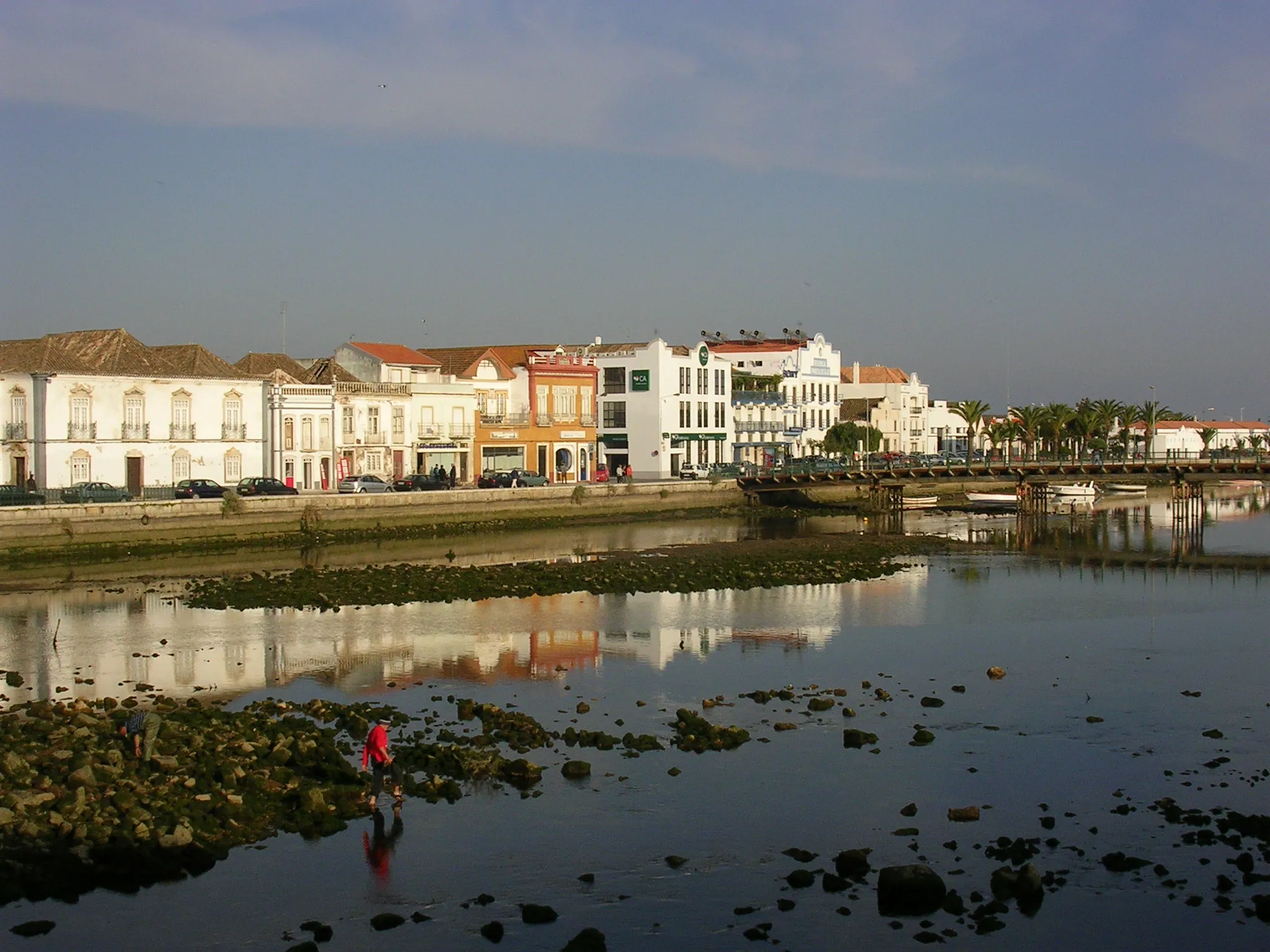
Tavira offers a rare balance in the Eastern Algarve (Sotavento), combining historic riverside architecture along the River Gilão with the barrier islands of the Ria Formosa Natural Park. Spanning 606.97 square kilometres with 28,280 residents as of 2024 according to Statistics Portugal (INE), the municipality sits just 30 minutes from Faro Airport via the toll-free A22 motorway. It features a minimum 0.30% municipal property tax (IMI) and flexible short-let rules.
Where is Tavira and how well connected is the Eastern Algarve?
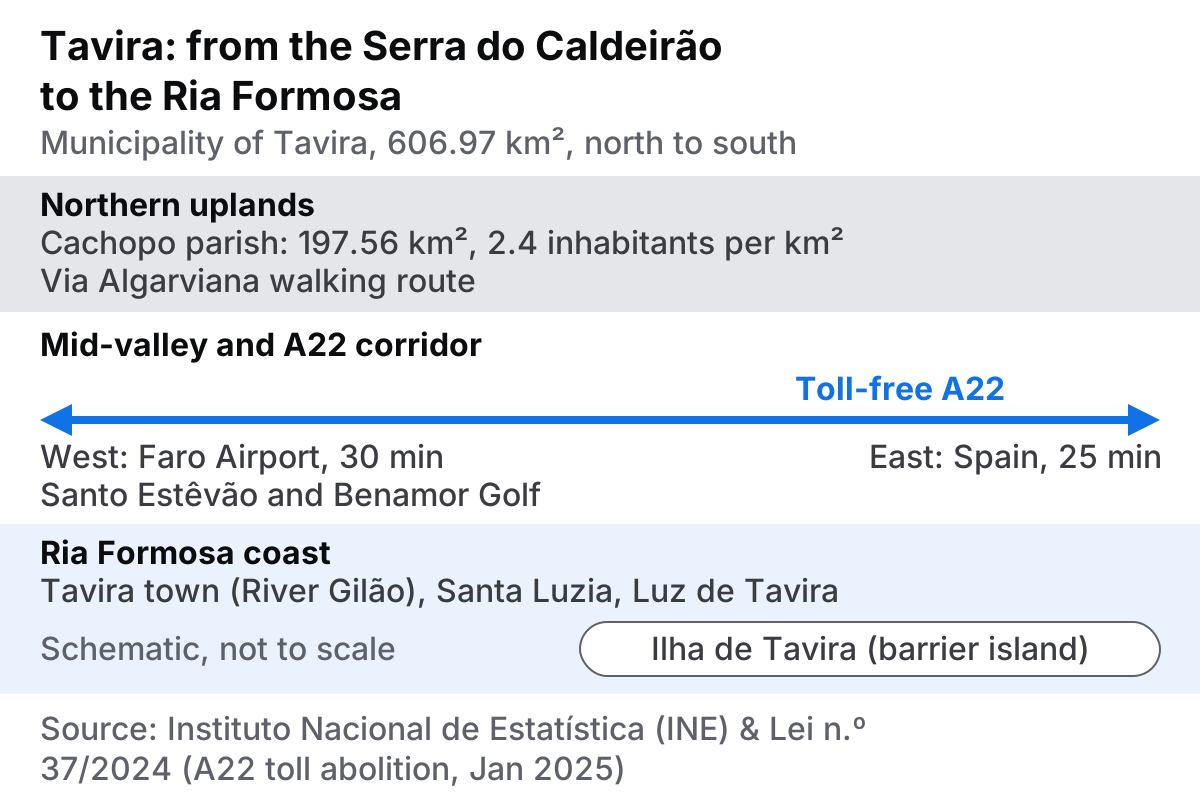
Set in the Eastern Algarve (Sotavento), Tavira sits astride the River Gilão, which rises in the Serra do Caldeirão as the Ribeira de Alportel, becomes the Séqua, and flows as the Gilão through the town centre beneath the historic Roman bridge (Ponte Antiga) before reaching the Ria Formosa Natural Park and Atlantic Ocean.
The coastline is defined by barrier islands: beaches such as Ilha de Tavira and Terra Estreita lie offshore across the lagoon, accessible via regular ferry services and water taxis from the town quays and Quatro Águas.
Road connections are excellent for international buyers and residents. Tavira is located 30 to 36 minutes (31–40 km) east of Faro International Airport and 25 to 31 minutes (28–32 km) west of the Spanish border at Ayamonte. Travel across the region became significantly more convenient on 1 January 2025, when tolls on the A22 motorway (Via do Infante) were completely abolished under Law no. 37/2024.
Buyer profiles vary across micro-locations: period townhouses in the historic core with distinct four-sided rooflines (telhados de quatro águas), contemporary riverside apartments, or traditional countryside estates (quintas) in the rolling hills.
What is everyday life like in Tavira, from golf and schooling to the Ria Formosa?
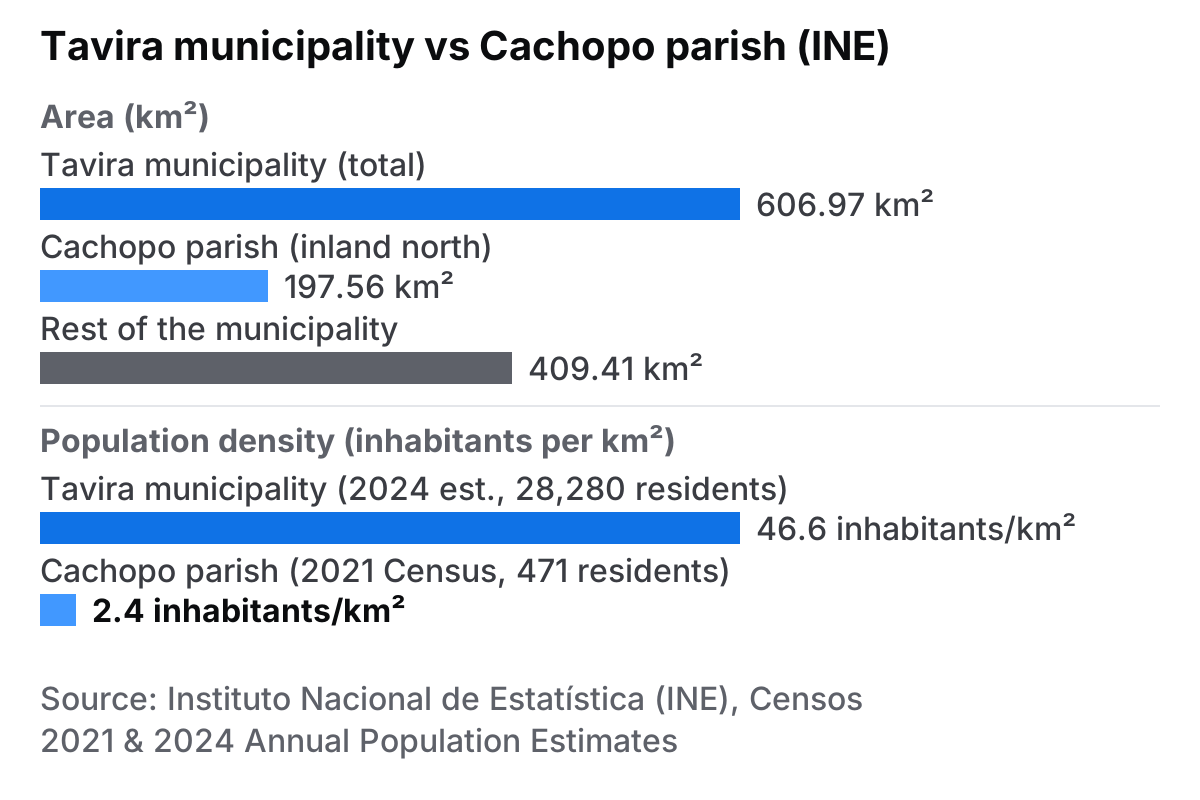
According to Statistics Portugal (INE) population data, the municipality covers 606.97 km² and recorded 28,280 residents in its 2024 annual estimate, rising from 27,523 in the 2021 Census. Strict local planning guidelines protect the town’s architectural heritage, preventing high-rise beachfront developments and maintaining a low-density atmosphere.
Golf enthusiasts are well catered for in the immediate area. Sir Henry Cotton’s 18-hole Benamor Golf is situated on the eastern outskirts of Tavira town. Just across the municipal boundary in Vila Nova de Cacela (municipality of Vila Real de Santo António), players can access the championship courses of Quinta da Ria and Quinta de Cima overlooking the coastal lagoons.
For relocating families, international education is available locally. The Colégio Santiago Internacional curriculum provides bilingual education following the English National Curriculum alongside Portuguese equivalence from Year 1 through to Year 13 (ages 5 to 18, covering Key Stage 1, IGCSEs, and A Levels). Additional international schools in Vilamoura are located roughly 40 minutes west via the A22.
Along the coast, the fishing village of Santa Luzia is celebrated as Portugal’s octopus capital (Capital do Polvo). Local gastronomy flourishes in spots such as Casa do Polvo Tasquinha, which was recognised with a Michelin Plate in the 2020 and 2021 Michelin Guides. From Santa Luzia, a scenic narrow-gauge railway transports beachgoers across the salt marshes to Praia do Barril.
How does the rural interior of Cachopo compare with coastal Tavira?
In sharp contrast to the bustling coastal estuary, the northern parish of Cachopo lies high in the Serra do Caldeirão mountains. Spanning 197.56 km² (203.9 km² under CAOP 2025 boundaries), Cachopo recorded just 471 residents in the 2021 INE Census, representing an ultra-low population density of 2.4 inhabitants per km².
This vast upland territory appeals to buyers seeking solitude and outdoor activity. The long-distance Via Algarviana walking and cycling route passes through Cachopo on its 300 km path across the region. In the neighbouring parish of Santo Estêvão, the Pego do Inferno waterfall on the Ribeira da Asseca stream remains a popular scenic spot for walkers, though its wooden walkways have been officially closed by Tavira City Council since a wildfire in July 2012.
For regional excursions, the Lower Alentejo (Baixo Alentejo) lies an hour’s drive north up the Guadiana river valley, offering historic destinations such as the Vale do Guadiana Natural Park, the hilltop town of Mértola, and the former mining village and river beach at Mina de São Domingos.
How can buyers and agents analyse the Tavira property market?
Understanding municipal tax structures is essential for property buyers. For 2025 and 2026, Tavira levies the legal minimum urban annual property tax (IMI) rate of 0.30% (0.80% for rural land). Property purchases attract a flat 0.80% Stamp Duty (Imposto do Selo) alongside progressive IMT transfer tax. In 2026, primary residence purchases are exempt from IMT up to €106,346, while qualifying first-time buyers aged 35 and under benefit from IMT exemption up to €330,539 under the IMT Jovem scheme.
Property investors also benefit from legislative changes to short-term holiday lets (Alojamento Local or AL). Under Decree-Law no. 76/2024, in force since 1 November 2024, the previous nationwide ban on coastal AL registrations was abolished, and licence transferability upon property sale was restored. Municipalities now manage local registrations, subject to standard 60-day review windows.
Navigating micro-markets across Tavira’s coastal villages and rural interior requires clear market data. Real estate professionals and buyers use CASAFARI Area Insights to evaluate local market trends, alongside Property Sourcing across the Algarve to search clean, deduplicated listings. Valuing properties across contrasting parishes is simplified using a dedicated property valuation and market study tool. To learn more about standard transaction procedures, consult our step-by-step guide to buying property in Portugal and explore broader reasons to invest in property in Portugal.
To explore live market listings and market data, professionals can sign in to CASAFARI Platform.
Frequently asked questions
What property taxes and purchase costs apply when buying a home in Tavira?
Buyers in Tavira pay two transfer taxes on completion: Stamp Duty (Imposto do Selo) at a flat 0.80% of the purchase price, and progressive Municipal Property Transfer Tax (IMT), which in 2026 is exempt on permanent residences up to €106,346 (or up to €330,539 for first-time buyers aged 35 and under via IMT Jovem). Once owned, Tavira charges the lowest legal urban annual property tax (IMI) rate in Portugal at 0.30% of the fiscal tax value (VPT) for 2025 and 2026, and 0.80% for rural plots.
Can you get an Alojamento Local short-term rental licence in Tavira?
Yes. Decree-Law no. 76/2024, which took effect on 1 November 2024, revoked the national suspension on new coastal Alojamento Local (AL) licences and restored the right to transfer existing AL licences when a property changes hands. Applications in Tavira are submitted via prior communication to the municipal council, which has 60 days (or 90 days in designated containment zones) to review the registration.
Are there international schools and toll-free motorway links near Tavira?
Tavira is home to the Colégio Santiago Internacional (CSi), which teaches the bilingual English National Curriculum and Portuguese equivalence from Year 1 through to A Levels (Year 13, ages 5 to 18). By road, the A22 motorway connects Tavira to Faro International Airport in roughly 30 minutes and to the Spanish border in 25 minutes, and all tolls on the A22 were permanently abolished on 1 January 2025 under Law no. 37/2024.
What is the difference between buying on the Tavira coast and inland in Cachopo?
Coastal parishes such as Tavira town, Santa Luzia and Luz de Tavira offer walkable access to the Ria Formosa lagoon, ferries to Ilha de Tavira, golf courses and year-round dining. By contrast, the northern mountain parish of Cachopo covers nearly 198 km² of the Serra do Caldeirão with just 471 residents (2.4 inhabitants per km² according to the 2021 INE Census), appealing to buyers seeking secluded country estates and hiking trails along the Via Algarviana.