
FARO PROPERTY GUIDE
Bustling, modern region retaining its Portuguese character and charm.
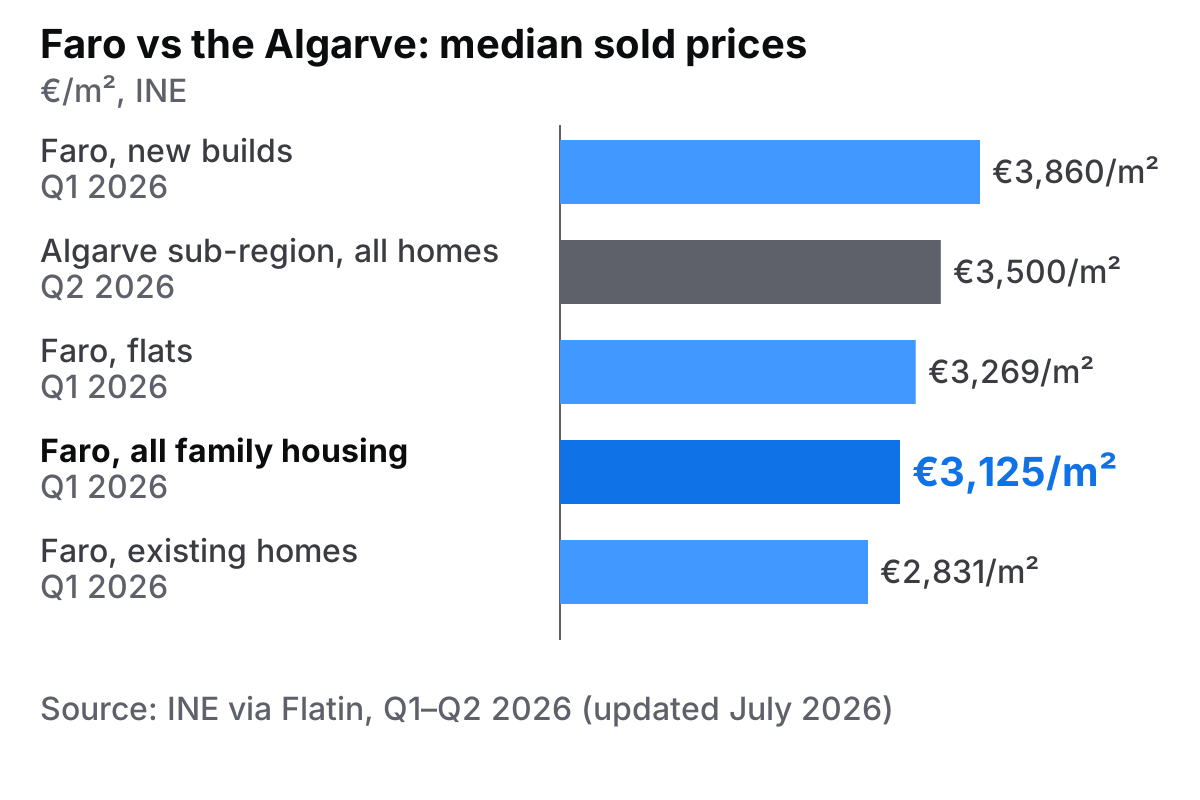
Faro, the administrative and academic capital of the Algarve, is home to 80,256 residents according to national population estimates by the Instituto Nacional de Estatística (INE) via Flatin released in 2026. In Q1 2026, the municipal median sold property price stood at €3,125/m², offering a compelling alternative to the broader Algarve sub-region median of €3,500/m² recorded in Q2 2026. Investors and homebuyers benefit from year-round urban infrastructure, a municipal minimum Property Tax (IMI) rate of 0.3%, and direct access to the Ria Formosa.
Why invest in property in Faro, Portugal?
In recent years, the market dynamics across the central Algarve have shifted noticeably. Where international buyers once focused almost exclusively on seasonal beach resorts, Faro has established itself as a prime location for year-round living and long-term capital preservation. The city attracts Portuguese working professionals alongside international buyers from the United Kingdom, Germany, France, the Netherlands, and Scandinavia who seek a functioning European coastal city rather than a seasonal resort town.
According to data from INE via Flatin, the overall median price per square metre of sold family housing in Faro municipality reached €3,125/m² in Q1 2026. This sits comfortably below the broader Algarve sub-region median of €3,500/m² reported in Q2 2026. Transaction values vary significantly by housing category: existing homes traded at a median of €2,831/m² in Q1 2026, flats registered €3,269/m², and new-build housing reached €3,860/m².
Tax structures in Faro are among the most competitive in coastal Portugal. For ongoing property ownership, Faro charges the legal minimum municipal urban Property Tax (IMI) rate of 0.3% on the registered tax value (Valor Patrimonial Tributário, or VPT) for 2025 and 2026, as reported by Idealista News. Upon purchase, Stamp Duty (Imposto do Selo) is set at 0.8%, while Property Transfer Tax (IMT) follows a progressive scale up to 7.5%. Under current IMT Jovem rules detailed by A Casa dos Financiamentos, buyers aged 35 or under purchasing a first primary residence enjoy full exemption from IMT and Stamp Duty on values up to €330,539, with partial relief extending up to €660,982.
For income tax, the classic Non-Habitual Resident (NHR) regime was succeeded by the Tax Incentive for Scientific Research and Innovation (IFICI, under Article 58.º-A of the EBF). As clarified by the Autoridade Tributária e Aduaneira (Ofício Circulado 20276/2025) in February 2025, qualifying professionals who were not tax residents in Portugal during the prior five years can access a 20% flat IRS rate on eligible employment or self-employment income for 10 years, alongside exemptions on most foreign-source income (excluding pensions).
Investors interested in short-term hospitality should note that under Faro’s Municipal Alojamento Local Regulation (Regulamento n.º 766/2025) and Decree-Law no. 76/2024, Alojamento Local (AL) licences submitted via the Balcão Único Eletrónico no longer expire automatically and remain transferable upon the sale of the property. Operations are subject to municipal containment zones, mandatory €75,000 civil liability insurance, and a capacity cap of 9 rooms or 27 guests.
Why choose Faro for a second home or permanent relocation?
Faro offers an authentic Portuguese lifestyle anchored by rich heritage and world-class leisure facilities. The historic Vila Adentro (Old Town), enclosed by ancient medieval walls, features cobbled avenues, ornate archways, and the 13th-century Faro Cathedral overlooking quietly active squares.
Gastronomy in Faro has reached new heights. In May 2026, the Michelin Guide Portugal 2026 awarded a Michelin star to Alameda in central Faro, celebrating the city’s modern culinary identity. Within a short drive across the central Algarve, residents can dine at Gusto by Heinz Beck (1 star) in Almancil, Vista (1 star) in Portimão, Bon Bon (1 star) in Carvoeiro, A Ver Tavira (1 star) in Tavira, or the two-star institutions Ocean in Porches and Vila Joya in Albufeira.
Active residents benefit from easy access to championship golf, tennis, and equestrian facilities in the neighbouring Golden Triangle—home to Quinta do Lago (Sul, Norte, and Laranjal courses), Vale do Lobo, and Pinheiros Altos—located under 30 minutes away. Understanding how these micro-markets perform is essential when reviewing our guide to buying property in Portugal or evaluating broader arguments for investing in property in Portugal.
What is daily life like in Faro: beaches, shopping, and healthcare?
Life in Faro balances municipal convenience with natural beauty. Retail needs are served by central shopping corridors and the modern Forum Algarve shopping centre, which houses 125 commercial spaces, 25 dining options, and 5 NOS cinema screens as of 2026.
Nature lovers and water sports enthusiasts benefit from the adjacent Ria Formosa Natural Park, a sprawling coastal lagoon system. In May 2026, the Câmara Municipal de Faro confirmed that four municipal island beaches—Praia de Faro-Mar, Ilha da Barreta (Deserta), Ilha do Farol-Mar, and Ilha da Culatra-Mar—were awarded Blue Flag status for the 26th consecutive year.
Healthcare infrastructure is exceptionally strong, reassuring both retirees and young families. Faro is served by major public regional medical facilities alongside leading private institutions, including Hospital Lusíadas Faro and specialized clinics within the HPA Health Group (Hospital Particular do Algarve). The local climate remains temperate year-round, characterized by mild winter days and warm summer months cooled by fresh Atlantic breezes across the lagoon.
How are Faro’s four parishes structured?
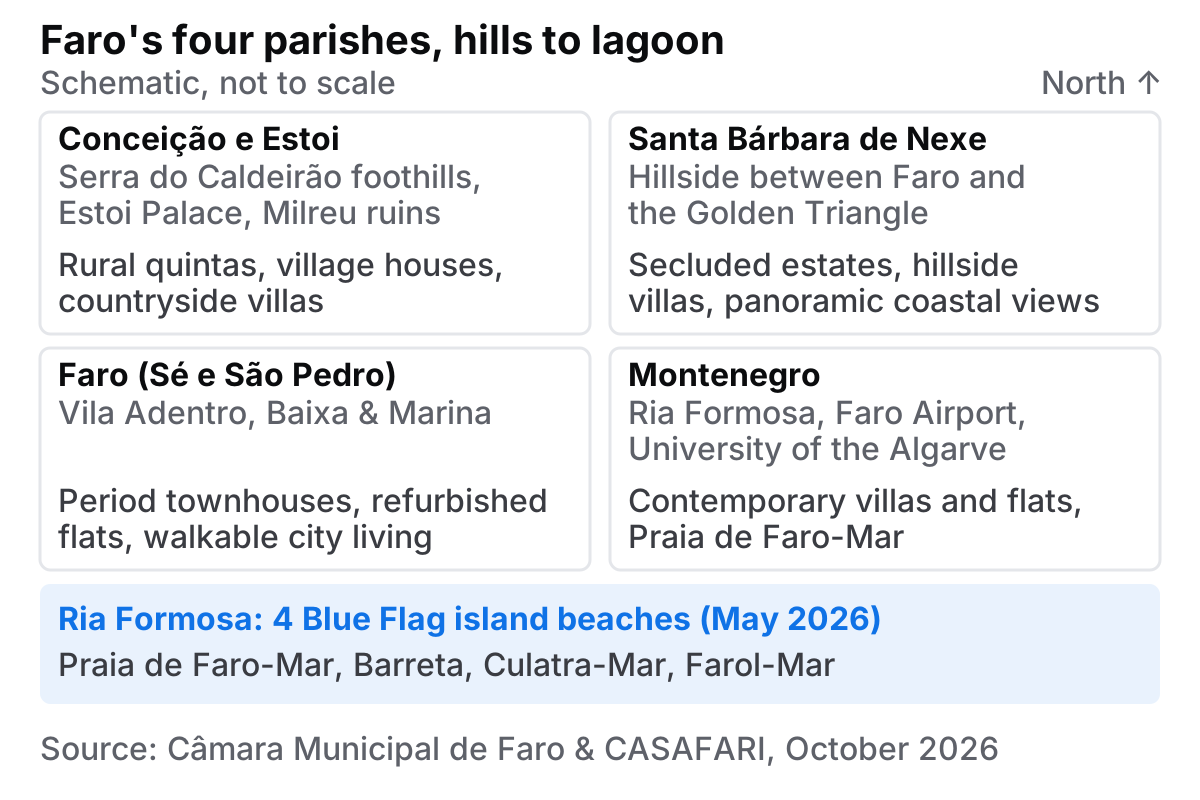
The municipality of Faro comprises four administrative parishes (freguesias), each offering distinct real estate characteristics and lifestyle advantages:
- União das Freguesias de Faro (Sé e São Pedro): The urban, cultural, and commercial heart of the city. Encompassing the historic Vila Adentro, the Baixa, and the Marina, this parish is favoured by buyers seeking period townhouses, renovated apartments, and immediate access to restaurants, cultural venues, and transport links.
- Montenegro: Located between the city centre, Faro International Airport, and the Gambelas campus of the University of the Algarve. Montenegro is a modern residential area popular with families, academics, and aviation professionals, featuring contemporary detached villas, modern apartment developments, and direct road access to Praia de Faro-Mar.
- União das Freguesias de Conceição e Estoi: Stretching into the scenic foothills of the Serra do Caldeirão, this parish combines historic landmark architecture—such as the neoclassical Palace of Estoi and the ancient Roman ruins of Milreu—with countryside quintas, renovated farmhouses, and tranquil village living.
- Santa Bárbara de Nexe: Situated on elevated terrain northwest of the city towards Loulé and the Golden Triangle. Santa Bárbara de Nexe is renowned for private detached villas, rustic stone estates, and panoramic views sweeping across the countryside to the Atlantic coastline.
Faro’s location offers excellent regional transit: the award-winning Vilamoura Marina—named TYHA Superyacht Marina of the Year in 2025 and 2026, according to the TYHA Marina of the Year Awards 2026—is less than 30 minutes away, while motorsport enthusiasts can reach the Autódromo Internacional do Algarve in Portimão in roughly 45 minutes.
How well connected are Faro Airport and the city’s transport links?
Faro is the principal international gateway to southern Portugal. Located in the parish of Montenegro, Faro International Airport provides direct, year-round flights across the UK, mainland Europe, and international hubs. For travel to the national capital, direct flights operated by TAP Air Portugal connect Faro to Lisbon in approximately 50 minutes as of October 2026.
Rail connections are equally accessible from central Faro train station. Rail schedules from rail.cc as of October 2026 show that Comboios de Portugal (CP) operates express Alfa Pendular trains reaching Lisbon in 2 hours 50 minutes to 3 hours, alongside Intercidades services taking 3 hours 20 minutes to 3 hours 30 minutes.
For estate agents, real estate investors, and relocation specialists tracking inventory and transaction trends in Faro’s parishes, tools like CASAFARI Area Insights and our professional property valuation and market study tool provide precise, real-time market analytics. To analyse local market metrics and evaluate comparative pricing across the Algarve, sign in to the CASAFARI platform.
Frequently asked questions
How have Portugal’s residency and tax rules changed for Faro property buyers?
The classic Non-Habitual Resident (NHR) tax regime is closed to new applicants and was replaced by the Tax Incentive for Scientific Research and Innovation (IFICI, under Article 58.º-A of the EBF, regulated in February 2025). Under 2025 and 2026 tax rules, eligible individuals who were not tax residents in Portugal in the preceding five years and work in qualifying scientific, academic, startup, or high-value innovation roles can access a 20% flat IRS rate on qualifying Portuguese income for 10 years. Foreign-source income (excluding pensions) may also qualify for tax exemptions under this framework.
What are the property taxes when buying a home in Faro?
When purchasing property in Faro, buyers pay Stamp Duty (Imposto do Selo) at a flat 0.8% of the purchase price or tax value (VPT), alongside progressive Property Transfer Tax (IMT) ranging from 0% to 7.5% for residential properties. Under IMT Jovem rules in 2026, first-time homebuyers aged 35 or under purchasing a primary residence up to €330,539 are fully exempt from IMT and Stamp Duty, with partial exemptions up to €660,982. For ongoing property ownership, Faro levies the national legal minimum urban Municipal Property Tax (IMI) rate of 0.3% on the VPT for 2025 and 2026.
What are the short-term rental (Alojamento Local) rules in Faro?
Under Faro’s Municipal Regulation no. 766/2025 and Decree-Law no. 76/2024, short-term rental (Alojamento Local) registrations submitted via the Balcão Único Eletrónico remain valid indefinitely and are transferable upon property sales, subject to municipal containment and sustainable growth zone restrictions. Operators must maintain civil liability insurance of at least €75,000, supply required safety and fire-extinguishing equipment, and adhere to maximum operational capacity limits of 9 bedrooms and 27 guests.
How long does it take to travel from Faro to Lisbon and international hubs?
Direct TAP Air Portugal flights between Faro International Airport and Lisbon take approximately 50 minutes as of October 2026. By rail from central Faro train station, Comboios de Portugal’s express Alfa Pendular service reaches Lisbon in 2 hours 50 minutes to 3 hours, while Intercidades trains take between 3 hours 20 minutes and 3 hours 30 minutes. Faro Airport also offers direct year-round flights connecting the Algarve to major UK and European metropolitan destinations.