
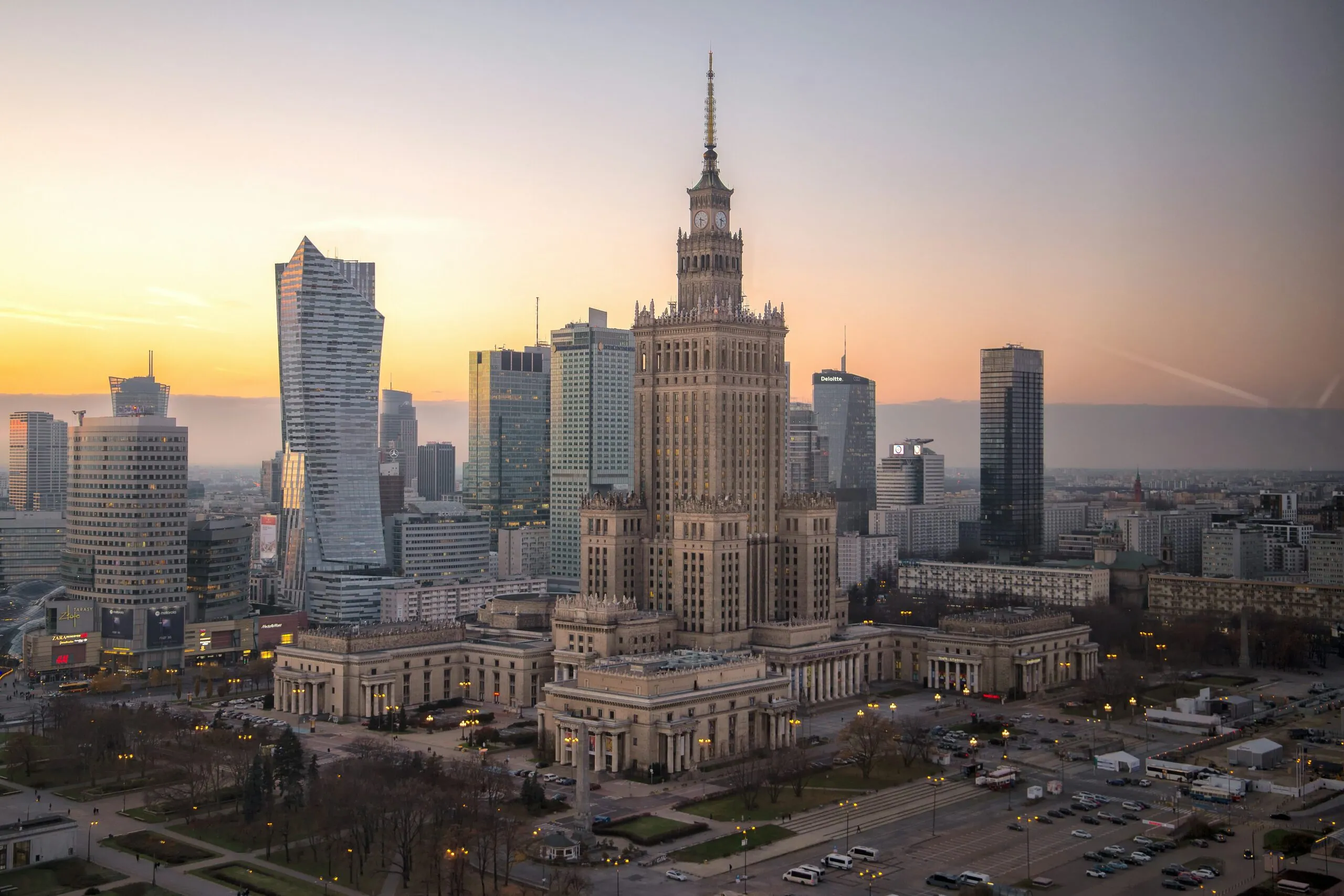
Warsaw is Poland’s capital and largest property market, housing 1,866,729 registered residents at the end of 2025 according to Statistics Poland (GUS). According to CASAFARI Area Insights, apartment asking prices reached €4,193/m² in Q3 2026, marking a 10.0% year-on-year increase, while monthly asking rents averaged €19.2/m². Supported by National Bank of Poland closing prices of 16,783 PLN/m² on the primary market, the city offers high liquidity for international investors exploring the Poland property market guide.
Where Warsaw sits and how its transport network shapes property demand
Divided by the Vistula River, Warsaw’s urban layout is structured around two key underground arteries. Metro Line M1 runs north–south from Kabaty through the central hub to Młociny, while Line M2 connects east and west. October 2026 marks final testing and integration on the western M2 extension in Bemowo, delivering three new stations at Lazurowa, Chrzanów and Karolin alongside the STP Mory depot. Meanwhile, Line M3 to Gocław is in design and environmental permitting for construction between 2028 and 2032.
Intercity rail connectivity is anchored by three primary stations: Warszawa Centralna in the commercial core, Warszawa Zachodnia handling western corridors, and Warszawa Wschodnia to the east. Aviation access is anchored by Warsaw Chopin Airport within the city limits—offering direct SKM and Koleje Mazowieckie rail links ahead of its planned 2032 commercial traffic transfer to the Central Communication Port (CPK)—and Warsaw-Modlin Airport to the north-west, for which PKP PLK launched the 2026 tender for a direct 7 km rail spur to be built in 2027–2029.
What Warsaw is like to live in and where the jobs are
Official registered figures from the City of Warsaw and Statistics Poland (GUS) recorded 1,866,729 inhabitants at the end of 2025, though experimental ‘traces of life’ research indicates over 2.07 million people actually reside and work in the metropolitan area. The city’s economic centre of gravity has shifted progressively westward from Śródmieście into Wola around Rondo Daszyńskiego. This financial and technology hub is anchored by landmarks such as Varso Tower—standing 310 metres tall including its spire to make it the tallest building in the European Union, featuring an observation deck opened in 2025—alongside modern office schemes like The Warsaw HUB and The Form, which delivered approximately 28,300 m² of office space at the end of 2024.
Beyond corporate density, Warsaw offers a balanced European lifestyle defined by four distinct seasons, weekend recreation along the Vistula boulevards, the UNESCO-listed historic Old Town (Stare Miasto), the royal palace and landscaped gardens at Wilanów, and the extensive woodlands of Kampinos National Park situated just beyond the north-western city boundary.
Housing stock and key districts: from Śródmieście and Wola to Mokotów and Bemowo
Warsaw’s residential real estate encompasses restored pre-war tenements (kamienice) and post-war socialist-realist blocks in Śródmieście and Old Mokotów, large-panel districts from the late communist era, and high-specification contemporary apartment developments (apartamentowce) built on former industrial brownfields. Buyer preferences divide clearly across districts:
- Śródmieście commands prime values for executive rentals and historic prestige.
- Wola attracts young professionals and buy-to-let investors seeking high-density new builds within walking distance of Rondo Daszyńskiego.
- Mokotów remains the preferred choice for established families and corporate tenants seeking leafy residential streets and excellent international school links.
- Bemowo and Ursus represent high-growth outer districts drawing first-time buyers and families with improving rail infrastructure.
Warsaw property prices and rents in 2026: asking vs closing figures
Tracking market performance requires distinguishing between active marketing listings and completed transactions. CASAFARI Area Insights data for apartments for sale in Warsaw (location id 6295646, queried 2026-10-23, outliers excluded) shows that the average asking price reached €4,193/m² in Q3 2026, representing a 10.0% increase from €3,812/m² in Q3 2025. Conversely, average monthly asking rents stood at €19.2/m² in Q3 2026, remaining completely flat at 0.0% year on year compared to Q3 2025. This divergence between rising asking sale prices and steady rents reflects robust capital appreciation driven by domestic demand and institutional investment.
To cross-reference listing dynamics with actual market liquidity, official transactional closing figures from the National Bank of Poland (NBP BaRN database) for Q2 2026 record average closing prices in Warsaw at 16,783 PLN/m² on the primary market—up from 16,471 PLN/m² in Q1 2026—and 16,723 PLN/m² on the secondary market. Understanding how transactional closing-price data works alongside asking prices is essential for accurate property valuation and market studies.
Taxes, permits and rental rules every Warsaw buyer must know in 2026
Foreign purchasers must navigate specific regulatory frameworks. Citizens of the EU, EEA and Switzerland acquire Polish real estate on identical terms to Polish nationals. Under Ministry of the Interior and Administration (MSWiA) rules, non-EU/EEA/Swiss nationals do not require a government permit to buy a standalone residential apartment (samodzielny lokal mieszkalny) or an associated garage in Warsaw, provided the property is outside border zones. However, an MSWiA permit subject to a 1,570 PLN stamp duty remains mandatory when purchasing a house with a plot of land.
Primary-market purchases from developers include VAT (typically 8% for residential units up to 150 m²) and are exempt from the 2% Civil Law Transactions Tax (PCC). On the secondary market, the standard PCC is 2% of market value, though two vital modifications apply: a complete 0% exemption for buyers purchasing their first-ever residential property in Poland, and a punitive 6% PCC rate levied on the sixth and each subsequent apartment acquired within a single residential development on one land parcel.
For ongoing ownership and letting, Warsaw’s annual municipal property tax (podatek od nieruchomości) for 2026 is 1.25 PLN per square metre of usable residential floor area per year, alongside 0.77 PLN per square metre for associated land shares. Private residential rental income is taxed via a mandatory lump-sum tax on registered revenues (ryczałt od przychodów ewidencjonowanych) at 8.5% on annual revenue up to 100,000 PLN (200,000 PLN combined for married couples filing jointly) and 12.5% on any surplus. Landlords utilising an occasional lease (najem okazjonalny) to simplify tenant repossession must register the agreement with the local tax office within 14 days of commencement.
Short-term rentals are governed by EU Regulation 2024/1028, requiring identification and data sharing from May 2026, alongside the Polish government’s implementing legislation establishing the Central Register of Tourist Accommodation Facilities (CWTON). Warsaw hosts must register short-let units in the municipal non-hotel accommodation register.
How to analyse and source Warsaw property with CASAFARI
Professionals navigating the Polish market rely on dedicated analytics tools to identify mispriced assets and monitor micro-market shifts. You can track historical pricing trends through CASAFARI Area Insights and review broader Polish real estate market trends and tools. To uncover unlisted opportunities and clean data feeds across multiple portals, CASAFARI Property Sourcing removes duplicate listings and tracks historical price adjustments on individual units.
For investment appraisal and lending decisions, professionals build reliable comparative market analyses using property valuation and market study tools backed by verified closing prices. You can sign in to the CASAFARI platform to begin analysing live inventory, or consult the Area Insights API and MCP documentation to integrate automated market feeds into your proprietary software workflows.
Frequently asked questions
Can foreigners buy an apartment in Warsaw without a government permit?
Yes, in most residential scenarios. Citizens of the EU, EEA and Switzerland require no permit for any property in Poland. According to the Ministry of the Interior and Administration (MSWiA), buyers from outside the EU, EEA and Switzerland are fully exempt from obtaining an MSWiA permit when purchasing a standalone residential apartment or associated garage in Warsaw, though a permit and 1,570 PLN stamp duty remain necessary when acquiring a house with land.
What are the property transfer taxes (PCC) when buying a flat in Warsaw?
Secondary-market apartment purchases carry a standard Civil Law Transactions Tax (PCC) of 2% of the market value, collected by the notary at signing. First-time buyers purchasing their very first home on the secondary market benefit from a complete 0% PCC exemption. Conversely, acquiring a sixth or subsequent apartment within a single development on one land parcel triggers a punitive 6% PCC rate, while primary-market units bought from developers include VAT and are exempt from PCC.
How is rental income taxed for private landlords in Poland?
Private residential rental income in Poland is subject to a mandatory lump-sum tax on registered revenues known as ryczałt. The tax rate is set at 8.5% on annual rental revenues up to 100,000 PLN—or 200,000 PLN for married couples filing jointly—and rises to 12.5% on any surplus above that threshold. Landlords employing an occasional lease agreement must formally notify the local tax office within 14 days of the tenancy beginning.
What are the short-term rental rules in Warsaw in 2026?
Short-term rentals across Poland and Warsaw are governed by EU Regulation 2024/1028, which mandates platform data sharing and host identification. Additionally, national legislation classifies short-term lets as hotel services and establishes the Central Register of Tourist Accommodation Facilities (CWTON). Hosts operating in Warsaw must formally register their short-let properties in the municipal register of non-hotel accommodation.
Which Warsaw districts are most popular with property buyers and tenants?
Śródmieście and Mokotów remain perennially popular with executives, diplomats, and families seeking pre-war architecture or green residential streets near the M1 metro line. Wola, centred around the Rondo Daszyńskiego financial district and Varso Tower, serves as the primary magnet for young professionals and buy-to-let investors. Meanwhile, Bemowo attracts growing buyer interest driven by the delivery of the western M2 metro extension stations.
How much is the annual municipal property tax for an apartment in Warsaw?
Annual municipal property taxes in Poland are exceptionally modest compared to Western Europe. Under Warsaw City Council resolutions for the 2026 tax year, the residential property tax is 1.25 PLN per square metre of usable floor area per year, with an additional 0.77 PLN per square metre charged on associated land shares. By contrast, commercial and business spaces face a much higher rate of 35.53 PLN per square metre annually.