
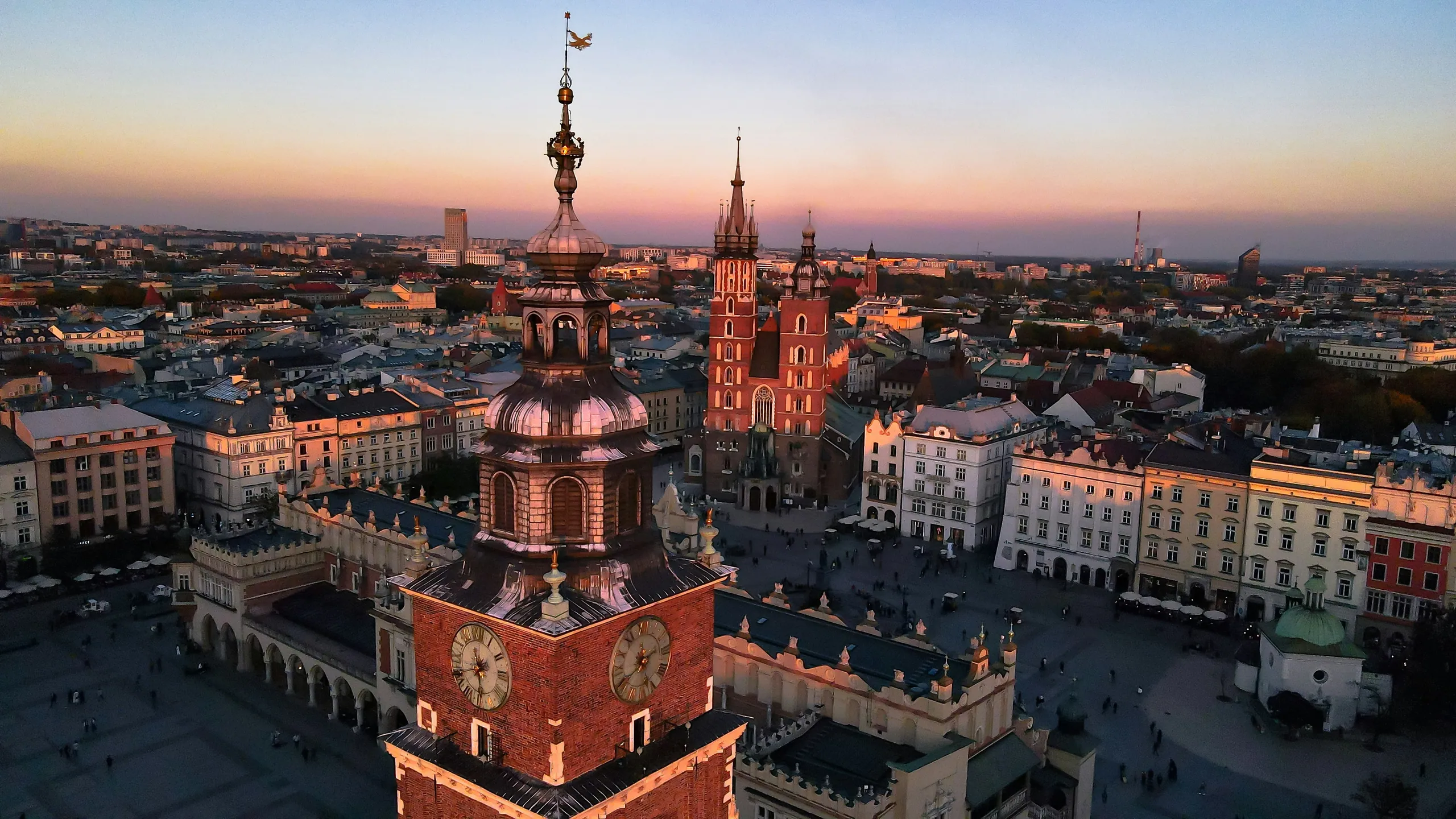
Krakow offers a resilient property market blending historic European charm with a thriving tech and commercial core. According to CASAFARI Area Insights, the average asking price for apartments for sale in Krakow reached €3,769 per square metre in Q3 2026, marking an 11.1% increase year on year from €3,393 in Q3 2025, while monthly asking rents stood stable at €15.9 per square metre. Explore further regional data via our property market in Poland guide.
How is Krakow connected to Poland and international hubs?
Kraków Airport (KRK) in Balice is Poland’s second-busiest aviation hub, handling a record 13,248,355 passengers in full year 2025 (representing a ~20% year-on-year growth), as reported by Kraków Airport. The Koleje Małopolskie SKA1 suburban train connects the airport terminal to Kraków Główny (Main Station) in 17 to 18 minutes.
From Kraków Główny, PKP Intercity Pendolino (EIP) trains reach Warsaw Centralna in 2 hours 21 minutes as of October 2026, with scheduled infrastructure upgrades aiming to drop journey times below two hours by late 2027, according to PKP Intercity. Locally, the dense municipal tram network and the Krakow Fast Tram (KST) tunnel link residential quarters directly to employment hubs.
What is it like to live and work in Krakow?
Official figures from Statistics Poland (GUS) recorded 816,614 registered residents in Krakow at the end of December 2025 (alongside experimental ‘traces of life’ studies estimating around 897,000 actual residents) and 136,300 university students for the 2025/2026 academic year, ensuring continuous residential housing demand. For broader context on national dynamics, see our analysis of real estate trends and tools in Poland.
Krakow is Poland’s largest regional office market, reaching 1,870,000 square metres of modern office stock at the end of Q2 2026 across five principal zones—Centre, North-East, North-West, South-East, and South-West—according to data published by the Polish Chamber of Commercial Real Estate (PINK) via PAP Biznes. Residents balance urban careers with extensive green spaces managed by the Municipal Greenspace Authority (ZZM), including the historic Błonia meadow (42.02 hectares registered area, 3.6-kilometre perimeter), Park Zakrzówek in Dębniki with its floating pools in a 32-metre-deep flooded limestone quarry, and the 422-hectare Las Wolski protective forest.
Which neighbourhoods and housing types attract buyers in Krakow?
Stare Miasto (Old Town) and Kazimierz feature historic 19th- and early-20th-century tenement buildings (kamienice) with high ceilings, attracting buyers seeking architectural heritage and short-let investment potential. Further out, districts such as Grzegórzki and Zabłocie have transformed former industrial plots along the Vistula into dense mixed-use communities favored by young professionals and corporate renters.
In the south and west, Podgórze, Ruczaj (near the Jagiellonian University campus), and Bronowice offer modern developer-built apartment complexes (rynek pierwotny) popular with families and domestic purchasers. Investors frequently evaluate these locations using strategies outlined in our guide to gross rental yields across European cities in 2026.
How are apartment prices and rents performing in Krakow?
Property pricing across the city reflects steady demand across both sales and lettings sectors:
- Asking prices (CASAFARI Area Insights): Average apartment asking prices for sale in Krakow reached €3,769 per square metre in Q3 2026, rising 11.1% year on year from €3,393 in Q3 2025 (asking prices from indexed listings, excluding outliers).
- Asking rents (CASAFARI Area Insights): Average monthly asking rents stood at €15.9 per square metre in Q3 2026, remaining virtually unchanged compared with €16.0 in Q3 2025 (-0.6% year on year), tracked via CASAFARI Area Insights.
- Official closing prices (NBP BaRN): According to transactional data from the National Bank of Poland (NBP BaRN quarterly report available via the National Bank of Poland (NBP) quarterly real estate report), Q2 2026 average closing prices reached 15,923 PLN per square metre on the primary market (+3.46% quarter on quarter from 15,391 PLN in Q1 2026) and 14,792 PLN per square metre on the secondary market (-1.9% quarter on quarter from 15,078 PLN in Q1 2026).
What taxes, permits and short-let rules apply to buyers in Krakow?
Foreign buyers from the EU, EEA, and Switzerland face no ownership restrictions in Poland. Non-EU/EEA/Swiss nationals can purchase self-contained residential apartments (plus associated garages) without a permit, but require formal authorisation from the Ministry of the Interior and Administration (MSWiA)—incurring a 1,570 PLN duty—when acquiring land, single-family houses, internal road shares, or commercial premises, as detailed by the Ministry of the Interior and Administration (MSWiA) permit guidance.
Transaction taxes vary by market segment: secondary-market resales incur a standard 2% civil law transactions tax (PCC), reduced to 0% for first-time home buyers or raised to 6% for purchasers acquiring six or more units on a single plot. Primary-market purchases from developers are exempt from PCC, carrying VAT instead (8% for residential apartments up to 150 square metres and houses up to 300 square metres; 23% for larger properties, standalone garages, or commercial units). Private rental income is taxed at a flat revenue rate (ryczałt, PIT-28) of 8.5% up to 100,000 PLN annually (200,000 PLN for married couples) and 12.5% on surpluses, following rules from the Polish Ministry of Finance rules on rental income taxation.
Short-term rentals must be registered in the Mayor of Krakow’s electronic register of non-hotel accommodation (eKON) prior to welcoming guests. Under EU Regulation 2024/1028 and Poland’s national tourism act updates, operators must display valid registration numbers on booking platforms, as outlined by the City of Krakow guidance on short-term rental registration (eKON).
How does CASAFARI help property professionals working in Krakow?
Real estate agents, valuers, and investors rely on CASAFARI Area Insights and property valuation and market study tooling to benchmark property values against official closing prices from Poland’s Register of Real Estate Prices (RCN).
Professionals use Property Sourcing to aggregate deduplicated listings across portals and trace complete property histories. Commercial teams analyzing office and retail footprints across Krakow’s 1.87 million square metres of commercial stock can utilise the Claro documentation on developers.casafari.com for footfall and demographic intelligence. Review live market datasets by choosing to sign in to the CASAFARI platform.
Frequently asked questions
Can foreigners buy property in Krakow without a permit?
Citizens and legal entities from the EU, EEA, and Switzerland can acquire any property in Poland without restriction. Non-EU/EEA nationals can buy a self-contained residential apartment and associated garage in Krakow without a permit, but require a permit from the Ministry of the Interior and Administration (MSWiA)—costing 1,570 PLN—when purchasing land, houses, internal road shares, or commercial premises, unless exempted by long-term residency status.
What taxes do you pay when buying an apartment in Krakow?
Secondary-market apartment purchases incur a 2% civil law transactions tax (PCC), which is waived (0%) for first-time home buyers and increased to 6% when purchasing a sixth or subsequent apartment on a single development plot. Primary-market developer purchases replace the 2% PCC with VAT: 8% for apartments up to 150 square metres and houses up to 300 square metres, and 23% for larger properties, commercial units, or standalone garages.
Which neighbourhoods in Krakow are best for property investment?
Stare Miasto and Kazimierz remain prime choices for historic apartments targeted at short-term tourists and cultural lifestyle buyers. Meanwhile, Grzegórzki, Zabłocie, and Podgórze attract strong long-term rental demand from corporate professionals and university staff due to their proximity to major office corridors and transport links.
What are the rules for short-term rentals and Airbnb in Krakow in 2026?
All short-term rental providers in Krakow must register their property in the municipal eKON electronic register before accepting guests. In compliance with EU Regulation 2024/1028 and Polish tourism regulations, hosts must display a valid registration number on booking platforms such as Airbnb and Booking.com.
How is rental income taxed in Poland for private landlords?
Private residential rental income earned outside a registered commercial entity is subject to a mandatory flat-rate revenue tax (ryczałt od przychodów ewidencjonowanych) filed via PIT-28. The tax rate is 8.5% on annual gross rental revenue up to 100,000 PLN (200,000 PLN for married couples filing jointly) and 12.5% on any revenue exceeding that threshold.
Why is Krakow a major hub for commercial and office real estate?
Krakow is Poland’s largest regional office market, boasting 1.87 million square metres of modern office stock at the end of Q2 2026. The city acts as a primary international hub for global business services, IT, and R&D operations, supported by a large talent pool from its 136,300 university students and robust transport connectivity.