
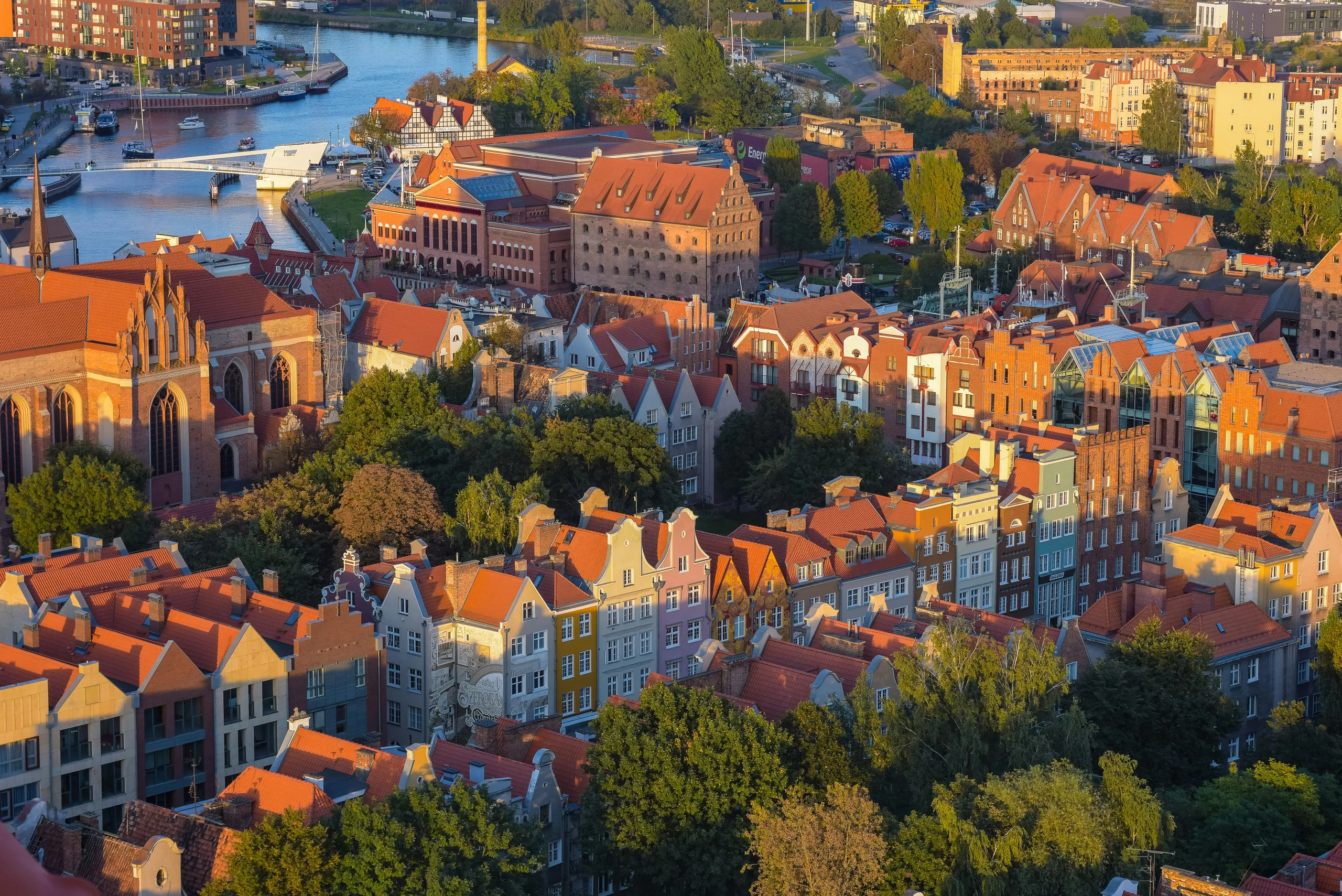
Gdańsk anchors Northern Poland’s 1.7-million-strong Tricity metropolitan area, combining a thriving maritime economy with historic urban regeneration. According to CASAFARI Area Insights (queried 23 October 2026), apartment asking prices from indexed listings averaged €3,706/m² in Q3 2026—marking an 11.3% year-on-year increase from Q3 2025—while asking rents averaged €16.6/m²/month (-2.4% YoY). For a broader view of the national property market across Poland, understanding hyper-local fundamentals is essential for international buyers.
Where Gdańsk sits in the Tricity and how it is connected
Gdańsk forms an integrated urban core alongside Sopot and Gdynia, accounting for 489,328 official residents (nearly 520,000 in GUS administrative register studies as of December 2025). Together, the Tricity constitutes a labour and housing market of 759,245 people, expanding to 1,697,856 across the wider metropolitan area according to official Główny Urząd Statystyczny (GUS) data.
International and domestic accessibility underpins strong regional demand. Gdańsk Lech Wałęsa Airport (GDN) handled nearly 7.4 million passengers in full-year 2025 and 6,344,284 passengers in the first nine months of 2026 (+12% year on year) across 52,464 flight operations, keeping pace to surpass 8 million passengers in 2026. Rail connectivity is equally robust: PKP Intercity Pendolino trains link Gdańsk Główny to Warsaw in 2 hours 46 minutes, with schedules accelerating to 2 hours 18 minutes from December 2026 with half-hourly departures, while the SKM urban rail network connects the coastal municipalities.
On the road and maritime front, the opening of the 32 km S7 Tricity Metropolitan Bypass (OMT) between late 2025 and mid-2026 streamlined regional logistics and commuter flows. Meanwhile, the Port of Gdańsk handled 80.4 million tonnes of cargo in 2025 (57.7 million tonnes in January–August 2026, +10% year on year), and the Baltic Hub container terminal handled a record 2,767,287 TEU in 2025 (+23% year on year) following the full commissioning of its T3 deep-water terminal in October 2025, which raised annual capacity to 4.5 million TEU.
What Gdańsk is like to live in: coastal districts, culture and green space
Gdańsk balances a maritime Baltic geography with rich historic architecture and extensive natural preserves. To the west, the forested hills of the Tricity Landscape Park frame the city, while the northern coastline features sandy beaches at Brzeźno, Jelitkowo, and Stogi, connected by President Ronald Reagan Park and extensive cycle routes.
Cultural life centres around the Gothic and Renaissance heritage of Main Town (Śródmieście, Długi Targ, St. Mary’s Church, and the historic St. Dominic’s Fair) contrasted with the post-industrial regeneration of the former Imperial Shipyard in Młode Miasto—home to Ulica Elektryków, 100cznia, and the European Solidarity Centre. Everyday urban amenities are anchored by Wrzeszcz as a vibrant commercial and gastronomic hub around Galeria Bałtycka, Forum Gdańsk at the edge of the old town, and Oliwa’s historic park and cathedral adjacent to the city’s primary corporate office corridor.
Housing stock, prime neighbourhoods and who buys in Gdańsk
Gdańsk held 269,357 dwellings (551 per 1,000 residents) at the start of 2025 and added 5,750 new apartment completions during 2025, sustaining an active primary development market alongside historic tenements and post-war residential estates.
- Śródmieście and Granary Island (Wyspa Spichrzów): Characterised by luxury waterfront apartment buildings and aparthotels, targeted by yield-focused investors and second-home buyers.
- Coastal Strip (Brzeźno, Jelitkowo, Przymorze): High demand for lifestyle residences, hybrid summer short-lets, and academic winter rentals within walking distance of the beach.
- Wrzeszcz and Oliwa: Leafy streets featuring early-20th-century tenements alongside modern infill, popular with local families, tech professionals, and long-term buy-to-let investors.
- Młode Miasto: Rapidly evolving post-shipyard mixed-use quarter attracting urban professionals and investors seeking capital growth.
Professionals can analyse micro-market pricing and identify undervalued opportunities using CASAFARI Property Sourcing alongside property valuation and comparative market analysis.
The Gdańsk property market in Q3 2026: asking prices, closing prices and rents
Understanding market values requires distinguishing between listing asking prices and recorded closing transactions. According to CASAFARI Area Insights (queried 23 October 2026), the average asking price from indexed listings for apartments in Gdańsk reached €3,706/m² in Q3 2026, representing an 11.3% year-on-year increase from €3,328/m² in Q3 2025 (outliers excluded).
By contrast, official closing (transaction) prices published by the National Bank of Poland (NBP BaRN database) stood at 14,491 PLN/m² on the primary market and 14,035 PLN/m² on the secondary market in Q2 2026, rising from 13,900 PLN/m² and 13,057 PLN/m² respectively in Q1 2025. On the rental side, CASAFARI Area Insights recorded average monthly asking rents of €16.6/m² in Q3 2026, a mild 2.4% year-on-year adjustment from €17.0/m²/month in Q3 2026 [sic: Q3 2025] as recent residential completions expanded tenant choice.
In the commercial sector, modern Grade A and B office stock reached 831,000 m² across 96 buildings in Q3 2026 (representing roughly 75% of the Tricity’s 1.07 million m² total), according to data from the Brookfield Partners Q3 2026 Gdańsk office market report. Overall office vacancy declined to 8.17% in Q3 2026 (dropping as low as 4.42% in Śródmieście and Młode Miasto), with average office asking rents standing at €15.63/m²/month, driven by growth in maritime logistics, shared services, and tech hubs.
For further macro context, review the analysis on trends and tools shaping the Polish real estate market and benchmark returns against gross rental yields across European cities in 2026.
Rules that matter to buyers and investors in 2026: permits, taxes and short lets
Foreign purchasers must navigate specific Polish legal and fiscal frameworks when acquiring real estate in Gdańsk:
- Border-Zone Permit Requirement: While EU, EEA, and Swiss nationals buy freely, all of Gdańsk, Sopot, and Gdynia lie within Poland’s designated coastal border zone (strefa nadgraniczna). Consequently, non-EEA buyers (including UK, US, and Ukrainian nationals without qualifying permanent residency) must obtain a permit from the Ministry of the Interior and Administration (MSWiA property permit rules for foreign buyers) prior to acquiring any residential property, including standalone apartments.
- Transfer and Value-Added Taxes: Primary-market developer purchases include 8% VAT for residential units up to 150 m² and incur no transfer tax. On the secondary market, the standard Civil Law Transactions Tax (PCC) is 2% of market value, reduced to 0% for first-time homebuyers, and increased to a 6% PCC surcharge for investors acquiring their sixth or subsequent apartment within a single development.
- Short-Term Rental Compliance: Short-term tourist rentals (<30 days per stay) must be registered free of charge in the municipal accommodation register (Gdańskie Obiekty Noclegowe, which encompassed roughly 7,000 properties / 44,000 beds by October 2026). Under EU Regulation 2024/1028, hosts must display their official registration number on booking platforms. Rental income is subject to Poland’s lump-sum tax (ryczałt) at 8.5% up to 100,000 PLN annually and 12.5% on the excess, alongside standard VAT rules once statutory thresholds are exceeded, as detailed by the City of Gdańsk municipal short-term accommodation register requirements.
How CASAFARI helps buyers, agents and investors work the Gdańsk market
Whether you are acquiring a coastal holiday home, evaluating buy-to-let yields, or advising institutional clients, accurate and verified data is essential. You can sign in to the CASAFARI platform to explore Polish market data to track real-time listing dynamics, comparable sales, and historical pricing across every Gdańsk neighbourhood.
Frequently asked questions
Do foreign buyers need a permit to buy an apartment in Gdańsk?
Citizens and legal entities from the EU, EEA, and Switzerland do not require a permit to purchase property in Poland. However, because Gdańsk, Sopot, and Gdynia lie entirely within Poland’s coastal border zone (strefa nadgraniczna), non-EEA and non-Swiss nationals—including UK and US citizens—must obtain an official permit from the Ministry of the Interior and Administration (MSWiA) even when purchasing a standard residential apartment, unless they hold qualifying long-term residency.
Which districts in Gdańsk are best for living and property investment?
For short-term holiday rentals and prime capital appreciation, investors frequently target Main Town (Śródmieście), waterfront developments on Granary Island (Wyspa Spichrzów), and the coastal strip of Brzeźno and Jelitkowo. For stable, year-round corporate and student demand, Wrzeszcz and Oliwa perform exceptionally well due to university proximity, SKM rail links, and major office clusters like Alchemia and Cube Office Park. Regenerated post-shipyard areas such as Młode Miasto also offer strong mixed-use investment appeal.
What are the property purchase taxes (PCC) in Poland for first-time and portfolio buyers?
New-build apartments purchased from developers on the primary market carry 8% VAT for units up to 150 m² and are exempt from transfer tax. On the secondary market, the standard Civil Law Transactions Tax (PCC) is 2% of market value, but natural persons buying their very first home enjoy a 0% exemption. Conversely, investors acquiring a sixth or subsequent apartment within a single residential development face a 6% PCC surcharge, applicable across both primary and secondary market transactions.
What are the rules and taxes for short-term holiday rentals in Gdańsk?
Hosts offering short-term holiday accommodation (<30 days per stay) must register their units in the municipal accommodation register (Gdańskie Obiekty Noclegowe) and display an official registration number on digital booking platforms in compliance with EU Regulation 2024/1028. Rental revenues are taxed under Poland’s lump-sum ryczałt regime at 8.5% for annual earnings up to 100,000 PLN and 12.5% for amounts exceeding that threshold, with 8% VAT applicable once turnover exceeds statutory VAT exemption limits.
How well connected is Gdańsk to Warsaw and international hubs?
Gdańsk is connected to Warsaw via high-speed PKP Intercity Pendolino services taking 2 hours 46 minutes, with schedules set to shorten to 2 hours 18 minutes with half-hourly departures from December 2026. Internationally, Gdańsk Lech Wałęsa Airport (GDN) handled nearly 7.4 million passengers in 2025 and 6.34 million in the first nine months of 2026, offering direct flights to major UK, Scandinavian, and European hubs.
What drives demand for commercial and office real estate in Gdańsk?
Commercial demand is anchored by Northern Poland’s maritime and logistics sector—led by the Port of Gdańsk (80.4 million tonnes handled in 2025) and the Baltic Hub container terminal, which expanded capacity to 4.5 million TEU with its T3 deep-water terminal—alongside multinational tech, business process outsourcing, and financial service centres. By Q3 2026, Gdańsk’s modern office stock reached 831,000 m² with an overall vacancy rate of 8.17% (just 4.42% in Śródmieście) and average asking office rents at €15.63/m²/month.