
Brussels area guide: living, visiting and buying property in the EU capital
The Multilingual Heart of Europe
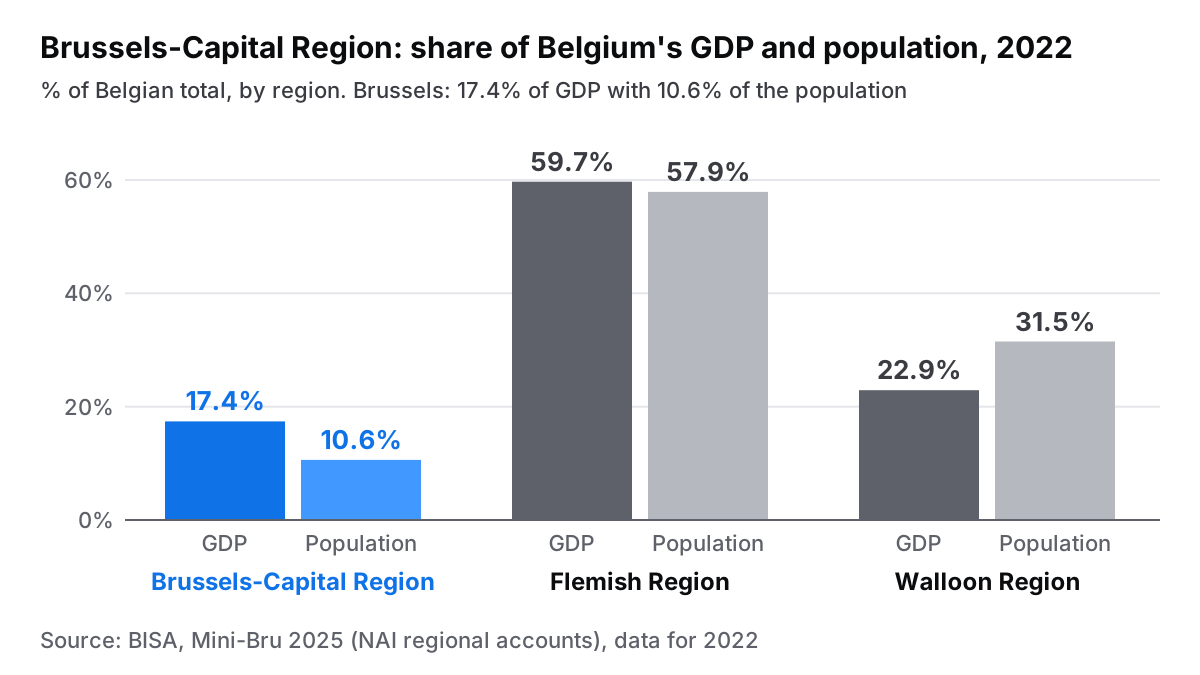
Buying property in the Brussels-Capital Region involves a standard registration duty of 12.5% (Fednot, July 2025), offset for owner-occupiers by a €200,000 duty-free allowance on primary homes up to €600,000. Across its 19 communes, Brussels generated 17.4% of Belgium’s GDP in 2022 with 10.6% of its population (BISA, 2025), creating an institutionally backed, resilient residential market.
Brussels in brief: a capital of 19 communes and three languages
Brussels operates as a mosaic of 19 distinct communes, each retaining its own administrative structure, architectural character and local pace. While French and Dutch are the official languages of the Brussels-Capital Region, English functions as the lingua franca across its international institutions, diplomatic missions and corporate headquarters.
This administrative duality creates a unique urban structure. Rather than a monolithic metropolis, Brussels functions as a collection of interconnected towns surrounding a historic core, offering stability grounded in permanent institutional demand.
What is it like to live in Brussels?
On a Wednesday evening around Place du Châtelain in Ixelles, tables spill onto the pavement as discussions float between French, English, Dutch and Polish. A short tram ride away towards Schuman, civil servants and diplomats return from the European Commission and Council quarters.
Living in Brussels feels less like inhabiting a metropolis and more like settling into a network of neighbouring villages:
- Ixelles and Saint-Gilles: Vibrant, Art Nouveau-lined neighbourhoods popular with young professionals, international staff and dining enthusiasts.
- Uccle and Watermael-Boitsfort: Leafy, quiet residential communes bordering woodland, favoured by families seeking proximity to international schools.
- Etterbeek and Woluwe-Saint-Pierre: Practical, diplomatic enclaves offering direct access to the European Quarter and NATO. According to KBC Brussels, Woluwe-Saint-Pierre remains the most expensive commune in the region for residential rentals in 2025.
- The Pentagon: The historic centre enclosed by the inner ring road, combining cobbled heritage with modern residential conversions.
Getting around and getting away: transport from Brussels
Car-free living is entirely practical within the ring road. The STIB-MIVB public transit network operates interconnected metro, tram and bus lines across all 19 communes.
Intercity rail services operated by SNCB connect Brussels-Central, Nord and Midi stations to Flemish and Walloon hubs including Antwerp, Ghent and Leuven within an hour. For international connections, Eurostar services run directly from Brussels-Midi to London, Paris and Amsterdam. Brussels Airport at Zaventem is linked directly by regular train services and the STIB bus line 12 connecting to the European Quarter.
Lifestyle, climate and what residents actually do
Brussels experiences a temperate oceanic climate with mild winters, warm summers and frequent rain, making indoor culture and outdoor green spaces equally central to local life. Neighbourhood markets define weekly routines, from the daily flea market at Place du Jeu de Balle in the Marolles to the Sunday food stalls at Marché du Midi.
The city’s architectural identity is defined by Art Nouveau heritage, including townhouses designed by Victor Horta (UNESCO World Heritage List, 2000). Extensive green space surrounds the city centre; the Sonian Forest on the southern margin contains ancient beech stands recognised as part of a multi-country UNESCO natural heritage site (UNESCO World Heritage List, 2017).
What should a visitor see first in Brussels?
First-time visitors typically begin in the central Pentagon district before exploring the surrounding southern communes:
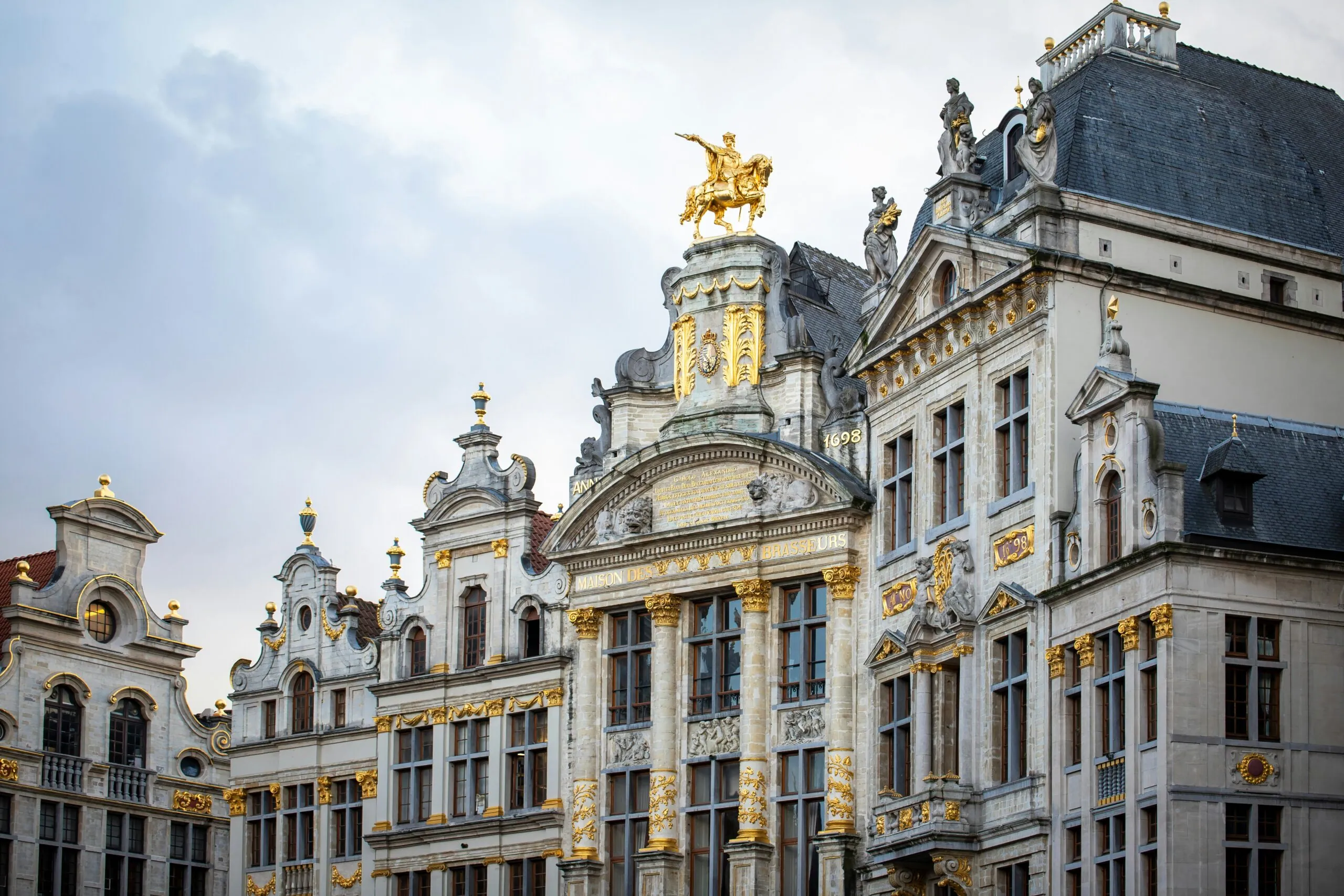
- Grand-Place: The historic central square lined with 17th-century guildhouses (UNESCO World Heritage List, 1998).
- Mont des Arts and Magritte Museum: The elevated cultural hub housing major national museum collections.
- Atomium and Mini-Europe: Built for the 1958 World Expo, located in the northern commune of Laken.
- Galeries Royales Saint-Hubert: 19th-century glazed shopping arcades near the central station.
- Flagey and Châtelain: The heart of Ixelles’ café culture and lakes area.
Day trips from Brussels: Ghent, Bruges, Waterloo and the Ardennes
Belgium’s compact rail network makes regional travel simple. The medieval historic centres of Ghent and Bruges sit within an hour’s rail journey. To the south, the Waterloo battlefield offers historical walking trails, while the Hallerbos forest attracts visitors during the spring bluebell bloom. Further southeast, the Ardennes hills provide hiking, kayaking and timbered villages for weekend escapes.
How strong is the Brussels economy for property investors?
According to BISA Mini-Bru 2025 regional accounts for 2022, the Brussels-Capital Region generated 17.4% of Belgium’s national GDP with 10.6% of the population, delivering a regional GDP per head of €78,344. This reflects a dense concentration of high-value services, public administration and professional firms.
Rental demand is underpinned by stable public institutions—including the European Commission, European Parliament, Council of the EU and NATO headquarters in Evere—alongside supporting law firms, consultancies and non-profit headquarters. Primary employment hubs include the Leopold Quarter (the European district), the central business district near Rogier, and emerging commercial quarters along the Canal zone and Tour & Taxis.
What does it cost to buy property in Brussels?
Residential property transactions in the Brussels-Capital Region attract a base registration duty (droits d’enregistrement) of 12.5% of the purchase price (Fednot, July 2025).
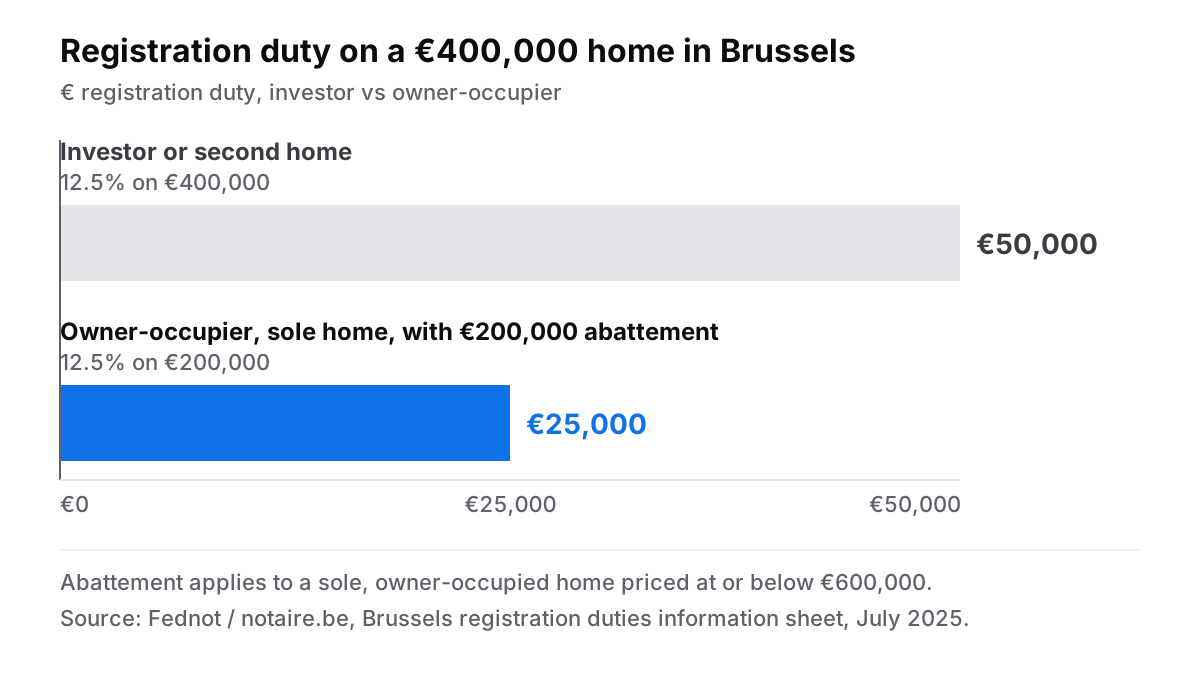
However, qualifying owner-occupiers purchasing their sole home priced at or below €600,000 benefit from a tax-free allowance (abattement). Following regional reforms (Renolution.brussels), registration duty is waived on the first €200,000 of the purchase price, yielding a maximum tax saving of €25,000, provided the buyer registers their primary address at the property within the statutory timeframe.
- Investor purchase (€400,000 flat): 12.5% duty on €400,000 = €50,000
- Owner-occupier purchase (€400,000 flat): 12.5% duty on (€400,000 - €200,000) = €25,000
Market data from Statbel reported by PIM for Q3 2025 recorded median prices of €525,000 for terraced and semi-detached houses across the Brussels region. In full-year 2025 data, KBC Brussels reported an average Brussels apartment price of €298,874 (up 2.8% year-on-year), compared to a Belgian national average apartment price of €277,927.
Can you let a Brussels flat short-term?
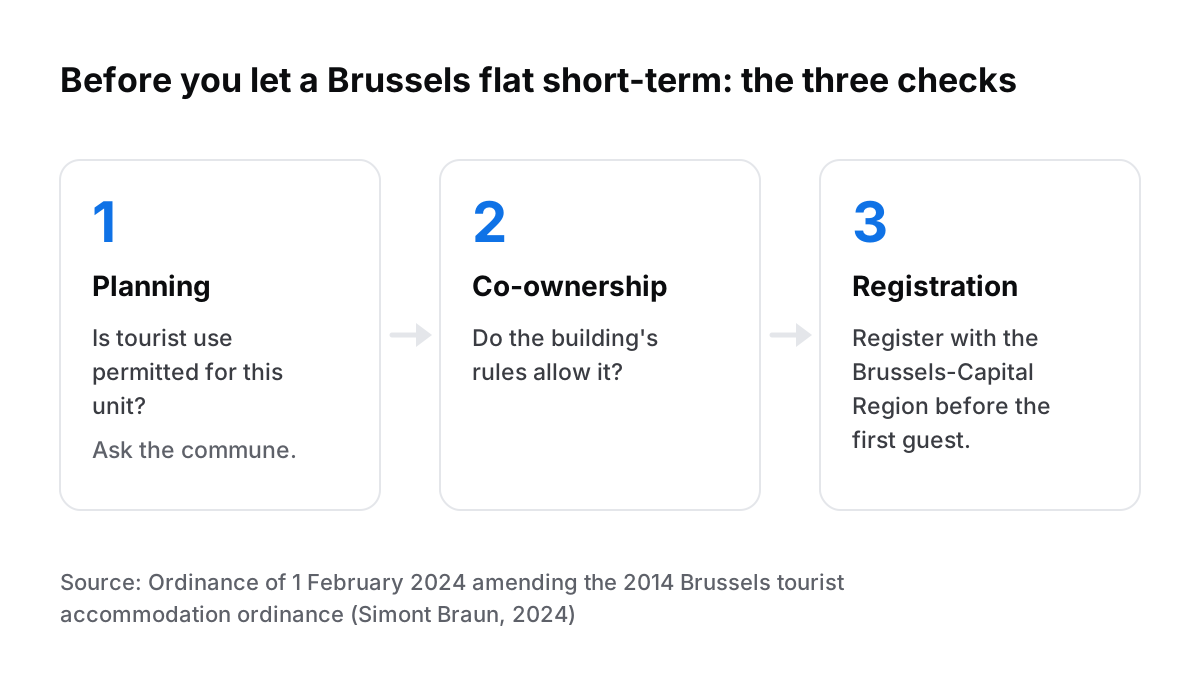
Short-term tourist lets are tightly regulated. Under the regional ordinance of 1 February 2024 amending the 2014 tourist accommodation regime, all operators must register properties with the Brussels-Capital Region prior to advertising (Simont Braun, September 2024).
Before purchasing a property intended for short-term holiday rentals, investors should perform three mandatory checks:
- Confirm with the commune whether urban planning regulations allow tourist accommodation at the specific building address.
- Verify that the building’s co-ownership regulations (acte de base) permit short-let commercial activities.
- Complete registration with the regional administration prior to listing.
How to make a data-driven investment in Brussels
Because asking prices in Brussels can diverge significantly from finalized notary deeds, buyers and professional investors rely on transactional datasets rather than public portal asking rates. To understand market dynamics, analysts review why transaction data beats asking prices.
Using Area Insights for Brussels commune-level market data, buyers can analyze actual stock turnover, yield distribution and localized price evolution across all 19 communes. Estate agents and institutional investors use valuations built on comparables and sold prices to establish realistic property values.
Developers and technical teams can consult the Area Insights developer documentation (in English) to integrate valuation models, or learn how to find the most profitable locations with data.
Why Brussels still makes sense for international buyers
Brussels offers international buyers steady institutional demand, an accessible European location and distinct commune identities. Navigating registration duties, local tax allowances and planning rules requires clear, verified data at the individual neighbourhood level.
To analyze current commune trends, supply levels and comparable valuations across Brussels, sign in to the CASAFARI platform or learn how to run a market analysis in CASAFARI.
Frequently asked questions
What are the registration duties when buying a flat in Brussels?
The standard registration duty for residential property in the Brussels-Capital Region is 12.5% of the purchase price. Qualifying owner-occupiers buying a sole home priced at €600,000 or less receive a duty-free allowance on the first €200,000, saving up to €25,000. Investors and second-home buyers pay the full 12.5% rate.
Can I rent out my Brussels apartment on Airbnb?
You can only let a residential flat short-term after registering the property with the Brussels-Capital Region under the local tourist accommodation ordinance. The regulations require urban planning compliance from the local commune and authorization under the building’s co-ownership rules. Investors should verify these conditions before purchasing.
Which Brussels communes are best for expats and families?
Communes such as Woluwe-Saint-Pierre, Woluwe-Saint-Lambert and Etterbeek are popular due to their proximity to EU institutions and international schools. Uccle and Watermael-Boitsfort offer larger family homes near the Sonian Forest, while Ixelles and Saint-Gilles attract buyers seeking central urban amenities. Renters find lower average prices in communes such as Jette and Anderlecht.
Can a foreigner buy property in Belgium?
Yes, Belgium places no restrictions on foreign citizens purchasing real estate. Property transactions follow standard Belgian notarisation procedures regardless of the buyer’s nationality. Ownership of real estate does not automatically grant residency rights, so non-EU purchasers must satisfy standard immigration requirements separately.