
Expanding Your Real Estate Portfolio: Strategies to Diversify

Real estate investors diversify a property portfolio by spreading capital across five key dimensions—property types, geographic markets, risk allocation strategies, asset sizes and niche sectors—to mitigate risk and stabilise returns. Using tools like CASAFARI’s Property Sourcing, Area Insights and CASAFARI Connect, investors and real estate professionals can identify, evaluate and acquire diverse assets across multiple markets efficiently.
How to diversify your real estate portfolio
Diversifying a real estate portfolio involves spreading investments across different types of properties, markets, and investment strategies to reduce risk and enhance returns. Here are a few strategies investors can employ to achieve diversification:
1. Invest in different property types
Invest in a mix of property types such as residential, commercial, industrial, and retail. Each property type reacts differently to market cycles and economic conditions, providing balance to the portfolio. For instance, while residential properties may offer steady rental income, commercial properties may provide higher potential for capital appreciation.
2. Go for geographic diversification
Investing in properties in different cities, regions, or countries helps mitigate risks associated with local economic downturns, regulatory changes, or market fluctuations. It also allows investors to capitalise on growth opportunities in emerging markets.
3. Choose investments according to a risk allocation strategy
Allocate capital strategically based on risk tolerance and investment objectives. For example, allocate a portion of the portfolio to low-risk, income-generating properties for stability, while allocating another portion to higher-risk, growth-oriented investments for potential capital appreciation. Balancing risk across different investments helps achieve a diversified portfolio.
4. Vary the property size
Invest in properties of varying sizes within the real estate market to provide access to different tenant demographics and market dynamics. For instance, diversify between large-scale commercial properties and smaller stores, bigger multifamily units or tiny lofts suitable for single tenants and students.
5. Invest in sector diversification
The same logic applies to investing in varied sectors: going for niche sectors, like healthcare or hospitality for example, minimises the exposure to sector-specific risks.
By implementing these strategies, real estate investors can build a diversified portfolio that reduces risk, enhances returns, and withstands various market conditions and economic cycles. Also, a regular monitoring and rebalancing of the portfolio are essential to maintain diversification and optimise performance over time.
How does CASAFARI help investors diversify a property portfolio?
Now that we understood how important it is to work with different markets and property types to increase revenues as well as prevent future problems when building a property portfolio, it’s time to see how technology can help you do that.
CASAFARI has many different possibilities for you to deep-dive into a market and find the best assets it has to offer.
Property Sourcing: the search for different types of properties
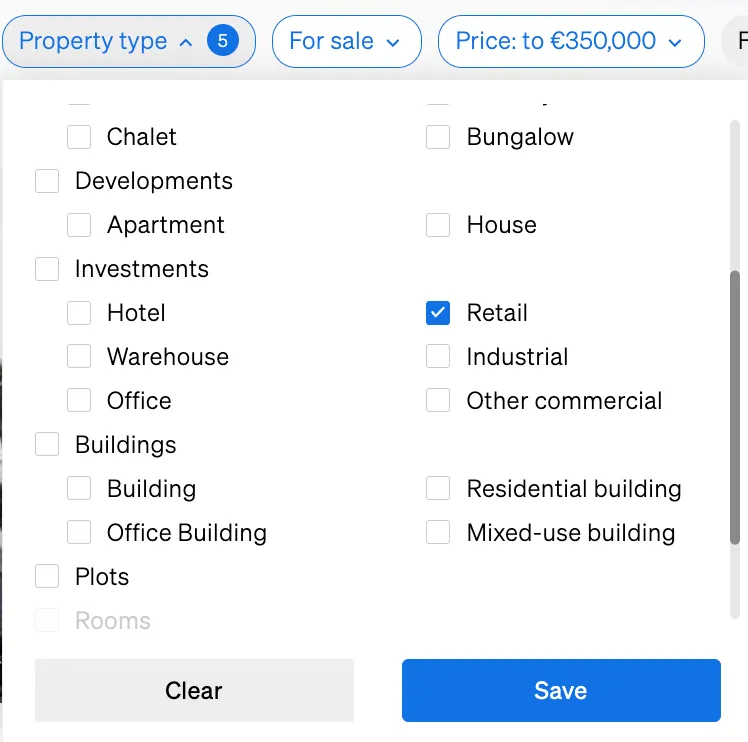
CASAFARI’s Property Sourcing offers a comprehensive view of all properties available on the market, catering to a wide range of investor preferences and needs. Through the Property Type filter, investors and their representing agents gain access to an extensive array of property types, ensuring they can find options suitable for various investment strategies and objectives.
Here are some examples:
- Different kinds of apartments (such as duplexes, studios and penthouses);
- Diverse housing options (like chalets, townhouses, villas, and bungalows);
- Hotels;
- Warehouses;
- Offices;
- Retail spaces;
- Industrial properties;
- Buildings for varied purposes;
- Plots;
- Garages.
With such a comprehensive range of property types available at different markets, Property Sourcing enables investors and agents to efficiently identify and evaluate opportunities across the entire real estate market spectrum, supported by technical documentation in the Property Sourcing API documentation.
Market Analytics: finding the market opportunities
CASAFARI Market Analytics and Area Insights empowers real estate professionals to identify emerging markets that have been appreciating over time or show potential for future appreciation.
The platform’s time series analysis provides insights into the rises and decreases of average asking prices and asking price per square metre over various time frames. This information allows agents to track market trends and identify areas where property values have been steadily increasing, signalling potential opportunities for investment.
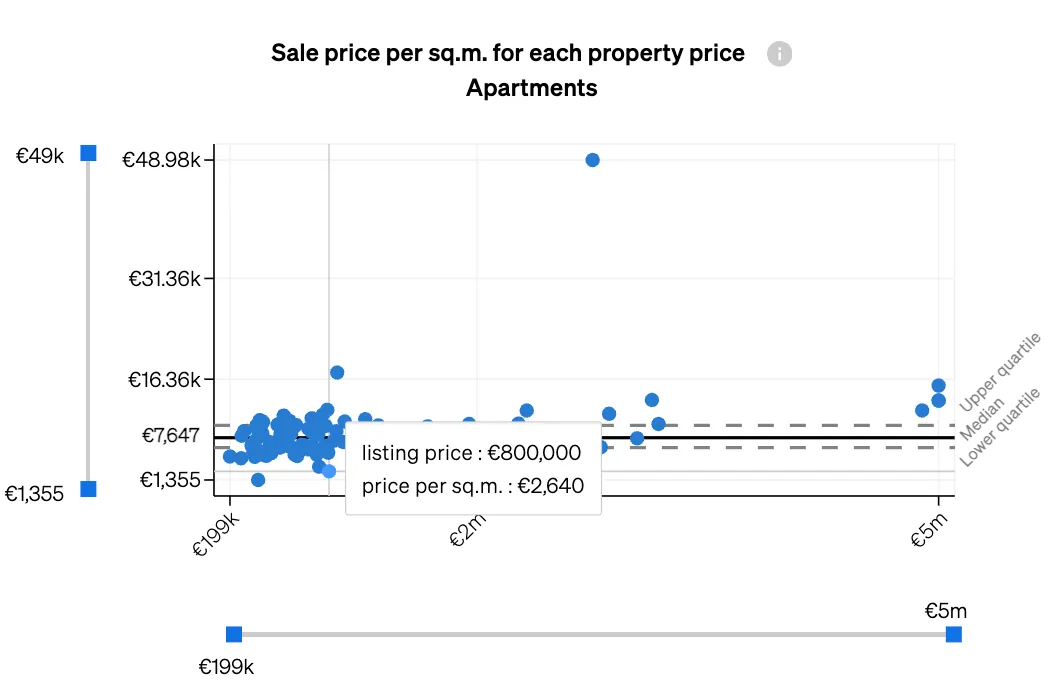
Furthermore, this product simplifies the process of identifying underpriced properties that may be attractive to investors on the asking price per square metre chart, through the platform’s Price Distribution feature.
CASAFARI Market Analytics: follow the property market trends
CASAFARI Connect: partner with other professionals to expand your investment horizon
With CASAFARI Connect, real estate professionals can partner in deals with peers from other markets. Meaning that, if the investors are represented by estate agents, they can explore portfolios of agents elsewhere and negotiate exclusive deals to expand the investor’s portfolio.
Basically, by partnering with other professionals, you can benefit from their expertise in areas of the country or the continent that you’re not used to investing in, finding market opportunities faster and easier than when exploring by yourself.
How CASAFARI Connect boosts property deals and who is it for
Diversifying assets with market insights helps protect and grow a real estate portfolio across changing economic cycles.
Frequently asked questions
What are the five main ways to diversify a real estate portfolio?
Investors can diversify a real estate portfolio by spreading capital across five core dimensions. These include property types (residential, commercial, industrial, retail), geographic locations, risk allocation tiers, property sizes, and niche sectors such as healthcare or hospitality.
Which property types can investors filter for in CASAFARI Property Sourcing?
CASAFARI Property Sourcing allows filtering across a wide spectrum of asset classes. These include apartments (such as duplexes, studios and penthouses), houses (chalets, townhouses, villas, bungalows), hotels, warehouses, offices, retail spaces, industrial properties, buildings, plots and garages.
How does CASAFARI help identify emerging or underpriced property markets?
CASAFARI Area Insights uses time series analysis to track average asking prices and asking prices per square metre over time to highlight appreciating locations. In addition, the Price Distribution chart identifies underpriced properties on a per square metre basis.
How does CASAFARI Connect support geographic diversification for investors?
CASAFARI Connect enables estate agents representing investors to collaborate on transactions with local professionals in other cities or countries. This partnership gives investors direct access to regional property portfolios and local market expertise.
Why is it important to combine residential and commercial assets in a portfolio?
Different property types respond differently to economic cycles. Residential units often provide steady rental income across varied tenant demographics, whereas commercial properties offer higher potential for capital appreciation.