
CALA MILLOR PROPERTY GUIDE
Getaway to the island’s best beaches and leisure
Cala Millor is the largest resort on Mallorca’s east coast, spanning the municipalities of Son Servera and Sant Llorenç des Cardassar along a 1.8-kilometre shallow Blue Flag beach. The local property market consists primarily of seafront and second-line apartments, alongside villas extending inland towards Son Servera and Costa de los Pinos. Consult the live price ticker on this page for up-to-date average prices per square metre.
Cala Millor property: what you are buying into
Walking along the palm-lined promenade from Cala Bona down towards Sa Coma on an October morning, the character of Cala Millor becomes clear. Unlike purpose-built seasonal enclaves across the Mediterranean, the town maintains a year-round rhythm. Local bakeries, cafes, and newsagents remain open, children head to local schools, and residents gather outside the municipal auditorium.
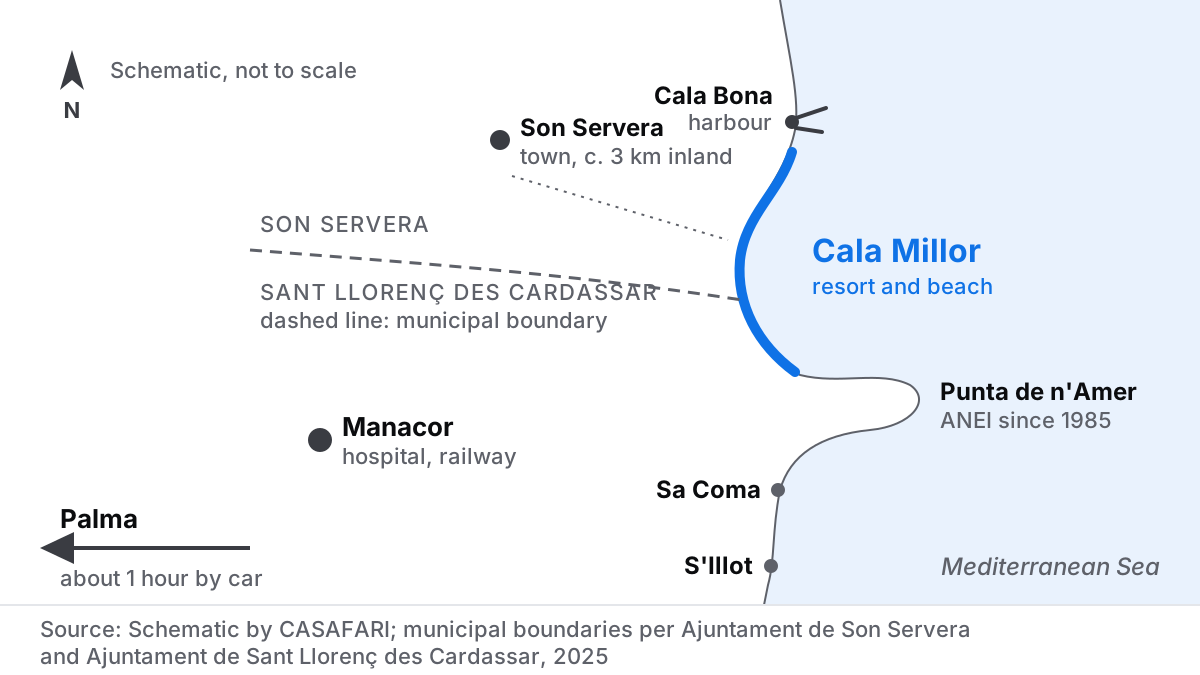
The town straddles two distinct administrative areas: the northern portion falls under the Ajuntament de Son Servera, while the southern half belongs to the Ajuntament de Sant Llorenç des Cardassar. This dual jurisdiction shapes everything from municipal planning and property tax processing to local refuse collection and street maintenance. For buyers, understanding which municipality a building sits in is an essential first step.
Where is Cala Millor and how do you get there?
Situated on Mallorca’s eastern coastline, Cala Millor lies between the harbour village of Cala Bona to the north and the resort of Sa Coma to the south, with the protected headland of Punta de n’Amer closing the bay. The historic inland town of Son Servera sits approximately 3 km inland.
For regional services and medical facilities, the major inland hub of Manacor is located nearby, housing the district hospital (Hospital de Manacor) and the regional railway terminus. Drivers reaching Cala Millor from Palma and Palma de Mallorca Airport can take the Ma-15 route via Manacor, covering the journey in roughly one hour.
Public transport is managed through the TIB regional transport network. Interurban bus routes connect Cala Millor directly to Manacor, Artà, and central Palma. Travellers taking the SFM railway from Palma reach Manacor before transferring to connecting buses. For precise route maps and schedules, consult the TIB bus timetables for Cala Millor.
The beach and the promenade: why families and winter residents stay
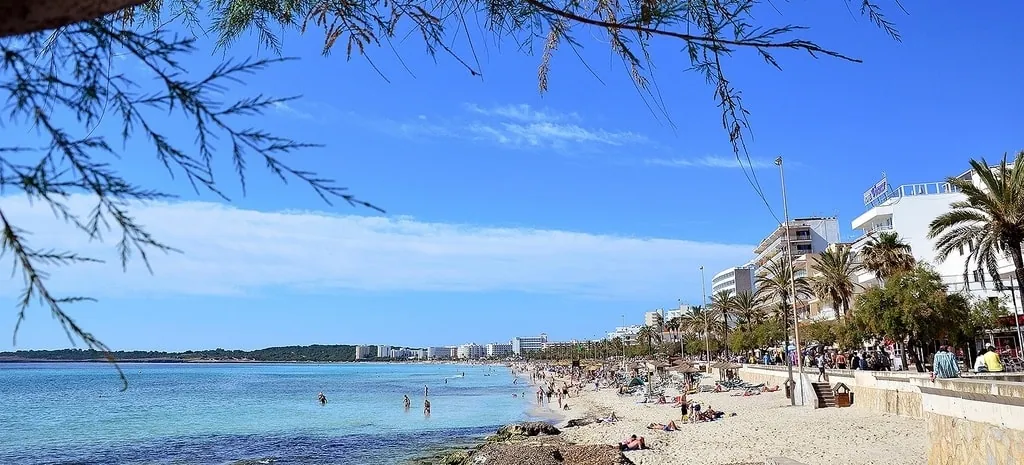
The focal point of the area is its broad, gently shelving beach of fine sand and shallow water, which consistently earns Blue Flag certification for water quality and amenities. While bustling during July and August, the bay transitions into a quiet, scenic haven from October through May.
Running parallel to the beach is a wide, palm-fringed, car-free promenade. Stretching from the fishing harbour at Cala Bona southwards towards Sa Coma, it provides a safe, peaceful thoroughfare for pedestrians, cyclists, and families. Along this seafront, independent boutiques, cafes, and seafood restaurants offer year-round dining with open sea views.
Beyond the beach: Punta de n’Amer, Na Penyal, golf and sport
At the southern extremity of the beach lies Punta de n’Amer, declared an Àrea Natural d’Especial Interès (ANEI) under Balearic legislation—the first protected natural area established in the Balearic Islands. Spanning coastal dunes, pine forests, and garrigue, the headland features coastal trails leading to the Castell de n’Amer, a 17th-century square defence tower erected in the 1690s.
Inland, the Na Penyal hill rises roughly 2 km behind the coast, delivering panoramic views across the entire bay. For active residents, the surrounding area offers watersports facilities, tennis courts, and three golf courses within a short drive: Club de Golf Son Servera, Pula Golf, and Golf Capdepera.
Cultural life centres around the Auditòrium Sa Màniga in the Sant Llorenç section of town, which programs theatre, music, dance, and film exhibitions throughout the year. Regional weekly markets take place in nearby towns: Son Servera on Fridays, Artà on Tuesdays, and Manacor on Mondays.
What does Cala Millor property look like, street by street?
The residential landscape is diverse. Frontline and second-line streets feature multi-storey apartment buildings constructed largely between the 1960s and 1980s, many of which have undergone extensive modern refurbishments. Moving back from the seafront towards Sa Coma and the Son Servera road, newer low-rise residential complexes feature communal pools and landscaped gardens. Further inland towards Costa de los Pinos, buyers find detached villas and generous building plots.
The buyer demographic includes established British and German homeowners alongside permanent Mallorcan residents. When evaluating specific properties, agents and buyers must look closely at micro-location details: distance to the beach, solar orientation, lift access in older blocks, community charges, and the precise rules recorded in the building’s community statutes.
To evaluate micro-market trends without relying on generalised district averages, CASAFARI Area Insights shows Cala Millor street by street, tracking pricing variations between frontline and inland roads, listing volumes, and average days on market.
Taxes, costs and residency when you buy in Cala Millor
Purchasing resale property in the Balearic Islands incurs Transfer Tax (Impuesto sobre Transmisiones Patrimoniales or ITP), calculated on a progressive scale ranging from 8% to 13% depending on property value. Check the Balearic tax agency’s ITP and AJD rates via ATIB for official details.
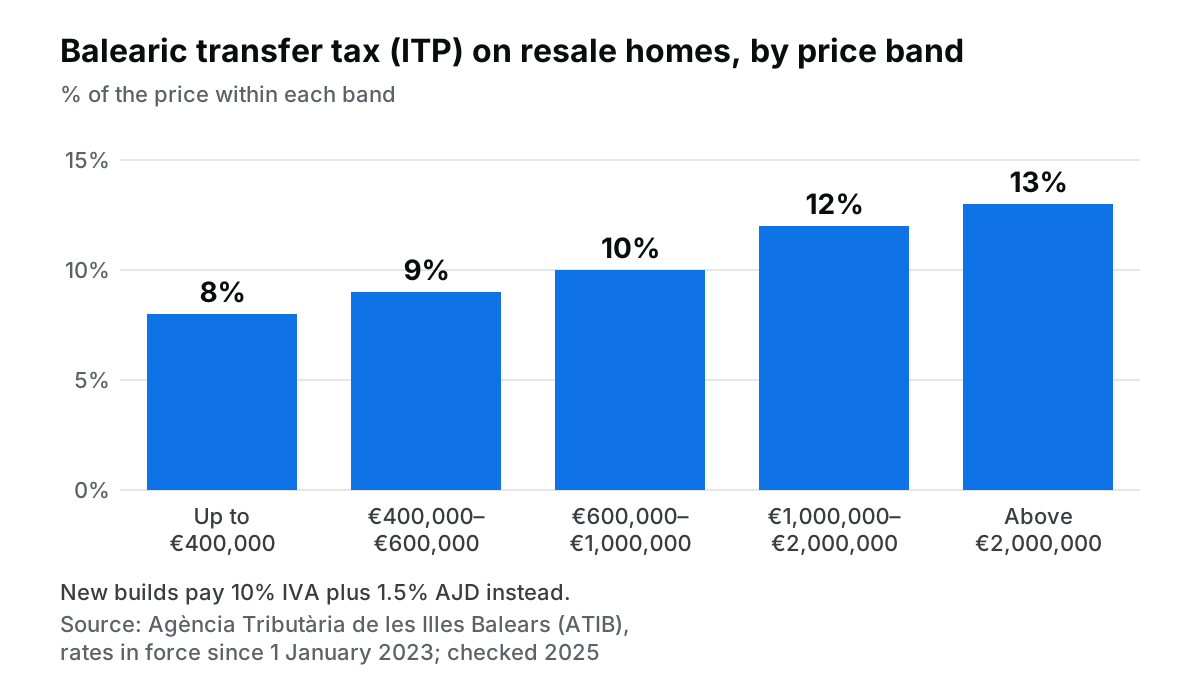
New-build homes carry 10% IVA (VAT) plus 1.5% Stamp Duty (AJD). Buyers should budget an additional 1% to 2% for notary, land registry, and legal fees. All non-resident buyers must obtain an NIE (Número de Identificación de Extranjero) prior to completion and account for annual Non-Resident Income Tax (IRNR). Read our guide to buying property in Spain and learn what happens at the contract and deed stage.
Note that Spain’s investor residence scheme (“Golden Visa”) was officially repealed on 3 April 2025 under Ley Orgánica 1/2025, published in the Ley Orgánica 1/2025 in the Boletín Oficial del Estado. Non-EU buyers, including UK citizens, are subject to standard 90/180-day Schengen limits unless applying for non-lucrative or other residency visas.
Can you let a Cala Millor flat to holidaymakers?
Short-term holiday letting in Mallorca requires a valid ETV tourist licence. Under Balearic Law 6/2017, advertising or letting residential property to tourists without a licence is illegal and carries substantial financial penalties.
Furthermore, the 2018 zoning regulations established by the Consell de Mallorca’s holiday-rental zoning restricted new ETV licences in multi-family apartment buildings across most of the island. In addition, the Balearic Government instituted an island-wide suspension on issuing new tourist bed capacity in 2024. Prospective buyers seeking rental returns should evaluate long-term residential leases under the LAU framework or seasonal winter lets. For detailed analysis on long-term leasing, consult our guide on owning a rental property in Mallorca. If you plan to market an existing home, explore how to sell a property in Mallorca.
How CASAFARI helps you research Cala Millor
CASAFARI aggregates property listings from over 30,000 sources to provide clean, real-time market intelligence across Mallorca. Real estate professionals use Area Insights for street-by-street analysis, Property Sourcing to monitor complete market supply, and a valuation built on Comparables to price properties accurately.
To access these real-time tools, sign in to the CASAFARI platform. Developers and technical teams can also review Area Insights documentation for developers (in English).
Frequently asked questions
Can I rent out my Cala Millor apartment to tourists?
Short-term holiday rentals in Cala Millor require a registered Balearic tourist licence (ETV), as mandated by Law 6/2017. Following the Consell de Mallorca’s 2018 zoning rules and the 2024 moratorium on new tourist capacity, new licences for apartments in multi-family buildings are generally unavailable. Buyers must verify whether a property possesses an existing transferable licence or consider long-term residential lets instead.
What taxes and costs do I pay when buying a resale property in Cala Millor?
Resale purchases are subject to Balearic Transfer Tax (ITP), levied on a progressive scale from 8% up to 13% based on purchase price bands set by the Balearic tax agency ATIB. New-build properties incur 10% IVA (VAT) plus 1.5% Stamp Duty (AJD). Additional buyer costs including notary, registry, and legal fees typically total between 1% and 2% of the purchase price.
How far is Cala Millor from Palma airport, and can I get there without a car?
Cala Millor is situated approximately one hour’s drive from Palma de Mallorca Airport via the Ma-15 highway. Public transit options include TIB interurban buses connecting Cala Millor with Manacor, Artà, and Palma. Alternatively, passengers can take the SFM railway from Palma to Manacor and transfer to local bus services for the remaining distance.
Is Cala Millor open all year or does it close in winter?
Unlike seasonal resorts, Cala Millor maintains an active permanent community supported by the municipalities of Son Servera and Sant Llorenç des Cardassar. Key services including health centres, schools, supermarkets, the Sa Màniga Auditorium, and selected restaurants operate throughout the year. Regional weekly markets in Son Servera, Artà, and Manacor also run year-round.