
CALA RATJADA PROPERTY GUIDE
Glamorous seaside resort with coastal properties, recreational facilities, and entertainment venues
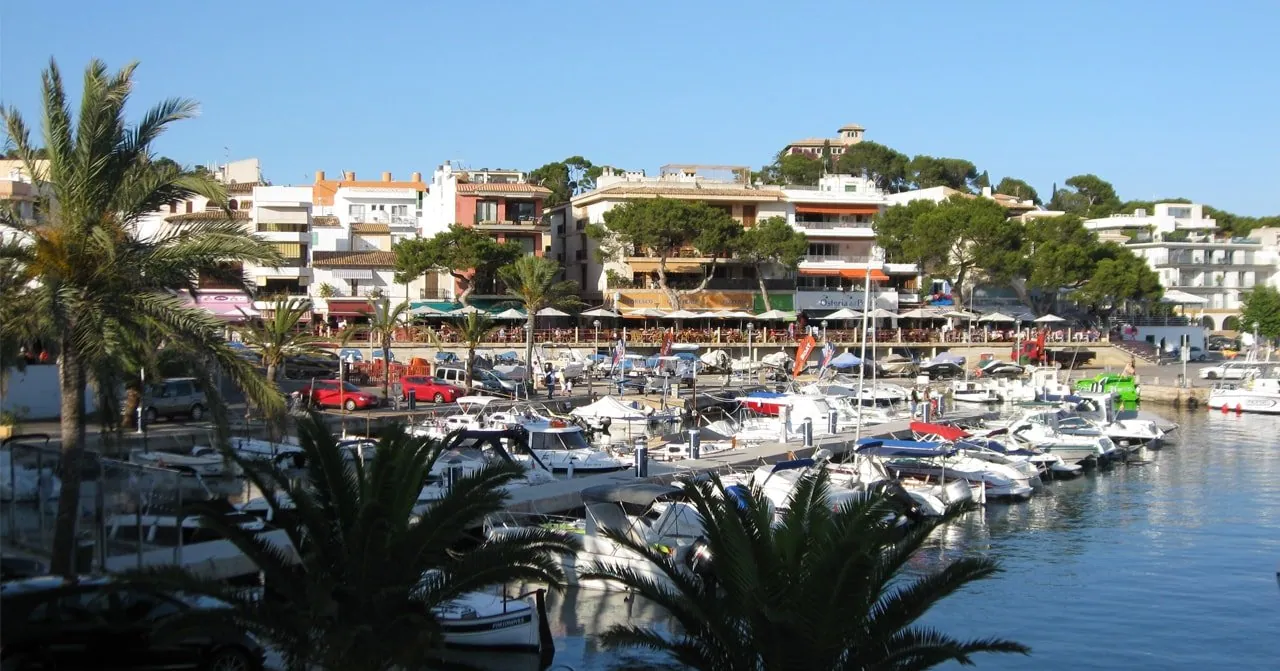
Cala Ratjada is the principal harbour town and coastal hub of the municipality of Capdepera, positioned at the easternmost point of Mallorca. Located approximately 76 km from Palma and Son Sant Joan airport, it offers a distinct contrast between a working fishing port and a relaxed Mediterranean resort. The local real estate landscape spans waterfront apartments along the promenade to detached villas situated on pine-clad hillsides overlooking four distinct surrounding beaches.
Cala Ratjada at a glance
Situated in the north-eastern corner of the Balearic island of Mallorca, Cala Ratjada (officially spelled Cala Rajada in Catalan) functions as the maritime heart of the municipality of Capdepera. According to the official toponymy published by the Ajuntament de Capdepera, the town derives its name from rajada, the Catalan word for the ray fish historically caught off its coast.
While inland Capdepera retains its historic hilltop castle and quiet stone lanes, Cala Ratjada presents an active maritime setting. Positioned roughly 76 km from Palma, the town balances its identity as a traditional fishing centre with its status as a well-established coastal destination for international property buyers.
Why do buyers choose Cala Ratjada over the rest of Capdepera’s coast?
Unlike many seasonal coastal developments in Mallorca, Cala Ratjada boasts a substantial year-round infrastructure. The harbour remains a active port where local fishermen land their daily catch beside private yachts. A paved waterfront promenade lined with cafes and restaurants forms the social axis of the town.
Buyers are drawn to the diversity of property choices within a compact area:
- Harbour and Son Moll front: Apartments offering sea views and immediate access to dining and maritime amenities.
- Old town core: Traditional Balearic townhouses set along narrow, quiet streets.
- Pine-covered slopes: Detached villas with private plots extending towards the Far de Capdepera lighthouse, Sa Pedruscada, and the residential enclave of Cala Lliteres.
The resident and second-home population displays a strong international mix, with longstanding demand from German, Scandinavian, and British buyers seeking a slower pace of life in north-east Mallorca.
Which beaches are within reach, and which stay quiet?
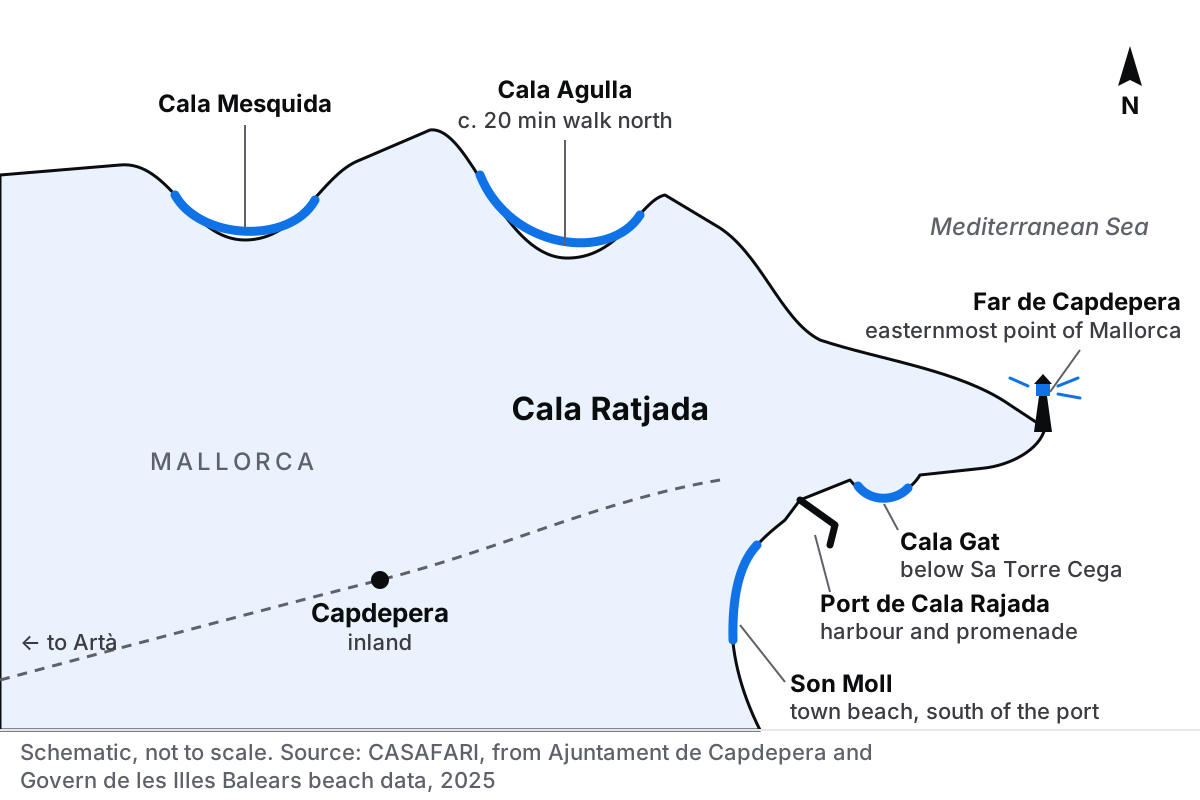
Cala Ratjada is notable for having four varied beaches accessible on foot or by a short cycle ride:
- Son Moll: The central town beach, featuring fine sand and urban conveniences, popular during midsummer.
- Cala Gat: A smaller, sheltered cove positioned east of the harbour beneath the wooded headland of Sa Torre Cega.
- Cala Agulla: Also recorded historically under the Castilian name Cala Guya, this expansive sandy bay lies within a protected natural area (ANEI) surrounded by pine forests, located a 20-minute walk north of town.
- Cala Mesquida: Situated further north-west along the coastline, offering open sea views and dune landscapes.

Coastal paths connect these beaches, providing walking routes along the shoreline to the easternmost tip of the island.
What is there to do beyond the beach: golf, lighthouse, gardens, markets
Beyond maritime activities, north-east Mallorca offers established recreational facilities within a short drive:
- Golf: Capdepera Golf features an 18-hole course set against the Llevant mountains, while Canyamel Golf, Pula Golf, and Son Servera Golf are all located within 20 km.
- Far de Capdepera: The lighthouse at Punta de Capdepera marks the easternmost point of Mallorca. On clear days, the neighbouring island of Menorca is visible across the channel.
- Sa Torre Cega: The historic estate of the March family overlooks Cala Gat, known for its architecturally significant gardens and sculpture collection.
- Markets: A weekly market takes place every Saturday morning on the Plaça dels Pins in Cala Ratjada. Additional regional markets run on Wednesdays in Capdepera and Tuesdays in neighbouring Artà.
- Local Fiestas: The town celebrates the Mare de Déu del Carme on 16 July each year, featuring a traditional maritime procession in the harbour to honour the patron saint of seafarers.
What is Cala Ratjada like from November to Easter?
Life in Cala Ratjada exhibits noticeable seasonality. Between November and Easter, many seasonal hotels, seasonal bars, and tourist shops close, returning the town to a calm, residential rhythm.
For residents and long-term visitors, essential services remain fully operational throughout the year. Supermarkets, pharmacies, local banks, state primary schools, and the municipal primary healthcare centre (PAC) in Capdepera run without interruption. Investors seeking long-term stability often weigh this winter shift when evaluating year-round demand versus seasonal holiday lets. You can read more about what owning a rental property in Mallorca involves across different seasons.
How do you get to Cala Ratjada, and how do you get around?
By car, Cala Ratjada is connected to Palma and Son Sant Joan airport via the Ma-15 main road through Manacor and Artà, a drive of approximately 1 hour and 15 minutes.
Public transport options provided by the regional transport authority include TIB bus timetables for Cala Rajada, connecting the harbour town with Capdepera, Artà, and Manacor. From Manacor station, travellers can transfer to the SFM railway network directly into central Palma.
For families considering full-time residence, local primary education is provided at CEIP S’Auba in Cala Ratjada and CEIP S’Alzinar in Capdepera, with secondary education at IES Capdepera. The nearest international curriculum option is the Rafa Nadal International School in Manacor, approximately 40 km away. Public healthcare is anchored by the local PAC centre, with hospital treatment provided at Hospital de Manacor (38 km) and Hospital Universitari Son Espases in Palma.
What should a buyer know about taxes, residency and holiday-let rules?
Acquiring real estate in Mallorca requires understanding Balearic taxation and regional property legislation. For a detailed breakdown of Spanish conveyancing procedures, consult our step-by-step guide to buying property in Spain.
Purchase taxes
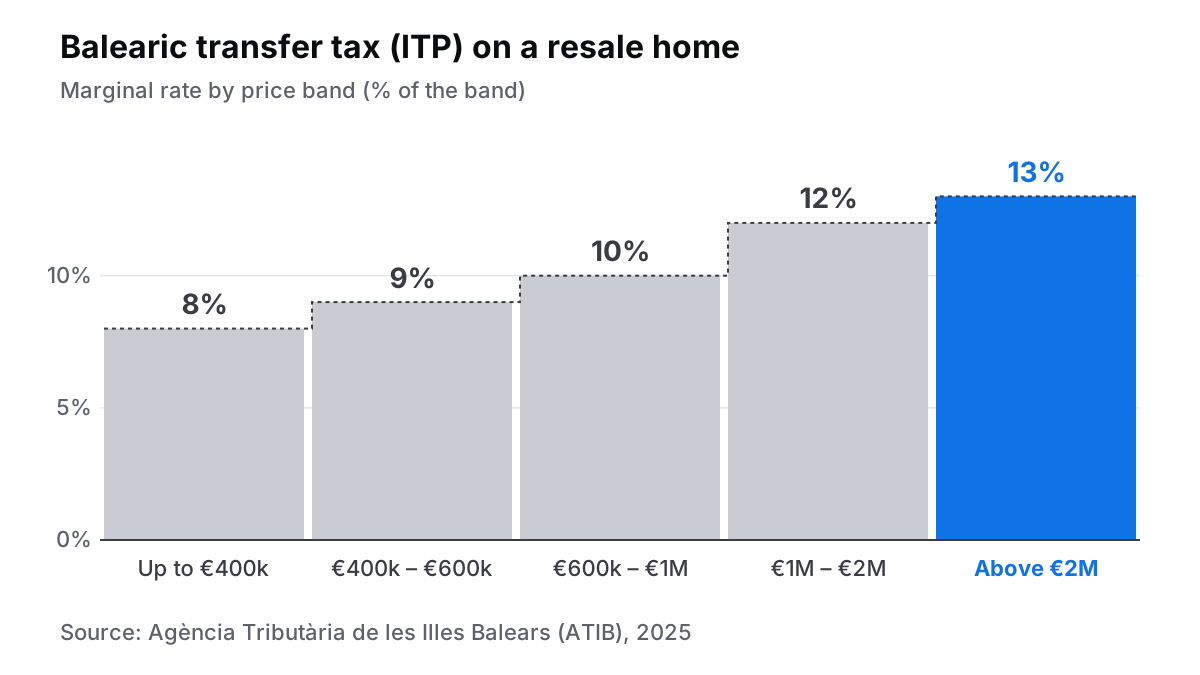
When buying a resale home in the Balearic Islands, Property Transfer Tax (ITP, Impuesto sobre Transmisiones Patrimoniales) is levied on a progressive scale based on the property value:
- Up to €400,000: 8%
- €400,000 to €600,000: 9%
- €600,000 to €1,000,000: 10%
- €1,000,000 to €2,000,000: 12%
- Above €2,000,000: 13%
Tax rates can be verified directly via the Balearic tax agency’s ITP and AJD rates. New-build properties are subject to 10% VAT (IVA) plus Balearic Stamp Duty (AJD). Notary fees, land registry charges, and legal representation typically add a further 2% to 3% to purchase costs.
Residency rules
Spain’s investor residence permit (commonly called the Golden Visa) was officially abolished for new property purchases under Ley Orgánica 1/2025, published in the Official State Gazette in April 2025. Non-EU citizens, including UK nationals, are subject to the standard Schengen allowance of 90 days within any 180-day period. Stays exceeding this threshold require an appropriate visa, such as a Non-Lucrative Visa or Digital Nomad Visa.
Tourist rental licensing
Holiday rentals on Mallorca are subject to strict regulations overseen by the island government. Anyone considering short-term lettings must review tourist-let licensing at the Consell de Mallorca. Key legal requirements include:
- ETV Licence Mandatory: Properties must possess a valid tourist licence (ETV) to operate short-term holiday rentals. A moratorium on issuing new tourist places remains active across Mallorca.
- Community Veto Power: Under Ley Orgánica 1/2025, effective April 2025, a community of owners (comunidad de propietarios) can vote to prohibit new short-term tourist rentals in their building by a three-fifths majority.
- National Registry: Advertisements on holiday rental platforms require an official registration number under national regulations introduced in 2025.
Property owners planning to list long-term rentals under standard residential leases should consult Spain’s 2023 Housing Act explained for legal obligations.
How CASAFARI tracks the Cala Ratjada market
Evaluating supply trends, price adjustments, and market velocity in Capdepera requires clean, aggregated real estate data. CASAFARI indexes properties across portals and agency websites, deduplicating listings to present an accurate picture of stock in Cala Ratjada.
Real estate professionals and analysts can leverage Area Insights for Capdepera and Cala Ratjada to monitor listing duration and stock movements, or review technical integration details via the Area Insights developer documentation. If you are considering listing an existing home, order a valuation and market study for a Cala Ratjada home or review our advice on how to sell a property in Mallorca.
To explore comprehensive market data for north-east Mallorca, sign in to the CASAFARI platform.
Frequently asked questions
Can I rent out a flat in Cala Ratjada to holidaymakers?
Short-term holiday lets in Mallorca require a valid tourist licence (ETV) registered with the Consell de Mallorca. Because new tourist places are subject to an island-wide moratorium, unlicensed apartments cannot currently acquire new licences. Furthermore, under rules in effect since April 2025, a community of owners can vote by a three-fifths majority to block holiday rentals in their building. Prospective buyers must confirm an existing ETV licence and check community statutes prior to paying a deposit.
How do I get to Cala Ratjada from Palma airport without a car?
Interurban TIB bus lines link Cala Ratjada to Palma and to Manacor station, where passengers can connect to the SFM train line to central Palma. Public bus lines also operate direct seasonal connections from Son Sant Joan airport during peak summer months. Journey times by public transport average around two hours, compared to approximately 1 hour and 15 minutes by car via the Ma-15 highway.
Is Cala Ratjada busy all year round, or does it close in winter?
Cala Ratjada is active and bustling between Easter and late October, while winter months from November to March are very quiet as seasonal hotels and tourist establishments close. However, the town maintains a permanent resident population served by year-round supermarkets, state schools, pharmacies, and a municipal healthcare centre. This clear seasonality shapes both local lifestyle and holiday rental yields.
What taxes do I pay when buying a property in Cala Ratjada?
Resale property purchases in Cala Ratjada incur Balearic Transfer Tax (ITP) on a progressive scale ranging from 8% on values up to €400,000 to 13% for portions above €2 million. New-build homes attract 10% VAT (IVA) plus Balearic Stamp Duty (AJD). Buyers should budget an additional 2% to 3% for notary, legal, and land registry fees, and obtain a Spanish tax identification number (NIE) before completing the transaction.