
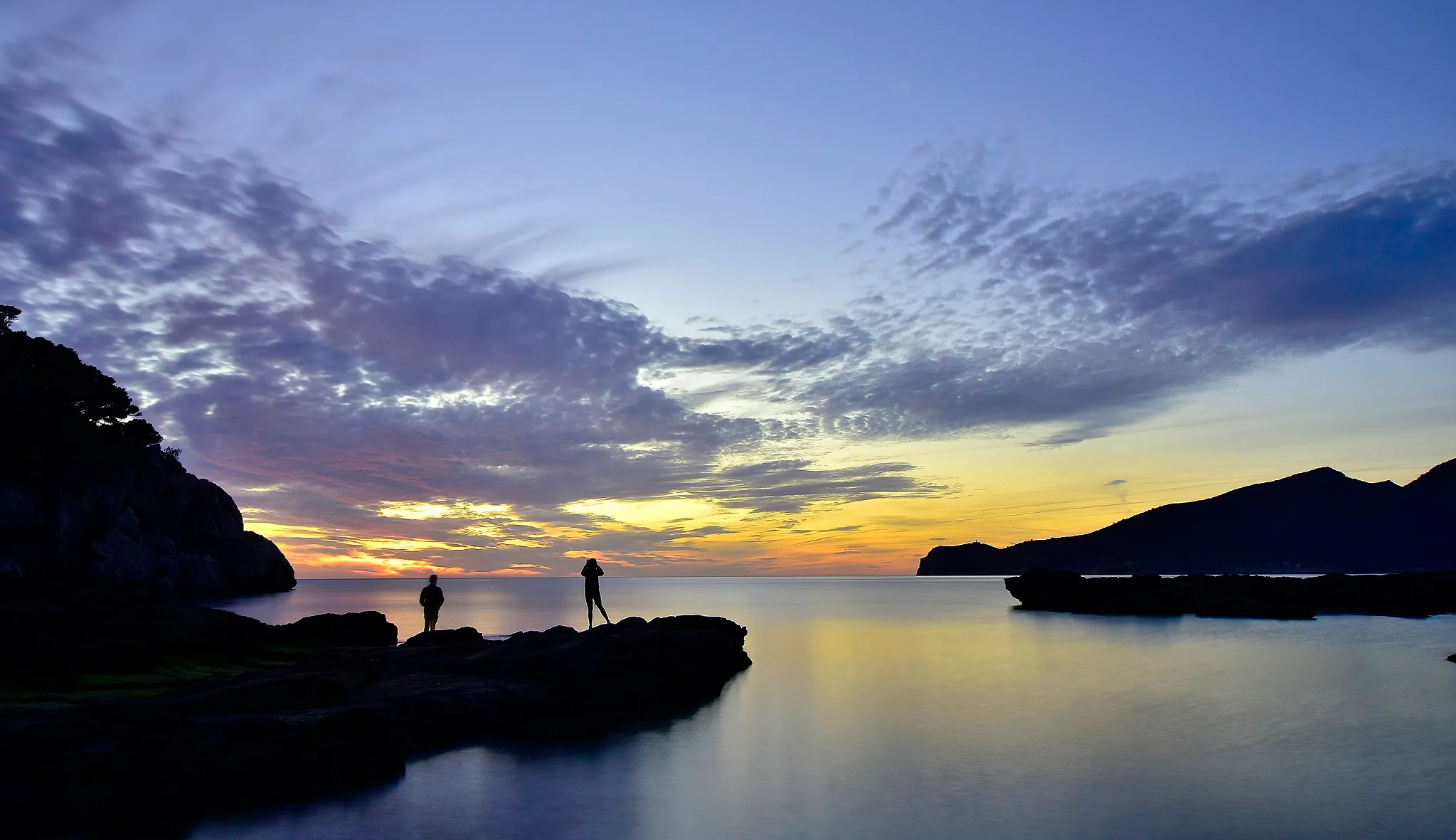
Sant Elm is a quiet coastal village of 405 permanent residents situated at the westernmost tip of Andratx, Mallorca. New residential construction is strictly capped by the 2024 Normas Subsidiarias of Andratx and Serra de Tramuntana landscape protections. Consequently, capital values in Sant Elm are anchored by scarce supply, where acquisition opportunities centre primarily on high-end renovations of existing coastal villas and apartments.
Why invest in property in Sant Elm, Mallorca?
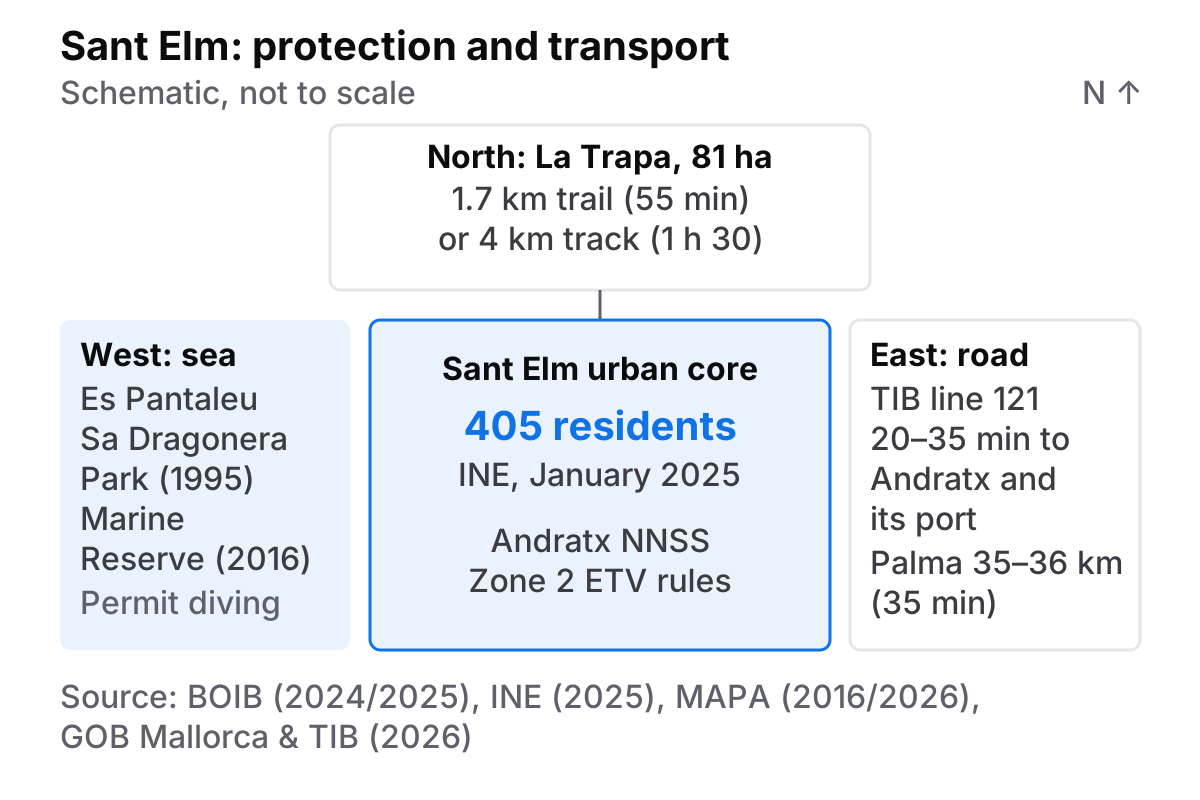
Sant Elm (San Telmo in Spanish) sits directly opposite the uninhabited island of Sa Dragonera, surrounded by protected pine forests and dramatic limestone cliffs. According to the Instituto Nacional de Estadística (INE), Sant Elm accounts for just 405 registered inhabitants within the wider municipality of Andratx, which recorded 12,195 residents as of January 2025.
Unlike urbanised resort zones across south-west Mallorca, Sant Elm maintains strict urban development caps. Municipal planning is governed by the Revisión de las Normas Subsidiarias (NNSS) of Andratx, definitively approved in July 2024 and amended by Modification No. 1 in June 2025. These regulations—published in the 2024 Normas Subsidiarias of Andratx in the BOIB—strictly regulate basement depths, facade projections, and permitted land uses. Coupled with the regional Plan Territorial Insular (PTI) and UNESCO-protected Serra de Tramuntana buffer rules, blank-canvas building plots are virtually non-existent.
For real estate professionals and private buyers, this structural supply bottleneck ensures strong long-term value retention. Development strategies focus heavily on acquiring existing seafront apartments or hillside Mediterranean villas for modernisation. To evaluate valuation trends, price distributions, and micro-market comparables across Andratx, real estate professionals rely on CASAFARI Area Insights and automated tools for property valuation and market study.
What is the history and village lifestyle of Sant Elm?
Sant Elm’s coastal heritage is deeply entwined with Balearic history. On 7 September 1229, the fleet of King Jaume I of Aragon anchored off Sant Elm (then known as La Palomera) beside the islet of Es Pantaleu to seek shelter from a gale, before setting sail on 9 September to complete his historic landing at Santa Ponça. Over subsequent centuries, the settlement operated primarily as a modest fishing village and fish-salting outpost.
Today, Sant Elm has evolved into a calm, pedestrian-friendly seaside haven. While summer brings day-trippers and luxury yachts anchoring off Es Pantaleu, the permanent community remains small and welcoming. A waterfront avenue lined with pine trees features family-run restaurants specialising in fresh Mediterranean catch and local Mallorcan rice dishes.
Community life peaks during local cultural celebrations. In early August, Sant Elm honours its patron saint, Santa Catalina Thomàs, featuring the Fira de sa Palomera and the dramatic Moors and Christians re-enactment on the beach during the first weekend of the month. Investors noting regional calendar events should distinguish these local festivities from the maritime procession of sailors, which takes place in July for the Festes del Carme in nearby Port d’Andratx.
Beaches, Sa Dragonera and outdoor life in the Serra de Tramuntana
The main beach, Playa de Sant Elm (Es Geparut), holds Blue Flag status and is divided into two sections: Sa Gran, offering fine white sand, and Sa Petita, characterized by smooth gravel and shingle. The beach provides complete municipal amenities, including lifeguard coverage, public showers, parasol and lounger rentals, and amphibious chair access for bathers with reduced mobility. Further along the coastline lies Cala s’Algar, a quiet 50-metre rocky cove equipped with a traditional boat slipway.
Directly offshore sits Sa Dragonera Natural Park, protected since 1995. The waters surrounding the island were declared a Marine Reserve in October 2016 and subsequently expanded to cover exterior waters. Detailed in the official Sa Dragonera Marine Reserve regulations, diving in key marine habitats such as Punta de Llebeig, Punta de Tramuntana, and underwater caves requires an official permit, with all diving strictly prohibited in integral reserve zones. Guided local dive excursions and PADI certification courses are operated by Scuba Activa in Sant Elm harbour.
For hikers and nature enthusiasts, Sant Elm serves as a gateway to the Serra de Tramuntana mountain range. Starting from Avinguda de La Trapa, trails lead into the 81-hectare La Trapa Nature Reserve, acquired in 1980 by environmental group GOB Mallorca. Walkers can reach the ruins of the 1810 Trappist monastery via a 4 km forest track (a 1-hour 30-minute walk) or a steeper 1.7 km mountain trail taking roughly 55 minutes, as detailed by La Trapa Nature Reserve (GOB Mallorca).
How well connected is Sant Elm to Andratx, Palma and the airport?
Despite its tranquil, end-of-the-road location, Sant Elm benefits from direct road links to the rest of the island:
- Palma City Centre: 35 to 36 kilometres away via the Ma-1 dual carriageway (approximately 35 minutes by car).
- Palma de Mallorca Airport (PMI): 41 to 45 kilometres away (around 35 to 40 minutes by car).
- Andratx Town & Port d’Andratx: 10 to 12 kilometres away (a 12 to 15-minute drive).
Public transit is managed by Transports de les Illes Balears (TIB). Bus line 121 links Sant Elm to S’Arracó, Port d’Andratx, and Andratx town in 20 to 35 minutes. According to the TIB line 121 timetable, passengers connecting at Andratx can board line 101 directly into central Palma or line A1 to Palma de Mallorca Airport, with total transit times averaging 1 hour 30 minutes.
What taxes and holiday rental rules apply when buying in Sant Elm?
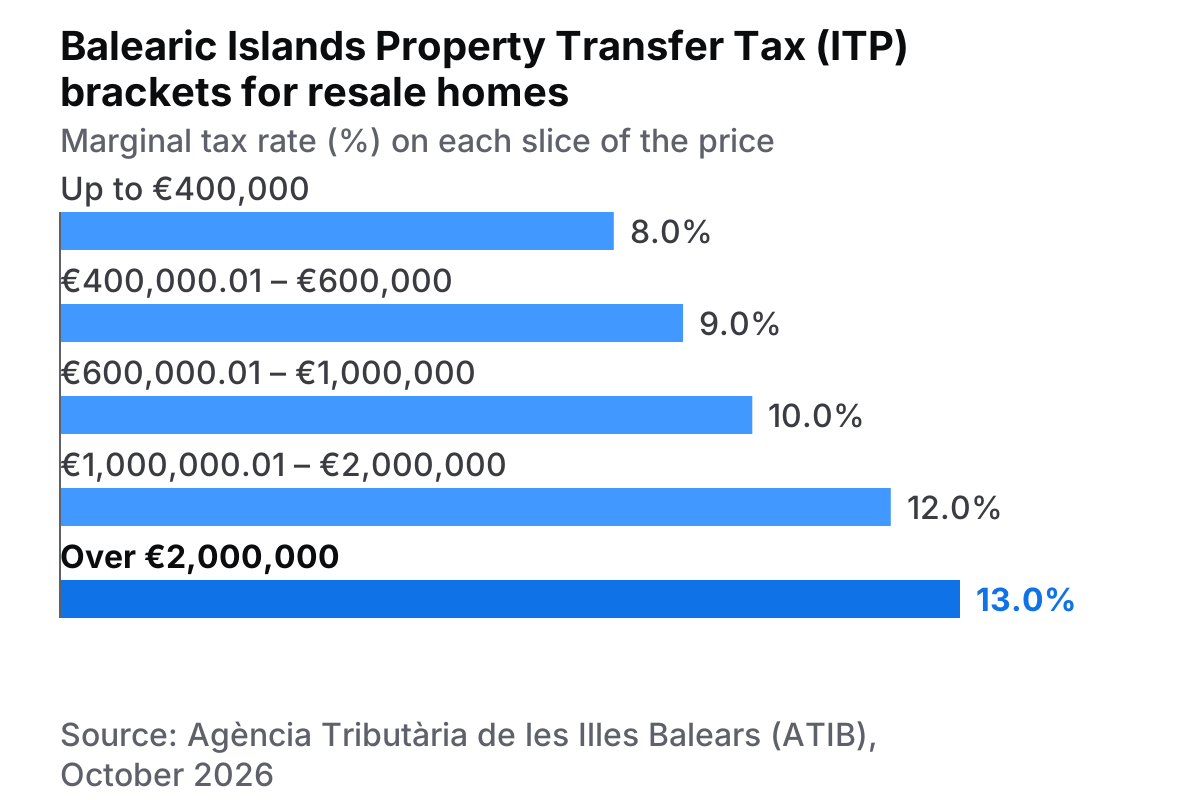
When buying resale residential real estate in Sant Elm, buyers are subject to the progressive Balearic Property Transfer Tax (Impuesto sobre Transmisiones Patrimoniales, ITP). Rates administered by the Agència Tributària de les Illes Balears (ATIB) apply in cumulative brackets based on the property value:
- Up to €400,000: 8%
- €400,000.01 to €600,000: 9%
- €600,000.01 to €1,000,000: 10%
- €1,000,000.01 to €2,000,000: 12%
- Over €2,000,000.01: 13%
Reduced rates (4%, 2%, or 100% relief) apply to qualifying young primary-residence purchasers under 30 or 36 years of age. Understanding your full acquisition overheads requires examining the complete legal process of contract and deed (escritura) when buying property in Spain.
Investors aiming for short-term holiday rental income must navigate strict Balearic regulations. Under the regional ETV moratorium (enforced since 2022 and strengthened by Decree-Law 4/2025, which bans new tourist places in multi-family apartment buildings), Andratx and Sant Elm are classified as Zone 2. Issuance of new ETV licences requires a case-by-case municipal certificate, depends on limited CBAT quota releases (such as the 1,069 places made available in March 2026), and is completely prohibited on protected rustic land. Consequently, investors targeting short-term rental yields must seek out detached villas that already possess an active, transferable ETV licence. Learn more about operational considerations in our guide on owning a rental property in Mallorca and Ibiza.
To discover live property listings, historical price trends, and off-market opportunities across Sant Elm and Andratx, agents and investors can leverage Property Sourcing. To get started with real-time market data, sign in to CASAFARI.
Frequently asked questions
Can you build or renovate a property in Sant Elm, Mallorca?
Building new properties in Sant Elm is strictly restricted by Mallorca’s Plan Territorial Insular (PTI), the Serra de Tramuntana buffer zone, and Andratx’s 2024 Normas Subsidiarias (updated in June 2025). As a result, investors and private buyers primarily focus on acquiring existing coastal apartments or hillside villas for high-end renovation. Any structural alterations must strictly comply with municipal rules governing basement depths, facade projections, and land use.
What are the property transfer tax (ITP) rates when buying in Sant Elm?
Resale residential acquisitions in Sant Elm attract Balearic Property Transfer Tax (ITP) on a progressive scale administered by ATIB. The tax rate starts at 8% for the first €400,000, rising to 9% on amounts between €400,000.01 and €600,000, 10% up to €1,000,000, 12% up to €2,000,000, and 13% on any portion exceeding €2,000,000. Qualifying young buyers acquiring a primary residence may benefit from reduced rates or exemptions.
Can you get a holiday rental licence (ETV) in Sant Elm, Andratx?
Securing a new ETV tourist licence in Sant Elm is heavily restricted under the Balearic Islands moratorium and Decree-Law 4/2025, which bans new licences for multi-family apartment buildings and protected rustic land. Sant Elm is classified as Zone 2 within Andratx, requiring a case-by-case municipal certificate and access to limited CBAT quota pools, such as the 1,069 places released in March 2026. Investors seeking rental yields typically purchase existing standalone villas with transferable ETV licences.
How far is Sant Elm from Palma and Palma de Mallorca Airport?
By road, Sant Elm is approximately 35 to 36 kilometres from central Palma (a 35-minute drive) and 41 to 45 kilometres from Palma de Mallorca Airport. Public transport is provided by TIB bus line 121, which connects Sant Elm to S’Arracó, Port d’Andratx, and Andratx town in 20 to 35 minutes. From Andratx, travellers can transfer to line 101 to central Palma or line A1 directly to the airport.