
PORT ANDRATX PROPERTY GUIDE
Luxury and beloved area of prime property buyers
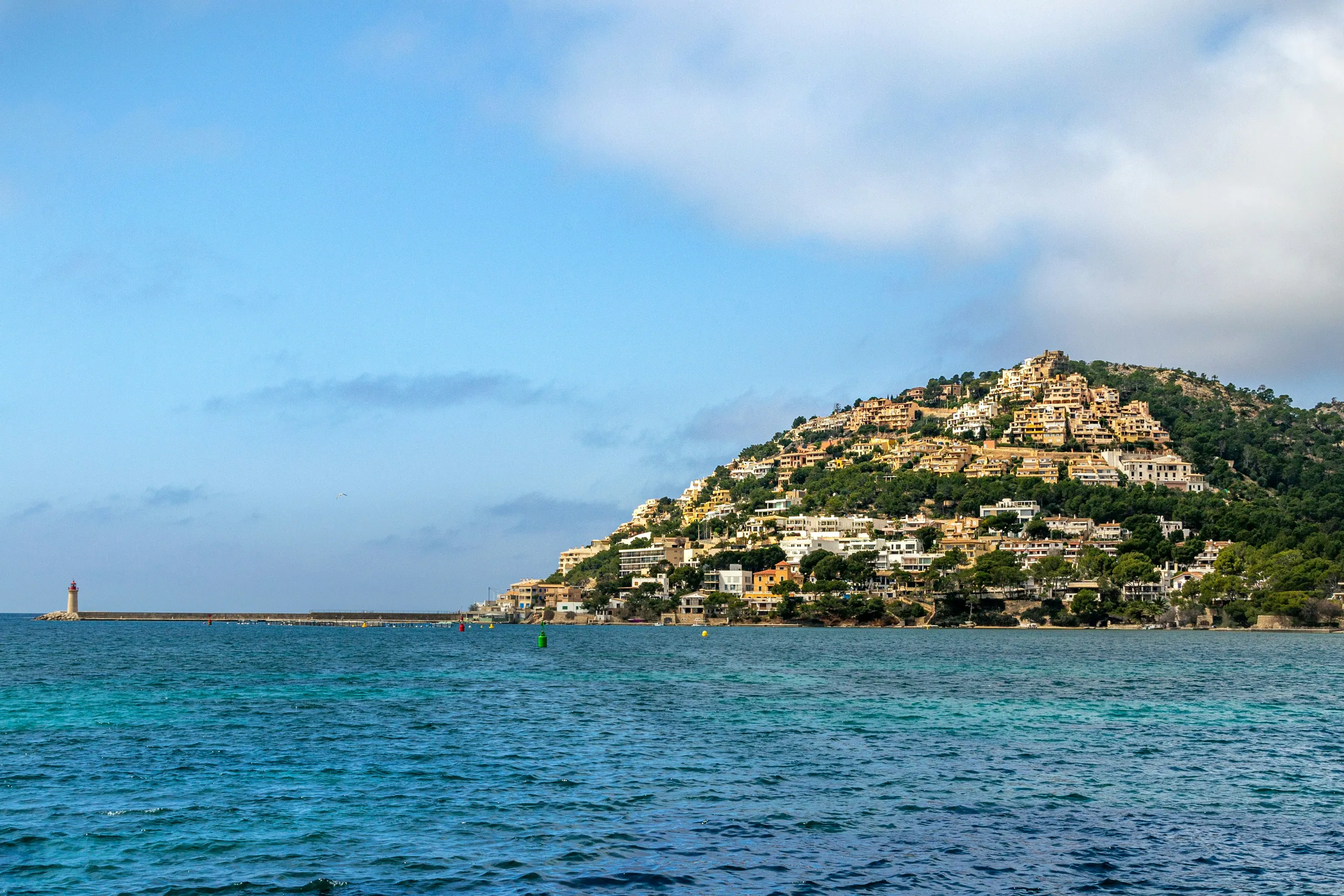
Port d’Andratx is a natural harbour at the western tip of Mallorca’s Serra de Tramuntana, home to 2,588 year-round residents within the 12,195-strong municipality of Andratx. Renowned as one of the Mediterranean’s most exclusive second-home enclaves, the municipality recorded average asking prices of €8,641 per square metre in September 2026 according to Idealista, driven by high international demand for prime cliffside villas and penthouse apartments.
Where is Port d’Andratx and which residential areas define its property market?
Port d’Andratx (known as Puerto de Andratx in Spanish) centers around a horseshoe bay that combines an active fishing harbour with private yachting facilities. According to the INE municipal population register for Andratx (January 2025), the port maintains a permanent community of 2,588 residents, offering year-round activity rather than operating purely as a summer resort.
The high-end residential market is shaped by distinct headland micro-locations that surround the bay:
- La Mola: A south-facing peninsula commanding elevated views over the open Mediterranean and Dragonera Island. It is widely regarded as one of the island’s most prestigious addresses for modern architectural villas.
- Mon Port: Set in the sheltered foothills behind the yacht club, offering private south-west-facing plots with mature gardens and views over the harbour entrance.
- Cala Llamp: A rocky cove on the southern flank of the headland, known for dramatic cliffside villas built directly above the turquoise water.
- Cala Moragues and Cala Marmacén: Quieter residential inlets situated along the northern shore, providing walking access to the harbourside promenade.
Beside detached villas, Port d’Andratx offers luxury apartments and penthouses. Gated hillside developments above Puig de s’Espart—such as Gran Folies, Las Milanas, Montamar, and Las Cascadas—feature landscaped gardens, private security, and communal pools. Directly along the waterfront promenade, traditional stone townhouses and converted flat complexes feature rooftop terraces overlooking the quayside.
Why do international buyers choose Port d’Andratx?
Port d’Andratx balances secluded coastal living with efficient access to the capital. Driving figures published by Visit Andratx road distances and travel times confirm that the port sits 26.2 kilometres (approximately 27 minutes by car via the Ma-1 motorway) from central Palma, and between 37.3 and 39.9 kilometres (32 to 35 minutes) from Palma de Mallorca Airport (PMI).
Unlike lower-density resort areas, Port d’Andratx benefits from its position within the wider municipality of Andratx. Inland, Andratx town hosts a traditional weekly market; s’Arracó offers a quiet valley village atmosphere; and Sant Elm, located 15 minutes to the west, provides sandy beach access facing the protected Sa Dragonera Natural Park.
The immediate coastline of Port d’Andratx consists primarily of rocky inlets—Cala Llamp, Cala Marmacén, Cala Moragues, and Cala Egos—rather than wide sand beaches. This natural topography historically prevented large-scale hotel developments, helping the area retain its character since international buyers from the UK, Germany, France, Switzerland, and Scandinavia first established second homes here in the 1960s.
Maritime infrastructure remains a central draw for property owners. According to official Club de Vela Puerto de Andratx specifications, the harbour’s Blue Flag-certified yacht club accommodates 475 moorings for vessels up to 35 metres in length with a maximum draught of 4 metres. The marina operates alongside a working fishing fleet. Fresh catch is sold directly to residents and local restaurateurs at La Lonja fish market on the quay, open Monday to Friday from 18:00 to 20:00, based on La Lonja Port d’Andratx opening hours.
What is daily life and the seasonal calendar like around the harbour?
Life in Port d’Andratx is structured around outdoor recreation and dining along the harbour front. The surrounding Tramuntana foothills provide established routes for cycling, hiking, and trail running, while the rocky coves offer clear waters for sailing, paddleboarding, and diving.
Key local venues maintain steady operational schedules throughout the year. As highlighted in the Visit Andratx guide to Beach Club Gran Folies, Beach Club Gran Folies in Cala Llamp operates seasonally from May to October between 10:30 and 22:00, offering sun loungers, saltwater pool facilities, and oceanfront dining set into the rocks. Along the harbour promenade, long-standing establishments like Tim’s Bar remain open year-round, serving as casual meeting points for local residents and visitors.
The harbour’s cultural calendar centres on the annual Festes de la Mare de Déu del Carme, honoring the patron saint of seafarers. According to the official Ajuntament d’Andratx programme for the Festes de la Mare de Déu del Carme 2026, celebrations take place between 7 and 19 July. Key highlights include the Correfoc i Nit de Dimonis fire-run along the quayside on 10 July and the traditional maritime procession of decorated fishing boats and yachts across the bay on 16 July.
What taxes, holiday-let rules and residency laws apply when buying in Port d’Andratx?
Acquiring real estate in Port d’Andratx requires careful planning around regional taxation, holiday letting restrictions, and Spanish immigration policy.
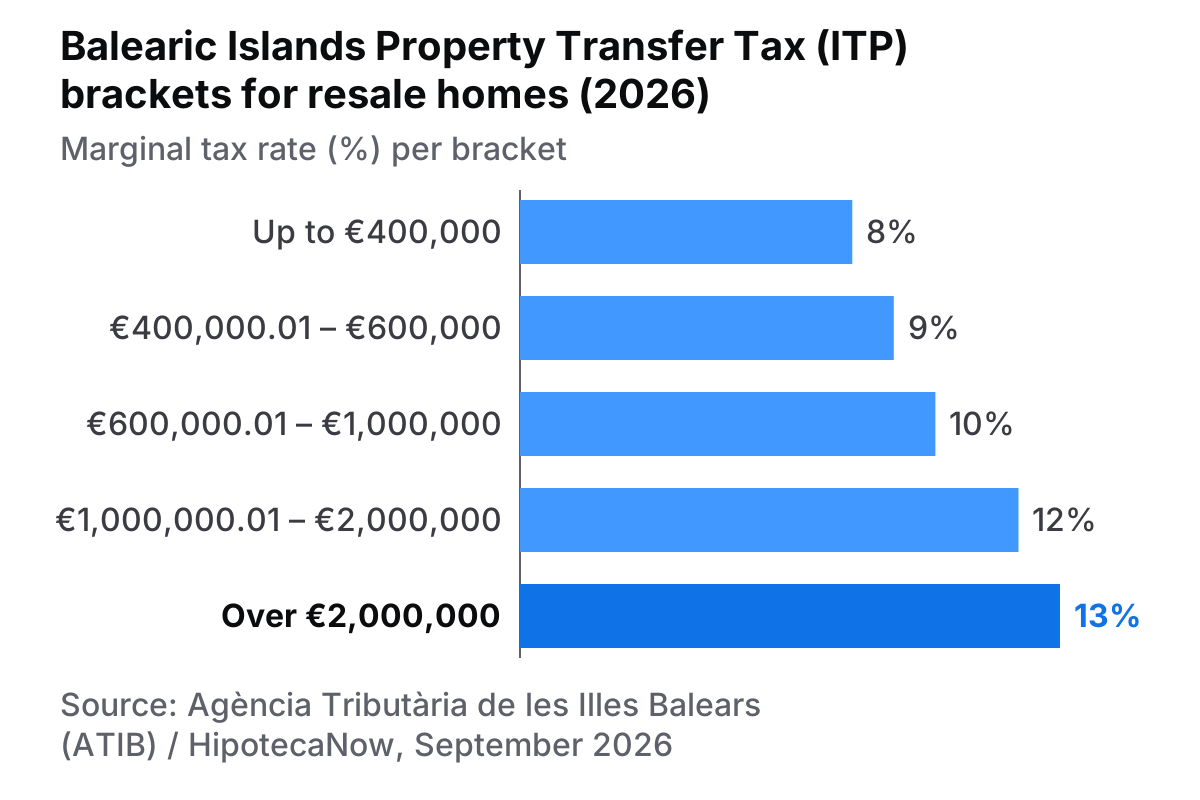
For resale properties in Mallorca, buyers pay the Balearic Property Transfer Tax (Impuesto sobre Transmisiones Patrimoniales, ITP). As confirmed by the Balearic Islands ITP transfer tax brackets, this is a progressive tax calculated across five marginal tiers based on property value:
- Up to €400,000: 8%
- €400,000.01 to €600,000: 9%
- €600,000.01 to €1,000,000: 10%
- €1,000,000.01 to €2,000,000: 12%
- Portion over €2,000,000: 13%
High-net-worth buyers should also account for the Balearic Regional Wealth Tax (Impuesto sobre el Patrimonio). Non-resident property owners benefit from an individual tax-free allowance of €3,000,000 (plus an additional €300,000 for primary residences), above which wealth is taxed on a sliding scale from 0.28% up to 3.45%.
Investors evaluating rental income potential must consider short-let legislation. Under Balearic Decree-Law 4/2025, analyzed in detail in the guide to Mallorca ETV holiday rental licence rules, issuing new tourist rental licences (ETV) for apartments in multi-family buildings is prohibited across the Balearic Islands. For detached or terraced villas, new ETV places can only be acquired on a strict 1:1 replacement basis from a limited temporary pool managed by the Consell de Mallorca (which released 1,069 places in 2026). Consequently, buyers seeking holiday rental income typically focus on standalone villas that already hold valid, transferable ETV licences.
Non-EU purchasers must also note changes to residency rules. Following the Spanish Government announcement on the end of the Golden Visa, Law 1/2025 repealed the real estate investor residency scheme effective 3 April 2025. Purchasing property valued at €500,000 or more no longer automatically entitles non-EU buyers to a Spanish residency visa.
To navigate hyper-local pricing variations and evaluate past sales across La Mola, Cala Llamp, and Mon Port, real estate professionals rely on specialized software. You can use CASAFARI Area Insights to monitor pricing trends, leverage our property valuation and market study tool to benchmark listing values, or deploy Property Sourcing to identify off-market and un-duplicated portfolio opportunities. For broader market analysis, consult our general guide to buying property in Spain or our strategic analysis on investing in Mallorca’s property market. Developers can review the Area Insights API documentation for custom integrations, while agents and advisers can sign in to CASAFARI platform to explore Port d’Andratx market data directly.
Frequently asked questions
What are the property transfer tax (ITP) rates in Mallorca for luxury homes?
In the Balearic Islands, resale purchases are subject to a progressive Property Transfer Tax (Impuesto sobre Transmisiones Patrimoniales, ITP) as of September 2026: 8% on the first €400,000; 9% between €400,000.01 and €600,000; 10% between €600,000.01 and €1,000,000; 12% between €1,000,000.01 and €2,000,000; and 13% on any amount exceeding €2,000,000. Buyers should also account for the Balearic Wealth Tax, which applies above a regional tax-free threshold of €3,000,000 for non-primary residences.
Can you get a holiday rental licence (ETV) for a property in Port d’Andratx?
Under Balearic Decree-Law 4/2025, new tourist rental licences (ETV) for apartments in multi-family buildings are prohibited throughout the Balearic Islands. For detached, semi-detached or terraced houses in Mallorca, new licences can only be obtained on a strict 1:1 replacement basis by purchasing dormant places from the Consell de Mallorca’s temporary pool (which allocated 1,069 places in 2026), meaning buyers who want guaranteed short-let income generally target villas that already hold an active, transferable ETV licence.
How far is Port d’Andratx from Palma and Palma de Mallorca Airport?
Via the Ma-1 motorway, Port d’Andratx is approximately 26.2 kilometres from Palma, which takes around 27 minutes by car under normal traffic conditions. Palma de Mallorca Airport (Son Sant Joan, PMI) lies between 37.3 and 39.9 kilometres away, a drive of roughly 32 to 35 minutes according to Visit Andratx figures.
Can non-EU buyers still get a Spanish Golden Visa by buying property in Mallorca?
No. Under Spain’s Organic Law 1/2025, the investor residency visa (Golden Visa)—which previously granted residency to non-EU nationals purchasing at least €500,000 in Spanish real estate—was abolished effective 3 April 2025. Non-EU buyers may still purchase property freely in Port d’Andratx, but those wishing to spend more than 90 days in any 180-day period in Spain must apply for standard visas such as the non-lucrative visa or digital nomad visa.