
ESTEPONA OLD TOWN PROPERTY GUIDE
Traditional white-painted Andalusian village of Costa del Sol
Buying property in Estepona Old Town (Casco Antiguo) offers investors and homebuyers access to a finite stock of restored Andalusian townhouses (casas mata) and low-rise apartments just steps from the 2,630-metre La Rada beach. Located in a municipality of 79,621 residents, purchases of resale residential property are subject to Andalusia’s 7% Property Transfer Tax (ITP), while holiday rental conversions require express approval from three-fifths of the building’s community of owners under 2025 regulations.
What defines the property market in Estepona Old Town?
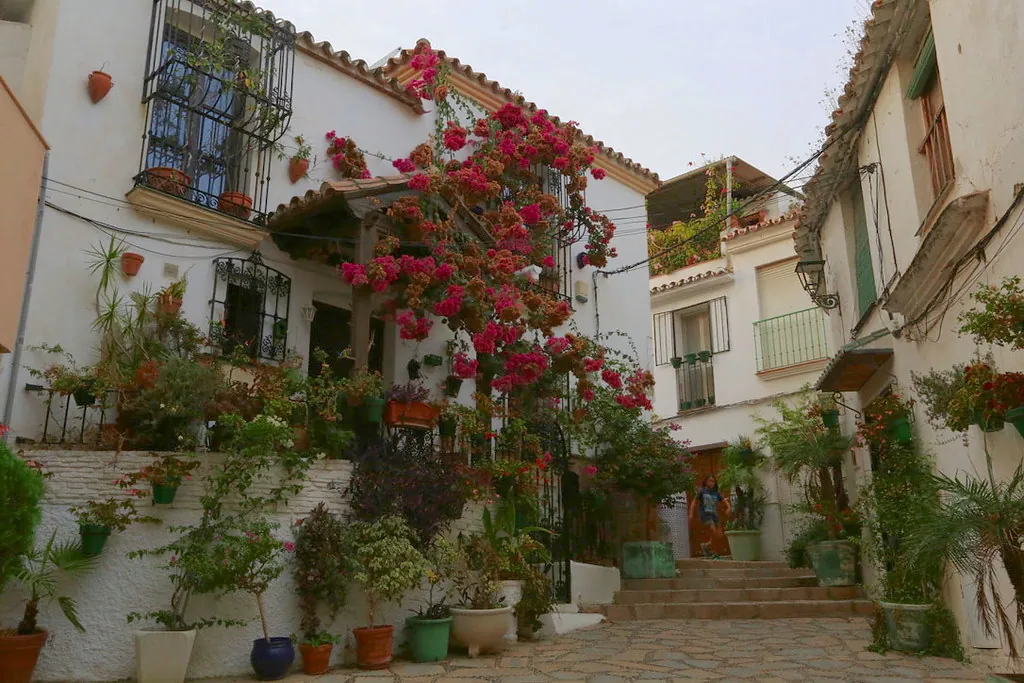
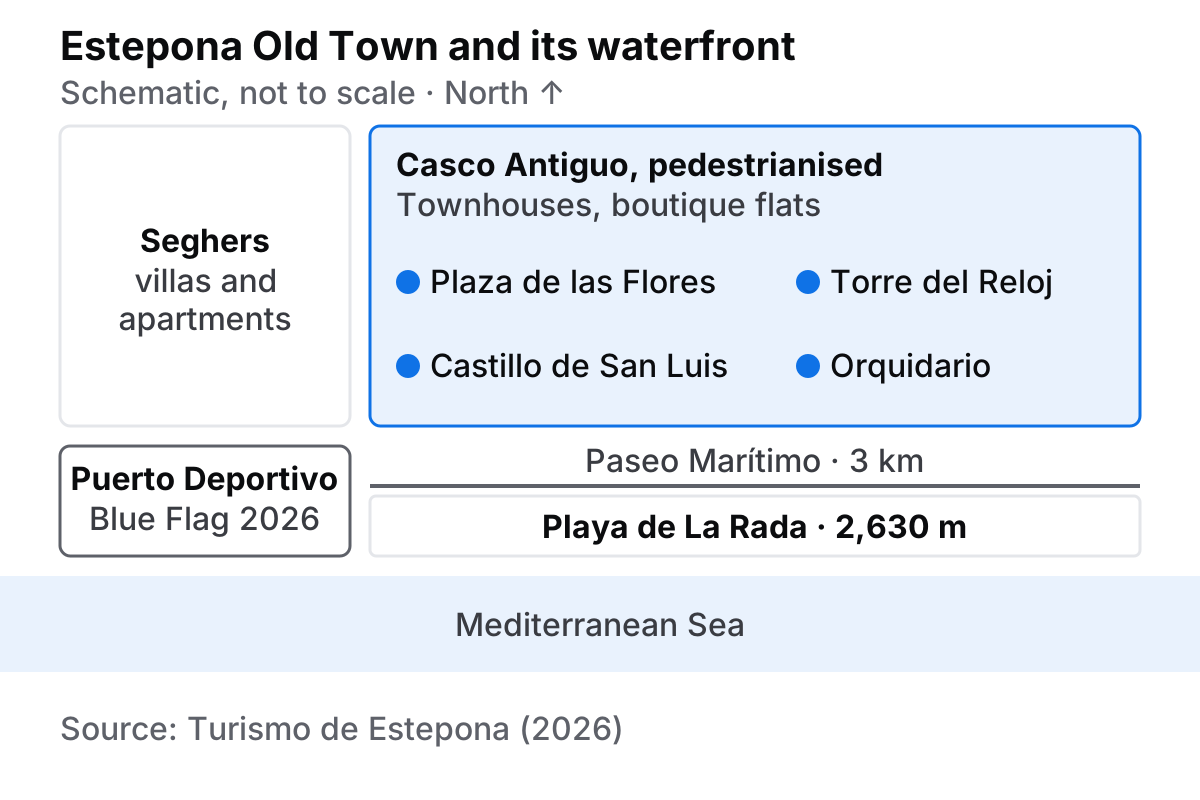
Estepona Old Town is defined by strict physical boundaries and heritage protections. Frame-like pedestrianised streets lead through flower-lined whitewashed lanes beneath the backdrop of the Sierra Bermeja mountains, terminating just a few hundred metres from the Mediterranean shoreline. Because of this historic urban layout, the market here operates under different dynamics to the wider western Costa del Sol.
The housing stock in the Casco Antiguo consists of traditional one- to three-storey Andalusian townhouses—known locally as casas mata—frequently suitable for high-end refurbishment, alongside low-rise apartment buildings and select top-floor penthouses with roof terraces. Detached villas and modern gated compounds are absent from the historic core itself; buyers seeking larger estates or modern high-rise developments typically look to neighbouring districts such as Seghers to the west of the harbour or the beachfront urbanisations along the New Golden Mile.
Because every street segment, patio orientation, and preservation order in the historic centre impacts value, real estate professionals and private investors rely on CASAFARI Area Insights to evaluate micro-market supply trends. Evaluating comparative historical listing data with a dedicated property valuation and market study tool helps buyers and advisors identify true market value when unique period properties enter the market.
Why are international buyers choosing historic Estepona?
According to data from the Instituto de Estadística y Cartografía de Andalucía (SIMA), Estepona reached a registered population of 79,621 inhabitants as of January 2025. Foreign nationals comprise between 25% and 30% of the municipal resident population, representing 120 to 135 different nationalities. British residents remain the largest international group, accounting for 17.9% of all foreign inhabitants.
Much of this international demand stems from Estepona’s extensive urban renewal project. Over the past decade, the municipality transformed its historic centre into the self-styled “Garden of the Costa del Sol”. By restricting vehicular traffic, color-coding ceramic flowerpots by individual street, and restoring peaceful public squares, Estepona provides a quieter, highly walkable residential alternative to larger urban centres across Málaga province.
Connectivity remains another primary driver for global purchasers. According to route measurements published by ViaMichelin in June 2026, Estepona Old Town sits 45 to 48 kilometres from Gibraltar Airport (GIB), taking 38 to 49 minutes by car. Málaga-Costa del Sol Airport (AGP) lies 75 to 82 kilometres to the east, accessible in 50 to 60 minutes via the AP-7 toll motorway or 70 to 75 minutes along the coastal A-7 highway.
Architecture, heritage and daily life around Plaza de las Flores
Daily life in the Old Town revolves around Plaza de las Flores, a central square bordered by pavement cafés, boutique shops, and the 18th-century Casa de las Tejerinas cultural centre. Historic landmarks dot the surrounding pedestrian quarter. The 16th-century La Torre del Reloj, detailed in Estepona municipal heritage records for La Torre del Reloj, stands free-standing after its original church was destroyed during the 1755 Lisbon earthquake; its neoclassical ceramic belfry was added in the early 18th century.
Nearby lies the Castillo de San Luis, a 16th-century coastal fortress commissioned by the Catholic Monarchs to reinforce the Islamic walls of ancient Estebbuna. Following extensive restoration, the Town Hall reopened the site in December 2024 as an archaeological museum and exhibition space featuring interior walkways, situated directly beside the Mercado Gastronómico de San Luis. Religious architecture is represented by the Church of Nuestra Señora de los Remedios, constructed between 1771 and 1791 over a former hermitage as a Franciscan convent church before becoming the primary parish church in 1835.
Botany and maritime amenities complement the historic urban fabric. The municipal Parque Botánico Orquidario covers 1,000 square metres beneath three glass domes—the tallest reaching 30 metres—housing a 15-metre indoor waterfall and over 4,000 orchids across 1,300 to 1,500 species. At the edge of the Casco Antiguo, the 2,630-metre Playa de La Rada runs alongside a 3-kilometre Paseo Marítimo. Just west along the promenade, the Puerto Deportivo de Estepona hosts the town’s active fishing fleet and seafood dining establishments—such as El Palangre, which relocated from the upper town to the marina—and holds the municipality’s single Blue Flag award for 2026.
Taxes and short-term rental rules for buyers in 2026
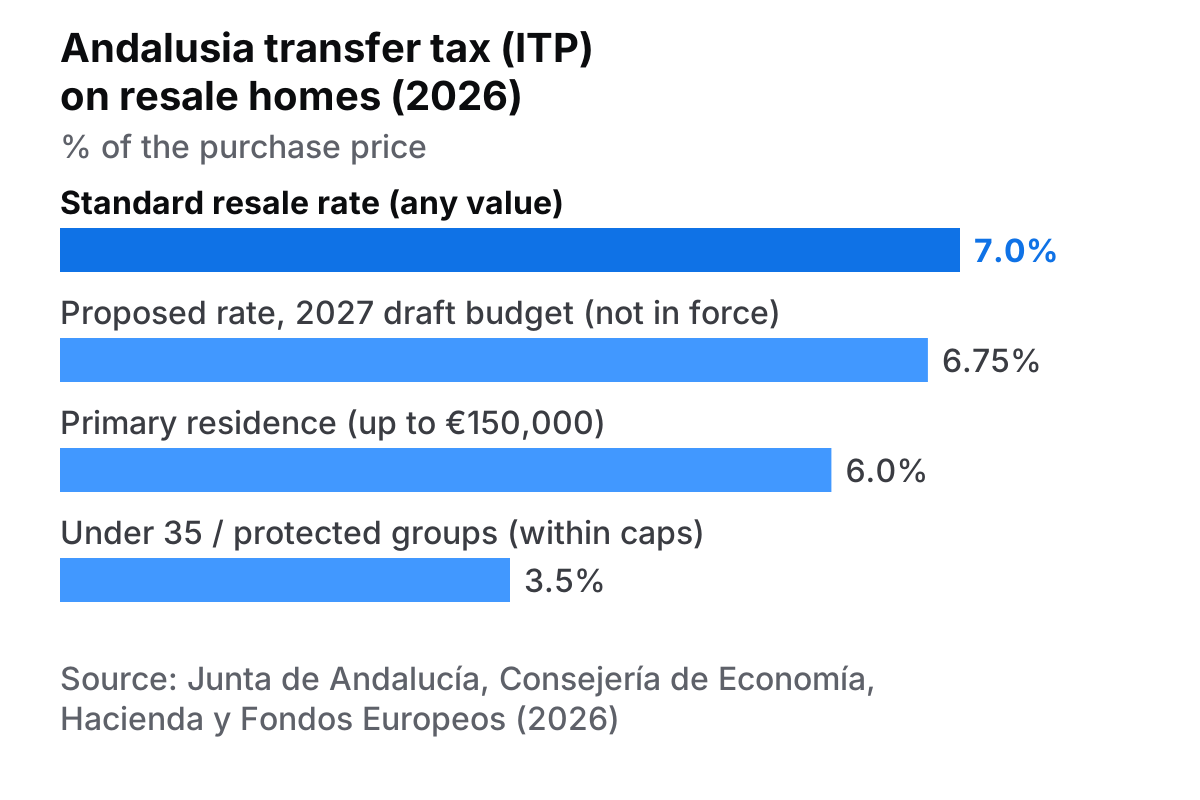
When purchasing a resale residential property in Estepona, international buyers must factor regional taxation into their financial planning. Under regional Law 5/2021, the Junta de Andalucía official ITP tax rates set a flat general Property Transfer Tax (Impuesto de Transmisiones Patrimoniales or ITP) rate of 7%. A reduced rate of 6% applies to primary residences valued up to €150,000, while a 3.5% rate is available for buyers under 35 years of age purchasing a primary residence capped at €150,000 (or up to €250,000 for buyers with recognised disabilities or large families). Prospective buyers should note that a proposed general rate reduction to 6.75% was announced in September 2026 for the 2027 draft budget.
For property investors targeting the short-term holiday market, legal compliance requires careful vetting. Under Decree 31/2024 in the Boletín Oficial de la Junta de Andalucía, short-term lets operate as Viviendas de Uso Turístico (VUT) and must comply with municipal urban planning conditions. Crucially, following national reforms to Spain’s Horizontal Property Law (Organic Law 1/2025), any buyer intending to register an apartment for holiday lets within a shared building must obtain prior express authorisation approved by a three-fifths (3/5) majority vote from the community of owners. standalone townhouses without shared common elements do not require community consent, making property typology a central decision point.
Navigating local conveyancing and tax liabilities requires precise legal guidance; buyers can review our detailed guide to the Spanish property purchase contract and escritura for step-by-step transaction details. Professional agents sourcing properties in low-supply heritage markets use Property Sourcing to filter off-market and multi-listed inventory across the Costa del Sol. To track real-time property listings, historical price changes, and comparative transaction data across Estepona Old Town, sign in to the CASAFARI platform.
Frequently asked questions
What types of property are available in Estepona Old Town?
Estepona Old Town (Casco Antiguo) consists mainly of traditional one- to three-storey Andalusian townhouses (casas mata), renovated boutique apartments, and low-rise penthouses. Because the historic centre is protected and densely built, detached villas are not found inside the Old Town itself, though they are available in neighbouring areas such as Seghers.
Can you get a tourist rental licence in Estepona Old Town?
Yes, provided the property meets municipal urban compatibility rules under Andalusian Decree 31/2024 for Viviendas de Uso Turístico (VUT). Since the 2025 reform of Spain’s Horizontal Property Law (Organic Law 1/2025), buyers of apartments in shared buildings must also secure express prior authorisation from a three-fifths (3/5) majority of the community of owners.
What are the property purchase taxes in Estepona, Andalusia?
In Andalusia in 2026, the general Property Transfer Tax (Impuesto de Transmisiones Patrimoniales, or ITP) on resale homes is a flat 7% under Law 5/2021. Reduced rates of 6% (for primary residences up to €150,000) and 3.5% (for buyers under 35 or buyers with disabilities within price caps) also apply.
How far is Estepona Old Town from Málaga and Gibraltar airports?
According to ViaMichelin (2026), Estepona is 45 to 48 kilometres from Gibraltar Airport, taking 38 to 49 minutes by car. Málaga-Costa del Sol Airport is 75 to 82 kilometres east, which takes 50 to 60 minutes via the AP-7 toll motorway or around 70 to 75 minutes along the toll-free A-7 coastal road.