
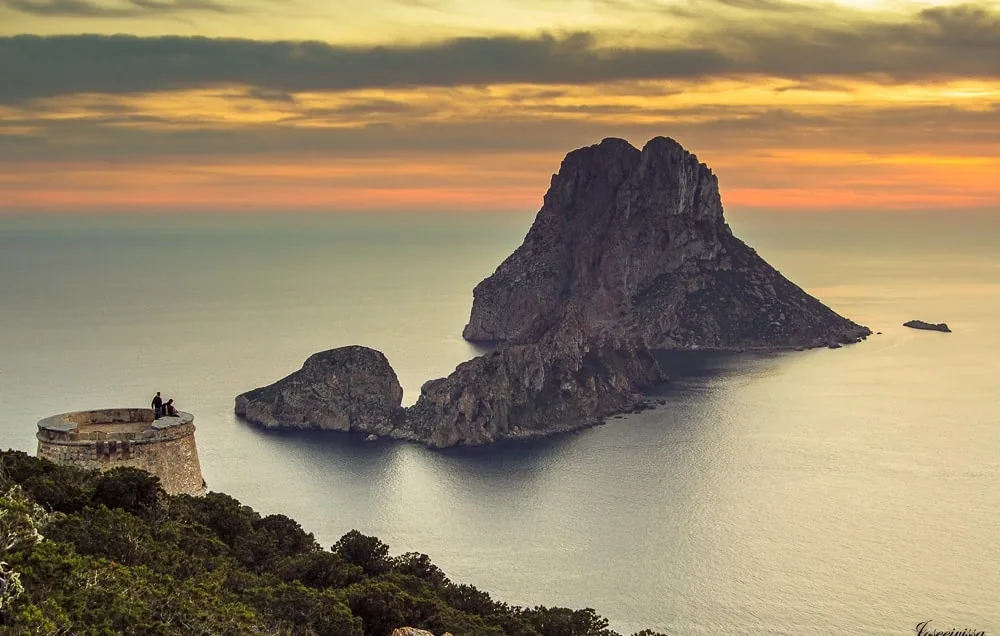
SANT AGUSTI DES VEDRA PROPERTY GUIDE
Pretty small town with amazing calas and spectacular views over the west
Buying property in Sant Agustí des Vedrà requires balancing protected 18th-century rural heritage with strict Balearic land regulations. Located in Sant Josep de sa Talaia, where average asking prices reached €7,513/m² in September 2026 according to Idealista, this parish features traditional casas payesas and luxury villas subject to 300 m² build limits on 15,000–25,000 m² rustic plots, an island-wide ETV tourist licence moratorium, and progressive ITP taxes up to 13%.
What defines the Sant Agustí des Vedrà property market?
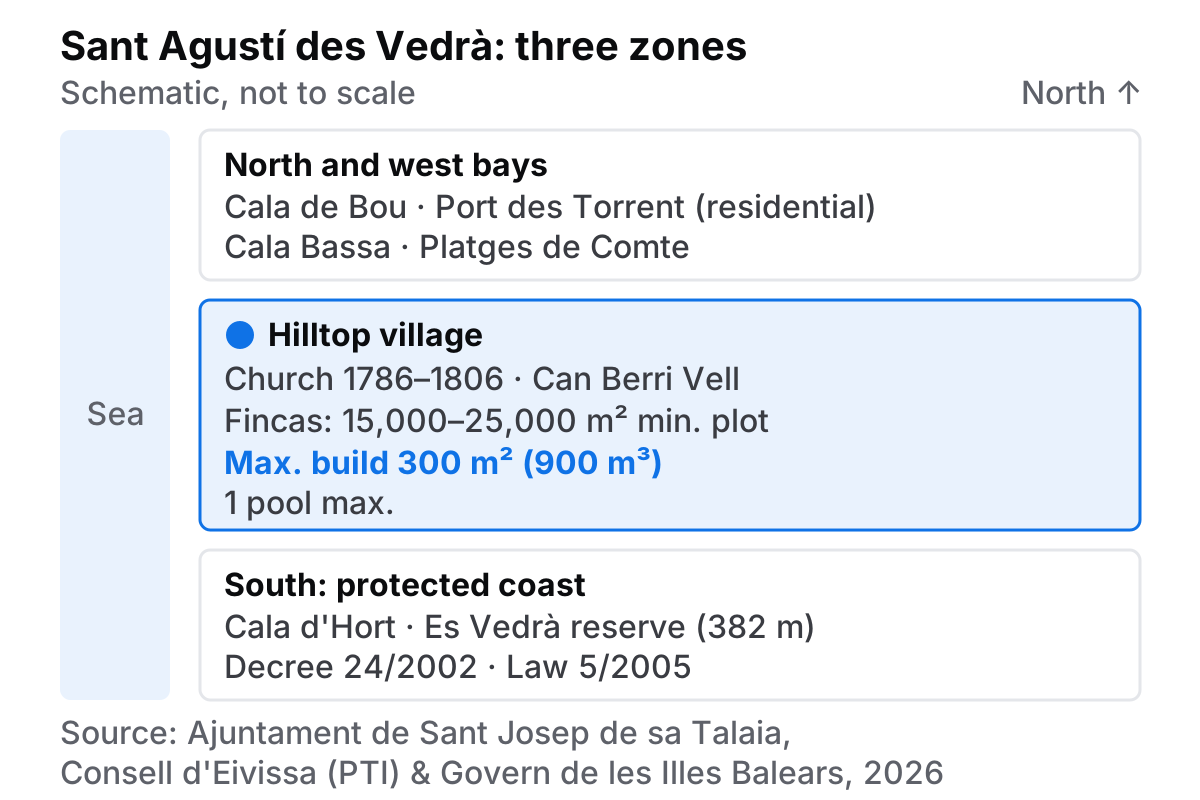
Sant Agustí des Vedrà occupies a tranquil setting in western Ibiza within the municipality of Sant Josep de sa Talaia (historically part of the quartó de Portmany). For investors and home buyers, understanding the area requires distinguishing between the historic hilltop conservation hamlet and the broader statistical parish. According to INE register data cited in the Ajuntament de Sant Josep de sa Talaia parish overview, the statistical area of Sant Agustí contains 13,099 inhabitants out of the municipality’s total population of 29,761. This broader boundary stretches from the peaceful interior to the busier coastal residential belts of Cala de Bou and Port des Torrent.
The architectural heart of the village remains virtually untouched. The settlement clusters around a parish church, traditional stone refuge towers, historic cisterns (aljibes), and whitewashed casas payesas set amidst terraced groves of olive, almond, carob, and vine. This authentic rural character makes inland properties exceptionally sought after.
At the municipal level, Idealista reported average residential asking prices of €7,513/m² for sales and €29.20/m² for rentals in September 2026. However, values vary significantly across micro-markets. Detached rural estates and sea-view villas around Sant Agustí command substantial premiums over coastal apartment complexes, depending on plot size, privacy, and legal status. Real estate professionals can analyze live sales listings and valuation trends using CASAFARI Area Insights or by choosing to sign in to the CASAFARI platform.
Heritage, architecture and village life on the hilltop
Preservation is central to life in Sant Agustí village. The main square is dominated by its parish church, whose construction began in 1786 before being blessed in 1806. Uniquely in Ibiza, the church faces west rather than south—a layout resulting from historical land disputes between local landowning families during its construction. Surrounding the church stand the parish house and ancient dry-stone enclosure walls.
The village’s culinary reputation is anchored by Can Berri Vell, which occupies a documented 17th-century casa payesa directly opposite the church. Awarded the official Sabors d’Eivissa gastronomic seal, it offers romantic outdoor courtyard dining that attracts diners from across the island.
The square also holds rich cultural history. The celebrated Galería Can Berri, established in 1980 by Brazilian gallerist Gastão Heberle, served as a cornerstone of the village’s artistic identity for 33 years until its closure in September 2013. The gallery’s legacy continues to shape Sant Agustí’s bohemian reputation.
Cultural traditions remain vibrant during the annual Festes de Sant Agustí, organized by the local municipality from late August to mid-September (running from 21 August to 18 September in 2026). The celebration peaks on Saint Augustine’s patronal day on 28 August, featuring a sung mass by the Cor de Sant Agustí, a solemn religious procession, ball pagès folk dancing performed by Sa Colla des Vedrà, and open-air evening concerts. Buyers interested in regional buying processes can review our comprehensive guide to buying property in Spain.
Coastline, beaches and protected natural landscapes
While the village offers an inland sanctuary, Sant Agustí is located just minutes from western Ibiza’s finest coastal spots. From elevated positions in the parish, views open towards Port des Torrent and the pine-fringed cove of Cala Bassa.
A short drive west leads to Platges de Comte (Cala Conta, postal code 07829), renowned for its clear turquoise waters and views across the western islets. Built into the rocky headland dividing the beaches sits Sunset Ashram, a venue celebrated for Mediterranean-Asian fusion dining and uninterrupted sunset views.
The parish derives its full name from Es Vedrà, the iconic 382-metre limestone island rising sharply off nearby Cala d’Hort. Declared a Natural Park in February 2002 under Decree 24/2002 and protected under Law 5/2005 (LECO), Es Vedrà forms part of the Balearic Government Natural Reserves of Es Vedrà, Es Vedranell and the Western Islets. These stringent environmental designations prevent coastal overdevelopment, safeguarding the local ecosystem and supporting long-term value preservation for nearby homes. Further context on regional trends is available in our Ibiza property market insights.
Planning rules, tourist licences and property taxes in Sant Agustí
Navigating real estate transactions in Sant Agustí requires a clear understanding of Balearic planning restrictions, holiday rental licensing, and transfer taxes:
- Rustic Planning Regulations (PTI): Governed by Balearic Law 6/1997 and the Plan Territorial Insular de Eivissa (PTI), all rural development requires approval from the island’s territory commission, CIOTUPHA. New construction is completely prohibited on protected natural land (ANEI and ARIP zones). On common rustic land (suelo rústico común), constructing a single-family home requires a plot of 15,000 m² to 25,000 m². Total footprint is capped at 300 m² (maximum 900 m³ volume including outbuildings), with a limit of one swimming pool and mandatory integration of traditional stone walling. Detailed rules are outlined in the Consell d’Eivissa rustic land regulations.
- Tourist Licences (ETV): Short-term holiday rentals (Estancias Turísticas en Viviendas) are tightly regulated by the Consell d’Eivissa. A zero-growth moratorium on new ETV licences remains in place from 2022 through 2026. Tourist lets are prohibited in multi-family apartment buildings. Licences automatically lapse if unused for three consecutive years. On rustic land, seasonal rentals are restricted to pre-1956 homes for up to 60 days per year with a maximum of three bedrooms. Official guidelines are published on the Consell d’Eivissa tourist rental rules portal.
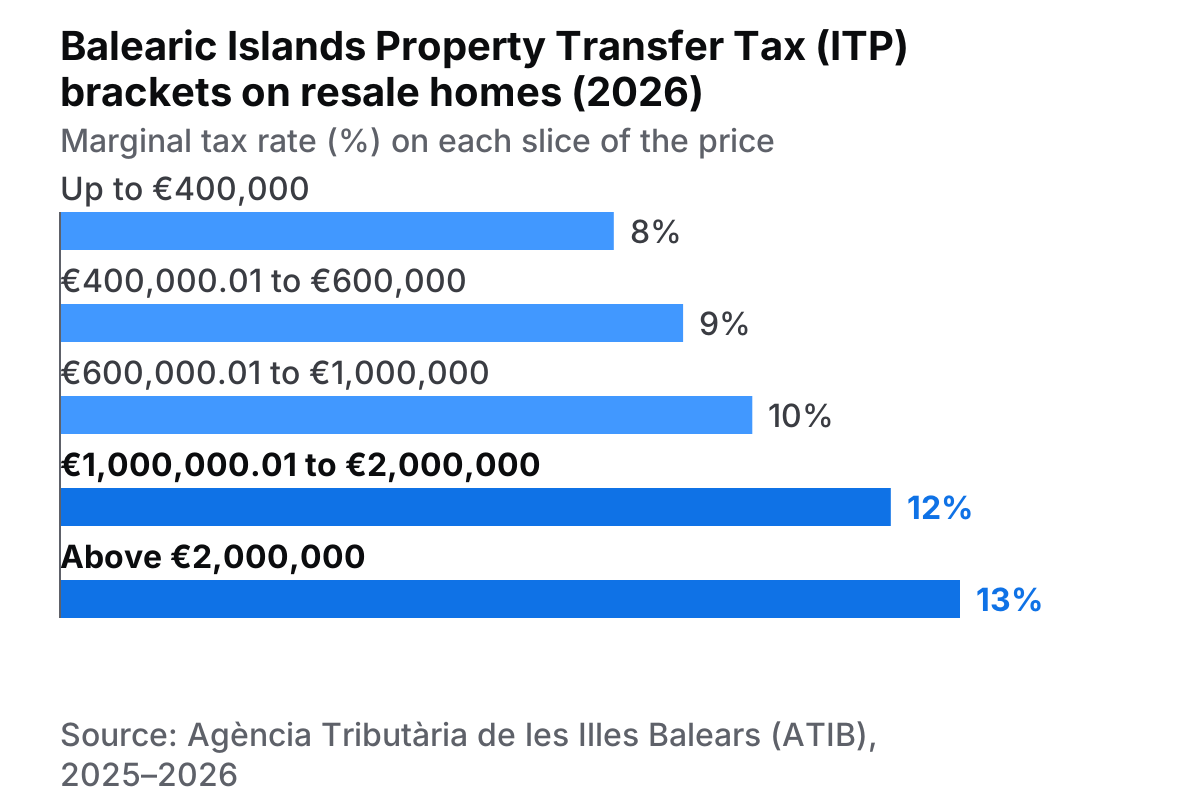
- Property Transfer Tax (ITP): For resale properties, the Agència Tributària de les Illes Balears (ATIB) applies a progressive transfer tax rate in 2026:
- 8% on values up to €400,000
- 9% on the slice from €400,000.01 to €600,000
- 10% on the slice from €600,000.01 to €1,000,000
- 12% on the slice from €1,000,000.01 to €2,000,000
- 13% on any portion exceeding €2,000,000 Full tax schedules are detailed in the Agència Tributària de les Illes Balears (ATIB) ITP tax brackets.
Given the complexity of rural planning and property histories in Ibiza, real estate professionals use CASAFARI Property Sourcing to cross-reference historical listings and detect unpermitted extensions. Combining this with our property valuation and market study tool enables buyers, sellers, and advisors to establish accurate market prices tailored to specific rural micro-locations.
Sant Agustí des Vedrà remains one of Ibiza’s most attractive locations for prime property investment, offering a balance of historic heritage, strict landscape protections, and access to the western coast. Real estate advisors and investors can access deduplicated property listings, pricing metrics, and market data by visiting the CASAFARI platform.
Frequently asked questions
Can you get a tourist rental licence (ETV) for a property in Sant Agustí des Vedrà?
The Consell d’Eivissa currently enforces an island-wide zero-growth moratorium on new ETV tourist licences through 2026, and short-term rentals are strictly prohibited in multi-family apartment buildings. Consequently, investors seeking holiday rental income must acquire a single-family villa or finca that already possesses an active, transferable ETV licence, which lapses if left unused for three consecutive years. Furthermore, historic rustic regulations restrict seasonal rentals on rural land to pre-1956 properties for up to 60 days per year with a maximum of three bedrooms.
What are the rules for building or extending a rural finca in Sant Agustí?
Rural construction in Sant Agustí des Vedrà is regulated by Balearic Law 6/1997 and the Plan Territorial Insular (PTI), requiring approval from the island’s territory commission, CIOTUPHA. Building is prohibited on protected natural land (ANEI or ARIP), while common rustic land requires a minimum plot size of 15,000 m² to 25,000 m² for a new detached dwelling. Permitted development is capped at a maximum built area of 300 m² (and 900 m³ volume including all outbuildings), with a single swimming pool allowed and mandatory integration of traditional dry-stone aesthetics.
How much is Property Transfer Tax (ITP) when buying a home in Ibiza?
Resale residential acquisitions in Ibiza are subject to the Balearic Agència Tributària’s progressive Property Transfer Tax (ITP). In 2026, rates start at 8% for the first €400,000, rising to 9% on values between €400,000.01 and €600,000, 10% from €600,000.01 to €1,000,000, and 12% between €1,000,000.01 and €2,000,000. Any portion of the purchase price exceeding €2,000,000 is taxed at the maximum rate of 13%.
What is the difference between Sant Agustí village and the wider parish for property buyers?
The historic hilltop nucleus of Sant Agustí des Vedrà is an exclusive, highly preserved rural hamlet surrounding an 18th-century parish church and traditional agricultural land. However, the wider statistical parish encompasses 13,099 residents according to INE figures and extends to coastal residential areas such as Cala de Bou and Port des Torrent. Property buyers and valuation professionals must differentiate between high-value inland rustic estates and coastal apartment developments when evaluating local price benchmarks.