IBIZA TOWN PROPERTY GUIDE
Exciting cosmopolitan destination with a mix of culture, plenty of activity and affluent appeal
Ibiza Town (Eivissa) serves as the island’s capital, housing 55,337 of Ibiza’s 164,265 residents according to the Instituto Nacional de Estadística (INE) (January 2025 data). In September 2026, residential property prices averaged €7,309/m² for sales and €30.6/m²/month for rentals according to Idealista. Buyers face strict legal conditions: apartment tourist licences are banned, Spain abolished the Golden Visa on 3 April 2025, while the Balearic wealth tax threshold sits at €3,000,000.
Why does Ibiza Town lead the Balearic property market?
As the capital of Ibiza, the municipality of Eivissa acts as the administrative, commercial, and cultural heartbeat of the island throughout the year. Data published by the Instituto Nacional de Estadística (INE) in December 2025 records a registered municipal population of 55,337 inhabitants (with an annual census baseline of 54,628), out of an island-wide total of 164,265. Unlike coastal resort towns that quiet down outside the summer months, Eivissa maintains a vibrant year-round economy supported by healthcare, public administration, maritime logistics, and finance.
This structural demand makes Eivissa one of the most competitive property markets in Spain. According to figures from Idealista, average asking prices for residential property in the municipality reached €7,309/m² in September 2026. The rental sector exhibits equal strength, with average asking rents recorded at €30.6/m² per month on Idealista’s rental index.
To navigate this environment, real estate professionals, buying agents, and institutional investors rely on granular data. Using CASAFARI Area Insights and accurate property valuations and market studies, market participants analyze real-time price evolution, supply volumes, and true sales comparables across Eivissa’s distinct micro-markets.
Where to buy in Ibiza Town: from Dalt Vila to Marina Botafoch
Eivissa offers remarkably diverse urban environments within a compact geographical footprint. Understanding the specific character of each district is essential for matching lifestyle requirements with investment goals.
Dalt Vila and La Marina
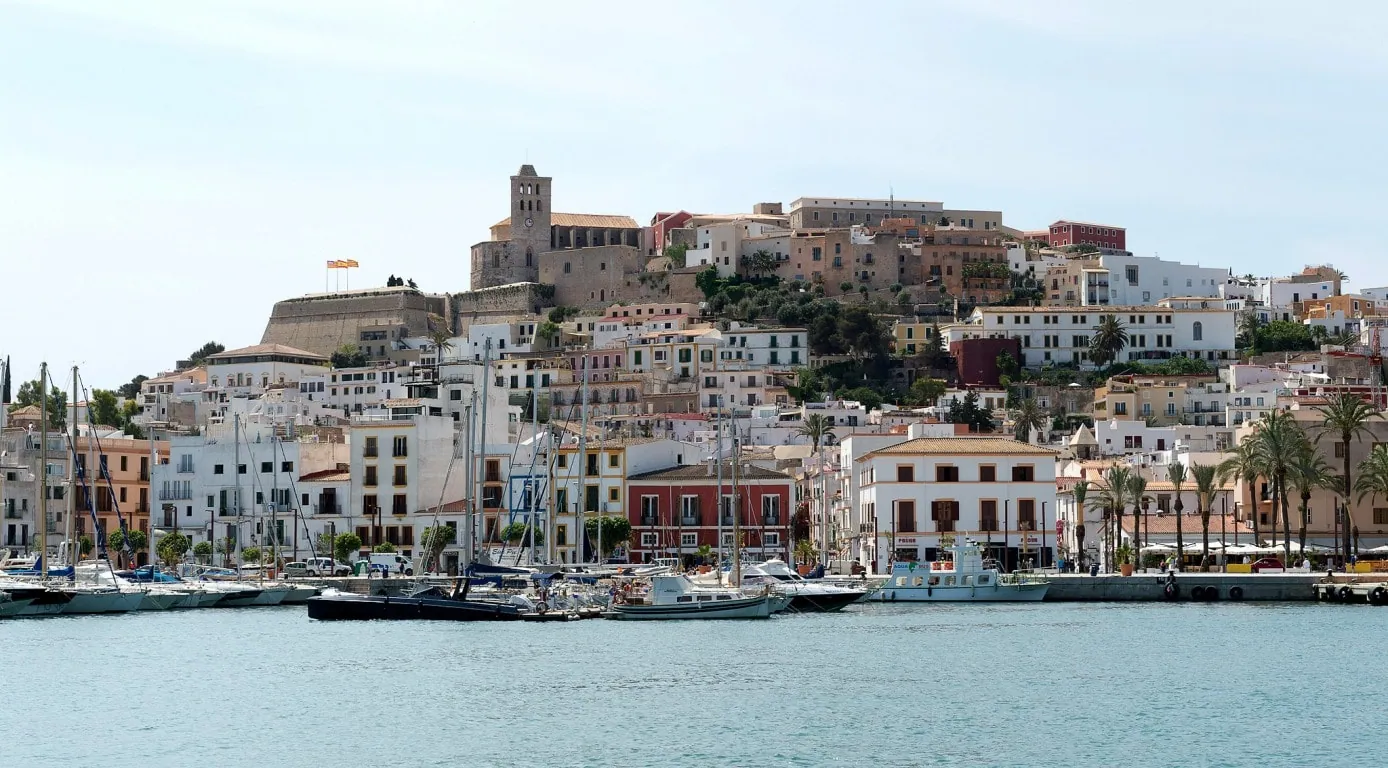
Perched on the hill overlooking the harbour, Dalt Vila is a UNESCO World Heritage site encased within 16th-century Renaissance fortifications. Properties here consist primarily of historic townhouses and restored apartment buildings featuring exposed timber beams, high ceilings, and panoramic sea vistas. Adjacent to the fortified walls lies La Marina, the historic fishermen’s quarter featuring cobblestone lanes, boutiques, and waterfront residences. Heritage status ensures strict urban conservation rules, protecting architectural authenticity while limiting new build construction.
Marina Botafoch and Paseo Marítimo
Located directly across the bay from the old town, Marina Botafoch and the Paseo Marítimo represent Eivissa’s contemporary prime district. High-end apartment complexes offer luxury amenities, private parking, communal pools, and security services. These properties appeal to high-net-worth buyers seeking penthouses with moorings for superyachts and direct access to fine dining venues, as well as the nearby sandy beach of Talamanca.
Figueretas, Ses Figueretes and Can Misses
Moving inland and southward, Figueretas features an urban beach promenade and mid-rise residential buildings popular with seasonal and permanent residents. Can Misses, located on the town’s western perimeter near the main island hospital, is a favoured residential sector among local professionals and families. It offers modern apartment blocks, townhouses, proximity to international schools, and sports facilities.
Towns and villages of the Ibiza Region beyond the capital
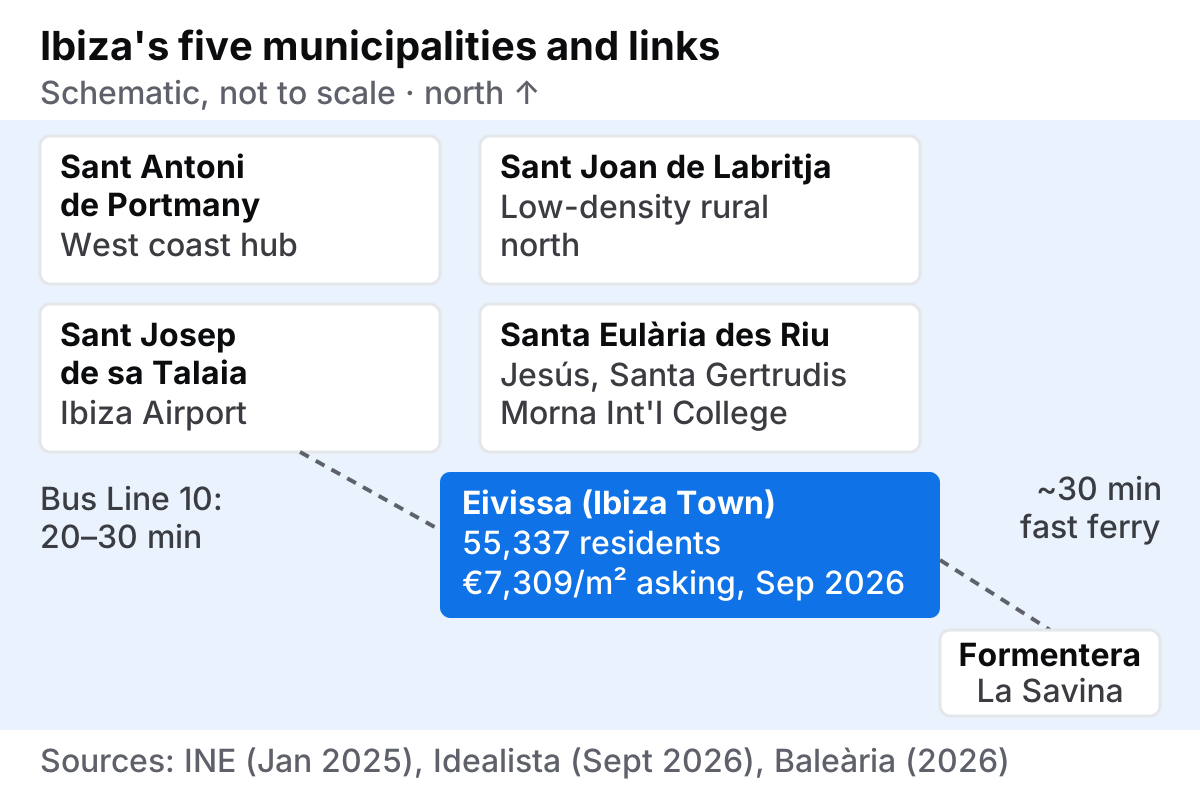
Ibiza is divided into five distinct administrative municipalities. While Eivissa serves as the central hub, international buyers frequently compare properties in the capital with surrounding municipal districts:
- Santa Eulària des Riu: The second-largest municipality, situated to the north-east, known for its family-friendly atmosphere, coastal promenades, and the sought-after village of Jesús located just north of Marina Botafoch.
- Sant Josep de sa Talaia: Covering the south and south-west, home to iconic beaches, luxury villa enclaves, and Ibiza Airport.
- Sant Antoni de Portmany: Located on the western coast, featuring major sunset bay developments and undergoing substantial urban regeneration.
- Sant Joan de Labritja: Covering the rural north of the island, characterized by protected pinewoods, low-density rustic estates, and secluded retreats.
For international buyers, the division between urban land (suelo urbano) in Ibiza Town and rural land (suelo rústico) in surrounding municipalities brings significant legal and regulatory distinctions.
Taxes, residency and short-let rules for buyers in 2026
Acquiring real estate in Ibiza requires careful planning around tax brackets, municipal licensing restrictions, and post-Brexit non-EU buyer obligations.
Property Transfer Tax (ITP)
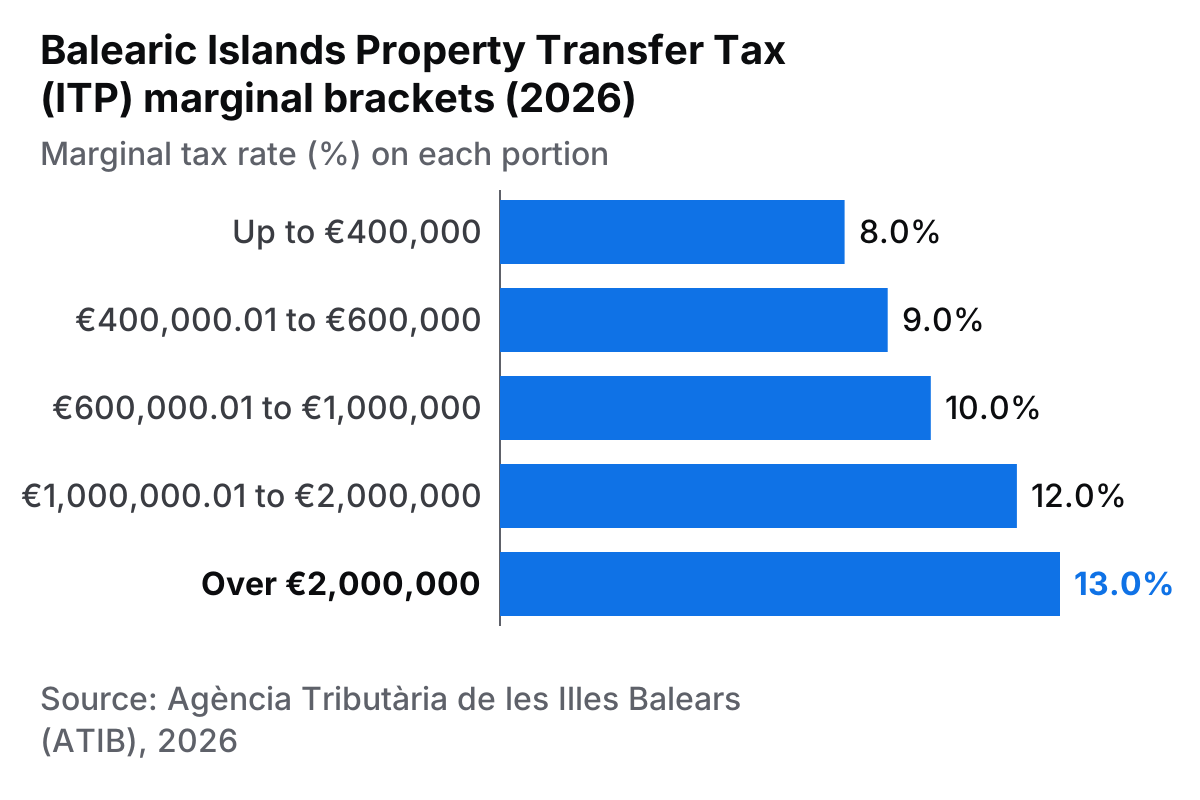
For resale properties in the Balearic Islands, buyers pay a progressive Property Transfer Tax (Impuesto sobre Transmisiones Patrimoniales – ITP). According to the Agència Tributària de les Illes Balears (ATIB), the marginal rate scale for 2026 is structured as follows:
- Up to €400,000: 8%
- €400,000.01 to €600,000: 9%
- €600,000.01 to €1,000,000: 10%
- €1,000,000.01 to €2,000,000: 12%
- Over €2,000,000: 13%
Balearic Wealth Tax Allowance
Under Ley 12/2023, in force for 2026, the Balearic Government significantly lowered property holding friction by increasing the tax-free allowance (mínimo exento) for Wealth Tax (Impuesto sobre el Patrimonio) to €3,000,000 per individual (ATIB). This higher threshold offers substantial advantages to prime and super-prime property owners.
Strict Tourist Licence Regulations (ETV)
Investors seeking short-term holiday rental yield must note that the Consell d’Eivissa strictly prohibits tourist rental licences (Estancias Turísticas en Viviendas – ETV) for apartments, multi-family buildings, and individual rooms across the island. ETV licences are limited exclusively to detached single-family houses and remain capped under the island’s zero-growth moratorium. Apartment owners in Eivissa may only rent under long-term residential or non-tourist seasonal contracts under Spanish tenancy law. For a detailed breakdown of regional rental dynamics, view our guide on owning a rental property in Mallorca and Ibiza.
Non-EU Residency and Military Permits
Spain officially abolished the real estate Investor Residency Visa (Golden Visa) on 3 April 2025 via Ley Orgánica 1/2025 published in the BOE. Non-EU buyers, including UK nationals following Brexit, must now utilize standard residency visas, such as the digital nomad visa or non-lucrative residency.
Additionally, non-EU buyers purchasing rural property (suelo rústico) in Ibiza must obtain a military permit (permiso militar) from the Spanish Ministry of Defence under Ley 8/1975 and Real Decreto 689/1978. Properties located on designated urban land (suelo urbano) in Eivissa are exempt from military permit clearance. Buyers preparing for conveyancing should review the essential steps involved when signing the purchase contract and public deed (escritura) in Spain.
Transport, international schools and year-round living in Eivissa
Ibiza Town offers excellent infrastructure for international families and year-round residents. Ibiza Airport is situated approximately 7 km south-west of Eivissa. Public bus Line 10, operated by ALSA, connects the airport terminal to Eivissa’s central CETIS bus station and the maritime port in 20 to 30 minutes. From the maritime port, Baleària and Trasmapi run fast ferry services reaching Formentera (La Savina port) in approximately 30 minutes.
For education, families residing in Eivissa can choose between top-tier educational institutions:
- Colegio Mestral: Situated directly in Eivissa (Can Misses), offering a trilingual curriculum (Spanish, English, Catalan) for students aged 3 to 18.
- Morna International College: Located near Santa Gertrudis, delivering the British National Curriculum (IGCSE and A-Levels) for students aged 3 to 18 (Morna Admissions).
In a tightly held market like Eivissa, accessing comprehensive market data and off-market inventory is vital for making sound investments. Real estate professionals use CASAFARI Property Sourcing to search clean, deduplicated listings across all active agencies on the island.
Whether you are evaluating a prime apartment in Marina Botafoch or a townhouse in Dalt Vila, access to verified property data ensures decisions are grounded in facts. You can explore complete market dynamics, clean listings, and valuation history on the CASAFARI platform.
Frequently asked questions
Can you get a tourist rental licence for an apartment in Ibiza Town?
No. Under Consell d’Eivissa regulations in force in 2026, tourist rental licences (Estancias Turísticas en Viviendas, or ETV) are strictly prohibited for apartments, multi-family residential buildings, and single rooms across the entire island. ETV licences apply solely to detached single-family houses and remain capped under the island’s zero-growth moratorium. Apartment owners in Eivissa may only let properties under long-term or non-tourist seasonal lease contracts governed by Spain’s Urban Leases Act (LAU).
Do UK buyers need a military permit to buy property in Ibiza?
It depends on the classification of the land. Following Brexit, UK and other non-EU/non-Schengen citizens must obtain a military permit (permiso militar) from the Spanish Ministry of Defence under Ley 8/1975 only when purchasing property on rural land (suelo rústico). Residential apartments, townhouses, and villas situated on designated urban land (suelo urbano) within Ibiza Town are exempt from this requirement.
Is the Spanish Golden Visa still available for Ibiza property buyers?
No. Spain officially abolished the real estate Golden Visa (Articles 63 to 67 of Ley 14/2013) on 3 April 2025 through Ley Orgánica 1/2025, published in the Boletín Oficial del Estado (BOE). Non-EU buyers purchasing real estate in Ibiza must now use standard immigration routes, such as the non-lucrative residency visa or the digital nomad visa, which operate independently of property investment.
What is the property transfer tax (ITP) and wealth tax in Ibiza?
According to the Agència Tributària de les Illes Balears (ATIB) for 2026, resale residential purchases incur a progressive Property Transfer Tax (ITP) starting at 8% up to €400,000, 9% for €400,000.01 to €600,000, 10% for €600,000.01 to €1,000,000, 12% for €1,000,000.01 to €2,000,000, and 13% above €2,000,000. For Wealth Tax (Impuesto sobre el Patrimonio), the Balearic Islands raised the tax-free allowance (mínimo exento) to €3,000,000 per individual under Ley 12/2023.