Cadiz
Southernmost province of Andalucia known for beautiful nature, wine and fiestas
Cádiz is a narrow peninsula city of approximately 110,000 residents, bounded by the Atlantic Ocean and the Bay of Cádiz, where geography strictly limits residential construction. Because new land cannot be created, housing supply remains fixed while buyer interest shifts from saturated Andalusian markets. Property decisions here depend on distinct micro-markets: the historic peninsular tip, beachside strips, and bayward districts.
Why Cádiz behaves differently from any other Andalusian city
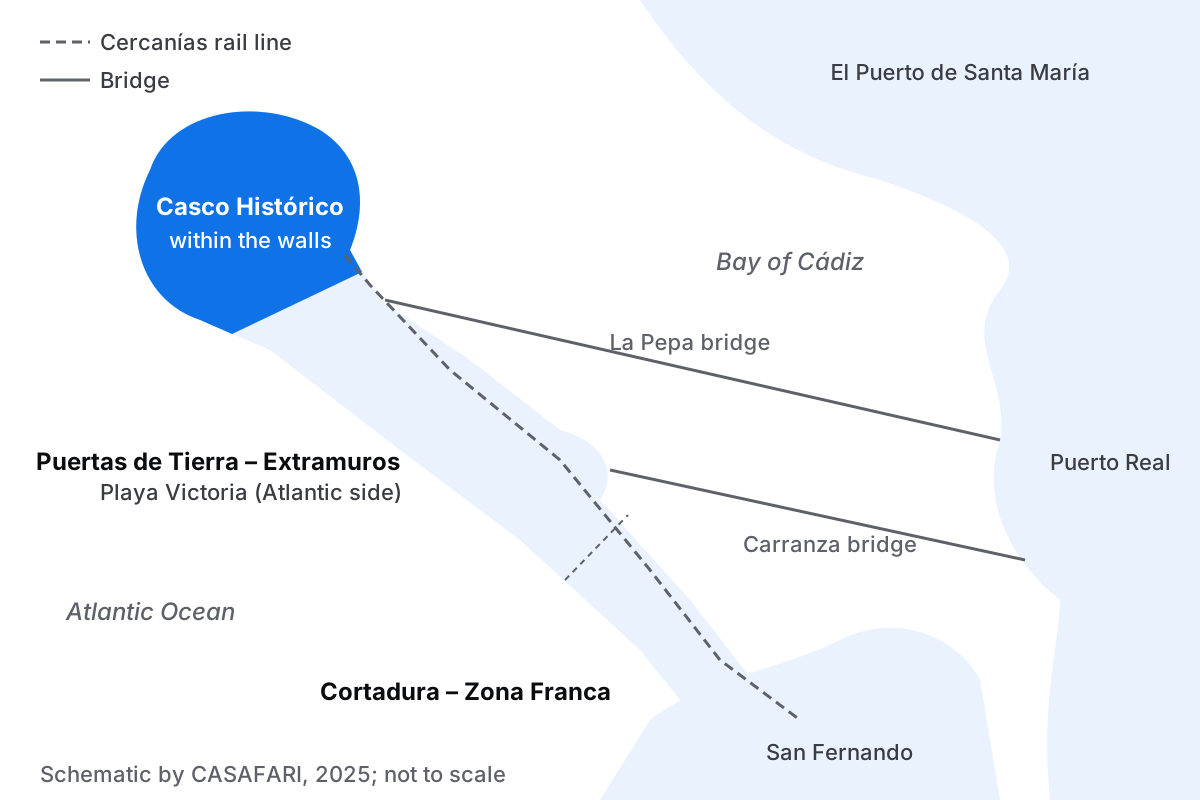
Unlike inland capitals or sprawling coastal resorts, Cádiz occupies a limestone spit of roughly 12 square kilometres jutting into the Atlantic. Water surrounds three sides of the historic core, leaving a single narrow strip of land linking the municipality to the mainland. According to data from the Instituto Nacional de Estadística (INE) as of 1 January 2024, the city’s registered population stands at approximately 110,000—a figure that has gradually declined over recent decades primarily because the city reached its physical construction boundaries long ago.
This geographical constraint creates a housing market where residential stock is essentially fixed. New developments are rare, appearing almost exclusively as redevelopment projects within historic structures or infill plots in former industrial zones. Consequently, market dynamics in Cádiz are driven by inventory availability rather than suburban expansion.
Demand stems from three distinct buyer groups: domestic buyers from Seville and Madrid seeking coastal residences, local buyers upgrading within the city, and international purchasers looking beyond Málaga and Seville. For international buyers, Cádiz offers an authentic Atlantic urban environment paired with direct coastal access.
Which areas of Cádiz should you look at?
Because the peninsula evolved across distinct historical eras, neighbouring districts display contrasting urban profiles, building ages, and ownership considerations. Professional investors and homebuyers can compare Cádiz districts with Area Insights to evaluate stock density and listing activity across each sector.
Casco Histórico (The Historic Centre)
The historic core encompasses long-established quarters such as El Pópulo, Santa María, La Viña, San Carlos, and Mentidero. Characterised by 18th-century merchant houses with central courtyards (patios) and lookout towers (torres mirador), this area forms the cultural heart of the city. Properties here consist predominantly of converted flats. Many historic buildings lack lifts, and maintenance standards vary between home-owner associations (comunidades de propietarios). Prospective buyers must account for structural upkeep and municipal heritage protection rules when evaluating renovation projects.
Puertas de Tierra and Extramuros
Extending south from the city walls toward Playa Victoria and Santa María del Mar, Extramuros represents the mid-to-late 20th-century expansion of Cádiz. High-rise apartment blocks constructed between the 1960s and 1980s dominate neighbourhoods like Bahía Blanca. These properties typically feature lift access, underground parking, and modern floor plans, making them the primary choice for year-round family living and long-term residential lettings.
Cortadura and Zona Franca
At the southern extremity of the peninsula lies Cortadura and the industrial-commercial zone of Zona Franca and Astilleros. This area contains the city’s newest residential developments and benefits from direct access to Cortadura beach alongside connections via the TramBahía transit line. For buyers seeking contemporary building standards with underground parking, this sector offers the main concentration of recent stock.
Municipalities across the Bay
Buyers seeking detached villas, larger plot sizes, or lower entry prices frequently extend their search across the Bay of Cádiz. Municipalities such as San Fernando, Puerto Real, El Puerto de Santa María, and Chiclana de la Frontera offer suburban housing types while remaining connected to Cádiz by commuter rail, tram, and highway networks.
What does it cost to buy in Cádiz beyond the price?
Acquiring real estate in Andalusia involves specific regional transfer taxes and administrative fees. Before signing contracts, buyers should consult our guide to buying property in Spain for an overview of national conveyancing practices.
Purchase taxes on residential real estate
Tax obligations in Andalusia differ depending on whether the asset is a resale property or a new-build development:
- Resale properties: Subject to Property Transfer Tax (Impuesto sobre Transmisiones Patrimoniales or ITP). The regional tax authority applies a general rate of 7%, with reduced rates available for eligible buyers under 35 years of age, primary residences below specific valuation thresholds, and registered buyers with recognized disabilities. Official guidelines are published by the Agencia Tributaria de Andalucía.
- New-build properties: Subject to 10% Value Added Tax (VAT/IVA) plus Stamp Duty (Actos Jurídicos Documentados or AJD) at a general rate of 1.2%.
Additional closing costs include notary fees, Land Registry (Registro de la Propiedad) registration fees, and legal representation. To understand transaction mechanics and legal documentation, review how the contract and escritura work.
Ongoing ownership expenses
Annual property ownership costs comprise:
- IBI (Impuesto sobre Bienes Inmuebles): Municipal property tax levied annually by the Ayuntamiento de Cádiz.
- Community fees: Monthly charges for shared building maintenance, which tend to be higher in older historic buildings requiring façade or roof restoration.
- Non-resident income tax (IRPF/IRNR): Imputed income tax payable by non-resident owners on properties not generating rental income.
Foreign purchasers require a Spanish Foreigner Identification Number (Número de Identidad de Extranjero or NIE) and a local bank account prior to executing the public deed (escritura).
Can you let a Cádiz flat to tourists?
Regulations governing short-term holiday rentals in Andalusia have tightened significantly to preserve permanent housing stock.
Under Andalusian regional decree (Decreto 31/2024), municipal councils hold the authority to limit or prohibit new licenses for tourist accommodation (Viviendas de Uso Turístico or VUT) in designated saturated areas. The Ayuntamiento de Cádiz has implemented urban planning restrictions restricting new tourist-let licenses within the historic centre (Casco Histórico). Existing valid licenses remain active, but prospective investors cannot assume new registrations will be granted.
Furthermore, nationwide regulations require short-term rental properties listed on digital platforms to obtain a national registration number via the Registro Único for short-term lets.
For long-term residential letting, landlords operate under national housing laws. Landlords should review what the 2023 Housing Act changed for landlords regarding tenant rights and lease structures. As of 2025, the regional government of Andalusia has not designated rent-controlled (“tensioned”) zones, meaning general lease terms apply. Long-term rental demand remains supported by the University of Cádiz, which enrols approximately 20,000 students across its regional campuses, alongside personnel stationed at nearby naval installations.
Getting to Cádiz and getting around
Cádiz is connected to regional and national transport networks via rail, road, and maritime transit.
Rail connections
Renfe operates regular passenger rail services directly from Cádiz central station:
- Cercanías C-1: Connects Cádiz to San Fernando, Puerto Real, Jerez de la Frontera, and Jerez Airport.
- Media Distancia & Intercity: Provides direct connections to Seville (Santa Justa station).
- Alvia: High-speed hybrid trains connect Cádiz directly to Madrid Puerta de Atocha in approximately four hours. Detailed schedules are maintained on Renfe timetables for Cercanías and Alvia services.
- TramBahía: The tram-train system links Cádiz directly with San Fernando and Chiclana de la Frontera, operating across both urban street tramways and shared heavy rail tracks.
Airports and road infrastructure
The nearest commercial airport is Jerez Airport (XRY), located roughly 40 kilometres north, offering domestic and seasonal European flights. Seville Airport (SVQ, ~125 km) and Málaga Airport (AGP, ~230 km) offer extensive international flight schedules.
Road access to the peninsula relies on two major bridges across the Bay: the historic Carranza bridge and the La Pepa bridge (Puente de la Constitución de 1812). The toll-free AP-4 motorway links the area directly to Seville.
Within the Casco Histórico, streets are narrow and predominantly pedestrianised, making private motor vehicles impractical. Residents in the old town rely on public buses, cycling paths, or the passenger ferry (catamarán) connecting Cádiz to El Puerto de Santa María and Rota.
Schools, healthcare and daily life
Cádiz provides comprehensive public services typical of a provincial capital. Public and state-subsidised (concertado) schools operate throughout the municipality, while international English-medium curricula are located in neighbouring Bay towns such as El Puerto de Santa María and Jerez.
Healthcare services are centred around the Hospital Universitario Puerta del Mar, the principal public hospital serving the coastline. The daily rhythm of the city is shaped by its maritime climate, Atlantic light, winter wind patterns (the Levante), and traditional cultural events such as the annual February Carnaval.
Residency and visas for non-EU buyers
Following legislative changes, Spain’s investor residence permit (commonly known as the Golden Visa) closed to new real estate applicants in April 2025. Purchasing real estate no longer grants automatic residency rights in Spain.
Non-EU citizens, including UK nationals post-Brexit, may reside in the Schengen area for up to 90 days within any 180-day period without a visa. Non-EU buyers seeking longer stays must apply for alternative immigration pathways, such as the Non-Lucrative Visa (for self-funded retirees and residents) or the Digital Nomad Visa (for remote workers), through Spanish consular channels.
How CASAFARI reads the Cádiz market
Navigating real estate transactions on a geographically constrained peninsula requires accurate market intelligence. CASAFARI aggregates property listings across regional portals to deliver clean, de-duplicated market data.
Real estate professionals utilise Area Insights to monitor supply patterns and average days on market across specific districts, while relying on a valuation built on comparables and notarial data to benchmark listing prices against historic transaction records.
Software developers and proptech teams can integrate regional market data directly via the Area Insights documentation for developers (in English) or explore dataset metrics directly to try Area Insights on the CASAFARI platform.
Frequently asked questions
Can I still rent out a flat in Cádiz old town on Airbnb?
Existing registered holiday lets retain their operating status, but obtaining new tourist accommodation licences in the historic centre is restricted by local planning measures under Andalusian regional regulations. Furthermore, short-term lets across Spain require a valid national registration number to be advertised on digital booking platforms.
How much tax do you pay when buying a house in Andalusia?
For resale properties, buyers pay Property Transfer Tax (ITP) at a general rate of 7%, with reduced rates available for eligible young buyers and lower-value primary homes. New-build homes attract 10% VAT plus 1.2% Stamp Duty (AJD), with notary, registry, and legal fees billed separately.
Can British citizens buy property in Cádiz after Brexit?
Yes, British citizens can purchase real estate in Spain using a Spanish Foreigner Identification Number (NIE) and a local bank account. Property ownership does not grant residency rights, so non-resident stays remain subject to the Schengen 90/180-day rule unless accompanied by an appropriate visa.
How do you get from Cádiz to Seville or Jerez airport?
Cádiz is connected directly by Renfe Cercanías C-1 regional trains to Jerez Airport in approximately 40 to 45 minutes, and to Seville Santa Justa station in around 1 hour and 40 minutes. By road, the AP-4 motorway links Cádiz to Seville in roughly 1 hour and 15 minutes.