
PRÍNCIPE REAL PROPERTY INSIGHT
An enchanting and prestigious neighborhood in the heart of Lisbon
Príncipe Real is one of central Lisbon’s most sought-after residential quarters, straddling the parishes of Misericórdia (9,658 residents, Censos 2021) and Santo António (11,060 residents). Named in 1859 after Queen Maria II’s eldest son, Royal Prince Dom Pedro de Alcântara, it combines 19th-century palacetes and quiet residential streets with independent design stores and long-term capital resilience.
Why do buyers and investors choose Príncipe Real property?
Stretching along the ridgeline between Rato and Bairro Alto, Príncipe Real offers an elegant urban character distinct from Lisbon’s flatter commercial quarters. The neighbourhood features 19th-century Pombaline-transition townhouses, classic azulejo tilework, and restored noble residences. A landmark example is the 1877 neo-Moorish Palacete Ribeiro da Cunha, designed by architect Henrique Carlos Afonso, which today serves as the EmbaiXada concept gallery.
While Bairro Alto immediately to the south is defined by its vibrant nightlife, Príncipe Real maintains a calm, sophisticated residential environment. Wide tree-lined avenues and boutique-lined streets attract both owner-occupiers and long-term investors. Real estate professionals and institutional buyers seeking micro-level pricing and inventory trends in Misericórdia and Santo António rely on CASAFARI Area Insights to monitor local availability and benchmark asset performance.
How have residency, tax and short-let rules changed for buyers in Príncipe Real?
Navigating the local market requires an up-to-date understanding of Portugal’s regulatory framework. Under Law no. 56/2023 (Mais Habitação) in Diário da República, effective since 7 October 2023, purchasing or rehabilitating real estate no longer qualifies for the Golden Visa (ARI). Investors seeking residency through the ARI programme must now utilize eligible non-real-estate vehicles, such as CMVM-regulated investment funds with minimum commitments of €500,000, or options in scientific research and cultural heritage.
Tax considerations for foreign income have also evolved. The Non-Habitual Resident (NHR) status was repealed by Law no. 82/2023 and replaced by the IFICI regime (Tax Incentive for Scientific Research and Innovation, Portaria no. 352/2024/1). Detailed in the Portuguese Tax Authority guide to the IFICI tax regime, IFICI provides a 20% flat personal income tax (IRS) rate for 10 years on qualifying scientific or high-value professional income.
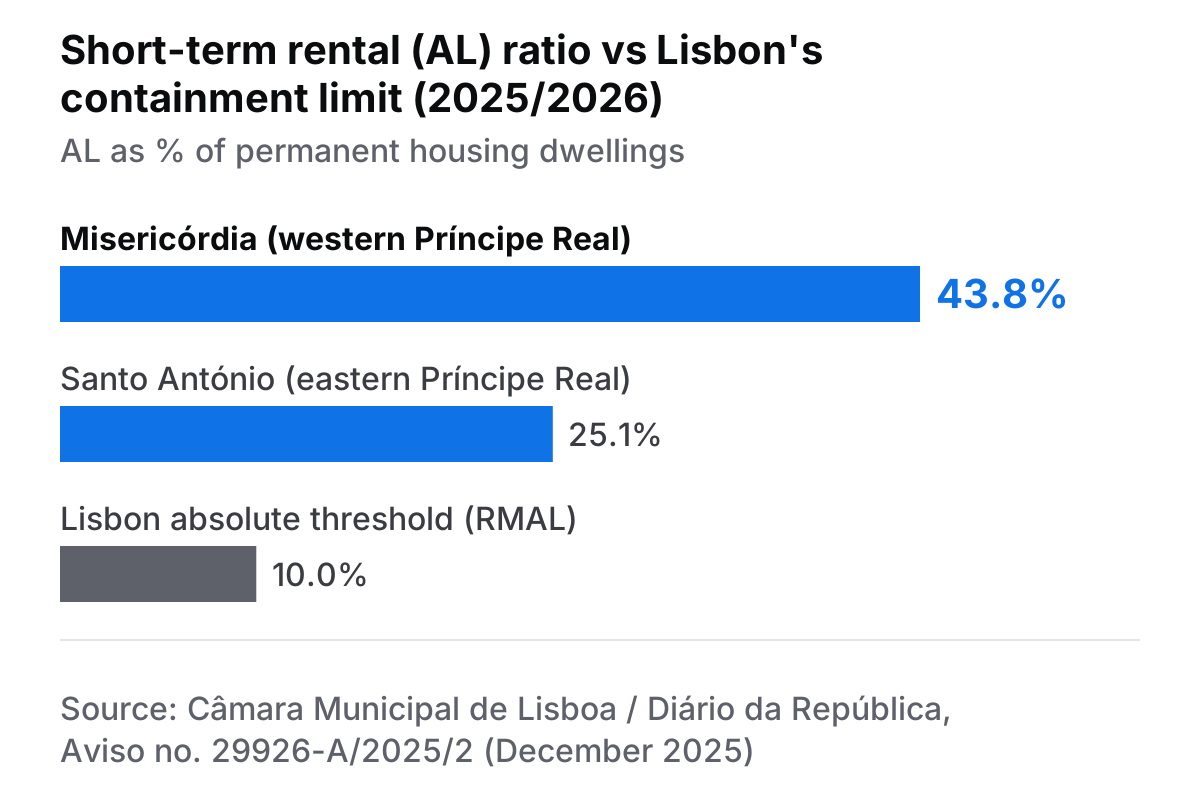
Short-term rental investors should take note of municipal restrictions. Under Lisbon’s revised Municipal Alojamento Local Regulation (Aviso no. 29926-A/2025/2) published in December 2025, parishes exceeding a 10% ratio of short-term rentals to permanent dwellings are designated absolute containment zones. Misericórdia stands at 43.8% and Santo António at 25.1%, making new Alojamento Local (AL) registrations strictly prohibited in both parishes. Consequently, real estate investors are increasingly focusing on standard residential letting; you can analyze broader rental market shifts in our overview of long-term rental market trends in Lisbon.
When acquiring residential property in 2026, buyers must calculate transaction costs based on updated tax brackets. According to the 2026 IMT and Stamp Duty brackets, Property Transfer Tax (IMT) applies at a flat rate of 6% for residential acquisitions between €660,982 and €1,150,853, and 7.5% for amounts exceeding €1,150,853. Stamp Duty (Imposto do Selo) is standard at 0.8%. Annual municipal property tax (IMI) in Lisbon is levied at the minimum statutory rate of 0.30% of the property’s registered value (VPT), with additional AIMI applicable on cumulative individual VPT values over €600,000. For a complete overview of statutory requirements, read our complete guide to buying property in Portugal.
What is daily life like in Príncipe Real: gardens, dining and viewpoints?
Daily life in Príncipe Real centres around its shaded public squares and botanical havens. At the neighbourhood’s heart lies Jardim França Borges (laid out in 1869), famous for its sweeping 20-metre-wide Buçaco cedar canopy and the 19th-century underground Patriarcal Reservoir beneath its square. A few steps down Rua da Escola Politécnica is the 5-hectare Lisbon Botanical Garden, opened in 1878, which provides a tranquil haven of global flora.
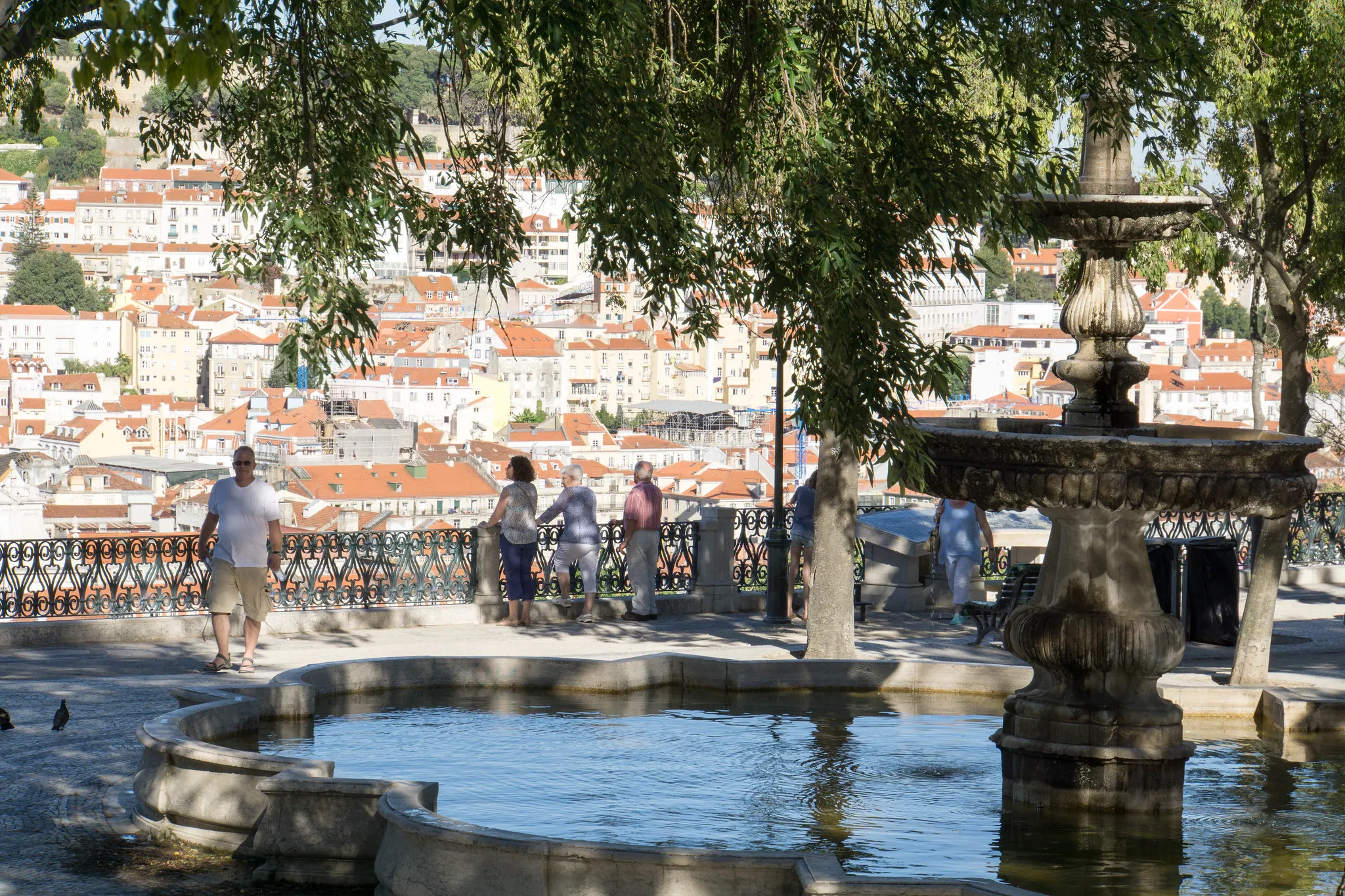
At the eastern boundary, Miradouro de São Pedro de Alcântara (Jardim António Nobre) offers a landscaped, two-tiered terrace with sweeping panoramic views across the Baixa district towards Castelo de São Jorge and the historic quarter of Graça. On weekends, the central square hosts organic farmers’ markets alongside traditional open-air kiosks, while restored townhouses host contemporary gastronomy, including Kiko Martins’s renowned A Cevicheria on Rua Dom Pedro V.
How well connected is Príncipe Real for schools and public transport?
Príncipe Real offers excellent municipal connectivity and quick access to top international educational facilities. Transport options include Rato station (Yellow Line) at the northern top of Rua da Escola Politécnica, Avenida station (Blue Line) down the hill to the east, and Baixa-Chiado station (Blue and Green Lines) to the south. The historic Carris Tram 24E runs directly along Rua da Escola Politécnica and Rua Dom Pedro V, complemented by bus routes 758, 773, and 202, as well as the nearby Glória and Bica funiculars.
Families relocating to Príncipe Real benefit from several renowned international schools within a short commute:
- Lycée Français Charles Lepierre (AEFE curriculum) in neighbouring Amoreiras
- Redbridge International School (multilingual, IB programme) in Campo de Ourique
- The British School of Lisbon located in nearby Cais do Sodré
- Salesianos de Lisboa in Campo de Ourique
For property advisors, buyer’s agents, and institutional investors seeking accurate property valuations and market studies, accessing comprehensive transaction histories and clean inventory data is essential. Developers and data analysts can also explore the Area Insights API documentation (in English) to integrate Lisbon market metrics directly into proprietary workflows.
Whether evaluating a restored apartment on Rua Dom Pedro V or an investment portfolio in Santo António, professionals can sign in to the CASAFARI platform to inspect complete market activity across central Lisbon.
Frequently asked questions
Can you still get a Portuguese Golden Visa by buying property in Príncipe Real?
No, real estate purchases no longer qualify for the Golden Visa (ARI) in Portugal. Under Law no. 56/2023, effective since 7 October 2023, direct or indirect property acquisitions and rehabilitation were fully removed from the ARI programme. Non-EU applicants can still obtain residency through alternative routes, such as committing at least €500,000 to eligible CMVM-regulated non-real-estate investment funds or supporting scientific research and cultural heritage.
Are new short-term rental licences (Alojamento Local) allowed in Príncipe Real?
New short-term rental (Alojamento Local) licences are strictly prohibited in Príncipe Real. Under Lisbon’s revised Municipal AL Regulation (Aviso no. 29926-A/2025/2 of December 2025), any parish where AL units exceed 10% of permanent housing is placed under absolute containment. Both Misericórdia (43.8% AL ratio) and Santo António (25.1% AL ratio) far exceed this threshold, meaning no new licences can be issued.
What property taxes apply when buying a home in Príncipe Real, Lisbon?
Buyers of residential property pay Municipal Property Transfer Tax (IMT) at a flat 6% rate for purchases between €660,982 and €1,150,853, and 7.5% on amounts exceeding €1,150,853, along with a 0.8% Stamp Duty (Imposto do Selo). Annually, property owners pay Lisbon’s municipal IMI tax, set at the legal minimum rate of 0.30% of the property’s registered value (VPT). An additional AIMI surtax applies to individual holdings exceeding €600,000 in total VPT.
Which international schools and transport links serve Príncipe Real?
Príncipe Real is served by Rato Metro station (Yellow Line), Avenida (Blue Line), and Baixa-Chiado (Blue and Green Lines), alongside Carris Tram 24E and bus routes 758 and 773 along Rua da Escola Politécnica. Families residing in the area have quick access to Lycée Français Charles Lepierre in Amoreiras, Redbridge International School in Campo de Ourique, and The British School of Lisbon in Cais do Sodré.