
MARQUÊS DE POMBAL PROPERTY GUIDE
Spacious lanes in the active heart of financial Lisbon
Marquês de Pombal, set at the northern crown of Avenida da Liberdade within the parish of Santo António (11,060 inhabitants according to Statistics Portugal (INE)), is Lisbon’s primary Central Business District and a premier residential location. In the 12 months ending Q1 2026, Santo António recorded a median residential sale price of €6,986/m², reaching €9,577/m² for new developments, while Zone 1 prime office rents reached €32.00/m²/month in Q2 2026.
What Defines the Marquês de Pombal Property Market?
Following Lisbon’s 2012 administrative reorganisation, the area surrounding the Marquês de Pombal roundabout—including the historic parish of Coração de Jesus—was integrated into the broader parish of Santo António. Bordered by Avenidas Novas and Saldanha to the north and Campolide and Amoreiras to the west, this address anchors Lisbon’s business core while offering residential avenues looking over green canopy.
The real estate footprint is divided between trophy commercial headquarters, international financial offices, boutique luxury hotels, and grand residential apartments. Prospective purchasers navigating the district will encounter a noticeable price tiering depending on property age and condition.
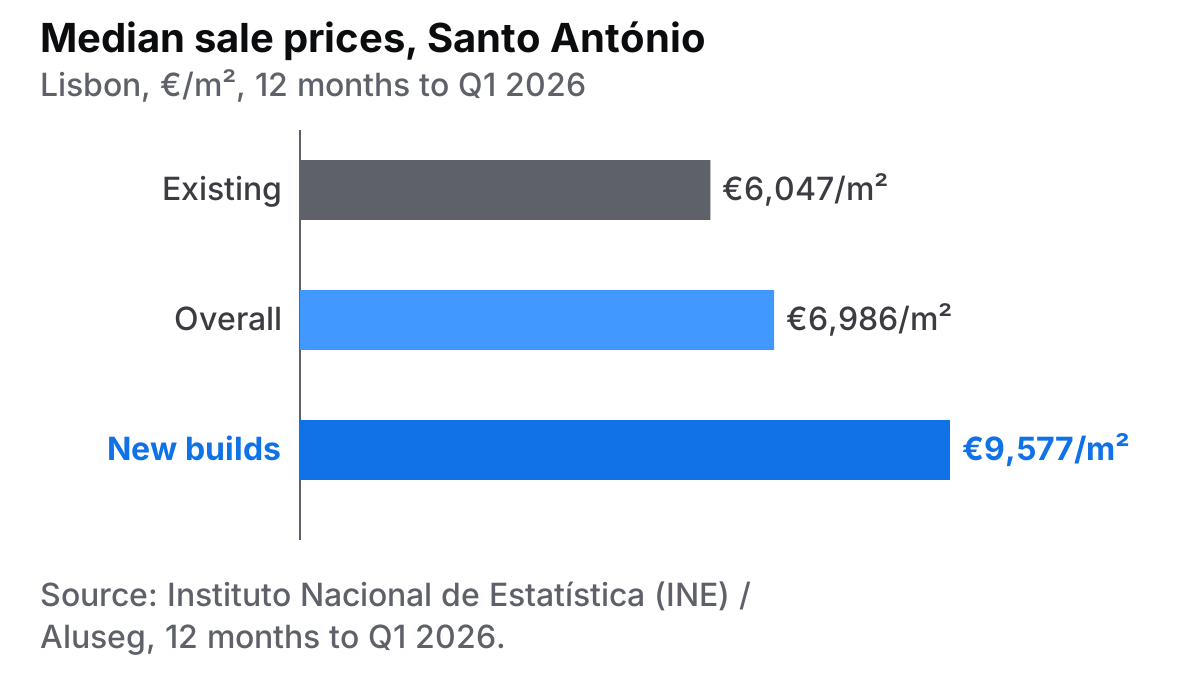
Data compiled for the 12 months ending Q1 2026 highlights a median sale price of €6,047/m² for existing residential units across Santo António, whereas new-build developments command a premium median rate of €9,577/m². Institutional buyers and private investors evaluating these figures frequently rely on a accurate property valuation and market study tool to benchmark listing values against real transaction trends.
History, Architecture and Lifestyle Around the Rotunda
The central roundabout was officially named Praça do Marquês de Pombal in 1882, honouring the statesman who spearheaded Lisbon’s modern urban planning following the 1755 earthquake. At its centre stands the 40-metre monument inaugurated on 13 May 1934, designed by architects Adães Bermudes and António Couto alongside sculptors Francisco dos Santos, Simões de Almeida, and Leopoldo de Almeida. The statue faces down Avenida da Liberdade towards the historic Baixa grid.
Architecturally, the streets extending from the plaza display a range of heritage styles. Late 19th-century Parisian-style avenues feature early 20th-century tile façades alongside modern corporate structures. Residential units along Avenida Duque de Loulé and Avenida Fontes Pereira de Melo often showcase high ceilings, intricate plasterwork, and generous floor plans.
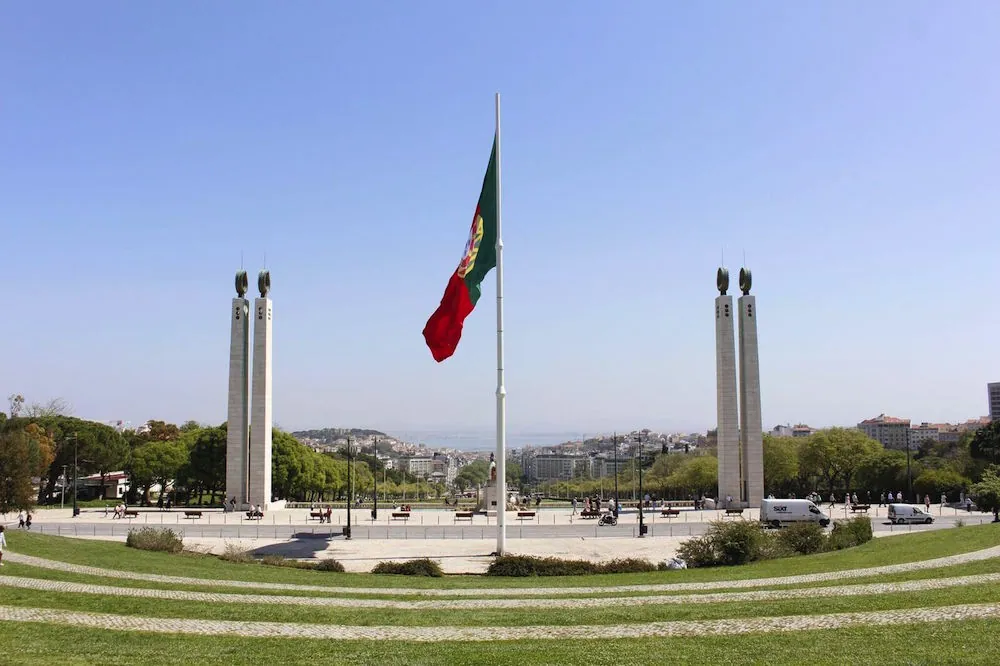
Immediately north of the monument lies Parque Eduardo VII, the neighbourhood’s principal green space. The park houses the Estufa Fria botanical greenhouse complex (divided into cold, hot, and sweet climate greenhouses), the historic Pavilhão Carlos Lopes (constructed in 1922 and repurposed as a high-profile cultural venue), and Clube VII, a private sports club featuring tennis and padel courts, a swimming pool, and health facilities.
By day, the area functions as Lisbon’s economic engine, bustling with private bankers, legal professionals, and diplomats. In the evening, activity shifts toward the fine-dining establishments and high-end hotels along Avenida da Liberdade, offering a noticeably quieter atmosphere than central entertainment hubs like Bairro Alto.
Transport Links, International Schools and Daily Amenities
Marquês de Pombal serves as one of central Lisbon’s key transit junctions. The underground station provides an interchange between the Blue (Azul) and Yellow (Amarela) lines. According to operational figures from Metropolitano de Lisboa, passengers can travel from Marquês de Pombal to Humberto Delgado Airport in 22 to 28 minutes by connecting to the Red line at Saldanha.
For vehicular transit, Avenida Engenheiro Duarte Pacheco provides direct access west towards the A5 motorway connecting Lisbon to Cascais and Estoril, as well as the A2 motorway crossing south over the 25 de Abril Bridge.
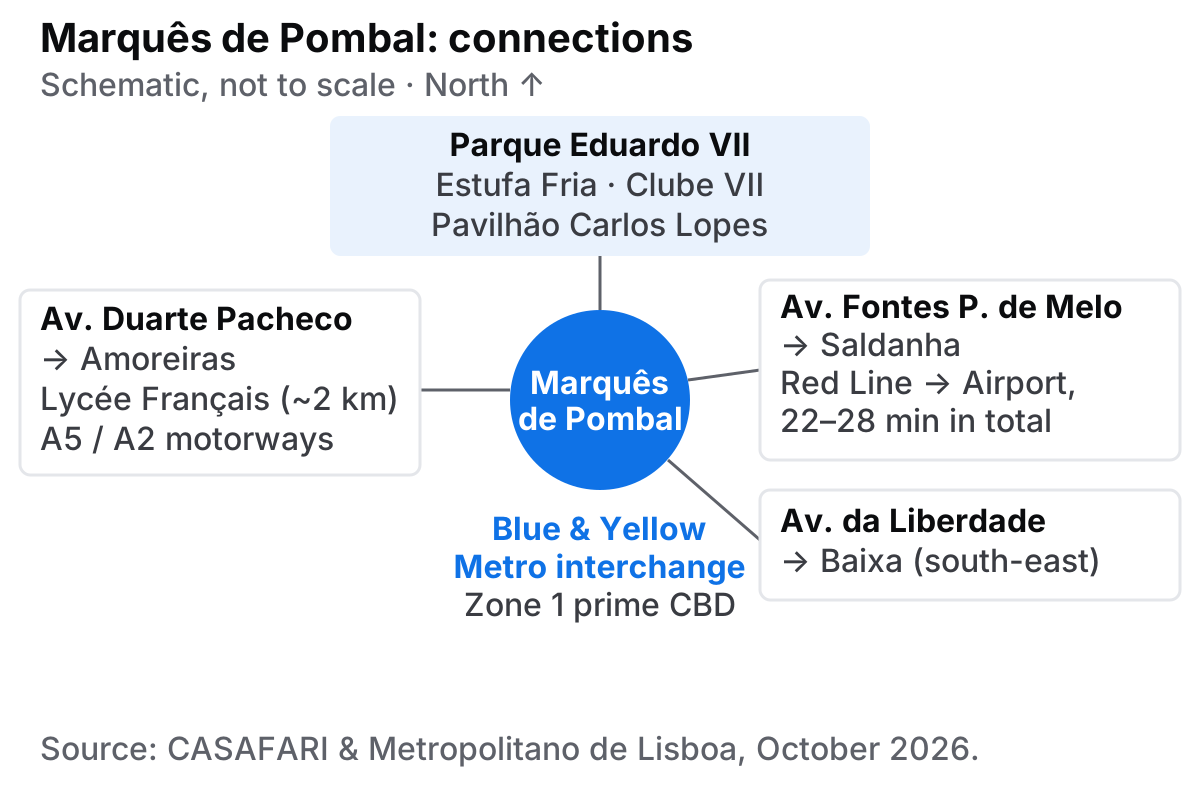
Families residing in Santo António benefit from nearby educational institutions. Higher education is represented by the Universidade Autónoma de Lisboa (~1 km away), while local primary and secondary education includes Escola Básica Santo António and Escola Básica e Secundária Manuel da Maia. International families are positioned approximately 2 kilometres from the Lycée Français Charles Lepierre and 4 kilometres from Redbridge International School in Campo de Ourique, alongside Salesianos de Lisboa.
Investment Potential, Short-Let Rules and Property Taxes in 2026
Santo António recorded Lisbon’s highest median rental value for new contracts in 2025 at €20.92/m², reflecting consistent demand for long-term residential leases among corporate executives and expatriates. Investors tracking long-term trends can examine our analysis on the evolution of rental prices in Lisbon.
Commercial real estate in Lisbon’s Zone 1 (Prime CBD) continues to perform strongly. According to the Cushman & Wakefield Lisbon Office MarketBeat, prime office rents in the Marquês de Pombal and Avenida da Liberdade corridor reached €32.00/m²/month in Q2 2026, rising from €30/m²/month at the close of 2025.
Short-term holiday lets, however, face strict regulatory limits. Under Lisbon’s Municipal Alojamento Local Regulation (RMAL) (Aviso n.º 29926-A/2025/2, in force since December 2025), Santo António is designated an absolute containment zone. With an AL-to-permanent-housing ratio of 25.1%—well over the 10% legal ceiling—new AL registrations are banned, with exceptions restricted strictly to the total restoration of ruined or vacant properties. Furthermore, existing short-term rental licences expire upon property sale and cannot be transferred to new buyers.
Tax obligations when purchasing property in central Lisbon comprise several elements:
- Stamp Duty (Imposto do Selo): A flat rate of 0.8% applied to the purchase price.
- Property Transfer Tax (IMT): Progressive rates apply to primary residences, rising to a flat 6% for transaction values between €660,982 and €1,150,853, and 7.5% for amounts exceeding €1,150,853. Buyers aged 35 or under benefit from IMT Jovem exemptions up to €330,539.
- Municipal Property Tax (IMI): Lisbon maintains the minimum urban rate of 0.30% calculated on tax registration value (VPT).
- Additional IMI (AIMI): Applies annually to individual ownership of residential property and land portfolios exceeding €600,000 in total VPT.
For broader context on structuring real estate acquisitions, view our complete guide to buying property in Portugal.
Real estate professionals, investment funds, and agencies active in central Lisbon use CASAFARI Area Insights and CASAFARI Property Sourcing to analyse live inventory and verify historical pricing. Technical teams integrating property intelligence directly into internal workflows can consult the Area Insights API documentation.
To explore verified property inventory, evaluate market trends, and source opportunities across Santo António, real estate professionals can sign in to the CASAFARI platform.
Frequently asked questions
Can you get an Alojamento Local (short-term rental) licence in Marquês de Pombal?
New Alojamento Local (AL) licences are prohibited in Marquês de Pombal under Lisbon’s Municipal AL Regulation (Aviso n.º 29926-A/2025/2). The parish of Santo António is classified as an absolute containment zone due to its 25.1% AL-to-housing ratio, which exceeds the 10% statutory cap. Furthermore, existing AL licences automatically lapse upon the sale of a property, with exceptions restricted to the total rehabilitation of derelict buildings.
What property taxes apply when buying a home in Marquês de Pombal?
Purchasers pay 0.8% Stamp Duty (Imposto do Selo) alongside progressive Property Transfer Tax (IMT). Due to Santo António’s median sale price of €6,986/m² in Q1 2026, most acquisitions attract a flat 6% IMT rate for values between €660,982 and €1,150,853, or 7.5% above €1,150,853, with IMT Jovem exemptions available up to €330,539 for qualifying buyers aged 35 or under. Annual holding costs include municipal IMI at Lisbon’s minimum rate of 0.30% and AIMI on individual residential portfolios exceeding €600,000 in tax value.
How long does it take to travel from Marquês de Pombal to Lisbon Airport?
Travelling from Marquês de Pombal underground station to Humberto Delgado Airport takes between 22 and 28 minutes, involving a single line change at Saldanha from the Yellow to the Red line. By road or taxi, the 7-kilometre journey typically takes 15 to 20 minutes outside of peak traffic hours via Avenida Fontes Pereira de Melo and the Segunda Circular.
Is Marquês de Pombal a good neighbourhood for families and international schools?
Yes, Marquês de Pombal offers strong family amenities, particularly around Parque Eduardo VII with its botanical gardens, green space, and the sports facilities at Clube VII. Families have access to international education within a short drive, including Lycée Français Charles Lepierre located approximately 2 kilometres away and Redbridge International School in Campo de Ourique roughly 4 kilometres away, alongside local options like Escola Básica Santo António.