

CAIS DO SODRÉ PROPERTY GUIDE
Historical blend of culture in the traditional heart of the city
Cais do Sodré is the primary riverside quarter of Lisbon’s Misericórdia parish, positioned between Praça do Comércio and Santos. Built around a major transport terminal connecting the Cascais railway line, the metro green line, and river ferries, the district blends historical architecture with waterfront living. Under Lisbon municipal regulations, Misericórdia is an area of absolute containment for short-term holiday lets, meaning flats here are reserved for owner-occupiers or long-term tenancy.
Where exactly is Cais do Sodré, and what is it like to live there?
Cais do Sodré stretches along the northern bank of the Tagus River from Ribeira das Naus towards Santos, climbing uphill into Bica and Santa Catarina. Administratively, the neighbourhood forms part of the central parish of Misericórdia.
Living in Cais do Sodré offers direct access to central Lisbon. Residents can easily walk to offices, shops, and restaurants in Baixa and Chiado, while commuters enjoy instant rail connections along the coastline towards Cascais. High-ceilinged Pombaline apartments with restored historic facades and river views appeal to international buyers, remote workers, and local professionals alike.
However, prospective residents must weigh clear urban trade-offs. The lower streets, particularly around Rua Nova do Carvalho and Praça de São Paulo, host bustling nightlife venues that draw evening crowds. Buyers seeking quiet residential settings typically gravitate towards the elevated streets near Miradouro de Santa Catarina or Praça Dom Luís I and Jardim Roque Gameiro. In older heritage buildings, lifts are uncommon, making floor level and accessibility key considerations when evaluating property.
How well connected is Cais do Sodré?
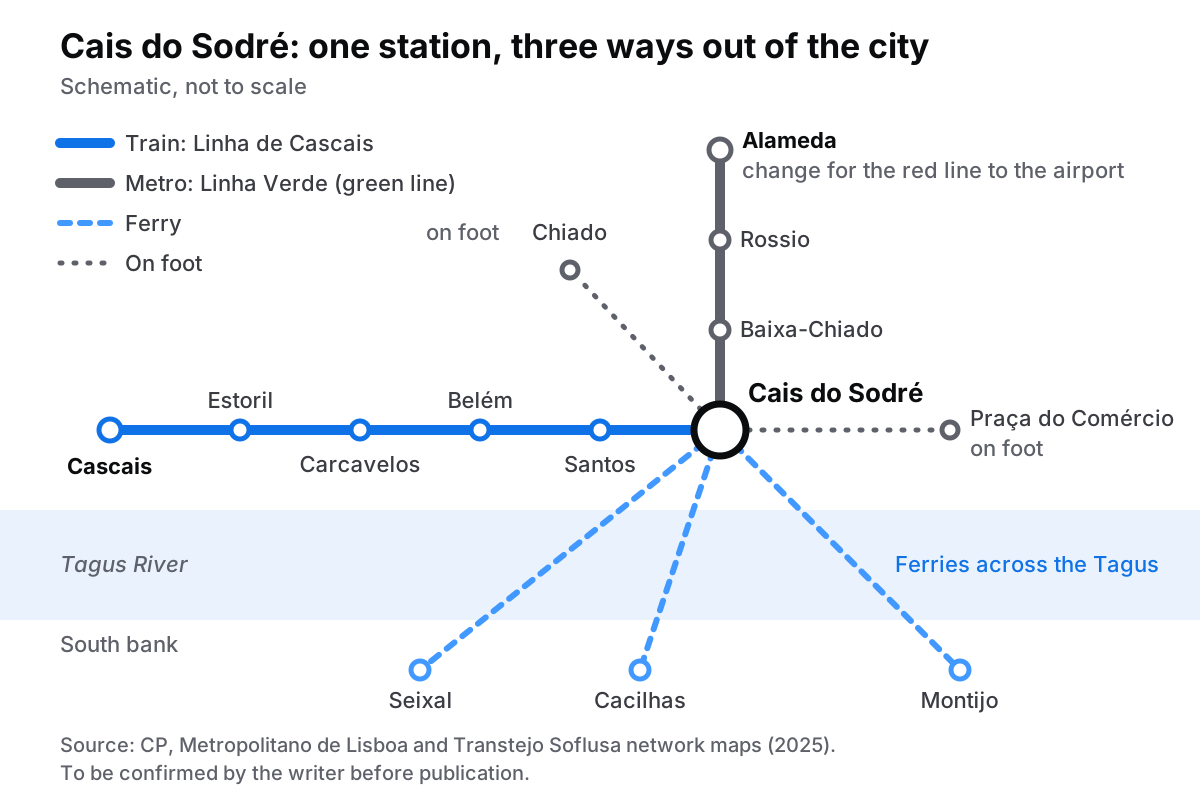
Transport infrastructure is one of Cais do Sodré’s strongest investment drivers. The multi-modal terminal acts as the Lisbon terminus for the Linha de Cascais railway line, providing direct suburban train service to coastal destinations, including Carcavelos, Estoril, and Cascais. This rail connection is widely used by families whose children attend international schools along the Cascais corridor.
The station is also the terminal for Metro de Lisboa’s Linha Verde (green line), offering rapid transit through Baixa-Chiado and Rossio up to Alameda. Passengers travelling to Lisbon Airport can transfer from the green line to the red line at Alameda station. Across the terminal, the river ferry service connects Lisbon directly to Cacilhas, Seixal, and Montijo on the south bank.
For exercise and leisure, the flat promenade along the Tagus provides a dedicated paved route for running and cycling westward towards Belém.
What has changed for short lets in Misericórdia?
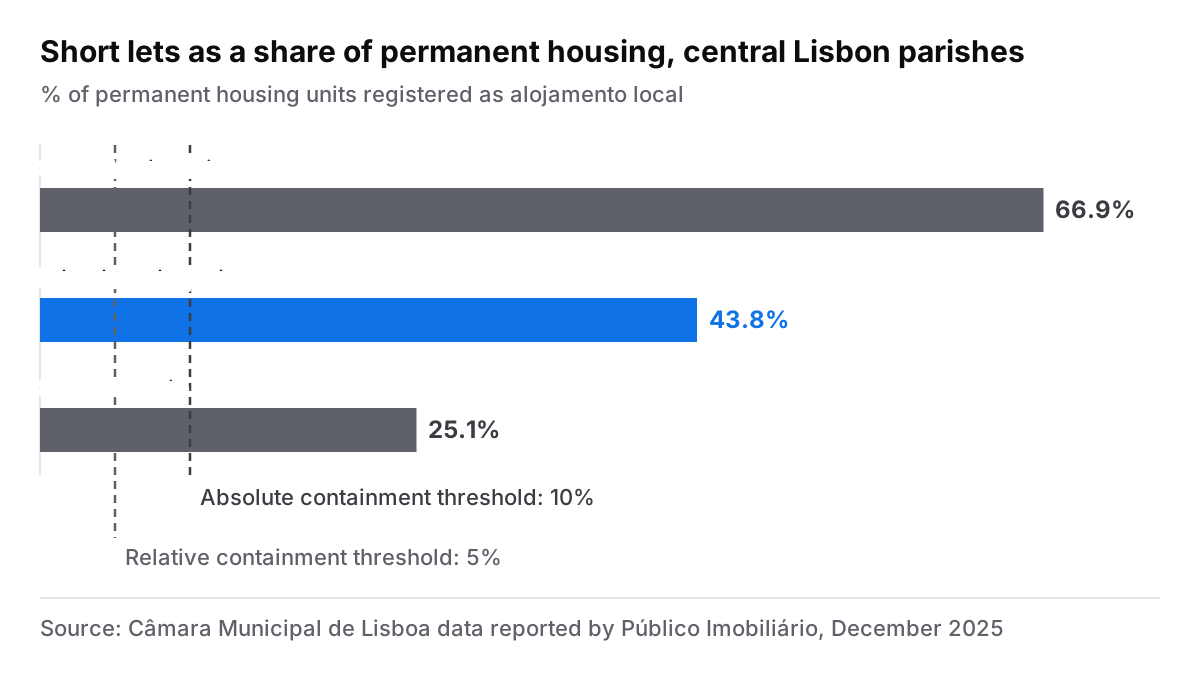
Under Lisbon’s municipal short-let regulation (Regulamento Municipal do Alojamento Local, or RMAL), approved in November 2025 and published in December 2025, the city introduced strict containment rules based on local housing stock ratios. Absolute containment applies in any parish where short-term rental units (Alojamento Local or AL) account for 10% or more of total permanent housing.
According to Público’s report on Lisbon’s short-let containment areas, citing Câmara Municipal de Lisboa data, Misericórdia recorded an AL ratio of 43.8% in December 2025. This ratio places Misericórdia firmly in absolute containment alongside neighbour parishes Santa Maria Maior (66.9%) and Santo António (25.1%). A municipal reclassification confirmed that Misericórdia remains under an absolute ban on new short-term rental registrations.
For real estate buyers, this regulatory framework means an apartment purchased without an existing, transferable AL licence cannot be registered as a holiday rental. Investors evaluating residential acquisitions in Cais do Sodré must underwrite their business plans around long-term lease returns or personal occupancy. To review structural rental market dynamics across the capital, read our analysis on how Lisbon rents have moved since 2018.
Can a property purchase here still bring residency or tax advantages?
Real estate investments in Cais do Sodré no longer grant eligibility for residency via the Golden Visa programme. As detailed in the history of the Portugal Golden Visa, Law 56/2023 (Mais Habitação) formally eliminated real estate acquisitions and property-backed capital transfers from the Golden Visa criteria. While the Golden Visa programme remains open through qualifying regulated investment funds and research activities, residential property purchases in Lisbon offer no direct pathway to residency.
Changes have also occurred regarding tax incentives for new residents. The Non-Habitual Resident (NHR) regime closed to new applicants and was replaced by the IFICI framework (Incentivo Fiscal à Investigação Científica e Inovação). Regulated by Ordinance 352/2024/1, the IFICI scheme provides a 20% flat tax rate on eligible employment and professional income for ten years, though eligibility is confined to specific high-value professions and activities. For full details on qualifying criteria, consult an overview of the IFICI regime that replaced NHR. Buyers should consult independent Portuguese legal and tax advisors before finalizing purchase structures.
Which taxes and costs apply when buying a flat in Cais do Sodré?
Property transactions in Portugal incur several standard taxes and administrative fees. The primary transfer tax is IMT (Imposto Municipal sobre as Transmissões Onerosas de Imóveis), calculated on a progressive scale based on the property value and intended use.
Under the 2026 State Budget, IMT tax brackets rose by 2%, setting the nil-rate threshold for a primary permanent residence at €106,346. For detailed tax tables, review the 2026 IMT brackets and the IMT Jovem ceiling. Stamp duty (Imposto de Selo) applies at a flat rate of 0.8% on the agreed purchase price.
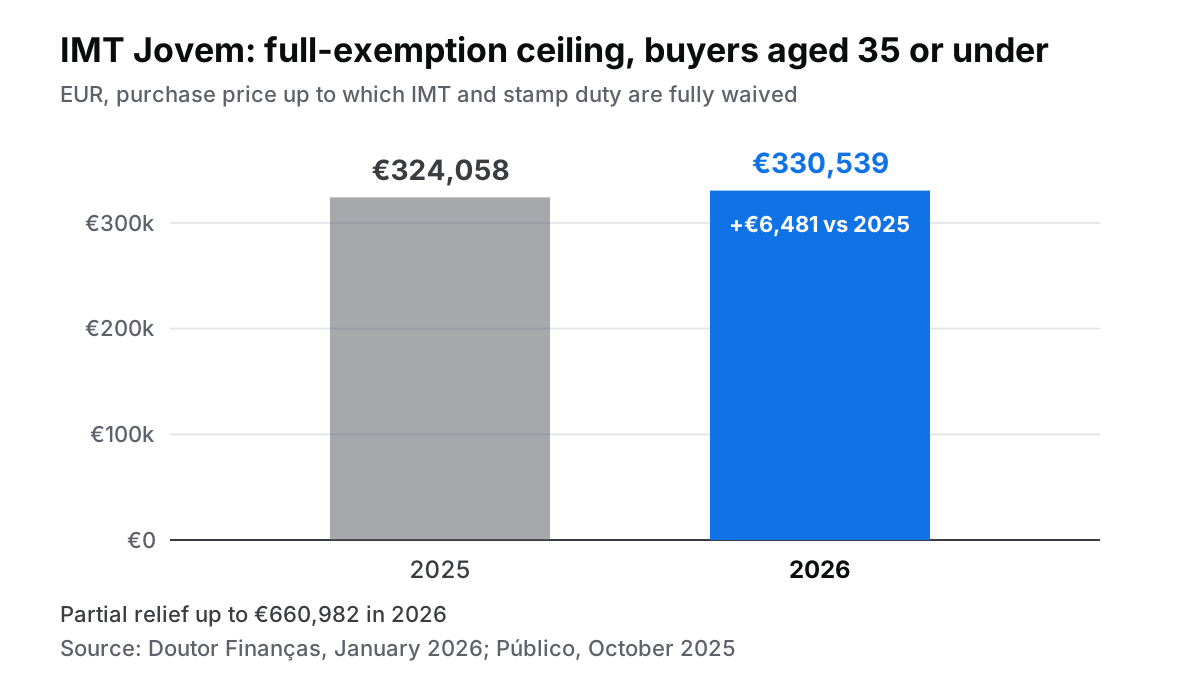
Younger buyers benefit from targeted tax relief under the IMT Jovem initiative. First-time buyers aged 35 or under purchasing a primary residence are fully exempt from both IMT and stamp duty up to a purchase price of €330,539 in 2026 (up from €324,058 in 2025), with partial tax relief extending up to €660,982.
In addition to transaction taxes, buyers must budget for notary fees, legal representation, land registry fees, and ongoing annual municipal property tax (IMI). Sellers must present an energy performance certificate prior to sale; learn why the energy certificate matters when you sell or let. For a complete breakdown of legal steps, read our step-by-step guide to buying property in Portugal.
The places that make the quarter: market, church, viewpoint, Pink Street
Cais do Sodré’s urban identity stems from a combination of historic landmarks and modern public spaces:
- Mercado da Ribeira: The landmark 1882 covered market houses both the traditional municipal fresh produce market and the Time Out Market food hall, featuring curated dining stalls.
- Praça de São Paulo and Igreja de São Paulo: A calm daytime square centered around the historic church rebuilt after the 1755 earthquake, which transforms into a social meeting place in the evening.
- Rua Nova do Carvalho (Pink Street): Once a district of historic sailors’ taverns, this street was repainted pink as part of an urban renewal initiative and now serves as a nightlife corridor.
- Miradouro de Santa Catarina: Positioned at the crest of the hill around the Adamastor statue, this scenic overlook provides panoramic views across the Tagus River and 25 de Abril Bridge.
- Ribeira das Naus: The wide, stepped promenade and lawn area stretching between Cais do Sodré station and Praça do Comércio along the former naval dockyard site.
How CASAFARI reads the Cais do Sodré market
Evaluating real estate in compact, high-density historic parishes requires granular local data. Through Area Insights, CASAFARI’s neighbourhood market data, property professionals analyze hyper-local metrics such as average asking prices per square metre, days on market, inventory distribution by property size, and available long-term rental stock.
For real estate agents and valuers, individual property features heavily influence valuations. In Pombaline structures, factors like building floor level, elevator access, outdoor space, and unobstructed river views create substantial price variations between units of identical square meterage. Professionals rely on Comparables and valuation reports to perform precise valuation models based on real-time market data.
Developers and real estate analysts can review technical specifications via Area Insights documentation on developers.casafari.com. To access current real estate inventory and property analytics across Portugal, sign in to the CASAFARI platform.
Visiting Praça de São Paulo at 11:00 AM reveals a serene residential neighbourhood with quiet cafes and market shoppers. Visiting at 11:00 PM reveals a lively social hub. Real estate data helps buyers understand both sides of Cais do Sodré before making an investment decision.
Frequently asked questions
Can I buy a flat in Cais do Sodré and let it on Airbnb?
Not under a new short-let registration. Cais do Sodré sits within Lisbon’s Misericórdia parish, which municipal short-let regulations (RMAL approved December 2025) place in absolute containment because short-term rental units equal 43.8% of total permanent housing, far exceeding the 10% threshold. Consequently, new short-term rental (Alojamento Local) licences are not granted. Properties with pre-existing, valid registrations require thorough legal verification before acquisition.
Does buying property in Cais do Sodré qualify for Portugal’s Golden Visa?
No. Law 56/2023 ended real estate acquisition and property-backed capital transfers as qualifying investment routes for the Golden Visa programme in October 2023. Investors seeking Portuguese residency must pursue alternative pathways, such as eligible investment funds, corporate creation, or research initiatives. For income taxation, qualifying new residents can explore the IFICI regime, which offers a 20% flat tax rate on eligible income for ten years.
How do I get from Cais do Sodré to Cascais, the airport and the south bank?
Cais do Sodré station acts as the primary Lisbon terminus for the Linha de Cascais railway line, offering direct train service to coastal towns including Estoril and Cascais. The station is also the terminal for Metro de Lisboa’s Linha Verde (green line); reaching Lisbon Airport requires taking the green line to Alameda and changing to the red line. Passenger ferries depart regularly from the river terminal to south bank destinations including Cacilhas, Seixal, and Montijo.
What taxes do I pay when buying an apartment in Cais do Sodré?
Purchasers pay IMT (property transfer tax) on a progressive scale, with 2026 brackets starting with a nil-rate threshold up to €106,346 for primary residences, alongside a 0.8% stamp duty on the purchase price. Under the IMT Jovem initiative, buyers aged 35 or under purchasing a first primary home receive a full exemption from IMT and stamp duty up to €330,539 in 2026, with partial relief available up to €660,982. Buyers must also budget for notary fees, registration costs, and annual IMI property taxes.