
CAMPO DE OURIQUE PROPERTY GUIDE
Family friendly neighborhood in Lisbon
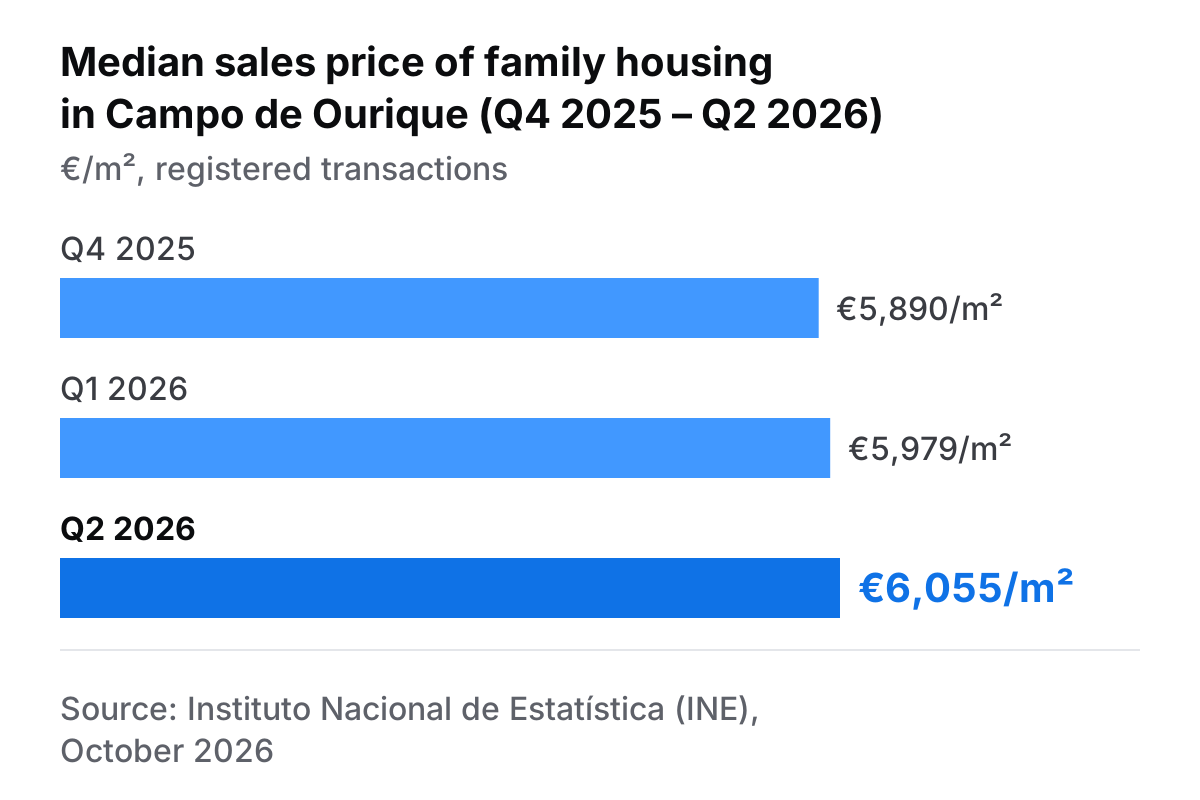
Campo de Ourique is a flat, 1.65 km² residential parish in Lisbon with 22,140 residents, laid out in an orthogonal grid in 1879 by engineer Frederico Ressano Garcia. In Q2 2026, family housing in the parish reached a median transaction price of €6,055/m², making it one of central Lisbon’s most established residential markets for long-term domestic and international buyers.
Why invest in a property in Campo de Ourique, Lisbon?
Positioned on a high plateau between Estrela, Alcântara and Campolide, Campo de Ourique offers flat walkability that is rare across central Lisbon. Originally planned in April 1879 on former estate grounds adjacent to army barracks, the district features wide streets lined with late-19th and early-20th-century residential structures, Art Nouveau facades, and selected modern infill developments. According to Junta de Freguesia de Campo de Ourique census and historical records, the parish spans 1.65 km² and is home to 22,140 residents.
Real estate valuation metrics demonstrate steady capital retention. Official data from the Instituto Nacional de Estatística (INE) Q2 2026 housing price data records a median transaction price for family housing of €6,055/m² in Q2 2026. This marks a consistent upward trajectory from €5,979/m² in Q1 2026 and €5,890/m² in Q4 2025.
Family demand remains strong due to the presence of respected educational institutions. Redbridge International School is located centrally at Rua Francisco Metrass, 97, offering English, French and Portuguese streams alongside Cambridge and IB curricula. Meanwhile, the Lycée Français Charles Lepierre sits on the northern edge of the parish at Avenida Engenheiro Duarte Pacheco, 32. Overseas investors consulting a guide to buying property in Portugal should note that residential yields in Campo de Ourique are primarily driven by mid-to-long-term tenancies.
Under Lisbon’s revised Regulamento Municipal do Alojamento Local (RMAL, published in December 2025 and updated in 2026), the historic neighbourhood (bairro) of Campo de Ourique is classified as an absolute containment zone (zona de contenção absoluta). As detailed in the current breakdown of Lisbon Alojamento Local containment zones under the revised RMAL, no new short-term rental licences can be registered in the core neighbourhood, reinforcing its character as a primary residential haven.
Public transport accessibility relies on traditional surface transport alongside upcoming infrastructure plans. The terminus for Carris historic tram routes 25E (connecting via Santos and Estrela to Praça da Figueira, as detailed on the Carris 25E tram route between Praça da Figueira and Prazeres) and 28E (running via Graça and Chiado to Martim Moniz) is located at Prazeres. The proposed extension of the Lisbon Metro Red Line (Linha Vermelha) includes a new station constructed 31 metres beneath Jardim da Parada with a target completion date of 2030. However, an October 2026 update on the Lisbon Metro Red Line extension confirms that construction work is currently paused while awaiting a Council of Ministers budget rescheduling resolution for Court of Auditors (Tribunal de Contas) clearance. Real estate professionals can track neighbourhood valuation metrics using CASAFARI Area Insights or run comparative analysis with our property valuation and market study tool.
Living in Campo de Ourique, Lisbon: daily life on the 1879 grid
The neighborhood’s daily life centers around Jardim Teófilo Braga, known locally as Jardim da Parada. Originally established as a military parade ground, the space was transformed in the 1890s into a public garden with mature trees, traditional pavement kiosks, and a dedicated dog park.
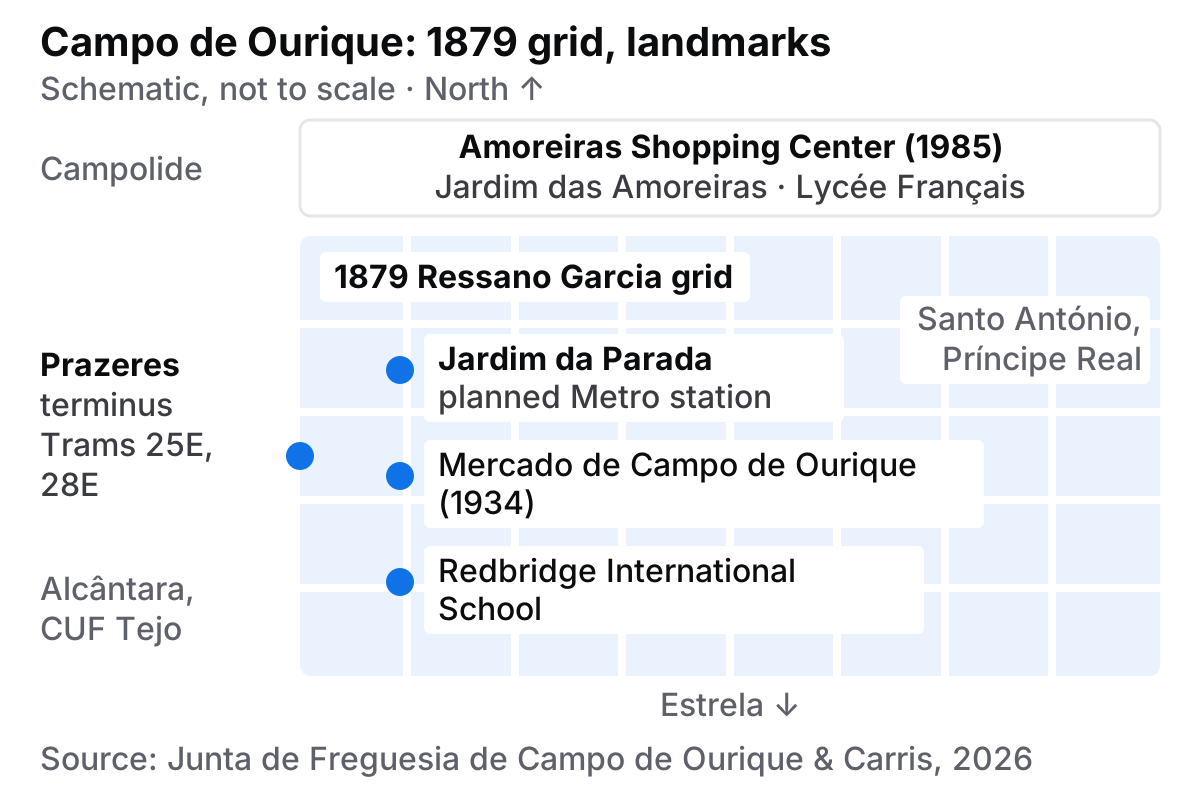
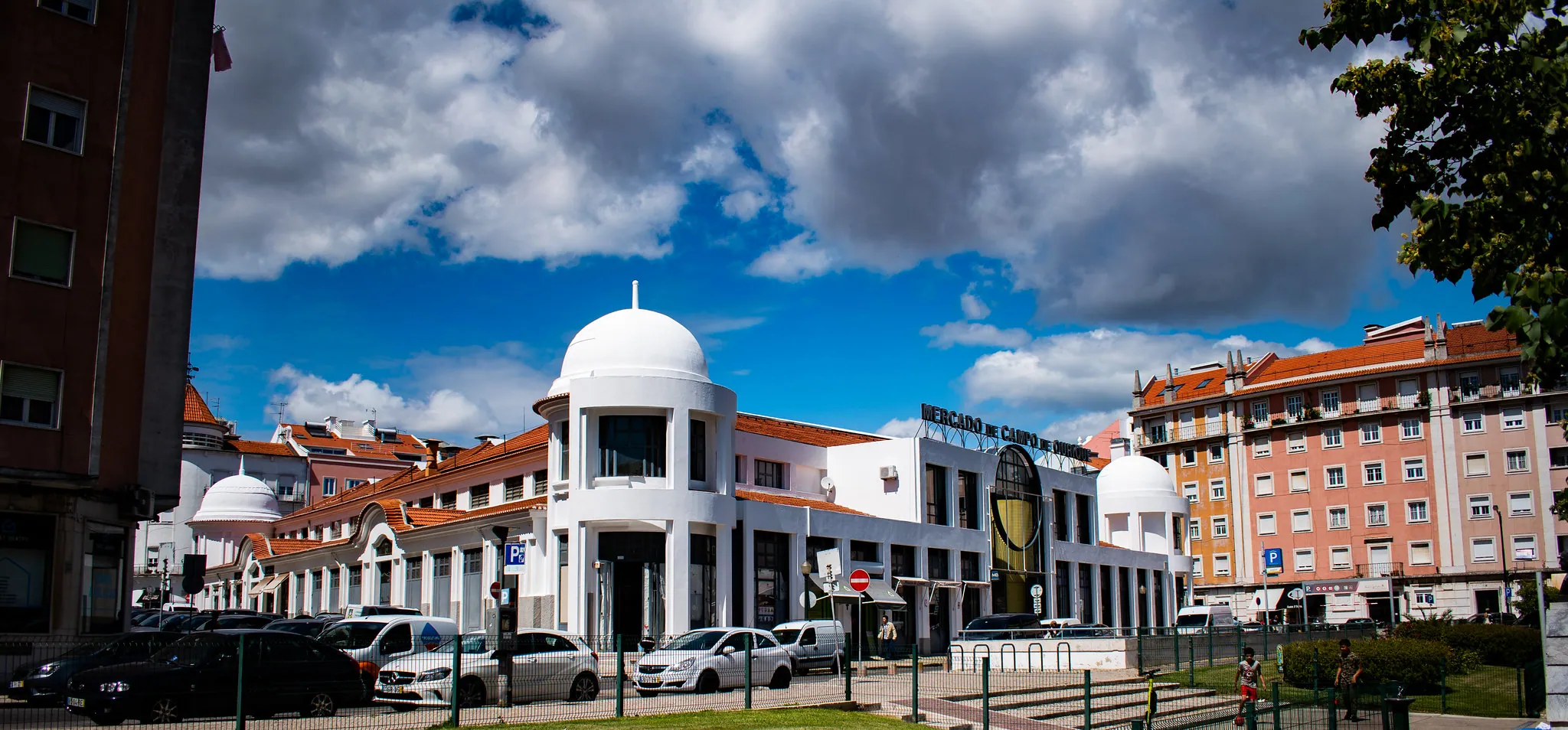
Commercial life is anchored by Mercado de Campo de Ourique. Designed by architect António Couto Martins and opened on 14 April 1934, the building was updated in 1991 and redesigned by architect António Maria Braga in 2013 into a hybrid municipal fresh-food market and culinary dining hall. The market opens Sunday to Wednesday from 10:00 to 23:00, Thursdays from 10:00 to 00:00, and Fridays and Saturdays from 10:00 to 01:00.
Street-level retail flourishes along Rua Ferreira Borges and Rua Saraiva de Carvalho, lined with independent bakeries, florists, bookshops and clothing boutiques. Driven by steady local owner-occupiers and long-term tenants, local leasing activity aligns with broader structural shifts in the evolution of Lisbon rental prices.
Amoreiras: postmodern architecture, greenery and city-wide connections
At the northern perimeter of the parish lies Amoreiras, dominated by the postmodern complex designed by architect Tomás Taveira and opened on 27 September 1985. An overview from the Open House Lisboa architectural profile of the 1985 Amoreiras complex highlights its multi-use layout incorporating corporate offices, broad residential units with underground parking, a panoramic 360-degree viewing deck, and Lisbon’s first major shopping centre. The complex’s anchor hypermarket, previously operating under the Pão de Açúcar and Jumbo banners, now trades as Auchan.
Private healthcare access is supported by neighborhood medical centers near Jardim das Amoreiras, while full inpatient and outpatient coverage is provided by Hospital CUF Tejo, which opened on 28 September 2020 in neighboring Alcântara following the permanent closure of Hospital CUF Infante Santo in November 2020.
Residents in Amoreiras benefit from proximity to the 18th-century Águas Livres Aqueduct arches, green spaces at Jardim das Amoreiras, and direct road links via Avenida Engenheiro Duarte Pacheco toward the A5 motorway, Monsanto Forest Park, and central hubs like Príncipe Real.
Agents and property developers seeking live street-level data, active market inventory and valuation tools can sign in to the CASAFARI platform or explore our English-language Area Insights API documentation.
Frequently asked questions
Can you get a short-term rental (Alojamento Local) licence in Campo de Ourique?
No new short-term rental licences can be issued in the core neighbourhood. Under the revised Lisbon Municipal Alojamento Local Regulation (RMAL), the historic neighbourhood of Campo de Ourique is classified as an absolute containment zone (zona de contenção absoluta). While the wider parish maintains a total tourist licence ratio below 5%, this local restriction blocks new registrations and directs real estate investment into long-term residential leases.
Which international schools are in Campo de Ourique and Amoreiras?
The area features two prominent international educational institutions within easy walking distance. Redbridge International School operates its main campus in the heart of the grid at Rua Francisco Metrass, 97, offering English, French and Portuguese bilingual streams along with Cambridge and IB programmes. On the northern border in Amoreiras, the Lycée Français Charles Lepierre is situated at Avenida Engenheiro Duarte Pacheco, 32, catering to students from primary through secondary levels.
When will the Lisbon Metro reach Campo de Ourique and how is it connected now?
A new underground station 31 metres beneath Jardim da Parada is planned as part of the Lisbon Metro Red Line extension, with an operational target of 2030. However, as of October 2026, construction works are temporarily halted pending a Council of Ministers budget rescheduling resolution for Court of Auditors clearance. In the meantime, the neighbourhood relies on Carris bus routes and historic trams 25E and 28E, both of which terminate at Prazeres.
What is the difference between buying in the Campo de Ourique grid and Amoreiras?
The 1879 Ressano Garcia orthogonal grid of Campo de Ourique predominantly offers late-19th and early-20th-century apartment buildings featuring classic tiled facades and high ceilings, located near street-level shops and the local municipal market. Amoreiras, centered on Tomás Taveira’s 1985 postmodern complex, provides late-20th-century and modern residential towers equipped with underground parking, lift access, concierge services and rapid road connections via Avenida Engenheiro Duarte Pacheco.