
BEATO PROPERTY GUIDE
A lively and welcoming neighborhood in the eastern part of downtown Lisbon
Walking east along Rua de Xabregas past the convent walls of the tile museum towards the former army depot, you enter Beato: Lisbon’s fastest-changing eastern riverside parish. Situated between Santa Apolónia and Marvila along the Tagus, this former industrial area offers warehouse conversions, historic convents, and tech hubs like the Hub Criativo do Beato. While it lacks a metro station, its strategic waterfront location and ongoing urban regeneration make it a compelling focus for buyers and investors analysing Lisbon real estate using CASAFARI Area Insights.
Where exactly is Beato, and what does it feel like?
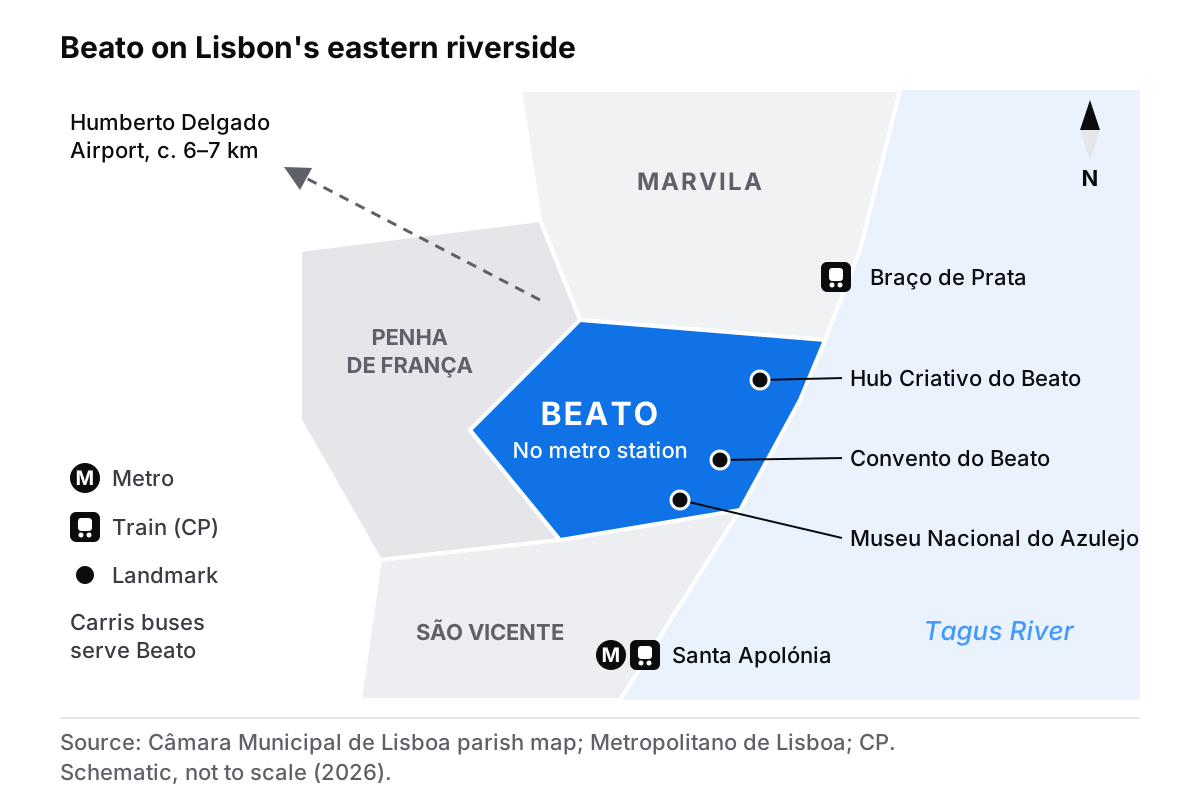
Beato is a civil parish (freguesia) located on Lisbon’s eastern waterfront. Its neighbouring parishes are Marvila to the north-east, Penha de França to the west, and São Vicente to the south-west, with the Tagus River running along its eastern border. It does not border Alfama, which lies two parishes further south-west.
The name ‘Beato’ originates from Friar António da Conceição (known as Beato António) and the 15th-century Convento do Beato. Characterised by streetscapes such as Rua do Grilo, Xabregas, and Calçada do Duque de Lafões, the parish retains a mix of 19th-century industrial architecture, aristocrat palaces, and former religious buildings.
In terms of transport, Beato does not have a metro station. Connectivity relies on Carris bus routes—including line 728 along the river—and CP suburban train services at Braço de Prata station on the Azambuja line. Santa Apolónia station, the terminus for the Blue Line metro and national rail services, sits roughly 1.5 to 2.5 km south-west depending on the street. Humberto Delgado Airport (LIS) is located approximately 6 to 7 km north by road.
Why are buyers and investors looking at Beato now?
The central driver of regeneration in the parish is the Hub Criativo do Beato, occupying the former Manutenção Militar army supply complex. Managed by Startup Lisboa for the Câmara Municipal de Lisboa, this major project houses initiatives such as Unicorn Factory Lisboa across renovated industrial spaces.
This commercial revival has stimulated residential development across the eastern riverfront, particularly warehouse-to-loft conversions and modern residential blocks that span Beato and neighbouring Marvila. Buyers comparing both parishes can review our earlier highlights post on Beato alongside real-time market metrics. Using CASAFARI Area Insights, investors and agents can assess parish-level listing volumes, supply distribution, and average time on market.
What has changed for foreign buyers since 2023: residency, tax and short lets?
Foreign buyers looking at Beato must navigate several legal and tax changes enacted since 2023:
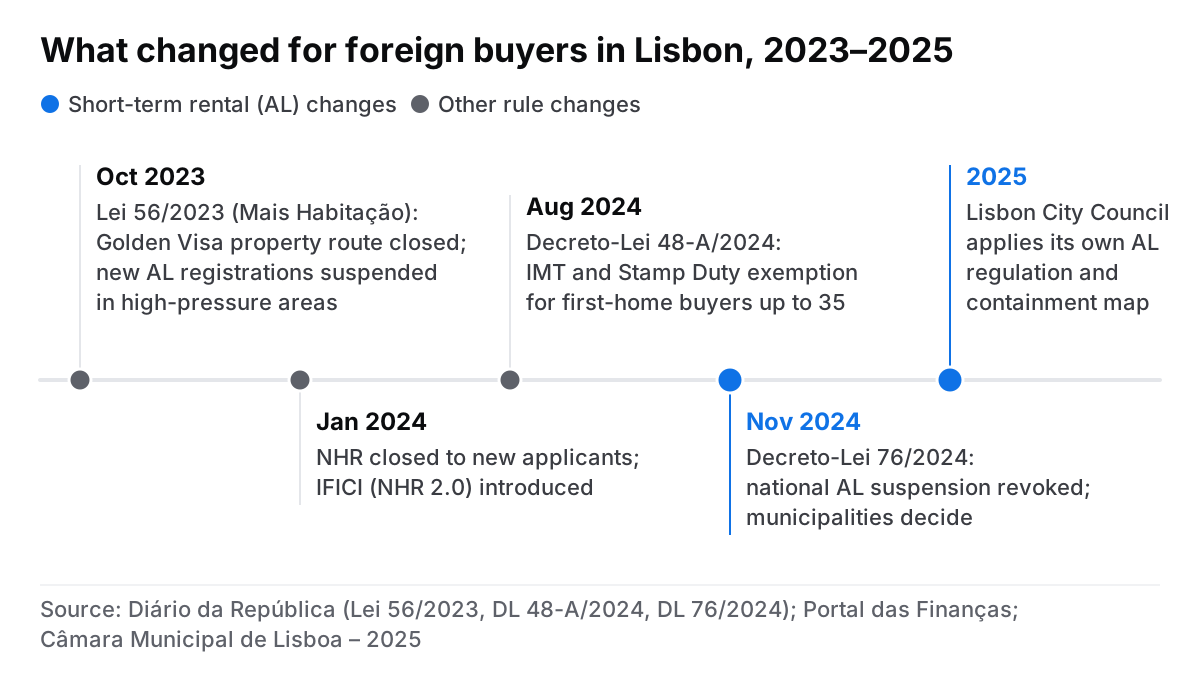
- Golden Visa (ARI): Real estate investment was formally removed as a qualifying path for residency under Lei n.º 56/2023 (Mais Habitação) in the Diário da República in October 2023. Alternative non-property residency options are detailed in our guide to buying property in Portugal.
- Taxation (NHR & IFICI): The original Non-Habitual Resident (NHR) tax regime closed to new applicants at the start of 2024. It was replaced by the IFICI scheme, focused on specific qualified roles and scientific research. Real estate buyers should verify their personal tax status on the IMT, IMI and Stamp Duty tables on the Portal das Finanças.
- Transaction Costs & Holding Taxes: Property acquisition incurs progressive IMT transfer tax (with higher rates for non-primary residences), Stamp Duty at 0.8% of the purchase price, and notary/registration fees. Annual municipal property tax (IMI) for Lisbon was set at 0.3% in 2025.
- Short-Term Rentals (Alojamento Local): National suspensions on new short-let licences were revoked by Decreto-Lei n.º 76/2024 on Alojamento Local, returning licensing control to municipalities. Prospective short-let hosts must consult the Câmara Municipal de Lisboa’s Alojamento Local regulation and containment map to confirm if new licences are permitted in specific Beato zones. Investors evaluating long-term rental options can analyze historical trends such as how Lisbon rents moved from 2018 to 2023.
Art, culture and history on your doorstep
Beato is home to several significant cultural institutions. The Museu Nacional do Azulejo, located at Rua da Madre de Deus 4, resides within the Convento da Madre de Deus, founded in 1509 by Queen D. Leonor. The museum displays five centuries of decorative ceramic tiles.
Contemporary art is represented by commercial spaces such as Galeria Filomena Soares at Rua da Manutenção 80, established in 1999. In addition, restored heritage properties including Palácio do Grilo and the Convento do Beato serve as private event spaces and cultural venues.
Where to eat and drink in the neighbourhood
Dining options in Beato reflect its industrial past and heritage architecture. A Casa do Bacalhau, located at Rua do Grilo 54, operates inside the vaulted former stables of the Palácio do Duque de Lafões, offering traditional Portuguese cod specialities.
A ten-minute walk into adjoining Marvila offers access to craft breweries and converted warehouse dining spaces. For wine enthusiasts, the wider Lisbon wine region (including the Bucelas and Colares DOCs) is situated within an hour’s drive of the parish.
Santo António and local cultural life
Lisbon celebrates its patron saint during the Festas de Lisboa each June. On the night of 12 June, street festivities occur across the city, characterised by grilled sardines, caldo verde, bifanas, and traditional pots of basil (manjerico). 13 June is an official municipal holiday in Lisbon, with event details published annually by Festas de Lisboa (Santo António).
Schools, daily life and practicalities
Beato provides day-to-day services including neighbourhood markets, local shops, and municipal services via the Junta de Freguesia. International schools serving Greater Lisbon—such as St Julian’s, Carlucci American International School, and the British School of Lisbon—are located predominantly in the western municipalities of Oeiras, Cascais, and Sintra or central Lisbon.
For real estate professionals, identifying available inventory in the area is straightforward using Property Sourcing, while establishing valuation benchmarks for unique conversion projects can be conducted via Comparables and market studies.
How to research a Beato purchase with CASAFARI data
Evaluating real estate opportunities in Beato requires clean market data across fragmented listings. CASAFARI aggregates market activity to provide clear insights into parish performance.
Developers and real estate analysts can review the Area Insights developer documentation (in English) or try Area Insights on the CASAFARI platform to analyze real-time pricing distributions and supply figures for Beato.
Frequently asked questions
Is Beato a good area to live in Lisbon?
Beato is a quiet, riverside parish located between Santa Apolónia and Marvila. It offers a mix of converted industrial properties, traditional housing, and new commercial spaces driven by the Hub Criativo do Beato. While it lacks a metro station, its proximity to central Lisbon and the Tagus riverfront makes it appealing to residents seeking a residential neighbourhood slightly removed from the heavy tourist centre.
Can I let a Beato flat as an Airbnb (Alojamento Local)?
Short-term holiday rental licences in Lisbon are governed by municipal containment rules following national legal changes in late 2024. Buyers must inspect the official Câmara Municipal de Lisboa containment map to determine if new Alojamento Local registrations are allowed in a specific street in Beato. Existing condominium rules and building regulations should also be reviewed prior to purchase.
How do I get to Beato from Lisbon airport and the city centre?
Beato is situated roughly 6 to 7 km from Humberto Delgado Airport (LIS), which is approximately a 15 to 20 minute taxi ride outside peak traffic. From central Lisbon, the parish is served by Carris bus routes such as the 728 along the riverbank, as well as CP suburban trains stopping at Braço de Prata station. Santa Apolónia station sits just south-west of the parish border.
What taxes and costs do I pay when buying a flat in Beato?
Purchasing real estate in Beato involves IMT transfer tax (calculated on a progressive scale based on property value and usage), Stamp Duty at 0.8% of the purchase price, and notary and registration fees. Property owners must also pay annual municipal property tax (IMI), set at 0.3% by Lisbon municipality in 2025. Note that purchasing residential property no longer qualifies for the Portuguese Golden Visa scheme.