

ALCÂNTARA PROPERTY GUIDE
A historic neighborhood in a trendy district
On a Saturday morning along Rua Rodrigues de Faria, footsteps echo through former industrial courtyards while suburban trains glide towards Alcântara-Terra behind 19th-century brick facades. Alcântara is Lisbon’s riverside civil parish situated between Santos and Belém, set beneath the northern spans of the 25 de Abril bridge. Serving as a crucial transition zone between central Lisbon and the western coast, the district combines historic housing, creative commercial hubs, rail and tram lines, and a Metropolitano de Lisboa extension currently under construction. For live district valuations and listing activity across Lisbon, check real-time market metrics using district-level price and stock data in Area Insights.
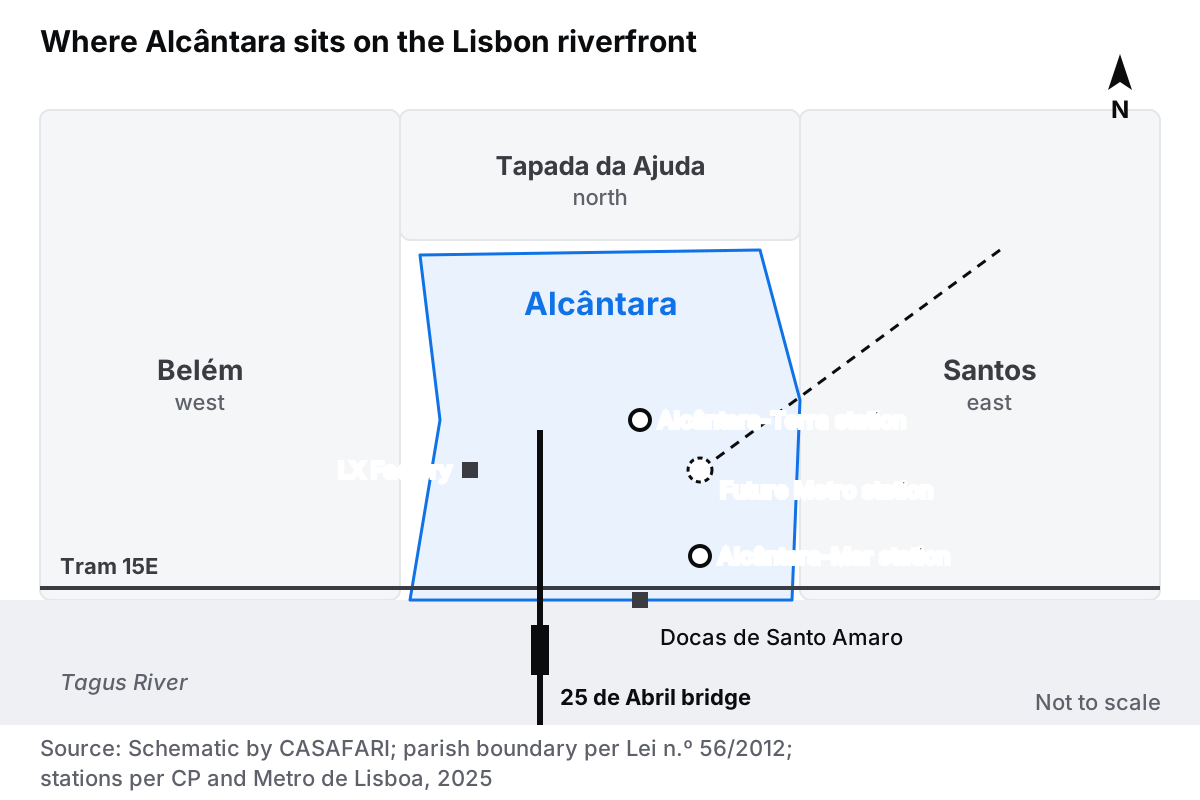
Where Alcântara sits and what the district feels like
Alcântara is defined by its topography and industrial history. Bounded by the Tagus river to the south, the green expanse of Tapada da Ajuda and Monsanto to the north, and the Avenida de Ceuta valley to the east, the parish occupies a strategic position on the western riverfront. Its everyday urban core centres around Largo do Calvário and Rua Prior do Crato, where traditional residential streets meet local commercial trade.
The parish comprises three distinct environments within a single administrative boundary. Along the waterfront, converted dock warehouses at Doca de Santo Amaro and the marina form an active leisure strip directly beneath the 25 de Abril bridge. Immediately inland, former 19th-century industrial complexes—most notably LX Factory—have been repurposed into commercial spaces for design, technology and dining. Ascending the hillside towards Ajuda and Estrela, the neighbourhood transitions into quieter residential quarters dominated by late 19th- and early 20th-century residential buildings.
Compared with historic core districts such as Chiado or Cais do Sodré, Alcântara offers a broader mix of open spaces and residential quietness, balanced by localized weekend visitor traffic around its commercial centres. The parish also hosts significant cultural venues, including the Museu do Oriente in a converted 1940s cod warehouse on Avenida Brasília, the Museu da Carris on Rua 1.º de Maio, and the Pilar 7 bridge experience. Surrounding landmarks like the Jerónimos Monastery and Belém Tower lie just beyond the parish’s western border in neighbouring Belém.
How well connected is Alcântara?
Alcântara functions as a key transport nexus for western Lisbon, providing dual-network rail connections, tram services and major roadway links.
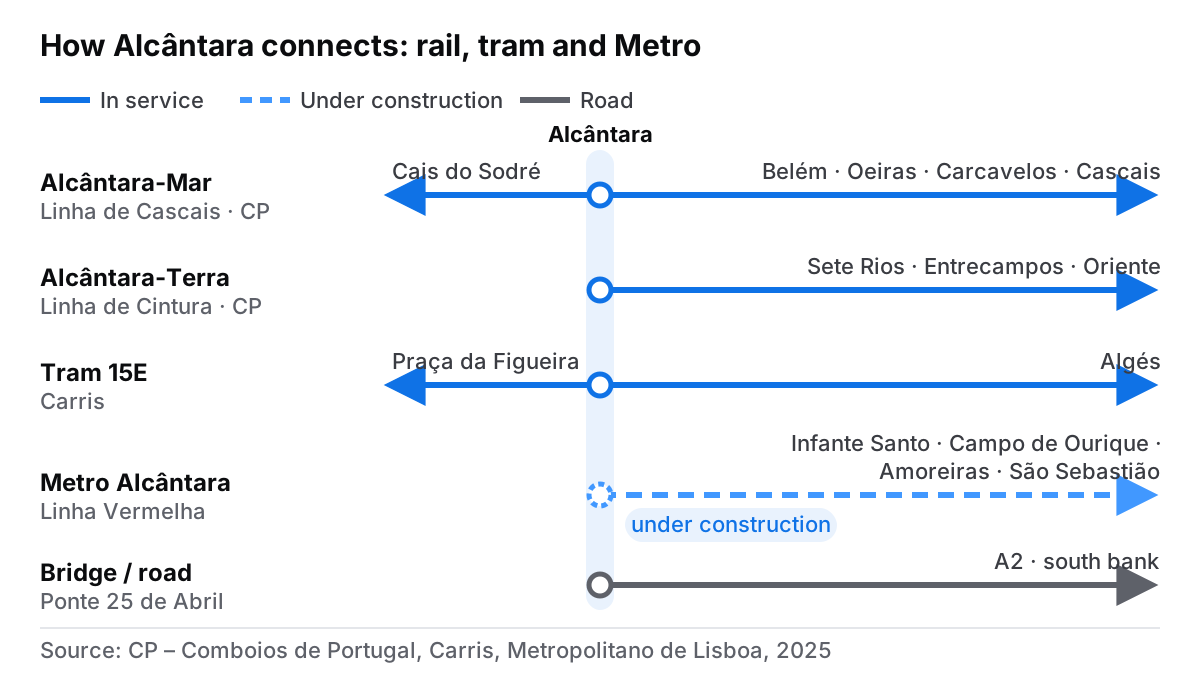
The parish contains two separate railway stations operated by CP – Comboios de Portugal:
- Alcântara-Mar: Positioned on the Linha de Cascais, connecting Cais do Sodré in central Lisbon with coastal destinations including Belém, Oeiras, Carcavelos and Cascais.
- Alcântara-Terra: Located on the Linha de Cintura, providing direct train service northbound towards Sete Rios, Entrecampos and Gare do Oriente.
Public transit along the riverfront is heavily anchored by the Carris tram 15E route, which connects Praça da Figueira in central Lisbon to Algés, complemented by multiple municipal bus routes and a dedicated riverfront cycle path running from Cais do Sodré to Belém.
To address long-standing gaps in rapid mass transit, Metropolitano de Lisboa is currently constructing an extension of the Linha Vermelha (red line) from São Sebastião through Amoreiras, Campo de Ourique and Infante Santo, terminating at a new station in Alcântara. For vehicle traffic, the parish provides immediate access to the 25 de Abril bridge—built by the American Bridge Company and carrying the Fertagus rail line on its lower deck—offering direct passage via the A2 motorway to southern Portugal, as well as eastern arterial routes along Avenida 24 de Julho.
LX Factory, Docas de Santo Amaro and daily life
Daily life in Alcântara balances neighbourhood retail with major commercial drawcards. The former 1846 textile complex of the Companhia de Fiação e Tecidos Lisbonense on Rua Rodrigues de Faria was converted in 2008 into LX Factory. Today, this complex houses design studios, corporate offices, restaurants and cultural spaces such as the Ler Devagar bookstore. While LX Factory brings sustained footfall and commercial vitality to the neighbourhood, resident buyers should note the associated traffic and crowd density on weekends.
Similarly, Docas de Santo Amaro features a row of converted warehouse restaurants operated under the authority of the Port of Lisbon. Positioned beside the marina, the area is a focal point for evening dining. Potential residential buyers looking at properties facing the riverfront or the bridge approach should consider evening noise levels and overhead traffic hum as part of their evaluation.
For daily practicalities, the area surrounding the Mercado de Alcântara and Rua Prior do Crato provides traditional groceries, bakeries and banks, supported by larger supermarkets along Avenida de Ceuta. Healthcare needs are served by the public Hospital de Egas Moniz (ULS Lisboa Ocidental) situated on the parish boundary with Belém, alongside local parish administrative services from the Junta de Freguesia de Alcântara. Families looking at educational options benefit from local public schools and convenient train connectivity via the Linha de Cascais to international schools located along the western coast.
What the Alcântara housing stock looks like
Alcântara’s architectural landscape reflects its evolution from a manufacturing quarter to a residential district.
The residential inventory generally falls into four main categories:
- 19th-century worker and merchant housing: Multi-storey structures featuring traditional tiled or rendered facades, primarily along the lower transit corridors and lower hillside streets.
- Mid-20th-century apartment blocks: Infilled residential buildings constructed between the 1930s and 1960s, offering classic layouts uphill towards Ajuda.
- Converted industrial buildings: Refurbished warehouses and loft spaces adapted for commercial and residential usage near the train lines and riverfront.
- Modern riverside developments: Contemporary multi-family residential complexes built on former industrial plots, providing underground parking, lift access and integrated facilities.
When evaluating property in Alcântara, international buyers should scrutinize specific building characteristics: whether a lift is present in older structures, the property’s energy performance rating, condominium maintenance history, and acoustic insulation against bridge overhead noise or rail lines.
To track transaction patterns, pricing dynamics and stock availability without relying on unverified averages, professionals use CASAFARI Area Insights. By aggregating and deduplicating property listings across major portals and agency websites, CASAFARI produces clean, structured market analytics for precise district valuation.
Buying in Alcântara as a foreign buyer: taxes, residency and short lets in 2025
Purchasing real estate in Portugal requires understanding structural legal and tax adjustments enacted between 2023 and 2024.
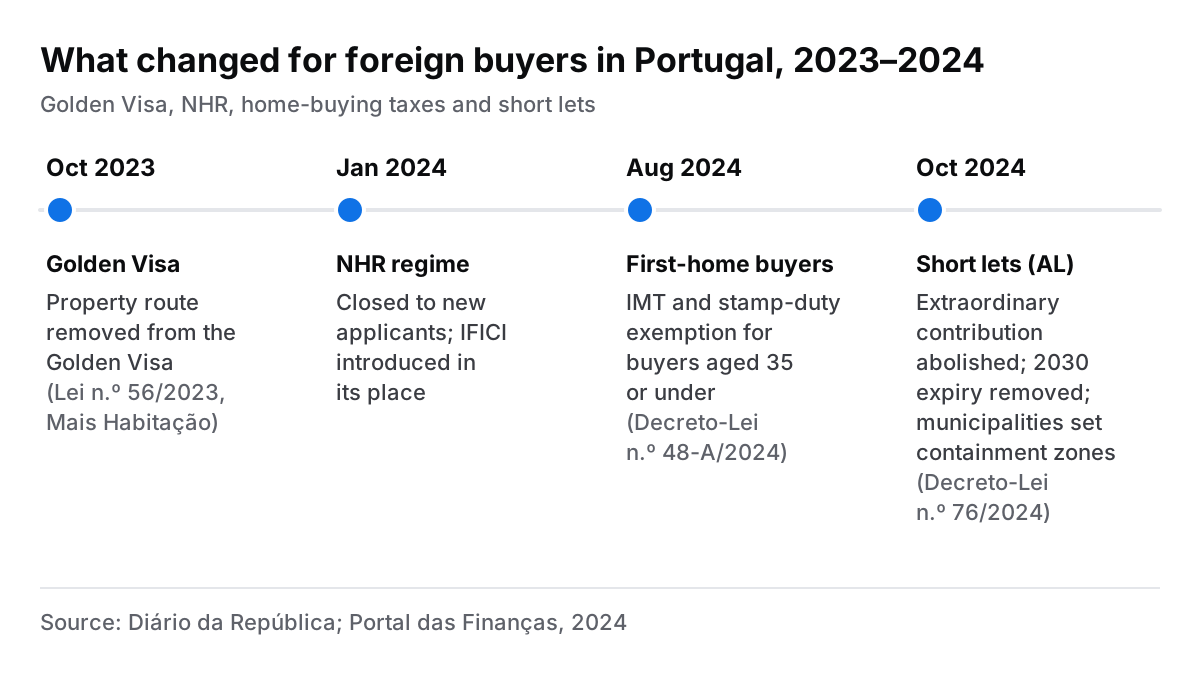
Acquisition costs and ongoing property taxes
Property transactions incur state transfer taxes and administrative fees administered by the Autoridade Tributária e Aduaneira:
- IMT (Imposto Municipal sobre as Transmissões Onerosas de Imóveis): A progressive property transfer tax calculated based on purchase value, intended property use (primary residence versus secondary/investment), and location.
- Imposto do Selo (Stamp Duty): Applied at a flat rate of 0.8% on the agreed purchase price or taxable property value.
- Municipal Property Tax (IMI): An annual municipal tax calculated on the property’s taxable value (VPT), set annually by the Câmara Municipal de Lisboa within statutory limits.
- AIMI (Additional IMI): Applies to buyers holding aggregate Portuguese real estate portfolios exceeding specific valuation thresholds.
Buyers seeking a full breakdown of the purchasing workflow, promissory contracts (CPCV) and deed execution should consult our step-by-step guide to buying property in Portugal.
Residency and tax incentive updates
Under Lei n.º 56/2023 (Mais Habitação), enacted in October 2023, direct property acquisition no longer qualifies for the Portuguese Golden Visa (ARI) residency programme. Investors seeking residency must evaluate non-real estate routes such as qualified investment funds or job creation. Furthermore, the Non-Habitual Resident (NHR) special tax status closed to new applicants at the start of 2024, replaced by the narrower IFICI framework focused on scientific research and specialized innovation.
Short-term rental regulations (Alojamento Local)
For investors planning short-let accommodation, legislative rules updated under Decreto-Lei n.º 76/2024 in October 2024 eliminated the mandatory national extraordinary contribution (CEAL), removed automatic 2030 licence expiries, and restored licence transferability. However, regulatory authority over new short-term rental (AL) registrations rests with local municipalities. Buyers must verify current municipal containment zone restrictions directly with the Câmara Municipal de Lisboa and check condominium regulations before relying on short-term rental yields. To understand broader residential market trends, explore how Lisbon rents moved between 2018 and 2023 and why Lisbon became the priciest capital in southern Europe.
Who Alcântara suits, and who it does not
Alcântara presents specific trade-offs depending on buyer priorities and investment profiles.
Alcântara is well suited to:
- Long-term investors and professionals: Buyers seeking strategic locations near business hubs, LX Factory commercial operations and the upcoming Metropolitano expansion.
- Coastal and urban commuters: Residents who value immediate train access along the Linha de Cascais to western international schools and beaches, combined with proximity to central Lisbon.
- Buyers desiring space and infrastructure: Buyers looking for riverside walking routes, cultural facilities and modern build options outside the high-density historic core.
Alcântara is less suited to:
- Buyers seeking complete evening quiet: Properties directly adjacent to Docas de Santo Amaro or major road and bridge infrastructure experience ambient urban noise.
- Immediate Metro users: Buyers who require direct underground rail access today, prior to the completion of the Linha Vermelha terminus.
When analyzing opportunities, professional valuation starts with comprehensive data. Estate agents and analysts evaluating specific flats can generate a valuation and market study for a specific flat or review how to run a market analysis for a district in CASAFARI.
To review real-time transaction activity, stock levels and pricing trends in Alcântara, sign in to the CASAFARI platform.
Frequently asked questions
Is Alcântara a good area to live in Lisbon?
Alcântara offers a balanced residential environment situated between central Lisbon and Belém, combining historic housing, riverfront amenities, and creative commercial hubs like LX Factory. It is well connected by two railway lines and tram 15E, offering a less congested environment than the historic city centre. However, residents near Docas de Santo Amaro or the 25 de Abril bridge access roads may experience higher weekend footfall and localized urban traffic noise.
Does Alcântara have a Metro station?
Alcântara does not currently have an operational Metropolitano de Lisboa station. Transit is presently served by CP suburban rail at Alcântara-Mar and Alcântara-Terra, as well as Carris tram 15E and multiple bus routes. An extension of the Metropolitano de Lisboa Red Line (Linha Vermelha) from São Sebastião to a new terminal station in Alcântara is currently under construction.
Can I rent out a flat in Alcântara as a short-term let?
Operating a short-term rental (alojamento local) requires an active registration licence. While national legislation under Decreto-Lei n.º 76/2024 removed mandatory licence expiries and national extraordinary contributions, municipal authority over new registrations rests with local councils. Buyers must check whether Alcântara falls within an active Lisbon municipal containment zone (zona de contenção) and confirm building condominium regulations before purchasing property intended for short-let use.
Can I still get a Golden Visa by buying property in Alcântara?
No. Under Lei n.º 56/2023 (Mais Habitação), which came into effect in October 2023, real estate acquisition was removed as an eligible investment route for the Portuguese Golden Visa (ARI). Investors must now consider alternative non-property pathways such as venture capital funds, research funding, or business creation. Additionally, the Non-Habitual Resident (NHR) tax status closed to new applicants in 2024, replaced by the narrower IFICI incentive.