
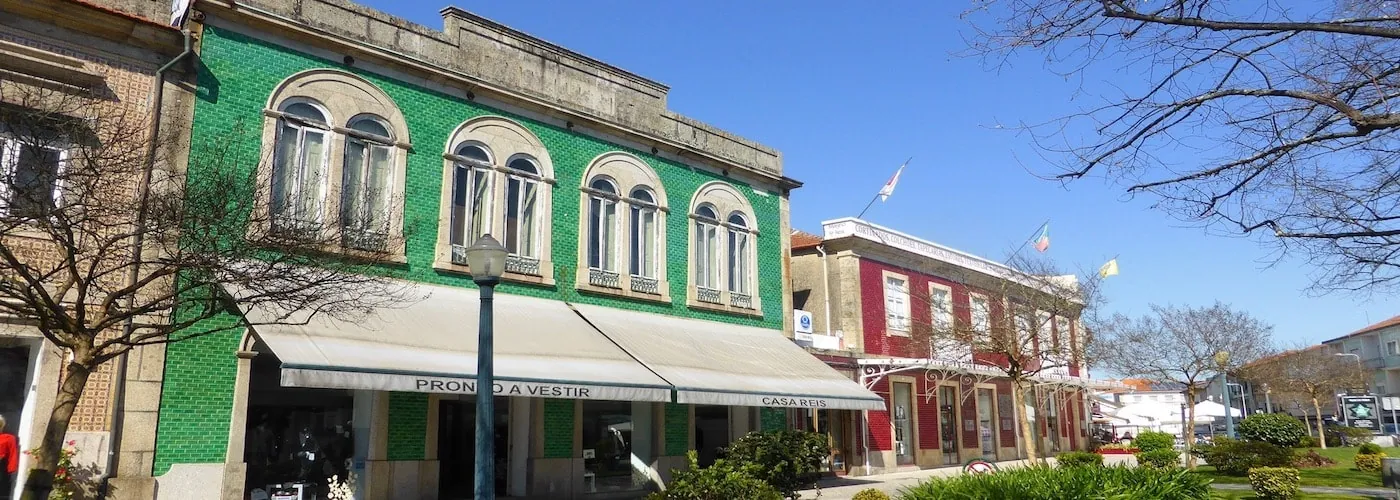
Buyers and real estate investors consider Santo Tirso property for its strategic position in the Porto district, where a 36-minute direct train journey connects residents to central Porto-Campanhã. Combining a competitive median residential transaction price of €1,700/m² according to Instituto Nacional de Estatística (INE) housing price statistics (Q1 2026) with Portugal’s lowest legal urban property tax rate of 0.30%, the municipality supports 69,810 residents across 14 parishes and a resilient base of 7,329 businesses.
Why are buyers and investors looking at Santo Tirso property?
Situated in the Ave Valley within the northern district of Porto, Santo Tirso borders the key commercial municipalities of Vila Nova de Famalicão, Guimarães, Paços de Ferreira, Trofa, Vila do Conde, and Maia. This geographical positioning creates a compelling alternative for professionals working in Porto or nearby industrial centres who seek lower residential acquisition costs without sacrificing accessibility.
While historic urban myths suggested a miniature municipal headcount, official demographic records confirm a robust local market. According to the PORDATA municipal portrait of Santo Tirso (2026), the municipality counted 67,709 residents in the 2021 INE Census and expanded by 3% to reach 69,810 residents by 2025 across its 14 parishes. The energetic urban core along the River Ave hosts modern apartment developments, while outer parishes feature generous detached family houses and traditional Portuguese quintas.
Local housing demand rests on a solid economic foundation rather than purely speculative tourism. Data from INE and INVEST Santo Tirso shows 7,329 active non-financial enterprises employing 27,071 people and generating €2,973.5 million in turnover. High-value manufacturing—including technical textiles, clothing, rubber, plastics, and precision metalworking—accounts for over half of municipal gross value added.
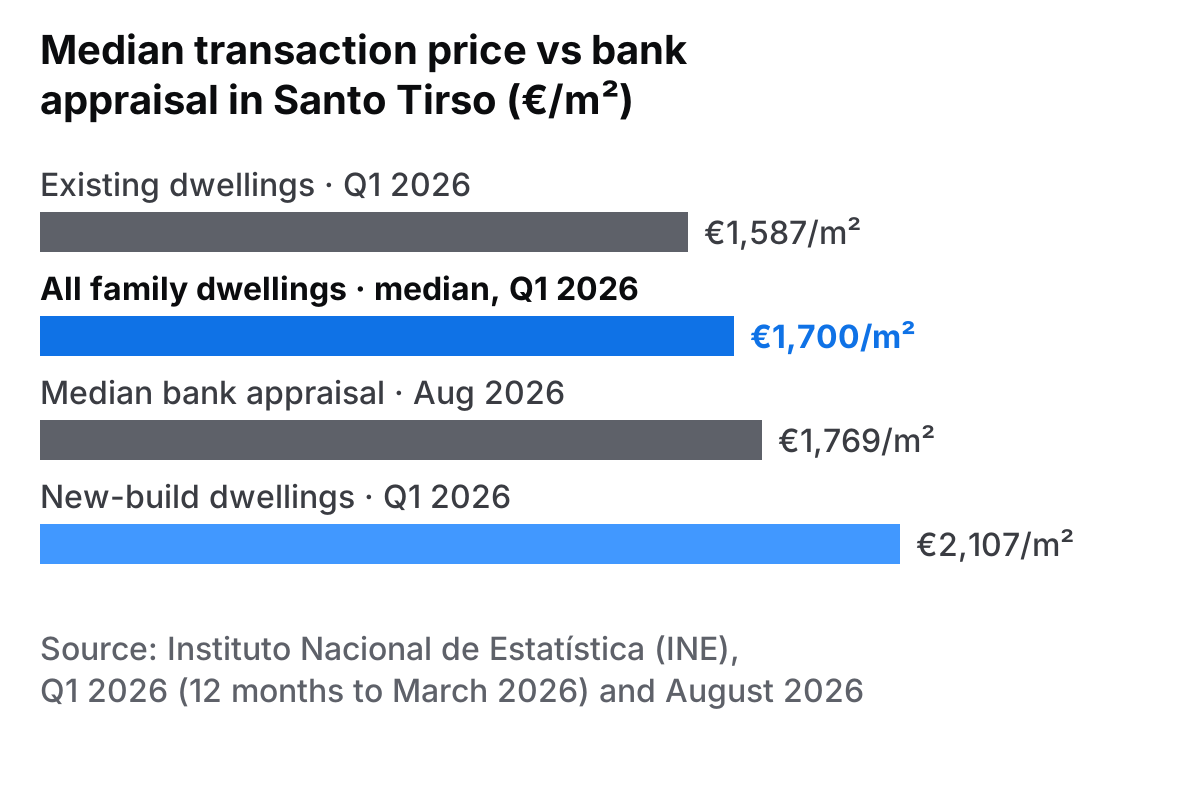
Residential values reflect this steady economic performance. In the 12 months to March 2026, INE figures established a median transaction price of €1,700/m² overall across the municipality. Existing homes traded at a median of €1,587/m², whereas new builds commanded €2,107/m². Demonstrating lender confidence, the median bank appraisal stood at €1,769/m² in August 2026. Real estate professionals assessing local inventory can utilise CASAFARI Area Insights and the property valuation and market study tool to benchmark pricing dynamics parish by parish.
How do taxes, residency rules and local incentives work in Santo Tirso?
International buyers moving to northern Portugal must navigate the updated national regulatory frame. Following the implementation of Law no. 56/2023 (Mais Habitação), direct or indirect real estate acquisitions no longer qualify for the Portuguese Golden Visa (ARI), as confirmed by AIMA Residence Permit for Investment (ARI) rules. Capital deployment for residence permits is now directed toward non-real-estate investment funds (€500,000 minimum) or commercial job creation.
Similarly, the original Non-Habitual Resident (NHR) tax regime closed to new entrants from 2024. It has been replaced by the IFICI framework (Incentivo Fiscal à Investigação Científica e Inovação). Designed for highly qualified specialists, scientific researchers, ICT professionals, engineers, medical researchers, and certified startup founders, IFICI offers a 20% flat income tax rate on qualifying Portuguese earnings for up to 10 years, alongside exemptions on most foreign-sourced non-pension revenue. Buyers reviewing financial strategy will find context in our broader guide to buying property in Portugal and overview of reasons to invest in property in Portugal.
At the local municipal level, Santo Tirso offers several direct tax relief incentives:
- Urban IMI Rate: The municipality charges the legal minimum urban IMI rate of 0.30%.
- IMI Familiar: Maximum allowance deductions apply for primary residences (€30 for 1 dependant, €70 for 2, and €140 for 3 or more dependants).
- Urban Rehabilitation Areas (ARU): Property owners undertaking urban restoration inside designated ARU boundaries benefit from complete or partial exemptions on IMI, property transfer tax (IMT), and municipal licensing fees via Câmara Municipal de Santo Tirso Urban Rehabilitation Area (ARU) incentives.
- Corporate Framework: Businesses benefit from a reduced municipal surcharge (Derrama) set at 0.1% for turnover up to €150,000 and 1.2% above, paired with streamlined approvals through the ‘Via Verde para o Investimento’ and Project of Municipal Interest (PIM) programmes.
What is daily life like in Santo Tirso: heritage, green spaces and schools?
Daily life in Santo Tirso centres around a deep cultural heritage balanced by modern public infrastructure. The municipality grew around the Monastery of São Bento (Mosteiro de Santo Tirso), founded in 978 and classified as a National Monument. The complex showcases a 17th-century church alongside historic Gothic cloisters.
Green open spaces are integrated directly into urban life. Parque Urbano Sara Moreira spans 96,274 square metres of oak and cork oak woodland along the banks of the River Ave, complementing the central 19th-century Parque D. Maria II. The town is further distinguished by the International Museum of Contemporary Sculpture (MIEC), an open-air collection distributing 57 modern sculptures across public parks.
Families moving to the municipality have access to respected private and cooperative educational institutions alongside comprehensive state schools:
- Colégio de Lourdes: Educates pupils from pre-school through to Year 12 secondary studies, specialising in Science & Technology and Socio-Economic Sciences.
- Instituto Nun’Alvres (INA): Located at Colégio das Caldinhas in Caldas da Saúde, INA provides primary, secondary, and vocational programmes through the paired APINA pre-school and OFICINA professional school.
- Colégio de Santa Teresa de Jesus: Offers nursery, primary, and lower secondary education up to Year 9 (3.º Ciclo).
Healthcare provision is anchored by the public Hospital Conde de São Bento (Unidade Hospitalar de Santo Tirso), part of the ULS do Médio Ave local health service. The hospital operates a 24-hour Basic Emergency Service (SUB), while complex medical-surgical and paediatric emergencies are handled by its paired hospital unit in neighbouring Vila Nova de Famalicão.
How well connected is Santo Tirso to Porto and Francisco Sá Carneiro Airport?
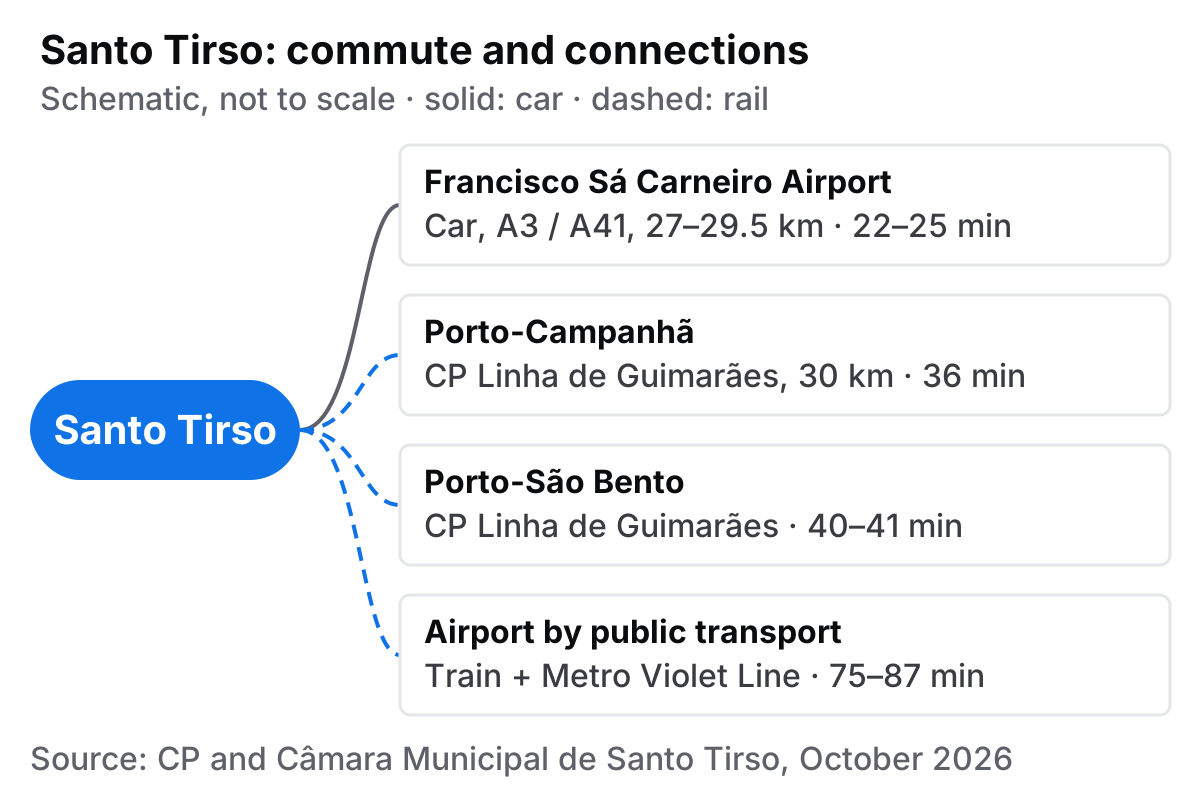
Commuters benefit from reliable rail connections into Porto. The CP Porto Urban Trains (Linha de Guimarães) cover the roughly 30 km rail line into the regional capital, as outlined in the CP Porto–Guimarães urban train timetable. Daily trains complete the journey to Porto-Campanhã in 36 minutes, reaching Porto-São Bento in 40 to 41 minutes.
Road connections provide swift access to regional hubs and international transit networks:
- Francisco Sá Carneiro Airport (Porto Airport): Situated 27 km to 29.5 km away via the A3 and A41 motorways, taking 22 to 25 minutes by car (or 1 hour 15 minutes to 1 hour 27 minutes via train and Metro do Porto Line E/Violet).
- Porto City Centre: Accessible in approximately 25 minutes by car via the A3 motorway.
- Coastal Atlantic Beaches: The coastal towns of Vila do Conde and Póvoa de Varzim are located 25 to 30 minutes away by road via the A41/A28 corridors.
For real estate professionals, buyers’ agents, and institutional investors evaluating northern Portugal, analyzing hyper-local pricing histories and off-market stock is essential. Estate agents use CASAFARI Property Sourcing to search consolidated market inventory across all 14 parishes, or sign in to the CASAFARI platform to monitor real-time pricing trends.
Frequently asked questions
How long is the train journey from Santo Tirso to Porto and how close is Porto Airport?
By rail on CP Porto Urban Trains (Linha de Guimarães), the 30 km journey takes 36 minutes to Porto-Campanhã and 40 to 41 minutes to Porto-São Bento with hourly services. By road via the A3 and A41 motorways, Francisco Sá Carneiro Airport is 27 to 29.5 km away, taking 22 to 25 minutes by car, or between 1 hour 15 minutes and 1 hour 27 minutes using combined public transport.
Can international buyers still use the Golden Visa or NHR tax regime when buying property in Santo Tirso?
Direct or indirect real estate purchases no longer qualify for Portugal’s Golden Visa (ARI) following Law no. 56/2023, though non-real-estate fund investments and job creation options remain available through AIMA. Similarly, the classic Non-Habitual Resident (NHR) regime closed to new applicants in 2024 and was replaced by IFICI, which offers a 20% flat tax rate on eligible income for 10 years to qualified professionals in technology, scientific research, engineering, and medicine.
What are the property tax (IMI) rates and local investment incentives in Santo Tirso?
The Municipality of Santo Tirso applies the minimum legal urban IMI rate of 0.30% and grants the maximum IMI Familiar fixed deduction of €30 for one dependant, €70 for two, and €140 for three or more. Property owners restoring buildings within the designated Urban Rehabilitation Area (ARU) and qualifying commercial projects can also access IMI and IMT tax exemptions or reductions alongside reduced municipal corporate surcharges.
Which schools and hospitals serve residents living in Santo Tirso?
Educational institutions include Colégio de Lourdes (nursery to Year 12), Instituto Nun’Alvres in Caldas da Saúde (basic, secondary, and vocational education), and Colégio de Santa Teresa de Jesus (pre-school to Year 9), alongside comprehensive state schools. Healthcare is anchored by Hospital Conde de São Bento (Unidade Hospitalar de Santo Tirso), which operates a 24-hour Basic Emergency Service (SUB), with specialized medical-surgical and paediatric emergency care provided at nearby Vila Nova de Famalicão.