
PORTO PROPERTY GUIDE
Get swept away by one of Portugal’s prettiest cities
The municipality of Porto records 273,476 residents (INE, end of 2025) and an average apartment asking price of €4,343/m² alongside an average asking rent of €26.0/m²/month in Q3 2026, according to CASAFARI Area Insights. Meanwhile, official transaction data from INE reports a median closing price of €3,631/m² for family dwellings in Q2 2026, reflecting strong capital appreciation across northern Portugal’s primary urban hub.
Where Porto sits and how new rail and metro links are reshaping the city
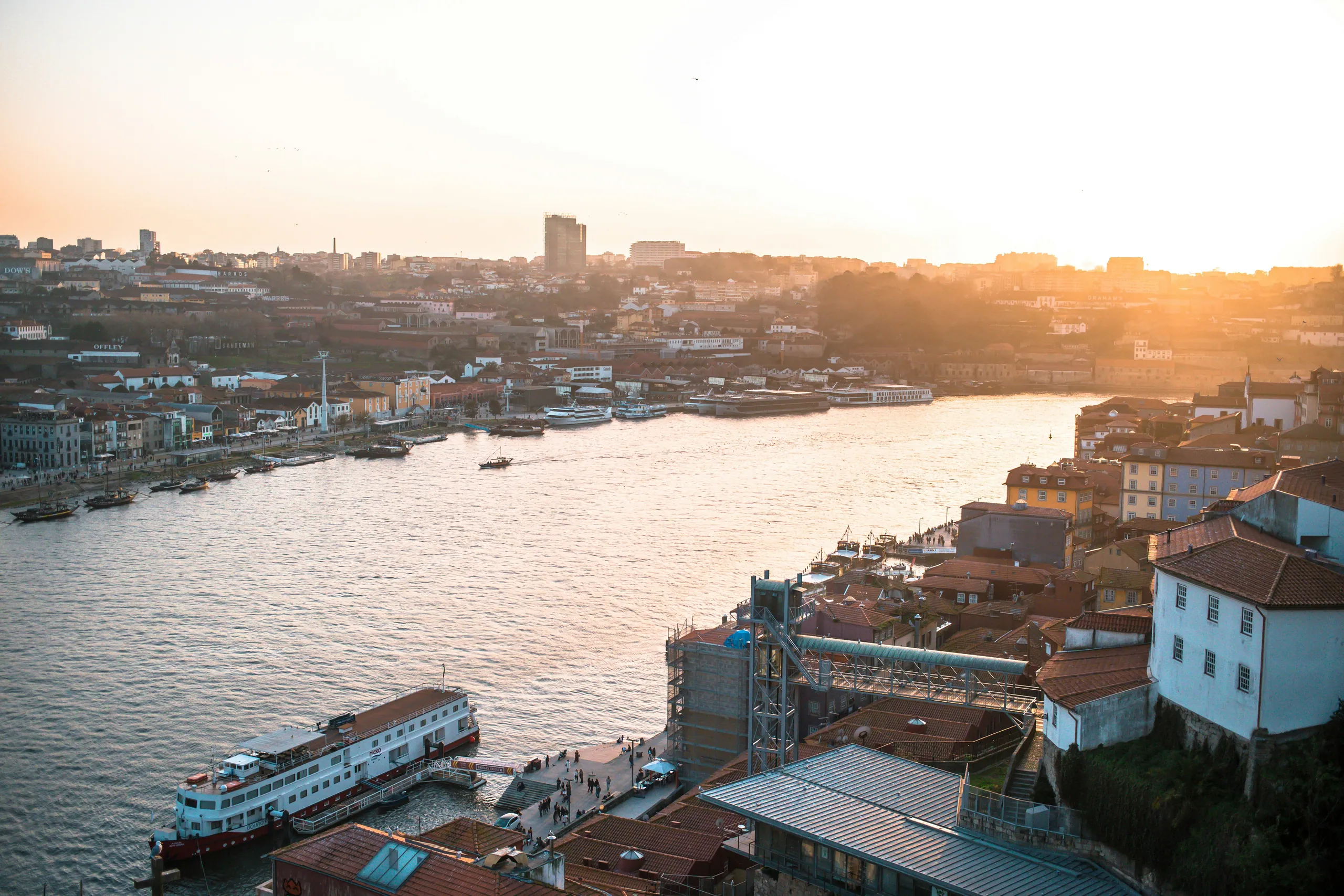
Situate Porto on the northern bank of the Douro estuary, linked to Vila Nova de Gaia by six bridges (including the UNESCO-listed Luiz I Bridge) with a seventh, Ponte Ferreirinha, now rising (Porto Vivo, SRU, 2026). As part of the broader Porto District guide, understanding the concelho’s geography is essential for investors. Three major infrastructure projects are redrawing buyer catchments: the Metro Pink Line (Linha Rosa, São Bento to Casa da Música, opening commercially by March 2027), the Ruby Line (Linha Rubi to Santo Ovídio, first tunnel bored August 2026, completion July 2028), and the Porto–Lisbon High-Speed Rail (LAV), which broke ground at Campanhã Intermodal Station on 12 October 2026 (Infraestruturas de Portugal / Idealista News, 2026).
Where to buy in Porto: the seven parishes, housing stock and buyer profiles
Walk through the seven official parishes (freguesias and uniões de freguesias) of the concelho and what kind of buildings and buyers define each micro-market.
União das Freguesias de Aldoar, Foz do Douro e Nevogilde and Lordelo do Ouro e Massarelos feature Atlantic-facing villas, early-20th-century chalets and prime condominiums favoured by international families and lifestyle buyers.
União das Freguesias do Centro Histórico (Cedofeita, Santo Ildefonso, Sé, Miragaia, São Nicolau e Vitória) and Bonfim showcase narrow bourgeois townhouses with granite façades, azulejo tiles and deep skylights (claraboias), prized for architectural heritage and creative-quarter living.
Campanhã, Paranhos and Ramalde complete the map. Campanhã is emerging as the eastern regeneration frontier around the high-speed rail terminal; Paranhos is anchored by the Polo Universitário student and academic rental market; and Ramalde (around Boavista) offers modern family flats and corporate offices.
Porto property prices and rents in 2026: asking prices vs closing prices
Using CASAFARI Area Insights (location id 2925, queried 25 October 2026), the average apartment asking price from indexed listings (outliers excluded) reached €4,343/m² in Q3 2026, representing a 6.2% year-on-year increase from €4,090/m² in Q3 2025. Over the same period, the municipal apartment rental series recorded an average asking rent of €26.0/m²/month, up 7.0% year on year from €24.3/m²/month, noting that the rental series has experienced historical volatility including a Q2/Q3 2024 spike.
In contrast, official median closing prices from INE (Estatísticas de Preços da Habitação ao Nível Local, Q2 2026, covering the 12 months to June 2026 and published in October 2026) show a median closing price of €3,631/m² for family dwellings across Porto municipality (+18.7% year on year). Prices peaked at €4,160/m² in the Historic Centre parish union and €3,636/m² in Ramalde, compared with €2,669/m² across the wider Porto Metropolitan Area.
The spread of roughly €712/m² between average asking prices (€4,343/m²) and median closing prices (€3,631/m²) highlights the premium commanded by newly rehabilitated prime stock in online listings versus the broader pool of transacted dwellings. Professionals can analyse these dynamics in detail using our property valuation and market study tool and CASAFARI Property Sourcing. You can also sign in to CASAFARI Platform to explore Porto market data and comparables in real time or consult the CASAFARI Area Insights API and MCP documentation.
Taxes, short-let licences and residency rules every Porto buyer must know
Navigating Porto real estate requires clarity on current legal and tax frameworks. Under Law n.º 56/2023 (Mais Habitação), buying real estate no longer qualifies for a Portuguese Golden Visa, and the old NHR regime has been replaced by IFICI (NHR 2.0, Portaria n.º 352/2024/1), offering a 20% flat IRS rate for 10 years solely to new tax residents in qualifying scientific, innovation and high-value roles (RFF Lawyers, 2025–2026).
Acquisition and holding taxes for 2026 include Stamp Duty at 0.8% of the deed value and municipal urban IMI at 0.324% of VPT (reduced to 0.27% for primary residences, with a 30% surcharge on dilapidated buildings). IMT brackets for primary residences are exempt up to €106,346, while IMT Jovem grants full IMT and Stamp Duty exemption up to €330,539 for buyers aged 35 or under purchasing their first primary residence. Non-resident buyers face a 7.5% IMT rate under DL n.º 97/2026 (ECO / DS Intermediários de Crédito, 2025–2026).
Short-term rental (Alojamento Local) rules are governed by Porto’s Municipal Alojamento Local Regulation (Regulamento n.º 1462/2024), which imposes a 15% AL-to-housing pressure cap. Five former parishes in the Historic Centre (Santo Ildefonso, Sé, Miragaia, São Nicolau and Vitória) are Containment Areas closed to new licences, while ten surrounding parishes (including Cedofeita, Bonfim, Campanhã and Foz do Douro) remain Sustainable Growth Areas open to new registrations under municipal monitoring (Diário da República, 2024).
For older stock, investors can leverage Urban Rehabilitation Area (ARU) incentives via the Porto Vivo, SRU guide to Urban Rehabilitation Area (ARU) tax incentives. Certified rehabilitation works in an ARU or on buildings over 30 years old qualify for a reduced 6% VAT rate, a 3-year IMI exemption (extendable by 5 years for permanent housing or long-term rental), IMT exemptions on purchase and first resale, and a favourable 5% autonomous tax rate on rental income and capital gains on first sale. For broader context on national procedures, consult our complete guide to buying property in Portugal and our 2026 European city rental yields study.
How to analyse and source Porto property with CASAFARI
Real estate professionals, investors and developers rely on CASAFARI to cut through market noise. By combining deduplicated listing histories with comparable asking and closing prices, CASAFARI Area Insights and CASAFARI Property Sourcing allow teams to evaluate parish-level supply trends, price renovations accurately, and track investment opportunities across Porto in real time.
Frequently asked questions
Can you still get an Alojamento Local short-let licence in Porto?
Yes, but it depends entirely on the parish under Porto’s Regulamento Municipal n.º 1462/2024, which enforces a 15% ratio cap of AL establishments to residential dwellings. Five former parishes in the Historic Centre (Santo Ildefonso, Sé, Miragaia, São Nicolau and Vitória) are Containment Areas closed to new registrations, whereas the remaining ten former parishes—including Cedofeita, Bonfim, Campanhã and Foz do Douro—are Sustainable Growth Areas where new licences are still granted under ongoing municipal monitoring.
Does buying property in Porto still qualify for a Portuguese Golden Visa?
No, real estate purchases no longer qualify for the Portuguese Golden Visa (ARI) following the enactment of Law n.º 56/2023 (Mais Habitação). Investors seeking residency by investment in 2026 must choose from alternative non-real-estate qualifying routes, such as committing at least €500,000 to eligible investment or venture capital funds, or contributing €250,000 to certified cultural heritage and artistic production.
What taxes do you pay when buying a property in Porto in 2026?
Buyers must pay Stamp Duty at 0.8% of the purchase price and Property Transfer Tax (IMT), which applies progressive brackets up to 8% for primary residences (exempt up to €106,346 in 2026, or up to €330,539 under IMT Jovem for first-time buyers aged 35 or under) and a flat 7.5% rate for non-resident buyers under DL n.º 97/2026. Once owned, Porto’s annual municipal urban property tax (IMI) is set at 0.324% of the tax value (VPT), reduced to 0.27% for primary residences.
What tax incentives apply to renovating an older building in Porto’s ARU zones?
Properties located inside a designated Urban Rehabilitation Area (ARU) in Porto—or buildings older than 30 years—that undergo certified works raising their conservation standard by at least two levels benefit from a reduced 6% VAT rate on construction. Owners can also claim a 3-year municipal IMI exemption (extendable by 5 years for permanent housing or long-term rental), complete IMT exemption on acquisition and first resale, and a favorable 5% autonomous tax rate on rental income and first-sale capital gains.
How does the discrepancy between asking prices and closing prices impact property valuations in Porto?
Listing data shows an average asking price of €4,343/m² in Q3 2026, while official INE figures for Q2 2026 report a median closing price of €3,631/m² for family dwellings. This difference of approximately €712/m² highlights the premium often commanded by newly rehabilitated prime stock in online listings compared to the broader pool of transacted properties. Investors should use both metrics to accurately assess the real market value of a potential acquisition.
How are infrastructure developments such as the high-speed rail and new metro lines influencing Porto’s property market?
Significant projects like the Metro Pink Line and the new Porto–Lisbon High-Speed Rail at Campanhã are actively redrawing urban catchments and growth frontiers within the city. These improvements, with completion dates ranging from 2027 to 2028, are making areas like the emerging eastern regeneration zone around Campanhã increasingly attractive. Investors should consider these connectivity gains when identifying long-term growth opportunities across the municipality.