
MARCO DE CANAVESES PROPERTY GUIDE
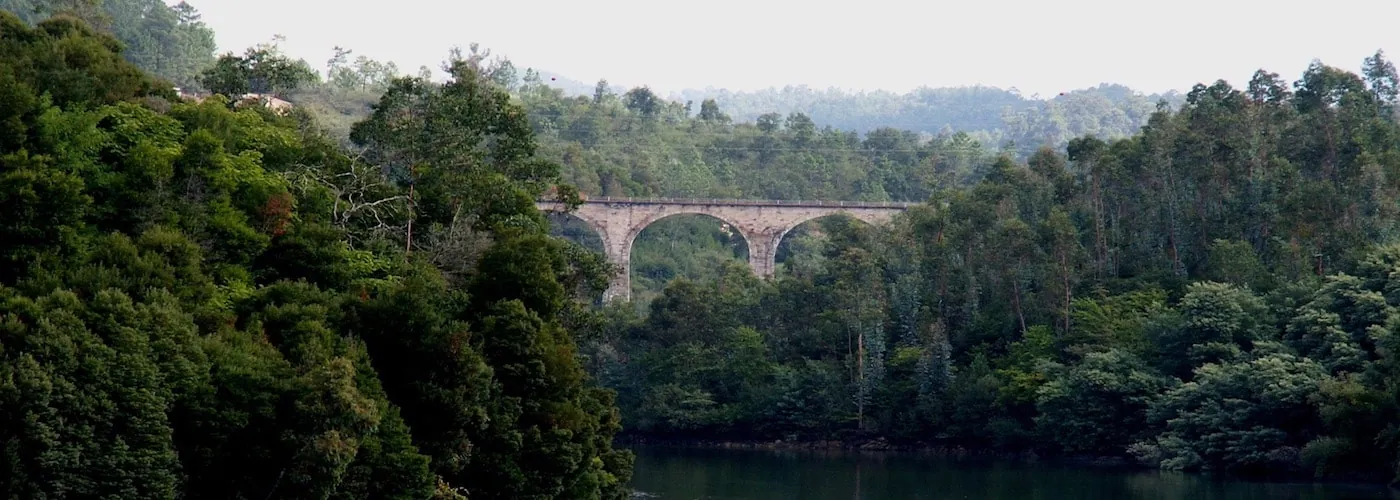
A pearl in the middle of lush and green forests
Marco de Canaveses property offers inland real estate value in the Porto district, where 49,541 residents live across 17 civil parishes between the Douro and Tâmega rivers. In early 2026, the municipality reached a median residential sales price of €1,366/m² alongside a median bank valuation of €1,522/m², supported by direct 52-minute electrified rail connections to Porto-Campanhã and 40-minute motorway links to Porto International Airport.
Why Are Buyers and Investors Looking at Marco de Canaveses Property?
Situated in the eastern section of the Porto district, Marco de Canaveses occupies a scenic territory bounded by the Douro River to the south and the Tâmega River to the west. Rising towards the granite slopes of the Serra da Aboboreira, the municipality combines rural river valleys with an established administrative town centre featuring Álvaro Siza Vieira’s internationally acclaimed Church of Santa Maria.
According to Instituto Nacional de Estatística (INE) census data, Marco de Canaveses is home to 49,541 residents (23,771 men and 25,770 women) spread across 17 civil parishes (freguesias). This spatial arrangement offers diverse property inventory, ranging from townhouses in the urban centre to traditional granite quintas and riverside villas.
In terms of market positioning, INE median residential sales data via Flatin shows a 12-month rolling median sales price of €1,366 per square metre in early 2026, with local bank appraisals averaging €1,522 per square metre. Compared with the urban core of Porto, Marco de Canaveses provides an accessible entry point for residential buyers and buy-to-let investors seeking higher yields or larger plot sizes within commuting distance of the regional capital.
Real estate professionals, advisors, and private investors can evaluate local supply trends and valuation spreads across individual parishes using CASAFARI Area Insights and conduct precision comparative analysis with property valuation and market study tools.
Taxes, Residency and Short-Let Rules: What International Buyers Need to Know in 2026
When evaluating real estate in northern Portugal, buyers must align their strategy with current legal and fiscal frameworks. Under Law 56/2023, purchasing residential or commercial property in Portugal no longer qualifies for the Golden Visa (ARI). Investors seeking residency by investment must utilize alternative capital routes, such as committing €500,000 to CMVM-regulated funds or €250,000 to cultural production, as outlined in current 2026 Portuguese Golden Visa and IFICI tax rules.
Taxation for non-habitual residents has also evolved. The classic NHR status is closed to new applicants and has been succeeded by the IFICI regime (Incentivo Fiscal à Investigação Científica e Inovação). This framework provides a 20% flat tax rate on employment and self-employment income for 10 years, strictly targeted at highly qualified professionals in research, higher education, and corporate innovation.
On the municipal level, Marco de Canaveses remains tax-friendly for property owners. For 2025 and 2026, the local municipal council maintains the statutory minimum IMI (annual property tax) rate of 0.30% for urban properties, alongside IMI Familiar reductions for households with dependent children. For property acquisitions, the 2026 IMT property transfer tax brackets exempt primary home purchases up to €106,346, while the IMT Jovem scheme provides full exemption up to €330,539 for buyers aged 35 or under. Investors navigating purchase steps can refer to our guide to buying property in Portugal.
Short-term accommodation (Alojamento Local) operates under local municipal guidelines and Decree-Law 76/2024. The legislation eliminated the extraordinary CEAL contribution, restoring decision-making powers to local municipalities while maintaining standard capacity limits of 9 rooms and 27 guests per establishment.
Living in Marco de Canaveses: Nature, Heritage and Everyday Amenities
Living in Marco de Canaveses offers a balance between active outdoor pursuits and rich cultural heritage. The surrounding landscape provides opportunities for hiking in the Serra da Aboboreira, water sports along the Tâmega reservoir, and nautical activities on the Douro River.
The municipality possesses a distinct cultural identity as the birthplace of notable Portuguese figures, including industrialist Belmiro de Azevedo (born 1938 in Tuías) and international performer Carmen Miranda (born 1909 in Várzea da Ovelha e Aliviada). Historical landmarks include the Roman archaeological site of Tongobriga in Freixo, the Carmen Miranda Municipal Museum, and key monuments on the regional Route of the Romanesque, documented in the Visit Marco de Canaveses historical guide.
Families moving to the area have access to complete educational infrastructure. According to the Câmara Municipal de Marco de Canaveses education directory, public schooling is organized into four main clusters: Agrupamento de Escolas n.º 1, Carmen Miranda, Alpendorada, and Sande. Specialized vocational training is provided by EPAMAC (Escola Profissional de Agricultura e Desenvolvimento Rural) in Avessadas e Rosém, alongside specialized artistic instruction at the Artâmega academy.
Healthcare services are distributed across public and private facilities. In the town centre, Hospital Santa Isabel (operated by Santa Casa da Misericórdia do Marco de Canaveses) delivers 24-hour urgent care services. Additional facilities include the Trofa Saúde Marco de Canaveses private outpatient clinic at MarcoShopping, the municipal SNS health centre, and the primary regional public hospital, Hospital Padre Américo in Penafiel, managed by the Unidade Local de Saúde do Tâmega e Sousa (SNS).
How Well Connected Is Marco de Canaveses to Porto, Braga and the Airport?
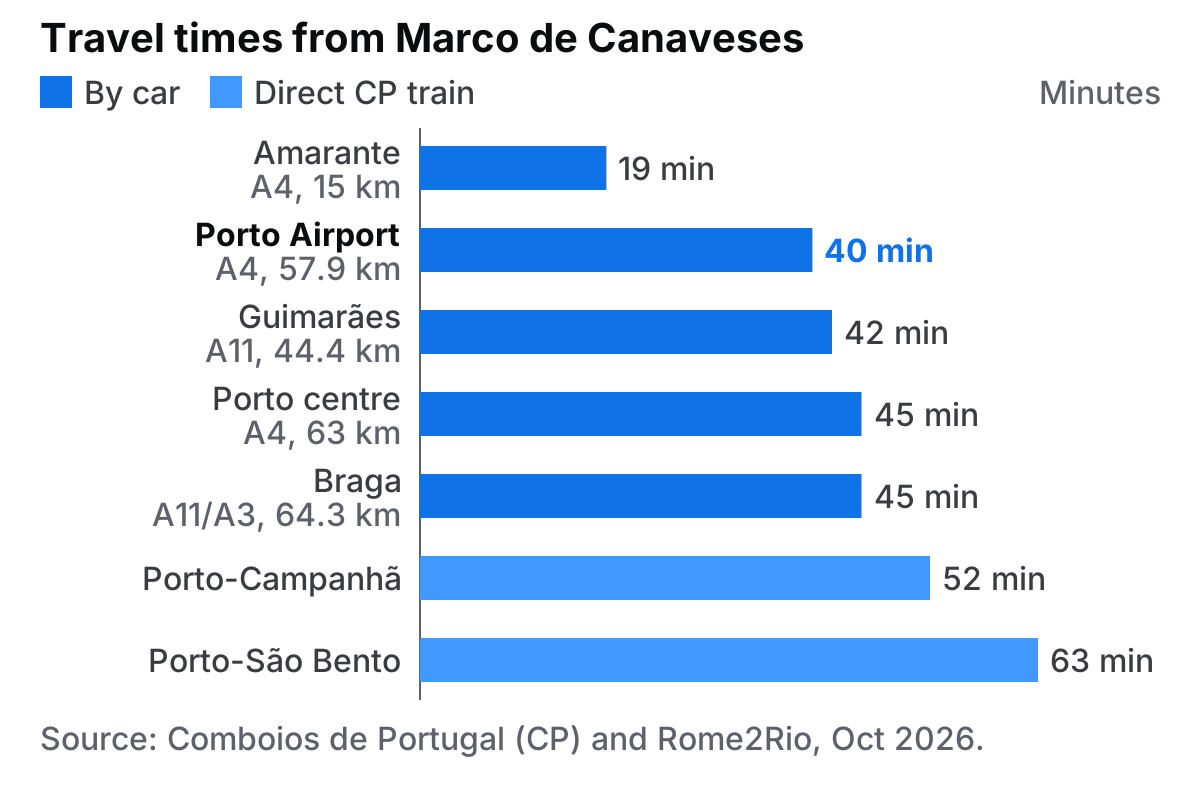
Marco de Canaveses serves as a primary transport gateway for the eastern Porto district. The municipality is the terminus of Porto’s suburban electric railway on the Douro Line (Linha do Marco). Direct electric train services operated by Comboios de Portugal connect Marco de Canaveses station directly to central Porto.
According to Comboios de Portugal (CP) Douro Line timetables, direct journey times stand at 52 to 58 minutes to Porto-Campanhã and 1 hour 03 minutes to 1 hour 14 minutes to Porto-São Bento. Modernisation works on line sections further east towards Peso da Régua include scheduled bus replacements during infrastructure upgrades.
Road access relies on the A4 and A11 motorways, providing efficient driving routes across northern Portugal:
- Amarante: 15 km (19 minutes via A4)
- Francisco Sá Carneiro Airport (OPO): 57.9 km (40 minutes via A4)
- Porto City Centre: 63 km (45 minutes via A4)
- Guimarães: 44.4 km (40 to 45 minutes via A11)
- Braga: 64.3 km (45 minutes via A11/A3)
Whether sourcing character homes, rural estates, or urban apartments across the 17 parishes, property buyers and real estate professionals can search verified active market listings using Property Sourcing or sign in to the CASAFARI platform to analyze real-time market data.
Frequently asked questions
Does buying property in Marco de Canaveses qualify for the Portugal Golden Visa?
No. Since Law 56/2023 took effect on 7 October 2023, residential and commercial real estate purchases no longer qualify for the Portuguese Golden Visa (ARI). Investors seeking residency by investment in 2026 must use alternative routes, such as transferring at least €500,000 into CMVM-regulated investment or venture capital funds or €250,000 into cultural and artistic production.
How long is the train journey from Marco de Canaveses to Porto?
Direct electric trains operated by Comboios de Portugal (CP) on the Douro Line connect Marco de Canaveses to Porto-Campanhã in 52 to 58 minutes, and to Porto-São Bento in 1 hour 03 minutes to 1 hour 14 minutes. The line between Caíde and Marco de Canaveses has been fully electrified since July 2019, making Marco the terminus of the Porto suburban rail network.
What are the IMI and IMT property taxes in Marco de Canaveses in 2026?
For 2025 and 2026, the Municipality of Marco de Canaveses applies the minimum legal IMI (annual municipal property tax) rate of 0.30% for urban properties, alongside IMI Familiar deductions for families. For IMT (property transfer tax) in 2026, primary residences are exempt up to €106,346, while buyers aged 35 or under buying their first permanent home are fully exempt up to €330,539 under the IMT Jovem scheme.
What hospitals and schools serve residents in Marco de Canaveses?
Healthcare in the town includes Hospital Santa Isabel (operated by Santa Casa da Misericórdia with 24-hour urgent care), the private Trofa Saúde clinic at MarcoShopping, the local SNS health centre, and the public reference Hospital Padre Américo in neighbouring Penafiel. For education, the municipality has four public school clusters (Marco n.º 1, Carmen Miranda, Alpendorada, and Sande), the EPAMAC vocational agricultural school, and the Artâmega arts academy.