
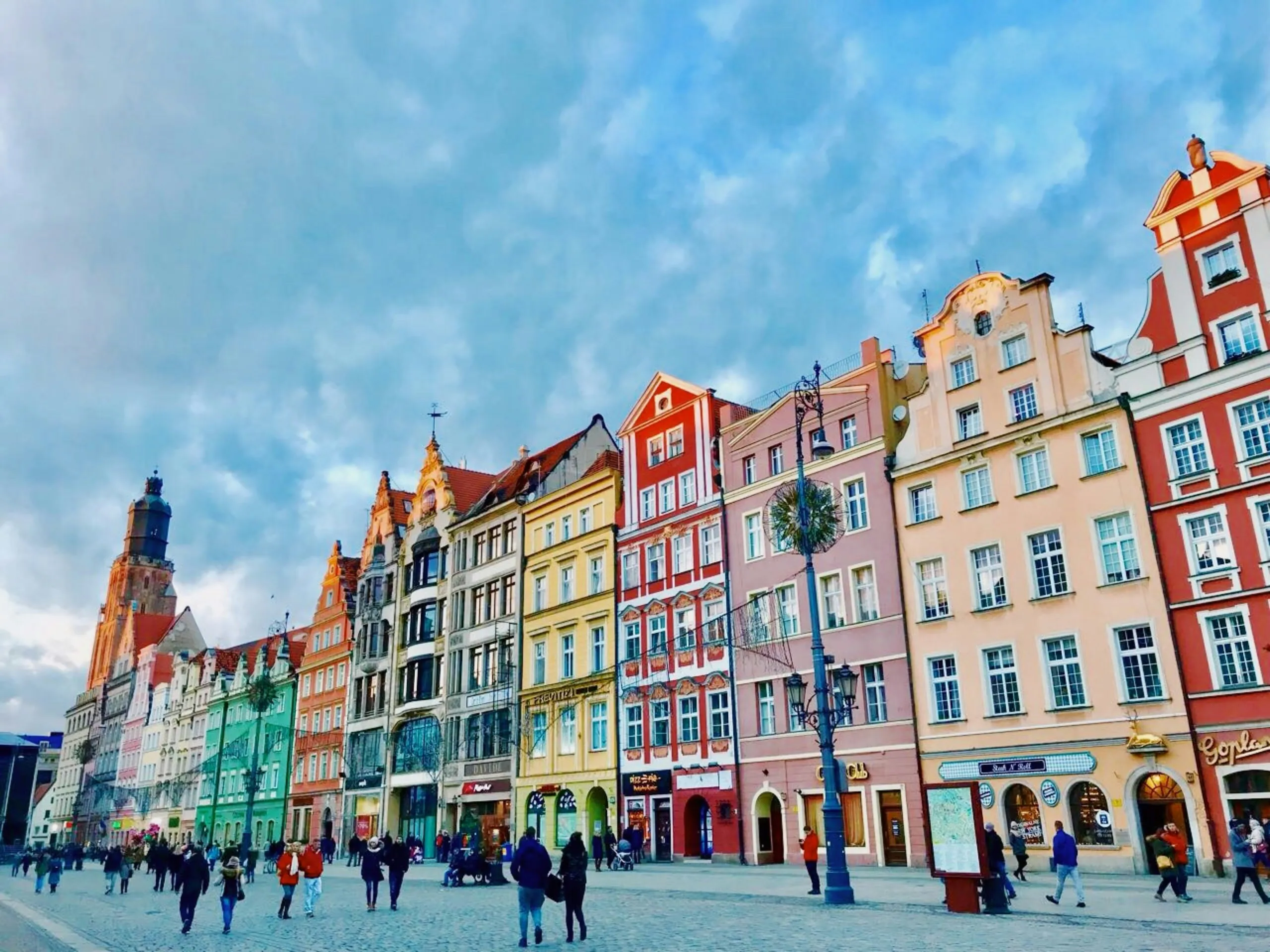
As Poland’s second largest regional office market and the vibrant capital of Lower Silesia, Wrocław bridges strong cross-border rail and air links with a rapidly expanding tech economy. Home to an official GUS population of 672,601—and an estimated 891,500 actual residents according to municipal water utility figures—the city supports 1.35 million square metres of modern office space. According to CASAFARI Area Insights, average apartment asking prices reached €3,107 per square metre in Q3 2026, marking an 8.8% increase year on year, while asking rents held steady at €15.8 per square metre per month. For deeper context on the country, explore our broader overview of Polish real estate market trends and tools.
Where Wrocław sits and how it connects to Central Europe
Built across 12 islands on the Oder River, Wrocław occupies a strategic geographical position in southwestern Poland. Direct rail and road corridors connect the city to Berlin, Dresden, Prague, and Vienna, while the Sudetes mountains, including the Karkonosze resort region and historic sites like Książ Castle, sit within a one- to two-hour drive. International accessibility is anchored by Wrocław Airport (Port Lotniczy Wrocław), which handled 4,907,527 passengers in full-year 2025 and 4,733,073 passengers between January and September 2026—a 13% year-on-year increase. This growth follows the completion of a 463.5 million PLN airside expansion in September 2026, with terminal designs already under way to accommodate 10 million annual passengers. Locally, daily mobility is served by an extensive tram and bus network, the year-round Wrocław City Bike (WRM) scheme featuring over 2,804 bicycles across the city and five neighbouring municipalities, and the unique Polinka cable car, which links Wrocław University of Science and Technology campuses across the Oder River.
What drives living and working demand in Lower Silesia’s capital?
The demographic engine of Wrocław extends well beyond official registry records. While Statistics Poland (GUS) recorded 672,601 permanent residents in December 2025, experimental GUS ‘traces of life’ datasets count 787,726 individuals, and municipal water utility (MPWiK) estimates place the actual population at approximately 891,500. This influx is propelled by university students, international professionals, and a thriving IT and corporate services sector. The commercial real estate backbone, tracked by the Polish Chamber of Commercial Real Estate (PINK) and REDD in their H1 2026 report, comprises 1,353,800 square metres of modern office stock. Key business hubs such as Concordia Design on Słodowa Island, Grunwaldzki Center, Carbon Tower, and Diamentum Office in Fabryczna—alongside new deliveries like the 15,000-square-metre Swobodna Spot I—anchor steady corporate relocations and white-collar employment.
Which Wrocław districts and housing types attract buyers and investors?
Property seekers in Wrocław encounter a diverse architectural landscape shaped by centuries of history and modern urban expansion:
- Stare Miasto (Old Town): Centred around the historic Rynek, this micro-market features restored burgher houses and luxury conversions, commanding high demand for short- and mid-term corporate lets.
- Nadodrze: Located just north of the Oder, this formerly industrial quarter is characterised by dense 19th- and early-20th-century tenement houses (kamienice). Private and municipal revitalisation efforts have turned it into a creative hub favoured by young professionals and value-add renovation investors.
- Śródmieście: Spanning academic zones around Grunwaldzki Square, Centennial Hall, and the Zalesie green belt, this district offers pre-war villas and established residential blocks popular with families and student landlords.
- Fabryczna and Riverside Developments: Western districts and riverside pockets like Kępa Mieszczańska feature modern developer new-builds (rynek pierwotny) adjacent to major office corridors, attracting institutional investors and private buy-to-let purchasers.
How are Wrocław property prices and rents performing in 2026?
Understanding market valuations requires a clear distinction between asking prices found on property portals and official closing prices from transaction registries. According to CASAFARI Area Insights (location id 6281674, queried 23 October 2026), the average apartment asking price in Wrocław stood at €3,107 per square metre in Q3 2026, compared to €2,854 per square metre in Q3 2025 (+8.8% year on year). Meanwhile, the average apartment asking rent was €15.8 per square metre per month in Q3 2026, remaining flat at 0.0% year on year compared to Q3 2025 (€15.8 per square metre per month), reflecting a period of rental stabilisation following earlier supply waves.
By contrast, official closing (transaction) prices recorded by the National Bank of Poland (NBP BaRN quarterly report) in Q1 2026 averaged 13,903 PLN per square metre on the primary market (-1.1% quarter on quarter) and 12,632 PLN per square metre on the secondary market. Professional investors analysing these trends often cross-reference asking data with closing prices from open registers like the Rejestr Cen Nieruchomości (RCN).
What taxes, permits and rental rules apply to buyers in Wrocław?
Foreign purchasers benefit from straightforward European regulatory frameworks. Citizens of the European Economic Area (EEA) and Switzerland acquire property in Poland under identical conditions to Polish nationals. Non-EEA buyers can purchase a standalone residential apartment (samodzielny lokal mieszkalny) in Wrocław without a Ministry of the Interior and Administration (MSWiA) permit, as the city lies outside Poland’s statutory border zone. However, acquiring a single-family house with land or a standalone land plot requires an MSWiA permit (subject to a 1,570 PLN stamp duty), unless specific exemptions apply, such as five years of permanent or EU long-term residence.
When purchasing residential property, transaction taxes depend on the market segment. Developer new-builds (rynek pierwotny) carry standard VAT (8% for homes up to 150 square metres) and 0% Civil Law Transactions Tax (PCC). Resale properties (rynek wtórny) incur a 2% PCC levied on market value, subject to two key exemptions and surcharges: first-time homebuyers purchasing a resale property pay 0% PCC, while investors acquiring a sixth or subsequent apartment within a single development on one land plot face a 6% PCC surcharge.
For landlords, private residential rental income generated outside a registered business is taxed exclusively via the lump-sum tax on registered revenue (ryczałt od przychodów ewidencjonowanych, reported on form PIT-28). The tax rate is 8.5% on annual rental revenue up to 100,000 PLN (or 200,000 PLN for married couples filing jointly on shared property) and 12.5% on any surplus above that threshold. Furthermore, short-term rentals are governed by EU Regulation 2024/1028 (effective 20 May 2026), requiring platform data sharing and registration in the municipal register kept by the Mayor of Wrocław, alongside Poland’s October 2026 amendment to the Act on Hotel Services, which classifies lets under 30 days as hotel services within the Central Register of Tourist Accommodation Facilities (CWTON).
How to analyse and source Wrocław real estate with CASAFARI
Navigating fragmented portal listings across Poland can introduce duplicate records and inflated asking prices. Real estate professionals, investors, valuers, and developers use CASAFARI to streamline their workflows. You can track district-level market dynamics via CASAFARI Area Insights, perform rigorous Comparative Market Analyses (CMA) by pairing active listings with verified closing prices through property valuation and market study with Comparables, or uncover unlisted inventory and direct-to-owner opportunities using CASAFARI Property Sourcing.
Technical teams and investment analysts can also query Polish market data programmatically using the Property Data API and developer documentation. To begin exploring transaction records and deduplicated listings, sign in to the CASAFARI platform to explore Polish market data (self-serve console, no old /signup link).
For broader context on European yields, review our analysis of gross rental yields across European cities in 2026.
Frequently asked questions
Can a foreign citizen buy an apartment in Wrocław without a permit?
Yes, in most cases. Citizens of the European Economic Area (EEA) and Switzerland do not need any permit to buy real estate in Poland. Non-EEA buyers can also purchase a standalone residential apartment (samodzielny lokal mieszkalny) in Wrocław without an MSWiA permit because the city sits outside the statutory border zone, whereas purchasing a house or land plot requires an MSWiA permit.
What are the property transfer taxes (PCC) when buying in Wrocław?
Resale market purchases carry a 2% Civil Law Transactions Tax (PCC) based on market value, collected by the notary. First-time buyers purchasing a resale home enjoy a 0% PCC exemption, and primary-market developer purchases are exempt from standard PCC. However, buying a sixth or subsequent apartment within a single development on one land plot triggers a 6% PCC surcharge.
How is rental income taxed for private landlords in Poland?
Private residential rental income outside of a business entity is taxed through the lump-sum tax on registered revenue (PIT-28). Landlords pay an 8.5% tax rate on gross rental revenue up to 100,000 PLN annually (or 200,000 PLN for married couples filing jointly on shared property) and 12.5% on any revenue exceeding that threshold.
What are the short-term rental rules in Wrocław in 2026?
Under EU Regulation 2024/1028, short-term rental hosts must register their units and display identification numbers. In Wrocław, operators of lets under 30 days must register in the municipal non-hotel accommodation register and comply with Poland’s October 2026 amendment to the Act on Hotel Services, integrating with the Central Register of Tourist Accommodation Facilities (CWTON).
Which districts in Wrocław are most popular with buyers and tenants?
Stare Miasto drives premium demand for historic properties and corporate short lets, while revitalised Nadodrze attracts young professionals and renovation investors with its 19th-century tenement houses. Śródmieście is favoured by students and families near university hubs, and Fabryczna draws buyers seeking modern developer estates close to western business parks.
How does CASAFARI cover the Wrocław property market?
CASAFARI aggregates, cleans, and deduplicates listings from portals and agencies across Poland into a single property record. Professionals use Area Insights for asking price trends, Comparables for valuations combining listings with closing prices from open data sources like RCN, and Property Sourcing to discover clean market inventory.