
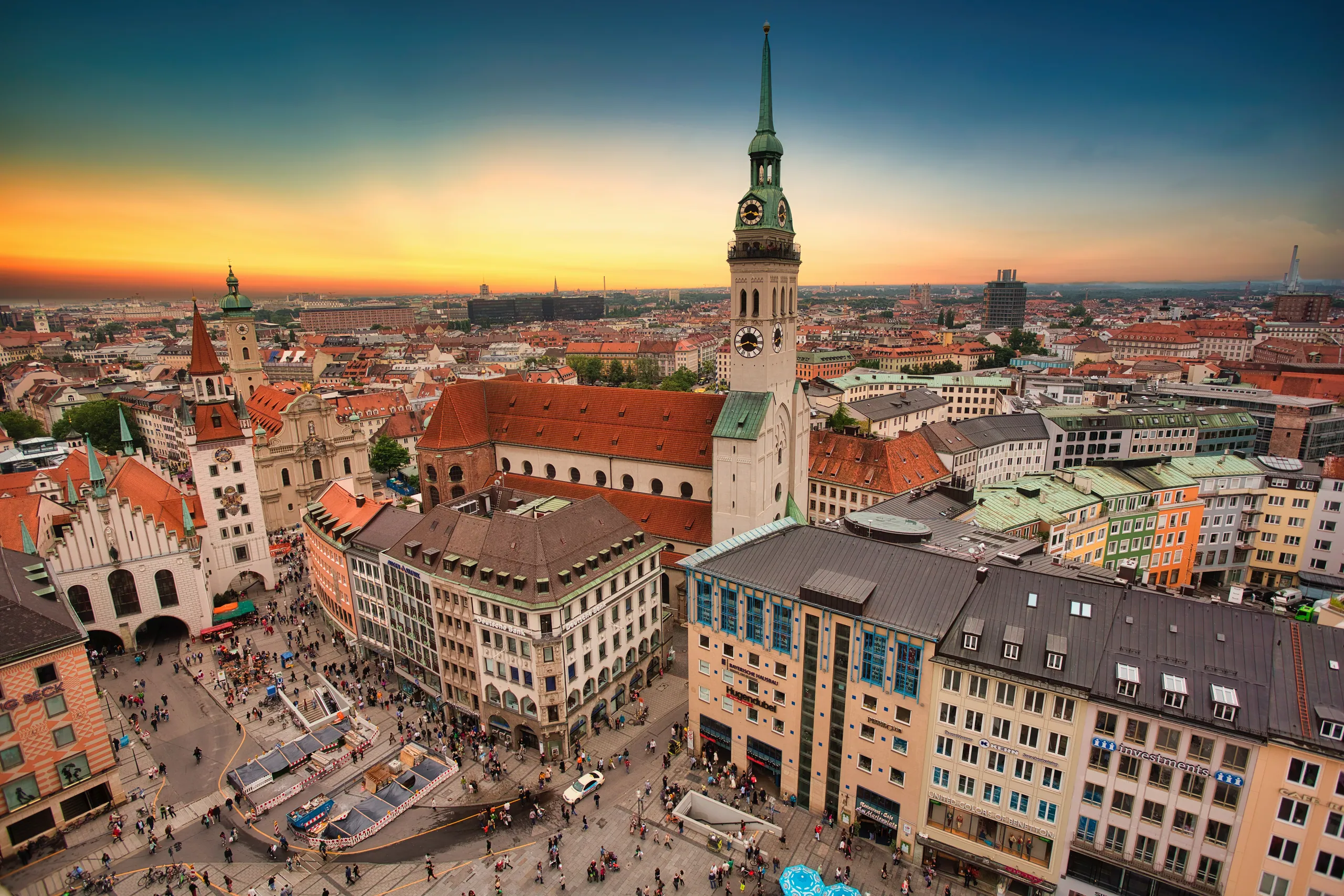
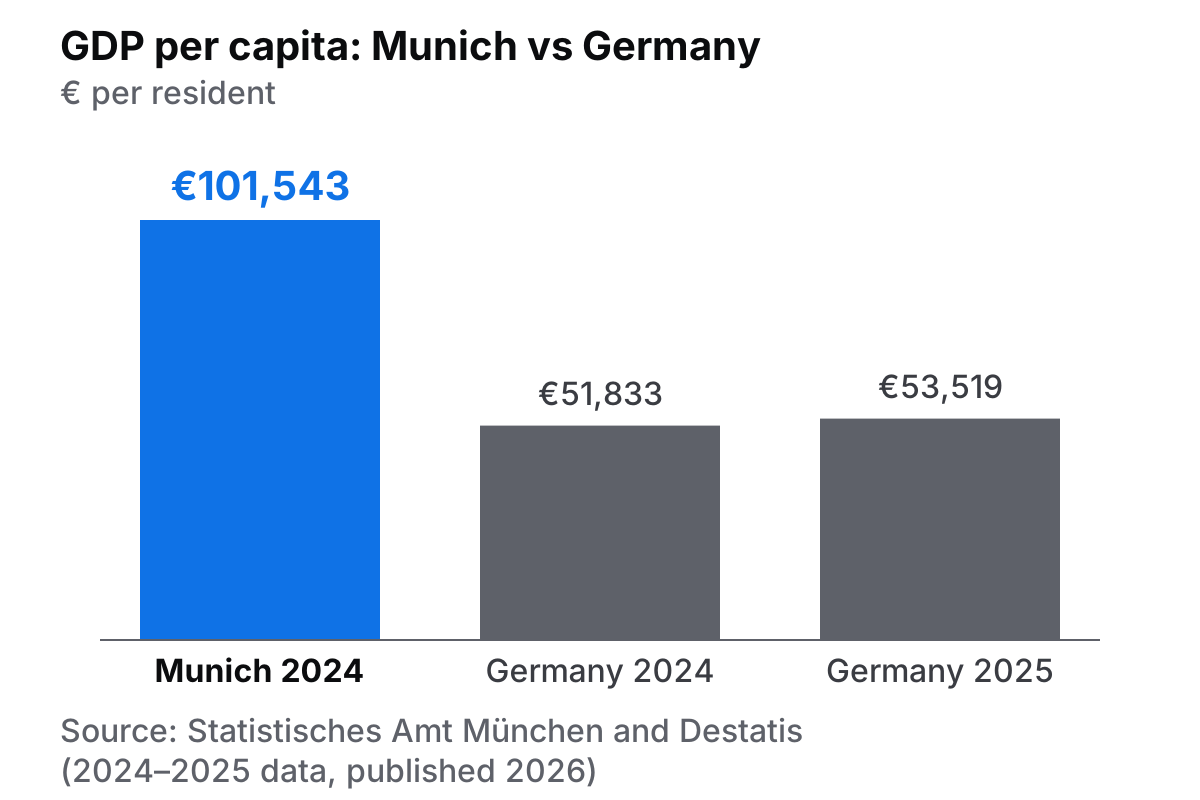
Munich combines an exceptionally robust economy with favourable acquisition terms for property buyers. Home to 1,605,264 primary residents as of July 2026, Bavaria’s capital generated a GDP per capita of €101,543 in 2024—nearly double the German national average of €51,833 in 2024 and €53,519 in 2025. Coupled with Bavaria’s 3.5% property transfer tax, the lowest in Germany, Munich remains a premier location for residential and commercial real estate investment.
Why is Munich Germany’s strongest metropolitan economy?
As the capital of Bavaria, Munich stands as Germany’s wealthiest major city and one of Europe’s premier corporate powerhouses. According to Munich economic statistics for 2024, the city generated a total GDP of €151.996 billion in 2024, representing an output of €125,211 per employed person. On a per capita basis, Munich achieved €101,543 in 2024, far outpacing the overall national output reported by Destatis GDP per capita figures.
This performance is anchored by world-leading industrial and financial institutions. Global DAX-listed conglomerates such as Siemens, Allianz, and Munich Re (Münchener Rück) maintain their global headquarters in the city. Surrounding these anchors is a dense innovation ecosystem comprising biotechnology, medical technology, automotive engineering, digital technology, media, and financial services.
Economic prosperity translates directly into personal safety and liveability. In the 2026 Monocle Quality of Life Survey, Munich ranked 9th worldwide and 1st among German cities, building on its consistently strong global standing in Mercer’s Quality of Living Ranking, where it placed 11th worldwide in December 2024.
Where is Munich located and what shapes its urban layout?
Situated in southern Bavaria roughly 520 metres above sea level, Munich spans both banks of the Alpine River Isar. Data from the Munich Statistical Office (Statistisches Amt) records a population of 1,612,429 primary residents as of December 2025 and 1,605,264 as of July 2026.
The city’s urban landscape reflects strict historic preservation and low-rise planning traditions. The central Altstadt is built around pedestrian streets and historic landmarks, while citywide building guidelines preserve sightlines towards landmark towers like the Frauenkirche. Because high-density vertical expansion is limited, residential supply remains constrained across inner-city districts.
For real estate professionals analysing neighbourhood price trends or sourcing opportunities across the city, using CASAFARI Area Insights and specialised property valuation and market study tools provides detailed local context. Agencies across Germany, as illustrated in this case study on how German estate agency Belle Estate GmbH prices property with data, rely on automated market intelligence to navigate these supply constraints.
What do buyers and investors need to know about taxes and short-let rules?
Acquiring real estate in Munich benefits from Bavaria’s pragmatic tax environment, though investors must navigate strict local municipal bylaws.
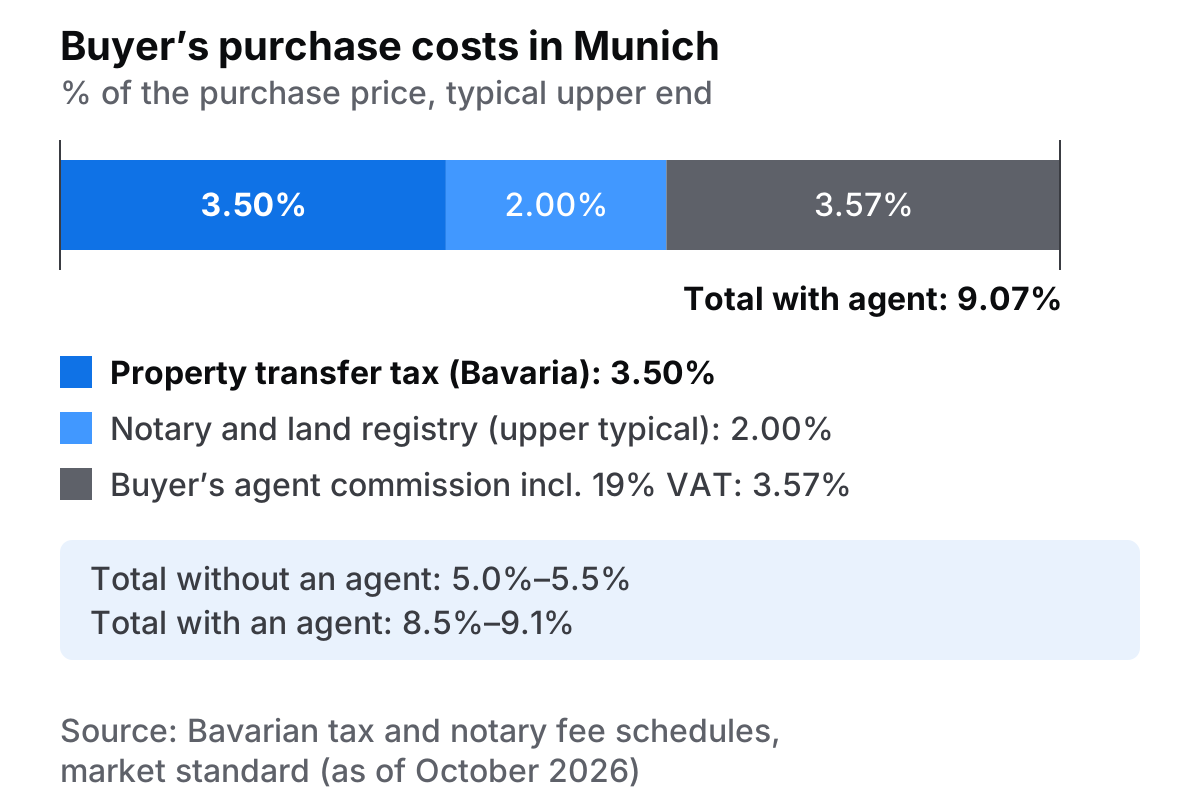
According to the Bavarian property purchase cost breakdown, property transfer tax (Grunderwerbsteuer) in Bavaria is set at 3.5%—the lowest rate of any German federal state. Additional buyer costs (Kaufnebenkosten) include notary and land registry (Grundbuch) fees of 1.5% to 2.0%. Under German law, estate agent commission (Maklerprovision) on residential sales is shared equally between buyer and seller at 3.57% including VAT each. Consequently, total buyer transaction costs range between 5.0% and 5.5% without an agent, or 8.5% to 9.1% with an agent.
Regarding short-term holiday letting, the Landeshauptstadt München enforces strict protections under the Munich Zweckentfremdungssatzung (short-let bylaw), reissued in July 2026. Key provisions include:
- Primary residence cap: Homeowners may let their entire primary dwelling to short-term guests for a maximum of 8 weeks (56 days) per calendar year without requiring a commercial permit.
- Partial room rentals: Letting individual rooms that constitute less than 50% of the overall floor space while the owner continues to live in the apartment remains permitted.
- Mandatory registration: Since August 2026, all online short-term rental listings must visibly display an official municipal registration number.
- Enforcement: Unauthorised commercial short-term lets incur administrative fines of up to €500,000 per dwelling.
Which cultural landmarks and traditions define daily life in Munich?
Daily life in Munich revolves around well-maintained public spaces, heritage institutions, and extensive urban greenery. Marienplatz marks the centre of the Altstadt, dominated by the Neues Rathaus and its renowned Glockenspiel. Nearby stand historic gathering places such as the Hofbräuhaus and the sprawling Englischer Garten, where surfers gather year-round at the Eisbach river wave.
How big is the Munich Oktoberfest?
According to official Oktoberfest visitor statistics, the annual festival runs for 16 days from late September into early October on the Theresienwiese. In October 2026, the event welcomed a record 7.4 million visitors (including 447,000 at the traditional Oide Wiesn zone), rising from 6.5 million visitors and 6.5 million Maß of beer served in 2025, and 6.7 million visitors in 2024.
How is Munich connected by public transport, road and air?
Munich maintains a dense multimodal transport infrastructure serving suburban commuters, cross-border road travel, and international aviation.
According to the 2026 MVV fare schedule, the public transport network operates 8 U-Bahn underground lines (U1–U8), 9 S-Bahn commuter rail lines (S1–S8, S20), 11 to 13 tram lines, and over 700 regional bus routes. As of January 2026, a single fare within central Zone M costs €4.20 (short trips €2.10; 10-strip Streifenkarte €18.70). The nationwide Deutschlandticket offers monthly unlimited regional travel for €63 (€43 per month for eligible students and apprentices in Bavaria).
Air connectivity is managed primarily by Munich Airport (MUC), situated 28 km northeast of the centre and linked via S-Bahn lines S1 and S8. Details on Munich Airport terminal operations show that Terminal 2 and its satellite facility (11 million annual passenger capacity) accommodate Lufthansa, Eurowings, and Star Alliance partners. Terminal 1 serves approximately 40 non-alliance carriers (including British Airways, Emirates, easyJet, and Ryanair) and inaugurated a new 95,000 m² non-Schengen pier in April 2026 capable of handling 6 million passengers annually. Regional low-cost routes are supported by Memmingen (Allgäu Airport), while Augsburg Airport caters to business and general aviation.
Road networks connect directly to major highways, including the A8 towards Salzburg and Austria and the A95 towards the Alps. Within central city limits, driver access is governed by Munich low-emission zone regulations. Since February 2023, the Umweltzone encompasses the Mittlerer Ring orbital road. Vehicles require a green emissions sticker (Feinstaubplakette), and diesel vehicles meeting Euro 4/IV standards or older are prohibited from entering. Unauthorised entry results in a €100 fine plus administrative costs.
Where do Munich residents go in the surrounding Alps and lakes?
One of Munich’s primary lifestyle drivers is its proximity to Bavarian nature reserves, lakes, and mountain ranges.
Cycling and walking in the Ebersberger Forst
Located 25 km east of the city, the Ebersberger Forst comprises roughly 90 km² of contiguous woodland, including 77 km² of managed state forest. The reserve rises to 617 metres at the Ludwigshöhe lookout tower, featuring extensive cycling and Nordic walking routes.
Sailing and cycling at Lake Chiemsee
Known as the “Bavarian Sea”, Lake Chiemsee is Bavaria’s largest lake. Located one hour east of Munich, it features historic island destinations such as Herrenchiemsee Palace and is encircled by a 55 to 60 km paved cycle route.
Hiking in Berchtesgaden National Park
Established in 1978 as Germany’s only Alpine national park, this 210 km² protected reserve borders Austria. It encompasses Lake Königssee and the Watzmann massif (2,713 m), the third-highest mountain peak in Germany.
Skiing in Garmisch-Partenkirchen
Positioned 90 minutes south of Munich via the A95 motorway, Garmisch-Partenkirchen sits at the foot of the Zugspitze (2,962 m), Germany’s highest peak. The resort provides over 60 km of ski pistes divided between the Garmisch-Classic area (40 km) and the high-altitude Zugspitze glacier terrain (20 km).
Paddling and recreation along the River Isar
Originating in the Tyrolean Alps, the River Isar flows directly through Munich before continuing towards the Danube. Its gravel banks and gravel beds south of the city centre provide extensive corridors for swimming, kayaking, and open-air recreation.
To conduct comprehensive market assessments or review active listings across Munich and broader German regions, explore Property Sourcing across the German market or refer to the Area Insights API documentation for developer integrations. Real estate professionals can sign in to the CASAFARI platform to access current market analytics.
Frequently asked questions
What are the property buying costs and taxes in Munich?
Buyers in Munich benefit from Bavaria’s property transfer tax (Grunderwerbsteuer) of 3.5%, the lowest rate in Germany. Notary and land registry (Grundbuch) fees add around 1.5% to 2.0% of the purchase price, and where an estate agent is involved, commission (Maklerprovision) is split equally at 3.57% including VAT each for buyer and seller. Total ancillary purchase costs therefore come to 5.0%–5.5% without an agent, or 8.5%–9.1% with an agent (as of October 2026).
What are the rules for short-term rentals and Airbnb in Munich?
Under Munich’s housing protection bylaw (Zweckentfremdungssatzung, reissued in July 2026), an entire flat that serves as your primary residence may be let to short-term visitors for a maximum of 8 weeks (56 days) per calendar year without a special permit. Letting individual rooms totaling less than 50% of the floor space while you live in the property remains permitted. Since August 2026, hosts must display an official registration number on every online listing, and breaches carry fines of up to €500,000 per dwelling.
How does public transport and airport connectivity work in Munich?
The Munich Transport and Tariff Association (MVV) network comprises 8 U-Bahn lines, 9 S-Bahn lines, 11 to 13 tram lines, and more than 700 bus routes. As of January 2026, a single ticket in the city zone (Zone M) costs €4.20, while the nationwide Deutschlandticket offers unlimited regional travel for €63 per month. Munich Airport (MUC), 28 km northeast of the city centre, connects to the city via S-Bahn lines S1 and S8 and operates two main terminals plus a recently expanded non-Schengen pier opened in April 2026.
What are the driving rules in the Munich low-emission zone?
Since February 2023, Munich’s low-emission zone (Umweltzone) covers all areas inside and including the Mittlerer Ring orbital road. Entering requires a green emissions sticker (Feinstaubplakette), and diesel vehicles with Euro 4/IV standards or older are banned even if they display a green sticker, whereas Euro 5/V and newer diesels and petrol vehicles with a green sticker are permitted. Driving into the zone without authorisation or with a banned diesel vehicle incurs a €100 fine plus administrative fees.