
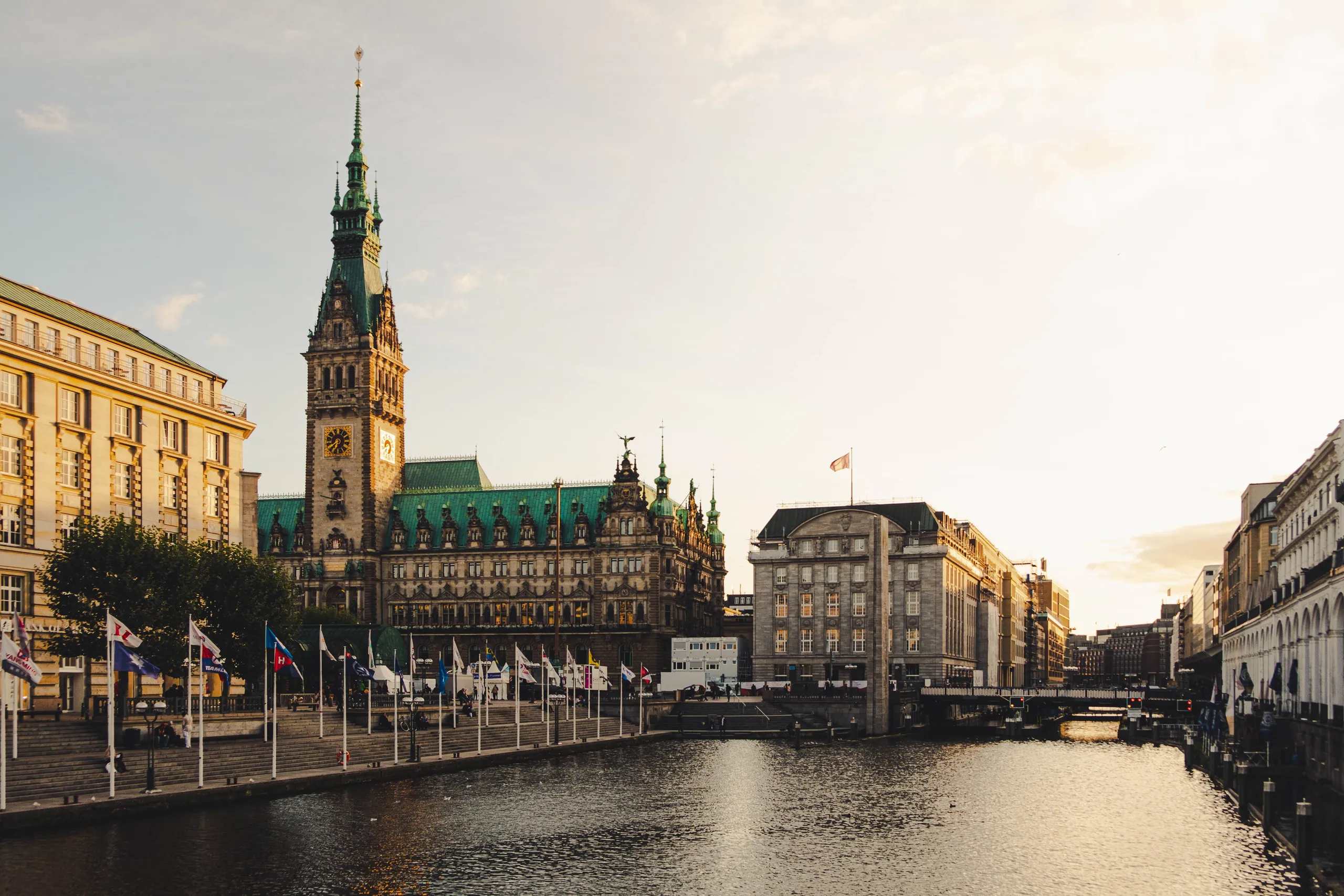
Hamburg is Germany’s second-largest city, home to 1,869,473 residents as of December 2025 according to the Statistikamt Nord, and Europe’s third-largest container port hub. Divided into seven administrative boroughs and 104 quarters along the Elbe and Alster rivers, it offers unrestricted property acquisition for international buyers, combining maritime logistics, aviation engineering, and over 20 higher education institutions with exceptional long-term capital appeal.
Why live and invest in Hamburg?
Hamburg stands as northern Europe’s premier commercial stronghold. Built upon maritime trade along the Lower Elbe, the city’s economic resilience relies on a diverse industrial matrix that spans banking, publishing, marine engineering, chemicals, pharmaceuticals, and aviation. The city hosts the global maintenance, repair, and overhaul headquarters of Lufthansa Technik, making Hamburg one of the world’s leading aerospace hubs alongside Toulouse and Seattle.
Educational infrastructure heavily supports long-term housing demand across the metropolitan region. As of September 2026, Hamburg’s tertiary education landscape comprises more than 20 universities and colleges catering to approximately 152,493 students. The flagship University of Hamburg, recognized as a German University of Excellence, educates 43,134 students across human science, natural science, and law faculties. Complementing this institution are the Hamburg University of Applied Sciences (HAW Hamburg), the Hamburg University of Technology (TUHH), and the private, business-focused Kühne Logistics University. For international families relocating to northern Germany, established schooling options include the International School of Hamburg (ISH) in Groß Flottbek and WABE International School, both delivering International Baccalaureate (IB) curricula.
Cultural vitality extends from the iconic glass waves of the Elbphilharmonie concert hall in HafenCity to the historic Kontorhaus district, the Museum für Kunst und Gewerbe, and the vibrant night-time economy of St. Pauli’s Reeperbahn. Expansive green spaces and water networks define daily life, with residents sailing on the Alster or kayaking through urban canals. Professionals requiring granular, quarter-level transaction data to model investment yields across these waterfront neighbourhoods rely on CASAFARI Area Insights and specialized property valuation and market study tools. Developers integrating localized market data into proprietary workflows can also review the Area Insights API documentation (in English).
Where is Hamburg and how are its 7 boroughs structured?
Situated on the Lower Elbe roughly 110 kilometres inland from the North Sea, Hamburg functions as Germany’s maritime gateway to Scandinavia and the Baltic region. Under its official administrative framework, the Free and Hanseatic City of Hamburg is structured into seven distinct boroughs (Bezirke), which are further subdivided into 104 quarters (Stadtteile) and 181 localities (Ortsteile).
- Hamburg-Mitte: The commercial and historic core, extending from the Inner City (Altstadt and Neustadt) across HafenCity, the harbour front, and dynamic eastern quarters like St. Georg and Billstedt.
- Altona: Situated directly west of the centre, combining dense urban quarters like Ottensen and Altona-Altstadt with the affluent Elbe suburbs (Elbvororte) of Othmarschen, Nienstedten, and Blankenese.
- Eimsbüttel: Located north-west of the Alster, known for turn-of-the-century Wilhelminian (Altbau) residential architecture, tree-lined avenues, and family-friendly neighbourhoods.
- Hamburg-Nord: Spanning from Winterhude and Eppendorf around the Outer Alster up to the city’s international airport in Fuhlsbüttel.
- Wandsbek: Hamburg’s most populous borough, dominating the north-eastern quadrant with suburban residential developments, parks, and green corridors.
- Bergedorf: Positioned in the south-east, offering a semi-rural character dominated by agriculture, historic estates, and the marshes of the Vier- und Marschlande along the Elbe.
- Harburg: Located south of the Norderelbe, balancing industrial maritime activity and technical academic campuses with scenic greenery in the Harburg Hills.
Understanding structural differences across these 104 quarters is critical for real estate professionals sourcing acquisition opportunities. For an explanation of how district-level granularity informs portfolio strategy, see our guide on why hyper-localised data matters in real estate. Agents and institutional investors searching available assets across every borough can leverage CASAFARI Property Sourcing or directly sign in to the CASAFARI platform.
What are the main landmarks and cultural highlights in Hamburg?
Architectural heritage and waterborne topography frame Hamburg’s urban environment. Exploring the city typically begins along the waterfront via public HADAG harbour ferries, canal walking tours, or visits to world-renowned cultural venues like the Hamburger Kunsthalle art museum and Miniatur Wunderland.
- St. Michaelis Church (‘Hamburger Michel’): Located at Englische Planke 1 at the corner of Ludwig-Erhard-Straße, this landmark represents northern Germany’s most famous Baroque church, offering sweeping panoramic views across the port from its iconic 132-metre spire.
- Elbphilharmonie: Positioned at the western tip of HafenCity, this landmark concert venue sits atop a historic brick cocoa warehouse (Kaispeicher A), crowned by a shimmering wave glass structure and a public observation plaza.
- Planten un Blomen and Tierpark Hagenbeck: Planten un Blomen provides 47 hectares of central urban parkland featuring a Mediterranean rose garden, authentic Japanese garden, open-air theatre, and summer water-light concerts. In the north, Tierpark Hagenbeck remains famous for introducing barless open-air animal enclosures.
- Speicherstadt: Stretched between Baumwall and Oberhafen along Am Sandtorkai, this late 19th-century district is the world’s largest historic warehouse complex built on timber pile foundations. Designated under local monument protection in 1991, the complex achieved official recognition through its UNESCO World Heritage listing for the Speicherstadt and Kontorhausviertel on 5 July 2015 alongside the adjacent Chilehaus.
- Binnenalster and Außenalster: Framed by Jungfernstieg, Ballindamm, and Neuer Jungfernstieg, these artificial lakes created by damming the Alster River form the core of Hamburg’s prime retail districts and waterfront promenade culture.
How does transport work within and from Hamburg?
Public transit throughout the metropolitan area is coordinated by the Hamburger Verkehrsverbund (HVV), integrating high-frequency U-Bahn underground lines, S-Bahn urban rail, extensive bus services, and harbour ferries operating along the Elbe. Hamburg Hauptbahnhof serves as one of Europe’s busiest railway hubs, offering direct high-speed ICE connections across Germany to Berlin, Frankfurt, and Munich, as well as international services northward to Copenhagen. Road traffic connects efficiently to federal motorways A1, A7, and A24, though peak-hour bottlenecks frequently occur near the Elbe tunnel crossings.
Hamburg Airport (HAM) in Fuhlsbüttel is located eight kilometres north of the city centre. The airport operates as an operational base for carriers such as Eurowings and Condor (along with sister airline Marabu). Lufthansa maintains its extensive Lufthansa Technik engineering facility at the airport, connecting passenger traffic to its intercontinental hubs in Frankfurt and Munich rather than basing flight crews locally.
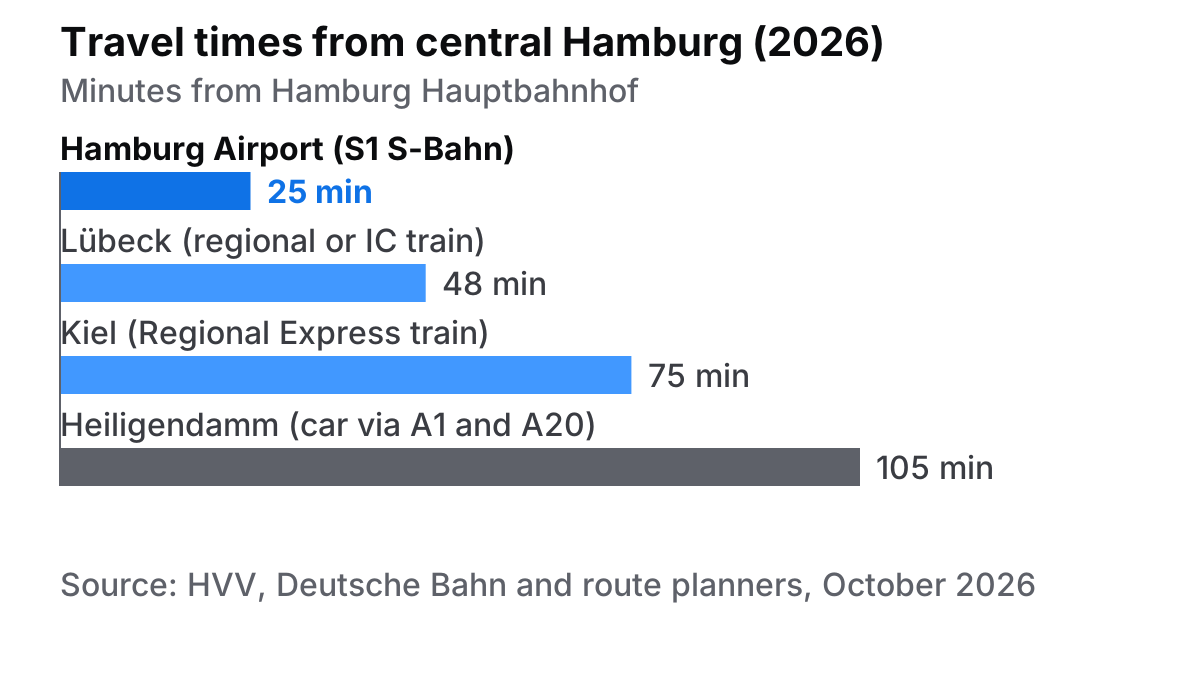
Transit between the main terminal and the central railway station is straightforward via public transport. The direct S-Bahn line S1 runs every 10 minutes between 06:00 and 23:00 (every 20 minutes off-peak), reaching Hamburg Hauptbahnhof in exactly 25 minutes. Passengers travelling from the city centre should note that trains split at Ohlsdorf station, with only the front three carriages continuing directly to the airport terminals.
Which destinations are within easy reach of Hamburg?
- Lübeck: The UNESCO-listed Hanseatic city renowned for Brick Gothic architecture and marzipan is situated northeast of Hamburg, reachable in 45 to 50 minutes by regional train or 40 to 50 minutes by car.
- Kiel: The state capital of Schleswig-Holstein on the Baltic fjord hosts world-famous sailing regattas and major maritime shipyards, located 1 hour 10 minutes to 1 hour 30 minutes away by train (1 hour to 1 hour 10 minutes by car).
- Heiligendamm: Germany’s oldest Baltic seaside resort, known as the ‘White City by the Sea’, lies approximately 1 hour 45 minutes to the east by car, or 3 to 3.5 hours via regional trains and the narrow-gauge Molli steam railway.
- Altes Land and the Lower Elbe: Located directly southwest across the Elbe, Europe’s largest contiguous fruit-growing region features historic timber-framed farmhouses, dyke trails, and orchard landscapes favoured for weekend excursions.
When evaluating real estate assets across northern Germany’s growth hubs, market clarity is essential. Access comprehensive district data and live inventory across Hamburg’s 104 quarters by exploring CASAFARI Area Insights or signing in directly to the CASAFARI platform.
Frequently asked questions
Can non-EU citizens buy property in Hamburg?
Germany imposes no legal restrictions on non-EU citizens or foreign entities purchasing residential or commercial real estate in Hamburg. International buyers acquire property under the exact same terms as German nationals as of 2026. However, purchasing real estate does not automatically grant residency or a visa, so foreign buyers must comply with standard German immigration regulations to reside in the country.
What are the property purchase taxes and fees in Hamburg?
As of October 2026, buyers purchasing real estate in Hamburg should budget approximately 7% to 11% of the property price for ancillary transaction costs (Kaufnebenkosten). This comprises the Hamburg property transfer tax (Grunderwerbsteuer) set at 5.5% since January 2023, notary and land registry fees of 1.5% to 2.0%, and a buyer’s agent commission typically around 3.57% including VAT where applicable.
What are the rules for short-term rentals and Airbnb in Hamburg?
Under the Hamburg Housing Protection Act (Hamburgisches Wohnraumschutzgesetz), owner-occupiers may let their primary residence on a short-term basis for up to 8 weeks (56 days) per calendar year without requiring a change-of-use permit. As of September 2026, hosts must register online to display a valid housing protection number (DEU-02000000-) on all platform listings and submit occupancy data under Regulation (EU) 2024/1028, with unauthorized lettings subject to fines up to €500,000.
Which international schools and universities are in Hamburg?
Hamburg features more than 20 universities and higher education institutions with roughly 152,493 enrolled students as of September 2026, including the University of Hamburg (a designated University of Excellence with 43,134 students), HAW Hamburg, TUHH, and Kühne Logistics University. Expatriate families also benefit from established International Baccalaureate (IB) educational options, such as the International School of Hamburg (ISH) in Groß Flottbek and WABE International School.