
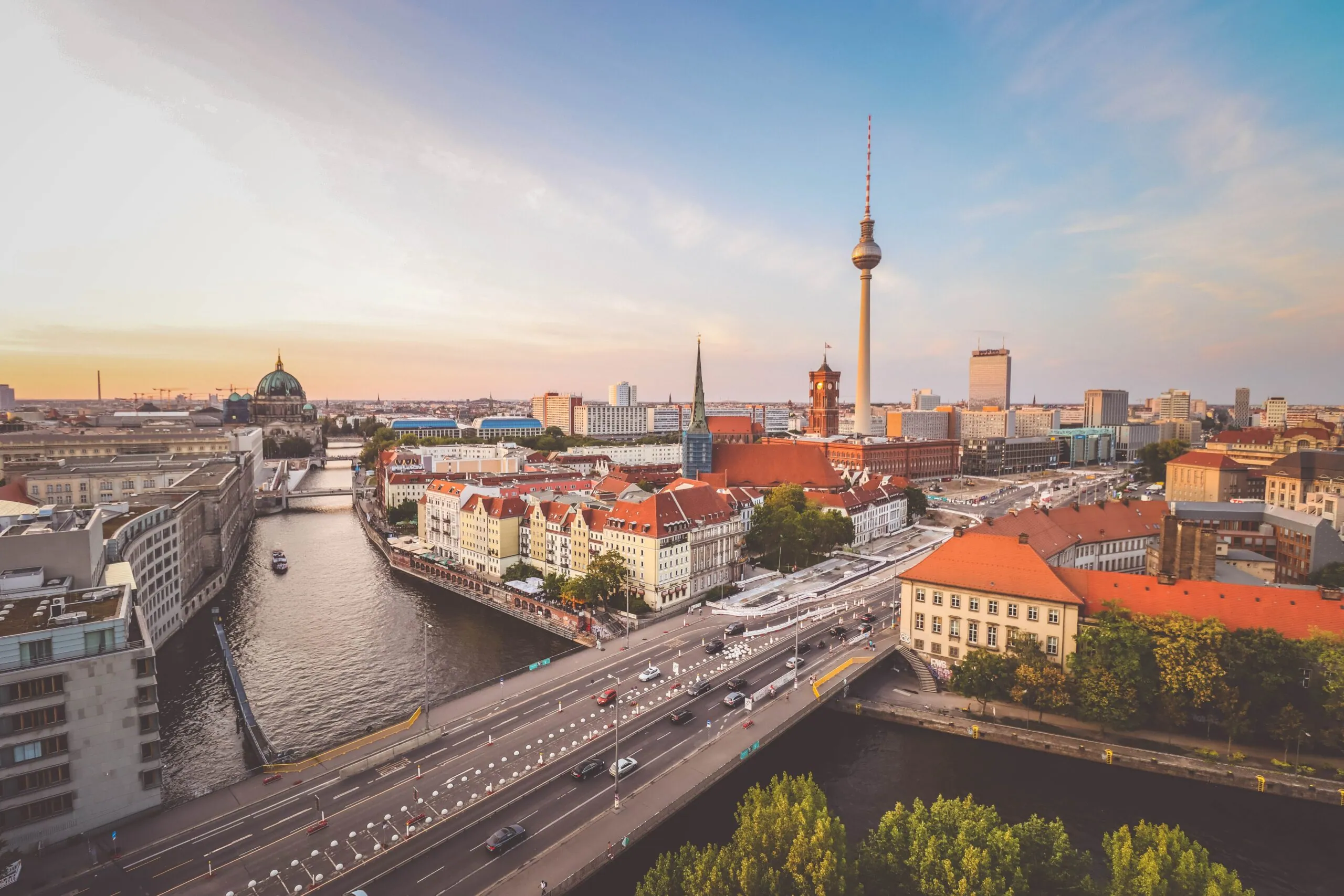
Berlin
Where historical events are remembered and an effervescent contemporary culture thrives
Berlin is Germany’s capital and largest city, with 3,700,577 official residents at the end of 2025 and ongoing growth driven by international immigration (Amt für Statistik Berlin-Brandenburg). Buyers face a 6.0 % property transfer tax, while new lettings remain subject to the Mietpreisbremse rent cap until 31 December 2029. Short-term whole-flat holiday lets require a district permit under the Zweckentfremdungsverbot regime.
Where is Berlin and how is the city organised?
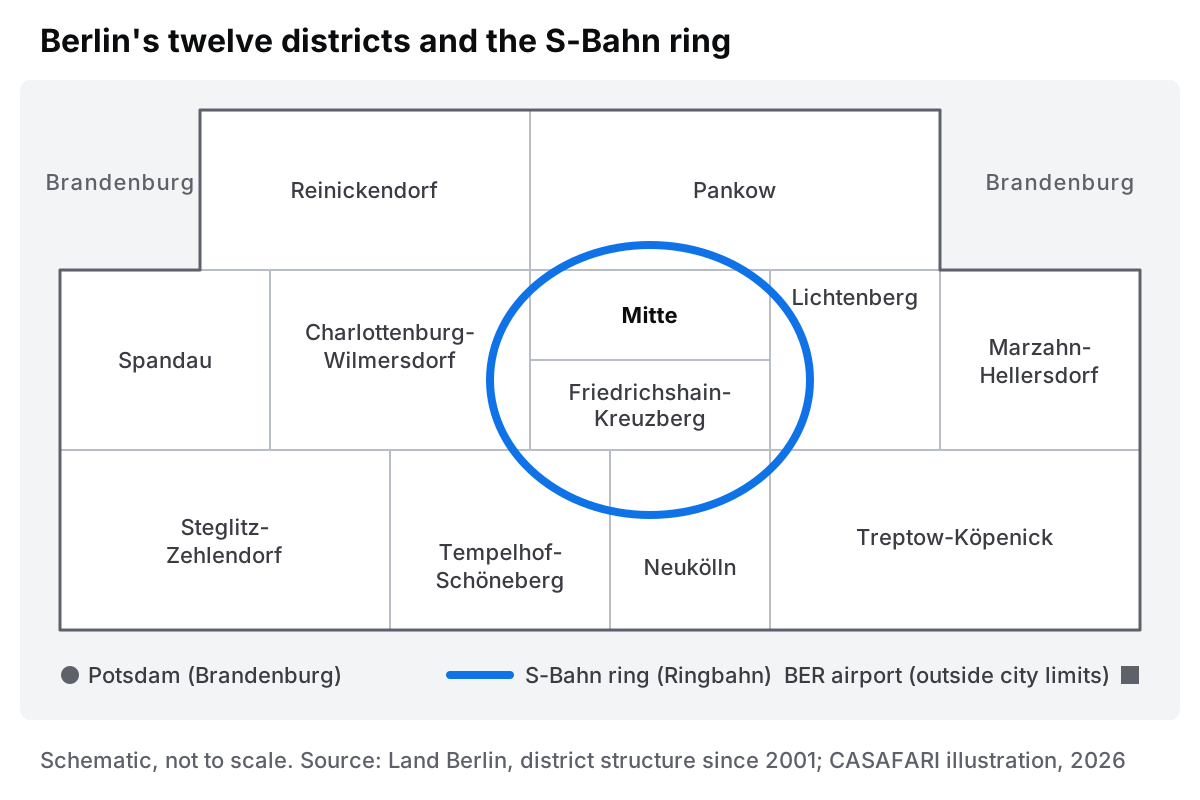
Berlin lies in north-eastern Germany as a dedicated city-state (Land), entirely surrounded by the federal state of Brandenburg. Potsdam, the state capital of Brandenburg, sits roughly 25 kilometres to the south-west.
Administrative governance is divided into twelve districts (Bezirke). Each Bezirk possesses distinct urban demographics and market characteristics:
- Mitte: The commercial and government core, dominated by modern infill developments and corporate headquarters.
- Charlottenburg-Wilmersdorf: The traditional western city centre, characterised by grand late-19th-century Altbau period apartments.
- Friedrichshain-Kreuzberg: Dense, vibrant central urban quarters with high rental demand among young professionals.
- Pankow (including Prenzlauer Berg): Berlin’s most populous Bezirk, featuring restored late-19th-century residential quarters popular with families.
- Steglitz-Zehlendorf: Suburban south-western residential neighbourhoods, close to international schools and green open spaces.
- Treptow-Köpenick: The south-eastern district featuring extensive lakes and forests alongside historic industrial conversion sites.
Population distribution across the city is shifting noticeably. Figures published by the statistics office in February 2026 show that eastern districts are growing while western districts remain largely static. Treptow-Köpenick recorded the highest net population increase across all districts in 2025, demonstrating how tenant and buyer demand is moving towards eastern submarkets.
Who lives in Berlin, and why does the city keep growing?
According to the local population register, 3,913,644 residents held their main domicile in Berlin as of 31 December 2025 (Amt für Statistik Berlin-Brandenburg, February 2026). This sustained growth is driven predominantly by international immigration.
Step onto Karl-Marx-Straße in Neukölln on a weekday morning or board the S-Bahn Ringbahn at 8 am, and Berlin’s international, youth-oriented demographic becomes immediately apparent. Most Berliners rent their homes rather than own them. Because tenant occupancy forms the backbone of the housing market, understanding German tenancy legislation is vital for any prospective residential investor.
What does it cost to buy in Berlin beyond the purchase price?
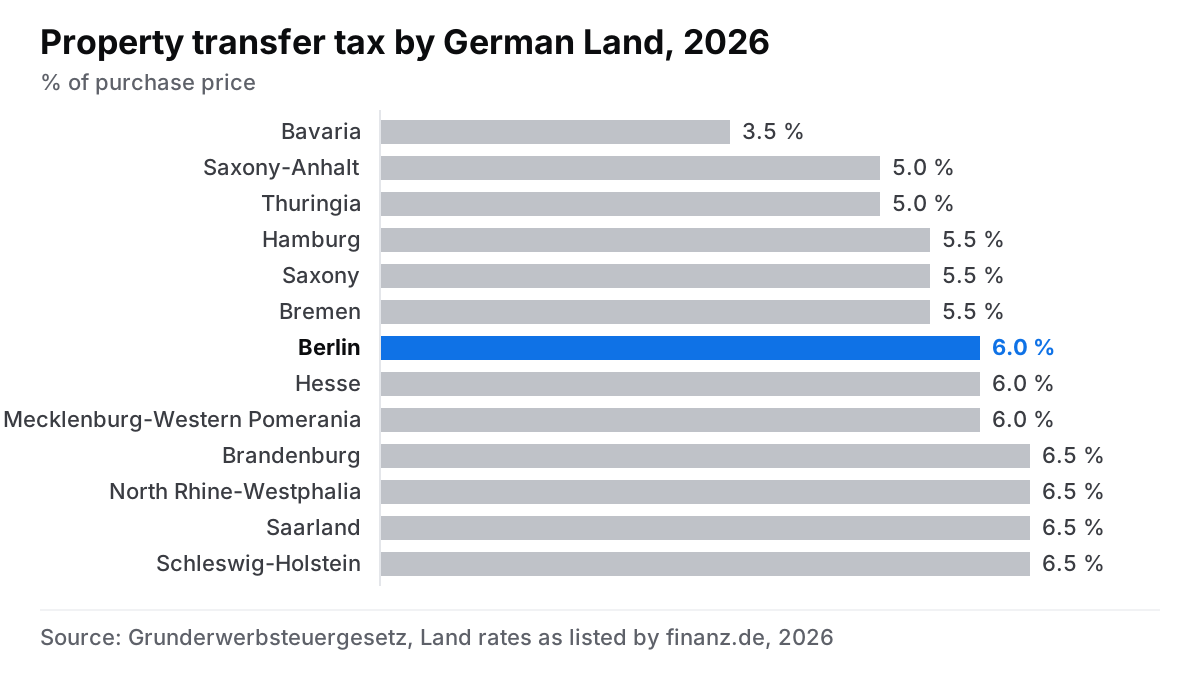
When calculating the total transaction cost base, investors must budget for the property transfer tax (Grunderwerbsteuer). The Land of Berlin levies a tax rate of 6.0 % on the agreed purchase price, which has remained unchanged since 1 January 2014 (finanz.de tax overview).
Transfer tax rates vary significantly across Germany’s 16 federal states. For context, Bavaria charges 3.5 %, whereas neighbouring Brandenburg charges 6.5 %.
In addition to transfer tax, statutory fees apply for the notary and the land registry entry (Grundbuch). Real estate agent commissions for residential flats and single-family houses are divided equally between buyer and seller under German federal law. Foreign nationals face no legal restrictions when buying real estate in Germany; international buyers simply require a German tax identification number and a local bank account to complete transactions.
Rental rules: Mietpreisbremse, Mietspiegel and short-let permits
Long-term residential letting in Berlin operates under nationwide and local statutory controls:
- Mietpreisbremse (Rent Cap): In force across the entire city of Berlin since June 2015, the federal rent brake was formally extended by the Bundesrat until 31 December 2029 (Deutscher Mieterbund). On new lettings, the agreed rent cannot exceed the local benchmark rent (Mietspiegel) by more than 10 %. Direct exceptions apply to first-time lettings of newly constructed buildings and comprehensive property modernisations. The Berlin Senate has operated a dedicated rent-check office (Mietpreisprüfstelle) since March 2025.
- Qualified Mietspiegel: The official Berlin Mietspiegel establishes the binding statutory benchmark for comparable local rents based on location, building age and amenities.
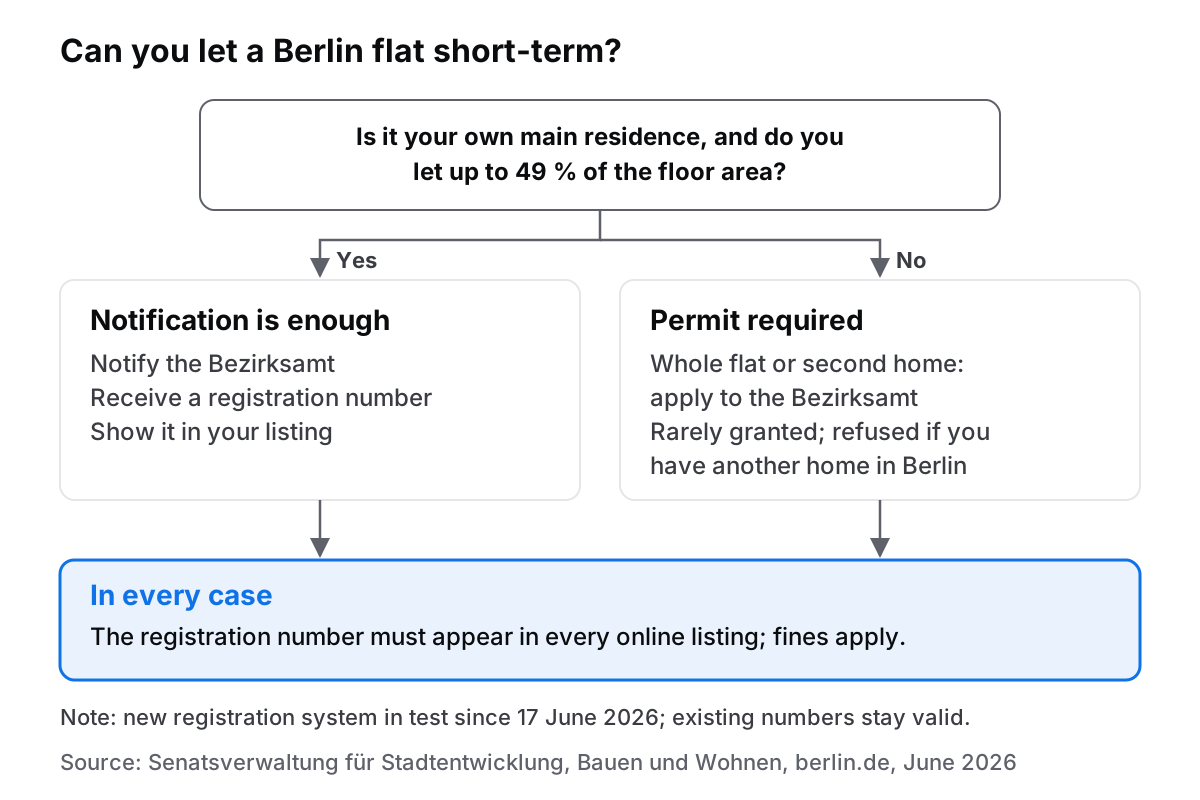
- Zweckentfremdungsverbot (Short-Let Ban): Berlin strictly regulates short-term holiday rentals under the law against housing misuse (Senate Department for Urban Development, Building and Housing). Homeowners may let up to 49 % of the floor space of their primary residence on a short-term basis following simple notification. However, letting an entire apartment or a second residence as a short-let requires an explicit district permit (Bezirksamt), which is rarely granted. Every online listing must display an official registration number. The Fourth Amendment implementing EU short-term rental rules took effect on 17 June 2026.
Getting around: BER airport, the Ringbahn and public transport
Berlin Brandenburg Airport (BER) opened on 31 October 2020 as the capital region’s sole commercial airport. Following BER’s opening, inner-city Tegel Airport permanently closed in November 2020 and is currently being redeveloped as an urban technology district.
Public transport across the capital is operated by the BVG and Deutsche Bahn, comprising U-Bahn underground lines, S-Bahn suburban rail, buses, and an extensive tram network in the eastern districts. The S-Bahn Ringbahn loop forms the traditional urban boundary distinguishing inner Berlin from the outer suburbs.
Under nationwide transport policy, the €63 monthly Deutschlandticket covers all local public transport, S-Bahn lines, and regional trains across Germany. Regional rail services run directly from Berlin Hauptbahnhof to Potsdam in under 40 minutes, alongside regular intercity ICE trains linking Berlin to Hamburg, Munich and Frankfurt.
Schools, residency and settling in
Berlin offers comprehensive public schooling alongside specialized bilingual state schools (Staatliche Europa-Schulen). International independent schools are largely concentrated in the south-western residential districts of Dahlem and Zehlendorf, as well as central Mitte.
Purchasing real estate in Germany does not confer automatic residence rights or an investor visa. Citizens of EU, EEA and Swiss states enjoy full freedom of movement, whereas UK and third-country nationals must apply for a residence permit grounded in employment, study, or business activities (Make it in Germany federal portal). Upon moving into a property, all residents are legally required to complete address registration (Anmeldung) at a local Bürgeramt within 14 days.
History and culture: why the city’s past still shapes its real estate
Berlin’s 20th-century political history remains directly visible in its urban building stock. The former East-West division created distinct architectural typologies: grand late-19th-century Altbau blocks in Charlottenburg and Prenzlauer Berg, industrial pre-fabricated panel housing (Plattenbau) in Marzahn and Lichtenberg, and modern post-1990 infill developments in Mitte.
Major historic landmarks such as the Reichstag building, Brandenburg Gate, Museum Island, Charlottenburg Palace, and the Fernsehturm define the city’s identity. For day trips beyond the city limits, Potsdam offers historic palaces including Sanssouci—the summer residence built for Frederick the Great—alongside the surrounding lakes of Brandenburg and the Spreewald biosphere reserve.
How CASAFARI helps you research Berlin property
Navigating Berlin’s property market requires clear, structured data on micro-locations, statutory rents and real transaction benchmarks:
- Use Area Insights for Berlin’s districts and neighbourhoods to evaluate district-level inventory, price distributions and time-on-market metrics across all 12 Bezirke.
- Prepare precise property valuations using a valuation and market study built on Berlin comparables.
- Technical development teams can integrate regional property data directly via the Area Insights documentation for developers (in English).
- Discover how to follow property market trends in Market Analytics to monitor yield shifts and listing volumes.
- Read how local German brokerages operate efficiently with market data, such as how Belle Estate prices with confidence using CASAFARI data and Rastorfer Gertig Immobilien on staying competitive with CASAFARI.
To explore current district supply figures and test market analytics live, access data services directly on the CASAFARI platform.
Frequently asked questions
What is the property transfer tax when buying in Berlin?
The Land of Berlin levies a property transfer tax (Grunderwerbsteuer) of 6.0 % on the purchase price, a rate unchanged since 1 January 2014. For comparison, neighbouring Brandenburg charges 6.5 %, whereas Bavaria charges 3.5 %. Buyers receive a tax assessment following contract signing and must settle the invoice before the land registry entry can be finalized.
Can I rent my Berlin flat on Airbnb?
Short-term holiday lettings are governed strictly by Berlin’s Zweckentfremdungsverbot legislation. You may let up to 49 % of the floor area of your primary residence after submitting a notification and displaying an official registration number in your listing. However, renting out an entire residence or a secondary home requires an explicit district permit, which is rarely granted in residential areas.
Is rent control still in force in Berlin in 2026?
Yes, the Mietpreisbremse rent cap applies city-wide across Berlin and has been extended nationally by the Bundesrat until 31 December 2029. Rents on new lettings cannot exceed the local comparative index (Mietspiegel) by more than 10 %, excluding initial lettings of new builds and comprehensive modernisations. The Berlin Senate also maintains a dedicated rent-check office to enforce compliance.
Does buying property in Berlin give me the right to live in Germany?
No, purchasing real estate in Germany confers no automatic entitlement to residency or an investor visa. EU, EEA and Swiss citizens possess full rights to reside and acquire property, while UK and other non-EU nationals require a residency permit based on employment, study or business grounds. Once living in Berlin, all residents must complete address registration at a local Bürgeramt.