

Toulouse
Where culture, technology and tourism meet by the riverbanks.
Toulouse is France’s fourth-largest city and the industrial heart of European aerospace, offering property investors and residents a resilient economy supported by a municipal population of 514,819 and over 120,000 university students. Situated in southwestern France along the Garonne, the city combines strong employment fundamentals with major infrastructure projects like Metro Line C and a defined regulatory framework for rental investments.
Where is Toulouse and why is its population growing?
Situated in southwestern France, Toulouse is the regional capital of Occitanie and the administrative seat of the Haute-Garonne department. The city occupies a strategic geographical position along the Garonne river, set between the Pyrenees mountains to the south, the Mediterranean coast to the east, and the Atlantic seaboard to the west.
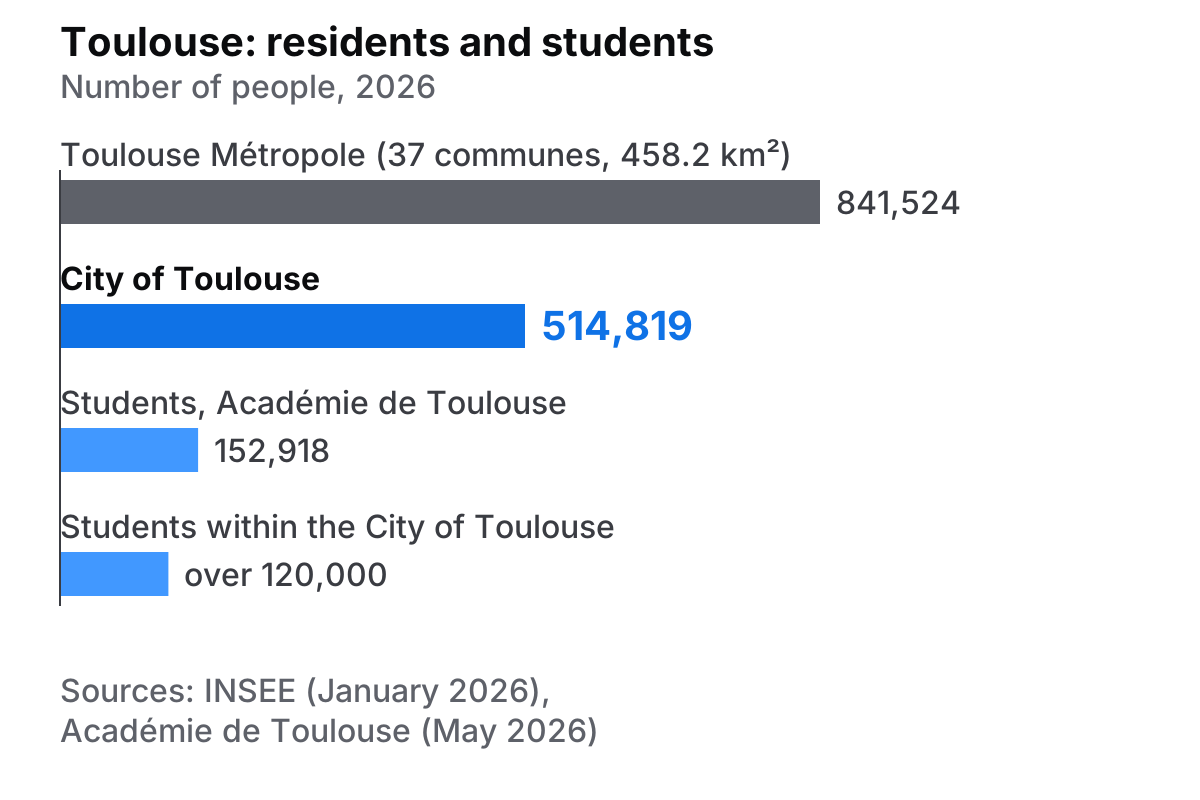
According to INSEE municipal population figures for Toulouse (January 2026), the commune of Toulouse officially counts 514,819 inhabitants, ranking it as the fourth most populous municipality in France. On a broader scale, INSEE metropolitan data for Toulouse Métropole (January 2026) shows that the intercommunal structure encompasses 37 individual communes across 458.20 square kilometres, hosting a collective population of 841,524 residents.
This sustained population momentum is fueled by a robust regional economy that continually draws skilled professionals, researchers, and university students. Coupled with a temperate climate featuring warm summers and mild, sunny autumns, the metropolitan area offers a balance of commercial activity and lifestyle appeal.
What drives the economy and lifestyle in Toulouse?
Known globally as the capital of Europe’s aerospace and space industries, Toulouse hosts the corporate and manufacturing headquarters of Airbus Commercial Aircraft alongside an extensive ecosystem of aviation subcontractors, satellite design firms, electronics manufacturers, and biotechnology research centres. This industrial core ensures high employment stability and attracts international talent.
The industrial base is closely aligned with a major higher education sector. Based on Académie de Toulouse higher education statistics (May 2026), 152,918 students are enrolled in higher education across the academic region, with more than 120,000 concentrated directly inside the commune of Toulouse. This student body underpins consistent structural demand for small-surface residential housing and shared accommodation. Investors focused on calculating and comparing rental yields with CASAFARI frequently target these university sectors.
Affectionately known as the Ville Rose (Pink City) due to its historic terracotta brick architecture, Toulouse boasts a distinct cultural profile. The city hosts an active calendar of cultural events throughout the year, including the Rio Loco music festival, Piano aux Jacobins, Printemps du Rire, and the Marathon des Mots literary event.
Sporting life is dominated by rugby union. According to the Ligue Nationale de Rugby (LNR) record on Stade Toulousain, local club Stade Toulousain holds a historic record of 25 French championship titles (Bouclier de Brennus), reinforced by consecutive league victories in June 2025 and June 2026, alongside 6 European Champions Cup titles.
Which heritage sites and landmarks define Toulouse?
The central urban landscape is anchored by notable historic architecture. At its heart lies the 18th-century Capitole, a imposing neoclassical building that accommodates both the municipal city hall and the Théâtre du Capitole opera house. Nearby, the Convent of the Jacobins features impressive Southern Gothic brickwork and palm-tree vaulting, while the Renaissance-era Hôtel d’Assézat hosts traditional learned societies, including the ancient Académie des Jeux Floraux.
As detailed in the Toulouse Métropole guide to UNESCO World Heritage sites, the city contains three Unesco-inscribed landmarks: the Canal du Midi (inscribed in 1996), alongside the Romanesque Basilica of Saint-Sernin and the riverfront Hôtel-Dieu Saint-Jacques (both inscribed in 1998 as part of the Routes of Santiago de Compostela in France).
River panoramas along the Pont Neuf, views of the iconic dome at La Grave, and thematic attractions such as Cité de l’espace and the Aeroscopia aeronautical museum complete the city’s landmark offering. Visitors and prospective residents exploring these sites often utilise the official Toulouse Tourist Office Pass Tourisme, which costs €26 (or €36 including 10 Tisséo transport journeys) for 1 to 3 days of access to municipal museums and guided tours.
How does public transport connect Toulouse and its suburbs?
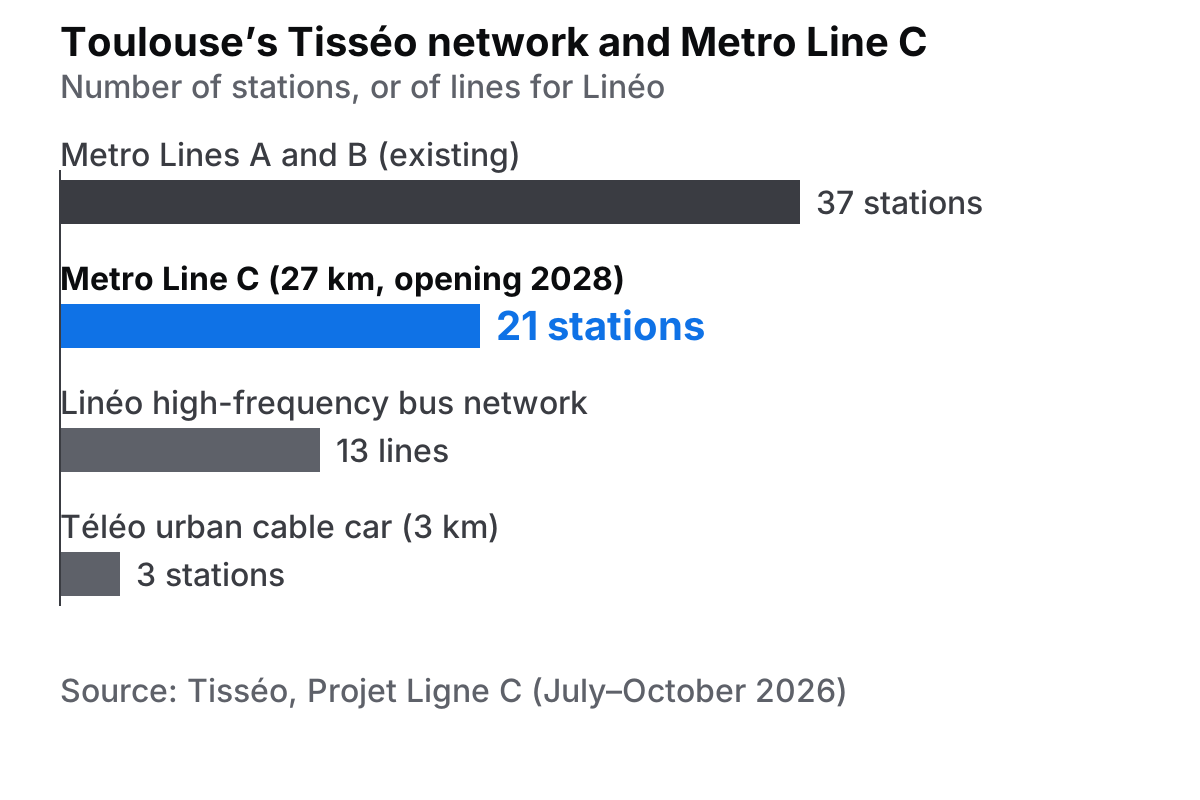
Public transit across the urban area is operated by Tisséo. According to the Tisséo public transport network overview (October 2026), the current transit infrastructure comprises two automated underground lines (Lines A and B, serving 37 stations), one tramway line (Line T1), 13 high-frequency Linéo express bus routes (L1 to L12 and L14), and the Téléo urban cable car, which spans 3 kilometres across 3 elevated stations in the southern sector.
Transit capabilities are expanding through a major infrastructure investment: the construction of Metro Line C. Official Tisséo Metro Line C project specifications confirm that the new automated route will run for 27 kilometres across 21 stations upon entering service in 2028, directly connecting major industrial parks and suburban residential areas. Understanding how infrastructure improvements affect location accessibility highlights why hyper-localised data matters in real estate.
Regional connectivity is provided by regional liO train and bus services, motorways connecting Toulouse to Bordeaux, Narbonne, Tarbes, Albi, and Limoges, and Toulouse-Blagnac international airport located west of the city centre.
What are the rental and short-let regulations for property investors in Toulouse?
Investors evaluating the Toulouse market must navigate specific national and municipal real estate frameworks governing long-term and short-term lettings.
For long-term residential leases, official French government guidance on zone tendue rent rules (Service-Public.fr) confirms that Toulouse is classified as a zone tendue (high-demand housing zone). Consequently, annual rent increases between successive tenancies (encadrement de l’évolution des loyers à la relocation) are capped and tied to the official rent reference index (IRL) through at least July 2027. However, the city does not impose a strict per-square-metre ceiling (encadrement du niveau des loyers).
Regarding property taxation, non-resident property owners should note that Toulouse Métropole applies the secondary residence council tax (taxe d’habitation sur les résidences secondaires) alongside the statutory zone tendue surcharge.
Short-term holiday rentals are subject to strict municipal rules. As outlined by Toulouse Métropole short-term tourist rental regulations, all tourist accommodation must display a municipal registration number. Primary residence lets are capped at 120 days per calendar year. For secondary residences, private individuals must obtain a temporary change-of-use (changement d’usage) authorisation, restricted to a maximum of two properties per individual owner. From the third property onwards for individuals, or from the first property for corporate entities (personnes morales), mandatory commercial-to-residential compensation in the same sector is required.
Real estate professionals, advisers, and investors can draw upon CASAFARI Area Insights, our property valuation and market study tool, and Property Sourcing to evaluate micro-location analytics, pricing metrics, and real-time residential market supply across Toulouse Métropole.
Whether assessing long-term rental demand near university campuses or evaluating suburban real estate connected by future transit developments, accessing accurate regional market intelligence is key. Explore comprehensive market data across Toulouse on the CASAFARI platform.
Frequently asked questions
Are there rent controls in Toulouse for buy-to-let investors?
Toulouse is designated as a high-demand housing zone (zone tendue), which means rent increases between successive tenancies are regulated under national law (encadrement de l’évolution des loyers à la relocation, renewed through July 2027). Landlords generally cannot increase rents for a new tenant beyond the previous rent indexed to the rent reference index (IRL). However, as confirmed by official guidance on Service-Public.fr, Toulouse does not enforce a strict per-square-metre rent ceiling (encadrement du niveau des loyers).
What are the Airbnb and short-term rental rules in Toulouse?
Every short-term tourist rental in Toulouse must be registered with the municipality to obtain an official registration number. Letting a primary residence is limited to 120 days per calendar year. For secondary residences, private owners must secure a temporary change-of-use (changement d’usage) permit, capped at two properties per owner; from the third property for an individual, or the first property for a corporate entity, mandatory commercial-to-residential compensation in the same district applies.
How is public transport in Toulouse changing with Metro Line C?
Tisséo’s transit network currently includes two metro lines (Lines A and B across 37 stations), one tramway line (T1), 13 high-frequency Linéo bus routes, and the 3-kilometre Téléo urban cable car. Network coverage will expand significantly with Metro Line C, a 27-kilometre automated underground line serving 21 new stations, scheduled to enter service in 2028.
Why is Toulouse so popular with students and aerospace professionals?
Toulouse is home to Airbus and forms the centre of Europe’s aerospace, satellite, and defence industries, supporting a metropolitan population of 841,524 inhabitants according to INSEE figures. Furthermore, higher education data from the Académie de Toulouse shows that the region accommodates 152,918 university students, with over 120,000 studying within the city of Toulouse itself, creating steady demand for housing.