
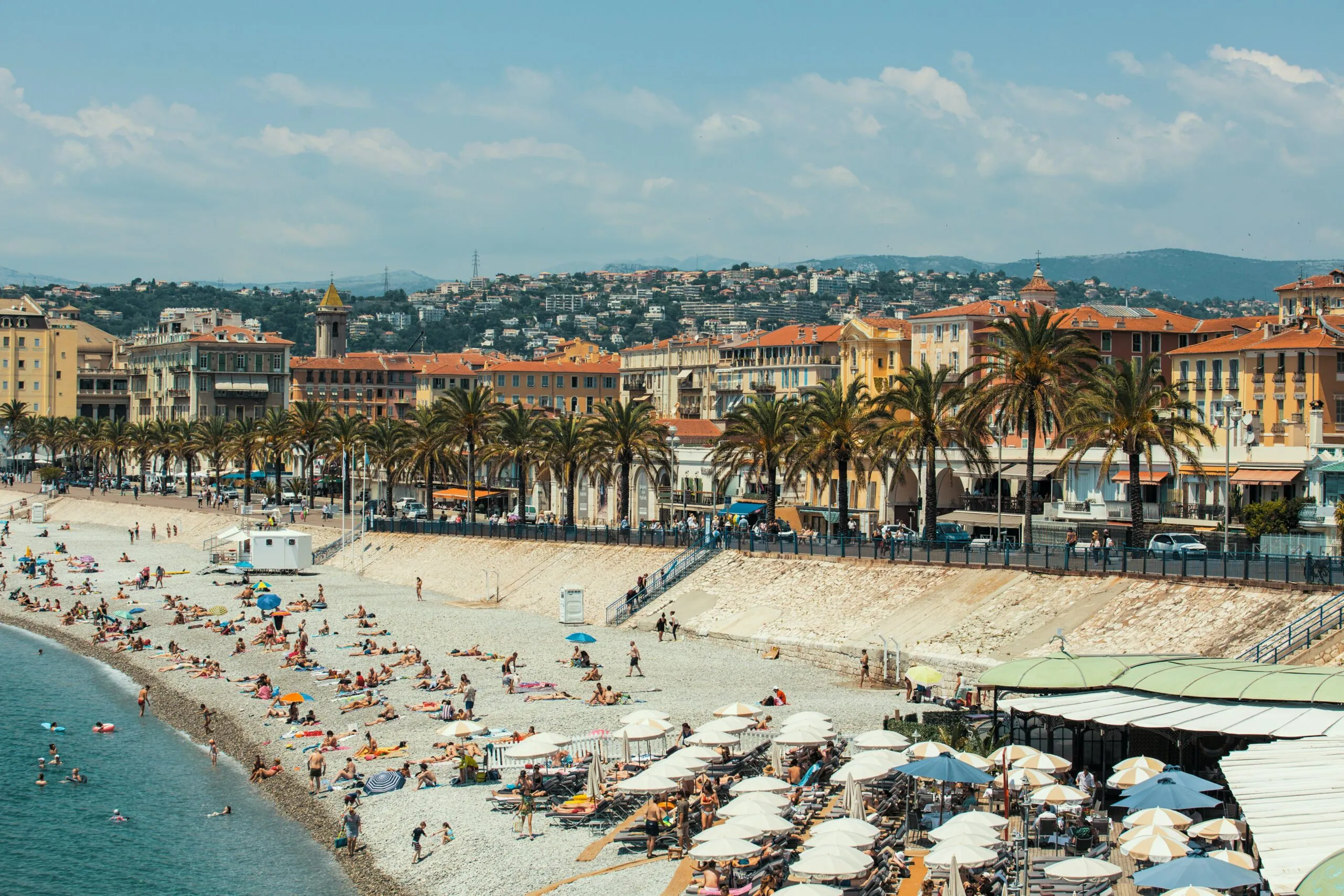
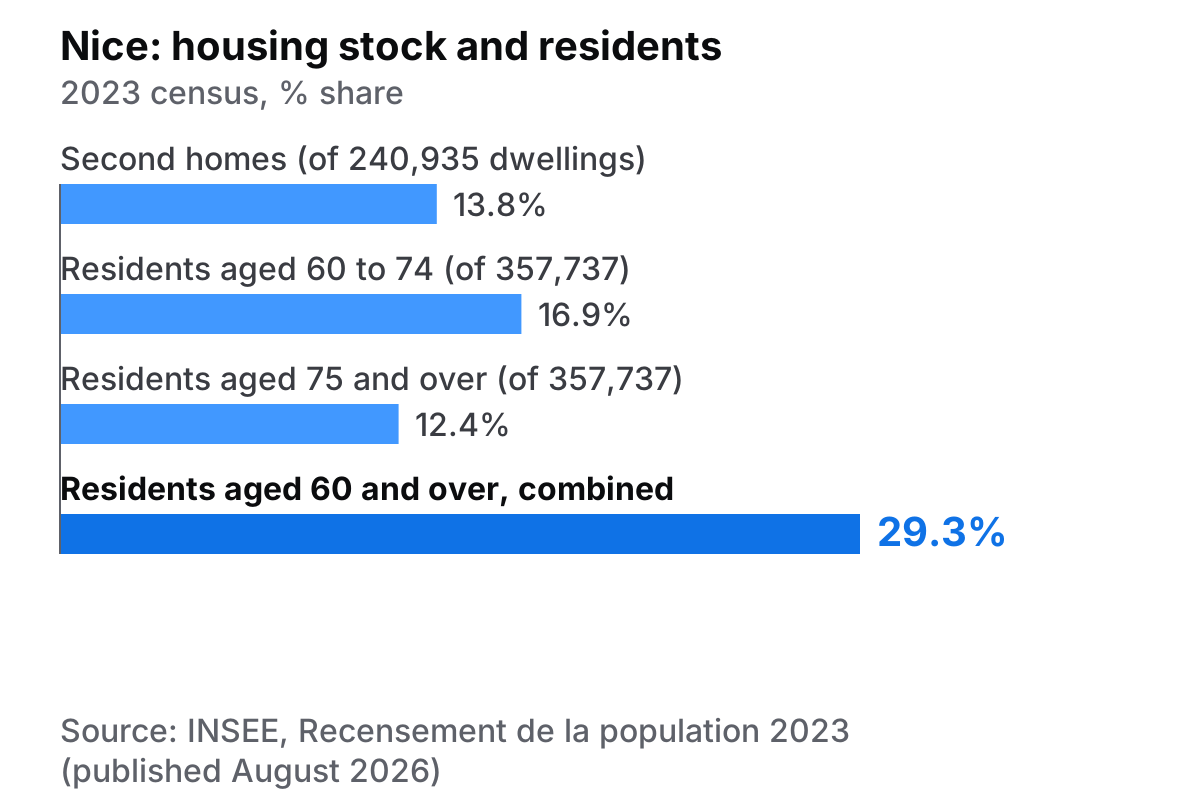
Nice is the capital of the Alpes-Maritimes department on the French Riviera (Côte d’Azur), set along the Baie des Anges between the Mediterranean Sea and the Alps. Covering 71.9 km² with 357,737 residents (INSEE 2023 census data for Nice, August 2026), France’s fifth-largest city combines a thriving year-round economy with nearly 5 million annual visitors and a housing stock where 13.8% of all 240,935 homes are second residences.
Where is Nice in France, and why does its property market stand out?
Founded by Phocaean Greeks as Nikaia, Nice developed across centuries into a major Mediterranean hub before becoming the premier winter resort for European aristocracy in the nineteenth century. That heritage remains visible along the iconic Promenade des Anglais, which was inscribed on the UNESCO World Heritage list in 2021 as part of Nice’s recognition as a Riviera winter resort town.
Beyond its waterfront promenade, Nice’s residential landscape is anchored by rich artistic and hospitality legacies. Hillside districts like Cimiez showcase classical architecture alongside cultural landmarks such as the Musée Matisse and the Musée National Marc Chagall. Hospitality capacity is equally substantial: according to the Nice Côte d’Azur Tourism Observatory (April 2026 figures), the city hosts around 180 hotels and tourist residences offering nearly 12,000 rooms, contributing to 6.6 million hotel nights annually across the wider Métropole.
How well connected is Nice by tram, rail, and international flights?
Transport infrastructure in Nice has undergone extensive modernisation over the last decade. The public transport network, managed under the Lignes d’Azur public transport network by the Métropole Nice Côte d’Azur, operates four distinct tram routes across three main lines (Lines 1, 2, and 3, plus branch Line B serving the CADAM administrative centre). The network is complemented by 140 to 165 bus and coach lines, including 5 high-frequency routes operated with tram-level service frequency.
Tram Line 2 forms a major east–west spine across the city, connecting Port Lympia and the historic centre directly to Nice Côte d’Azur Airport in 15 to 30 minutes. Situated just 7 km west of the centre, the airport recorded between 14.8 million and 15.23 million passengers annually according to Nice Côte d’Azur key figures (2025/2026 data), providing direct connections to more than 100 destinations across 40 countries.
For rail commuters and national connections, the SNCF Connect Paris to Nice high-speed rail schedule confirms direct TGV INOUI and OUIGO services from Paris Gare de Lyon to Nice-Ville in 5 hours 42 minutes. Regional TER trains run along the coast, linking Nice to Monaco and Cannes in under 30 minutes.
What is the climate like in Nice throughout the year?
Sheltered from harsh northern winds by the Maritime Alps, Nice benefits from a Mediterranean microclimate characterised by mild winters and warm, sunlit summers. Based on official Météo-France climate normals for Nice (1991–2020 reference period), the city registers an annual average temperature of 16.3 °C, with average daily minimums of 12.8 °C and maximums of 19.8 °C.
The region records 2,760.5 hours of bright sunshine per year, providing strong year-round appeal for international residents, holidaymakers, and long-term tenants.
What drives lifestyle, demographics, and investment demand in Nice?
Demographic stability and strong tourism demand combine to create a resilient real estate landscape. INSEE 2022/2023 age statistics show that 16.9% of Nice residents are aged 60 to 74, and 12.4% are aged 75 or older. In total, 29.3% of the resident population is aged 60 or over, reflecting a robust resident retiree demographic that balances the seasonal tourist market.
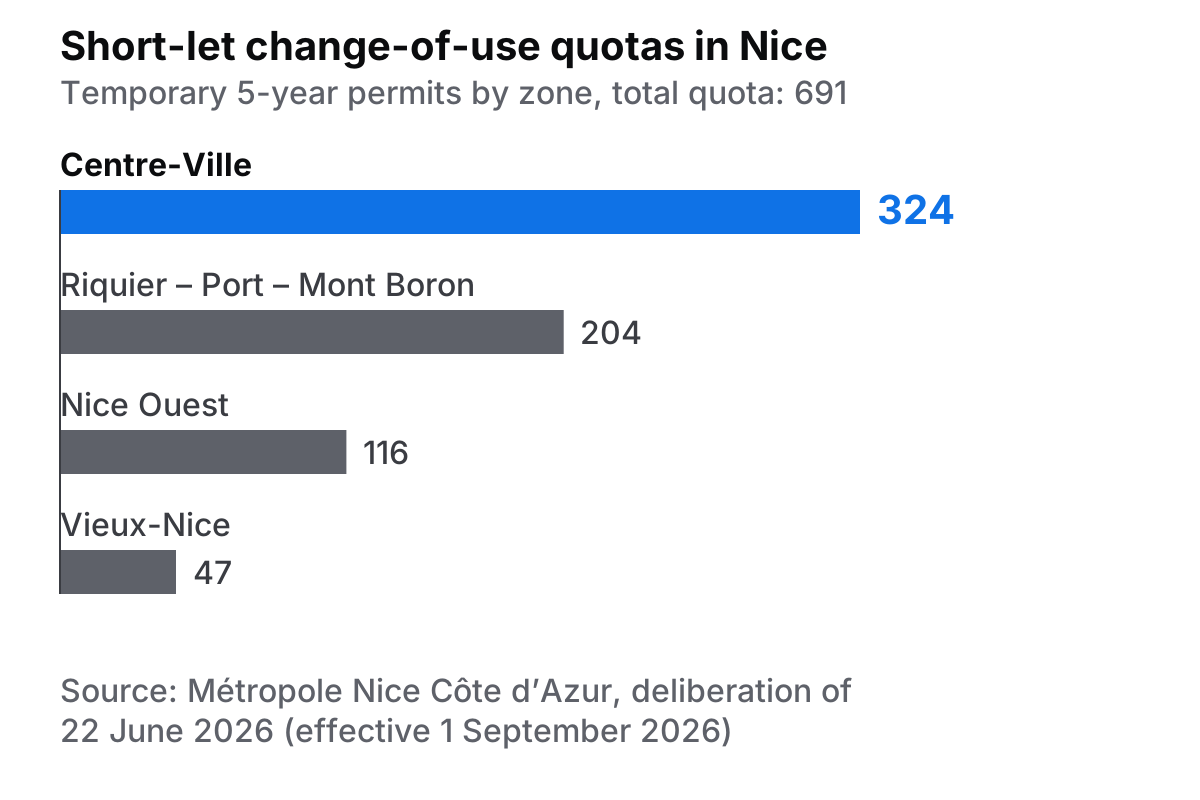
For property investors, understanding local taxation and short-term rental restrictions is essential. Primary residences may be rented out on holiday platforms for up to 90 days per year. For second homes, the Métropole Nice Côte d’Azur change-of-use regulations effective from 1 September 2026 establish a strict total limit of 691 temporary, 5-year non-renewable change-of-use permits across four designated zones, capped at one permit per tax household for private individuals. Companies (personnes morales) face mandatory commercial-to-residential property compensation from the first unit.
Tax considerations for second-home buyers include the municipal council tax surcharge. As detailed in the French tax authority guide to second-home council tax, Nice applies the maximum 60% surcharge on the communal share of the taxe d’habitation sur les résidences secondaires. Transaction costs must also be factored in: the Notaires de France guide to property acquisition costs notes that notary and acquisition fees total 7% to 8.5% for resale properties and 2% to 3% for new-build properties.
Nice also stands out for its gastronomy. The Michelin Guide selection for Nice includes 115 recommended establishments across Nice and its immediate surroundings, with 6 to 7 Michelin-starred restaurants within the city boundaries (led by two-star Flaveur) and 31 starred tables across the wider area. To evaluate market conditions, inventory, and micro-location metrics across these districts, real estate professionals rely on tools like CASAFARI Area Insights, perform an accurate property valuation and market study, or use CASAFARI Property Sourcing to identify potential deals across the Riviera. Understanding why hyper-localised data matters in real estate is critical when navigating these municipal regulatory zones.
Architecture, heritage, and leisure across Nice’s districts
Nice offers diverse architectural styles that reflect its historical transitions. Military history is preserved at the sixteenth-century Fort du Mont Alban on the eastern heights, while Baroque and Piedmontese civic landmarks define Vieux-Nice and Place Saint-François, including the Palais du Sénat and the Palais de la Préfecture. Place Garibaldi showcases nineteenth-century arcaded facades, whereas the Carré d’Or and Baumettes quarters display grand Belle Époque and Palladian architecture.
Everyday life in Nice centers on outdoor activity—from walking along the Mediterranean shoreline to watching traditional wooden pointus fishing boats moored in Port Lympia. Cultural events span from regional jazz festivals to film productions, while outdoor enthusiasts enjoy water sports along the bay and access to numerous golf courses across the surrounding Alpes-Maritimes hinterland.
Which Riviera destinations sit within 45 minutes of Nice?
- Antibes (approx. 23 km west, 25 minutes by train): Known for its historic ramparts and the Musée Picasso located within the Château Grimaldi. According to the French Ministry of Culture record for the Musée Picasso in Antibes, the museum holds roughly 245 works by Pablo Picasso created during his stay in 1946.
- Bellet Vineyards (western hills of Nice, 20 minutes by car): One of France’s few urban AOC wine appellations, featuring historic estates such as Château de Bellet.
- Principality of Monaco (approx. 20 km east, 20 to 30 minutes by train): Home to the Oceanographic Museum of Monaco, perched on a sheer cliff 85 metres above sea level. The Oceanographic Museum of Monaco Shark Lagoon feature details its 6-metre-deep basin containing 450,000 litres of seawater.
- Grasse (approx. 45 km west, 45 minutes by car): The international capital of perfume, home to the Musée International de la Parfumerie and historic fragrance houses.
Whether you are acquiring a second home or sourcing investment opportunities, access comprehensive market data across the Riviera by choosing to sign in to the CASAFARI platform. Developers and analysts can also review the CASAFARI Area Insights API documentation for technical integration details.
Frequently asked questions
What are the rules for short-term holiday rentals (Airbnb) in Nice?
Primary residences in Nice may be let as short-term holiday rentals for up to 90 days per calendar year, subject to mandatory municipal registration. For second homes, municipal regulations effective from 1 September 2026 establish a strict quota of 691 temporary, 5-year non-renewable change-of-use permits across four designated zones (Centre-Ville: 324; Riquier–Port–Mont Boron: 204; Nice Ouest: 116; Vieux-Nice: 47). Private individuals are limited to one permit per tax household, while corporate owners must provide commercial-to-residential property compensation from the first property.
How much are notary fees and property taxes for a second home in Nice?
Property acquisition costs (frais de notaire) in Nice range from 7% to 8.5% of the purchase price for resale properties and 2% to 3% for new-build developments. Because Nice is designated as a high-demand housing area (zone tendue), second-home owners are also subject to a 60% municipal surcharge on the communal portion of the second-home council tax (taxe d’habitation sur les résidences secondaires).
How well connected is Nice for international buyers and commuters?
Nice Côte d’Azur Airport is located just 7 km west of the city centre and can be reached in 15 to 30 minutes via Tram Line 2. The airport serves between 14.8 million and 15.23 million passengers annually with direct connections to over 100 destinations worldwide. Rail connectivity is equally robust, featuring direct TGV services to Paris Gare de Lyon in 5 hours 42 minutes and regional TER lines serving Monaco and Cannes in under 30 minutes.
What share of properties in Nice are second homes?
According to 2023 INSEE census data published in August 2026, 13.8% of Nice’s total housing stock of 240,935 dwellings are second homes or occasional residences (approximately 33,250 properties). Combined with nearly 5 million annual visitors, this non-resident property demand helps maintain dynamic market liquidity across central and coastal neighbourhoods.