
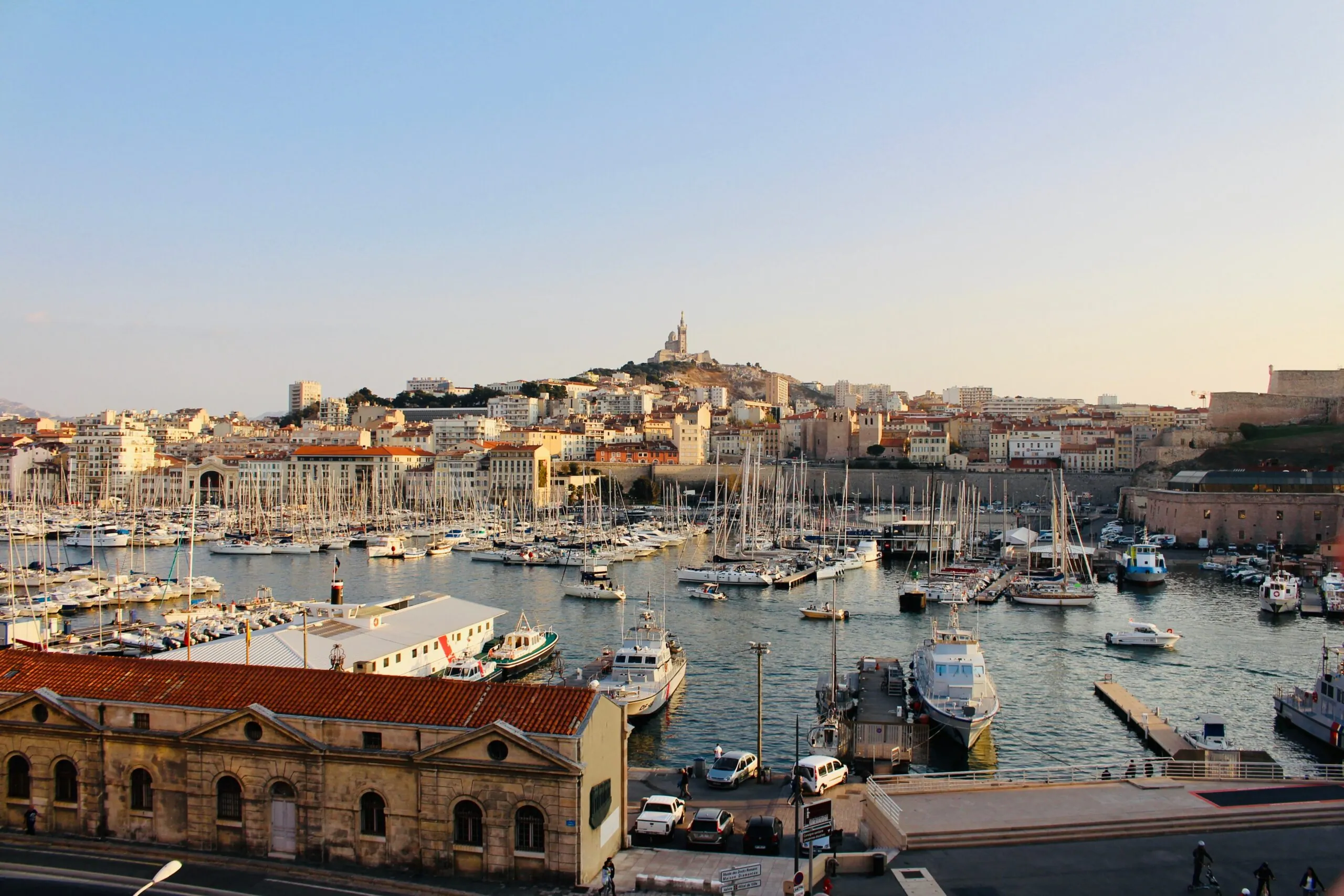
As France’s principal Mediterranean port and second-largest metropolitan hub, Marseille spans 240.6 km² with 886,040 municipal residents and anchors a metropolis of 1,939,077 people (INSEE 2026 legal population figures, January 2026). Linked to Paris in 3 hours 03 minutes by TGV, the city combines vibrant Mediterranean trade with stricter 2025–2026 rental caps, compulsory compensation rules, and updated property transfer taxes.
Where is Marseille and how is the metropolis structured?
Founded around 600 BC by Phocaean Greek mariners as Massalia, Marseille is France’s oldest city. Situated along the Gulf of Lion on the south-eastern coast of France, it has served for millennia as a natural maritime crossroads connecting Western Europe with North Africa, the Middle East, and Asia. Today, it remains the primary maritime and logistics gateway of the French Mediterranean.
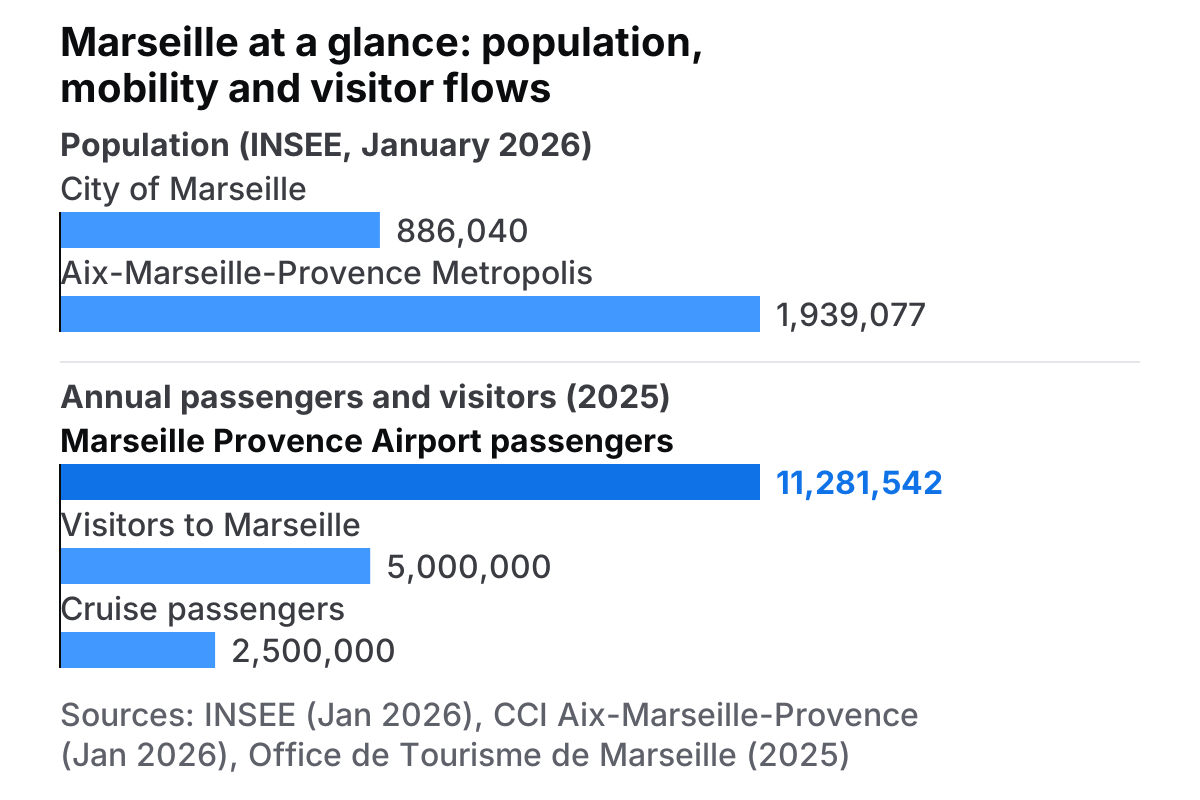
When evaluating real estate opportunities, investors and home buyers must distinguish between the city proper and the broader urban region. According to official INSEE 2026 legal population figures published in January 2026, the commune of Marseille covers 240.6 km² and houses 886,040 municipal inhabitants (892,391 total population). Surrounding this core is the Métropole d’Aix-Marseille-Provence, an expansive administrative territory encompassing 92 municipalities over 3,149.2 km² with a municipal population of 1,939,077 (1,961,169 total population).
Architecturally, Marseille is divided into 16 municipal arrondissements grouped into eight sectors. The urban landscape reflects distinct eras of growth and urban renewal:
- Historic Core & Waterfront: The Old Port (Vieux-Port) forms the historical heart, flanked by the historic Le Panier quarter and the 19th-century Haussmannian avenues around the Canebière.
- Euroméditerranée Renewal Zone: Spanning the northern waterfront, this major urban regeneration project features contemporary architectural icons, including Zaha Hadid’s 147-metre CMA CGM Tower (completed in 2010) and the Museum of European and Mediterranean Civilisations (Mucem) on the J4 pier, inaugurated in June 2013 and designed by architect Rudy Ricciotti in association with Roland Carta.
- Mid-Century Modernism: Located in the 8th arrondissement, Le Corbusier’s landmark Cité Radieuse (Unité d’Habitation), built between 1947 and 1952, remains an international benchmark for modernist residential architecture.
- Southern & Eastern Districts: Leafy residential areas such as Roucas-Blanc, Périer, and Saint-Barnabé contrast with the dense central sectors, offering coastal villas, private parks, and period townhouses.
How does transport and infrastructure connect Marseille?
Public transit across the city is managed by the Régie des Transports Métropolitains (RTM). According to the Ville de Marseille (September 2025), the network comprises:
- Metro: 2 lines serving 29 stations, connecting the central railway hub to the northern, southern, and eastern sectors.
- Tramway: 3 lines with 34 stations providing modern surface transit through key commercial and cultural corridors.
- Buses: 92 to 93 bus routes, including the high-service bus (BHNS) lines B4 and B5 launched in September 2025 to improve east-west peripheral connectivity.
- Maritime Shuttles: Seasonal passenger ferries operated by RTM during warmer months, linking the Vieux-Port with Pointe Rouge and L’Estaque.
For intercity and national travel, Marseille Saint-Charles station serves as the regional rail hub. High-speed TGV services operated by SNCF connect Marseille to Paris Gare de Lyon, with the fastest direct trains completing the journey in 3 hours 03 minutes, while average services take between 3 hours 42 minutes and 3 hours 53 minutes (SNCF Connect, October 2026).
International connectivity is anchored by Marseille Provence Airport, situated northwest of the city in Marignane. In its annual performance report published by the CCI Aix-Marseille-Provence in January 2026, the airport recorded 11,281,542 passengers in 2025, offering direct flights to over 131 destinations served by 34 to 37 airlines.
What is the climate like in Marseille?
Marseille enjoys a classic Mediterranean climate characterised by mild, temperate winters and hot, dry summers tempered by coastal breezes. Sky conditions are predominantly bright, though the region is regularly exposed to the Mistral—a strong, cold, dry north-westerly wind that sweeps down the Rhône Valley, clearing atmospheric moisture and driving exceptional cloudless clarity.
Official climate normals for the 1991–2020 period recorded by Météo-France at the Marseille-Marignane station show:
- January (coldest month): Mean temperature of 7.7 °C, with average daily minimums of 3.5 °C and maximums of 11.8 °C.
- July (hottest month): Mean temperature of 25.2 °C, with summer daily maximums frequently exceeding 30 °C.
- Precipitation: Rainfall is concentrated principally in autumn and winter torrential bursts, leaving late spring and summer largely dry.
Lifestyle, economy and cultural landmarks in Marseille
Marseille’s local economy relies on port logistics, maritime freight, technology, healthcare, research, and tourism. The cosmopolitan character of the city has been shaped over centuries by Mediterranean trade and waves of migration, creating a distinct cultural tapestry reflected in local gastronomy, art, and traditional craftsmanship such as Savon de Marseille soap making and Provençal ceramics.
Everyday convenience is supported by major shopping districts with special Sunday trading permissions in designated international tourist zones. Prominent commercial centres include Les Docks Village in La Joliette, Prado Shopping in the 8th arrondissement, Centre Bourse near the Old Port, and the Grand Littoral complex in the north.
Tourism generates significant economic output. Figures from the Office de Tourisme de Marseille (2025) indicate that the city welcomes approximately 5 million visitors annually, including 3.9 million overnight tourists who generate 16.3 million overnight stays. The Grand Port Maritime de Marseille handled over 4.12 million maritime passengers in 2025, including 2.5 million cruise passengers.
Cultural landmarks span several historical eras:
- Notre-Dame-de-la-Garde: The neo-Byzantine 19th-century basilica perched on the city’s highest natural outcrop, offering 360-degree views across the urban bay.
- Cathédrale de la Major: The grand 19th-century cathedral situated above the commercial port area.
- La Vieille Charité: A 17th-century former almshouse designed by Pierre Puget in the Panier district, now housing museums and cultural exhibits.
- Palais Longchamp: A 19th-century monument built to celebrate the arrival of water from the Durance river, home to the Fine Arts Museum and Natural History Museum.
- Archipel du Frioul: A four-island archipelago located just off the coast, including the Île d’If and its 16th-century fortress (Château d’If), accessible by regular passenger ferries from the Vieux-Port.
Property rules, rental regulations and taxes in Marseille
Acquiring and letting residential property in Marseille requires strict compliance with local administrative regulations, which underwent significant tightening in 2025 and 2026.
Short-Term Tourist Rentals (Airbnb)
According to the Ville de Marseille short-term rental regulations, rules governing furnished tourist lets (meublés de tourisme) are among the strictest in France:
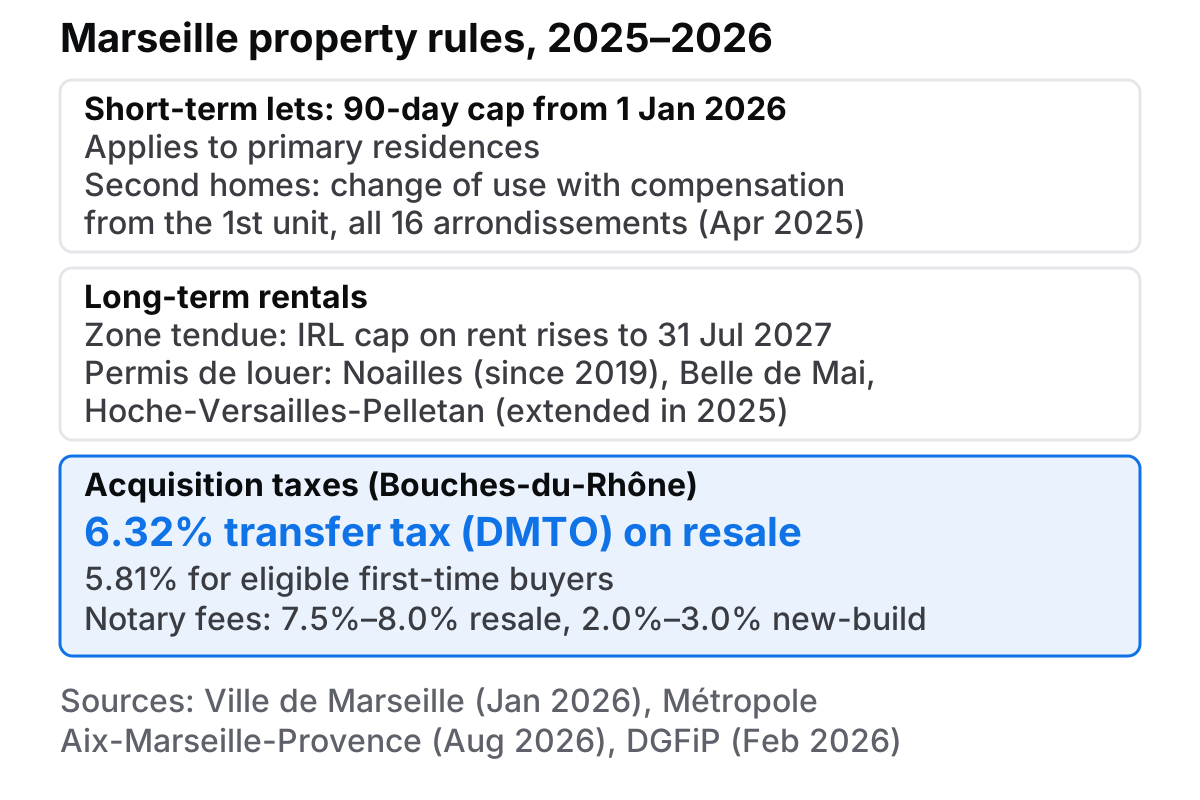
- Primary Residences: Effective 1 January 2026, home-owners may let their main residence for a maximum of 90 days per calendar year (reduced from the previous 120-day limit).
- Secondary Residences and Investment Properties: Effective since April 2025, converting a secondary residence or buy-to-let flat into a short-term holiday rental requires prior administrative authorisation with mandatory property compensation (compensation) from the very first property across all 16 arrondissements. Landlords must purchase non-residential commercial premises of equivalent surface area within the same group of arrondissements and convert them into permanent residential housing.
Long-Term Residential Tenancies and Landlord Licensing
While Marseille has formally submitted requests to apply per-square-metre rent caps under the national ELAN law, as of October 2026 no baseline rent ceiling (encadrement des loyers) is enforced in the city. However, because Marseille is classified as a high-demand zone tendue, annual rent increases between consecutive tenancies are capped and indexed to the national rent reference index (IRL), extended through 31 July 2027 by Decree No. 2026-644.
To combat substandard housing, the municipality enforces a mandatory prior rental authorisation scheme (permis de louer). Managed under the Aix-Marseille-Provence Metropolis permis de louer scheme, landlords must obtain an inspection clearance before signing a new lease in designated central neighbourhoods:
- Noailles: Mandatory since October 2019.
- Belle de Mai and Hoche-Versailles-Pelletan: Extended to these sectors during 2025.
Property Transfer Taxes and Acquisition Costs
Following provisions in the Finance Act, the department of Bouches-du-Rhône raised its departmental transfer tax rate from 4.50% to 5.00% in spring 2025. As detailed in the DGFiP February 2026 transfer tax rates, overall registration duties (droits de mutation à titre onéreux or DMTO) on resale properties stand at 6.32% for standard buyers, and 5.81% for eligible first-time buyers purchasing their main residence.
When notary fees, land registry charges, and disbursements are added, total acquisition costs in Marseille average:
- Resale Properties: 7.5% to 8% of the purchase price.
- New-Build Properties (VEFA): 2% to 3% of the purchase price.
Navigating these micro-market variations requires accurate data. Estate agents and institutional investors use CASAFARI Area Insights to evaluate district trends, while developers consult the Area Insights API documentation for technical integrations. Property buyers rely on our property valuation and market study tool alongside aggregated listing intelligence from Property Sourcing to identify sound investments. Understanding why hyper-localised data matters in real estate is essential when evaluating street-by-street risk across Marseille. Professionals ready to explore market analytics can sign in to the CASAFARI platform.
What to see around Marseille: the Calanques and Cassis
Immediately south of Marseille’s urban core lies the Parc national des Calanques, established in 2012 as Europe’s first peri-urban national park encompassing both terrestrial and marine zones. Stretching along dramatic limestone sea cliffs, the park features secluded coves such as Calanque de Sormiou, offering regulated hiking trails, rock climbing, and pristine swimming waters under strict summer access restrictions to protect fragile coastal ecosystems.
Further east past the Cap Canaille headland sits Cassis, a historic coastal port town famous for its picturesque harbour, seafood restaurants, and protected AOC Cassis white wines. Connected to Marseille Saint-Charles by direct regional TER train services, Cassis serves as a popular gateway for boat tours exploring the eastern sea inlets.
Frequently asked questions
What are the short-term rental and Airbnb rules in Marseille in 2026?
Since 1 January 2026, letting a primary residence as a short-term tourist rental in Marseille is capped at 90 days per calendar year. For secondary residences or buy-to-let properties, a rule in force since April 2025 requires change-of-use authorisation with mandatory property compensation from the very first property across all 16 arrondissements. This requires investors to acquire non-residential premises of equivalent surface area within the same group of arrondissements and convert them into permanent housing (Ville de Marseille, 2025–2026).
Is there rent control or a landlord licence requirement in Marseille?
As of October 2026, Marseille does not enforce per-square-metre rent caps under the national ELAN law, though rent increases between consecutive tenancies are restricted under zone tendue rules pegged to the IRL index through 31 July 2027. Landlords must, however, secure a prior rental authorisation licence (permis de louer) before letting properties in designated regeneration sectors, including Noailles (since 2019), Belle de Mai, and Hoche-Versailles-Pelletan (extended in 2025).
What are the notary fees and transfer taxes when buying property in Marseille?
Following a rate increase in spring 2025, the departmental transfer tax in Bouches-du-Rhône stands at 5.00%, raising total registration duties (DMTO) on resale property to 6.32% for standard buyers and 5.81% for eligible first-time main residence buyers (DGFiP, February 2026). Including notary emoluments and administrative disbursements, total transaction costs average 7.5% to 8% for existing resale properties and 2% to 3% for new-build homes.
How well connected is Marseille to Paris and international hubs?
Marseille Saint-Charles station is connected to Paris Gare de Lyon by direct TGV high-speed trains, with the fastest daily services completing the journey in 3 hours 03 minutes and average travel times ranging between 3h42 and 3h53 (SNCF Connect, October 2026). For international connectivity, Marseille Provence Airport served 11.28 million passengers in 2025, providing direct flights to over 131 destinations via 34 to 37 airlines (CCI Aix-Marseille-Provence, January 2026).