
Île-de-France is France’s capital region, encompassing 12,012 km² across 8 administrative departments and 1,266 communes. Home to 12.45 million residents (18.8% of metropolitan France), it forms one of Europe’s premier economic hubs. The region’s property market is currently undergoing a structural evolution driven by price stabilisation, strict short-term rental regulations, and the rollout of the 200 km Grand Paris Express automated metro network.
How is the Île-de-France region structured around Paris?
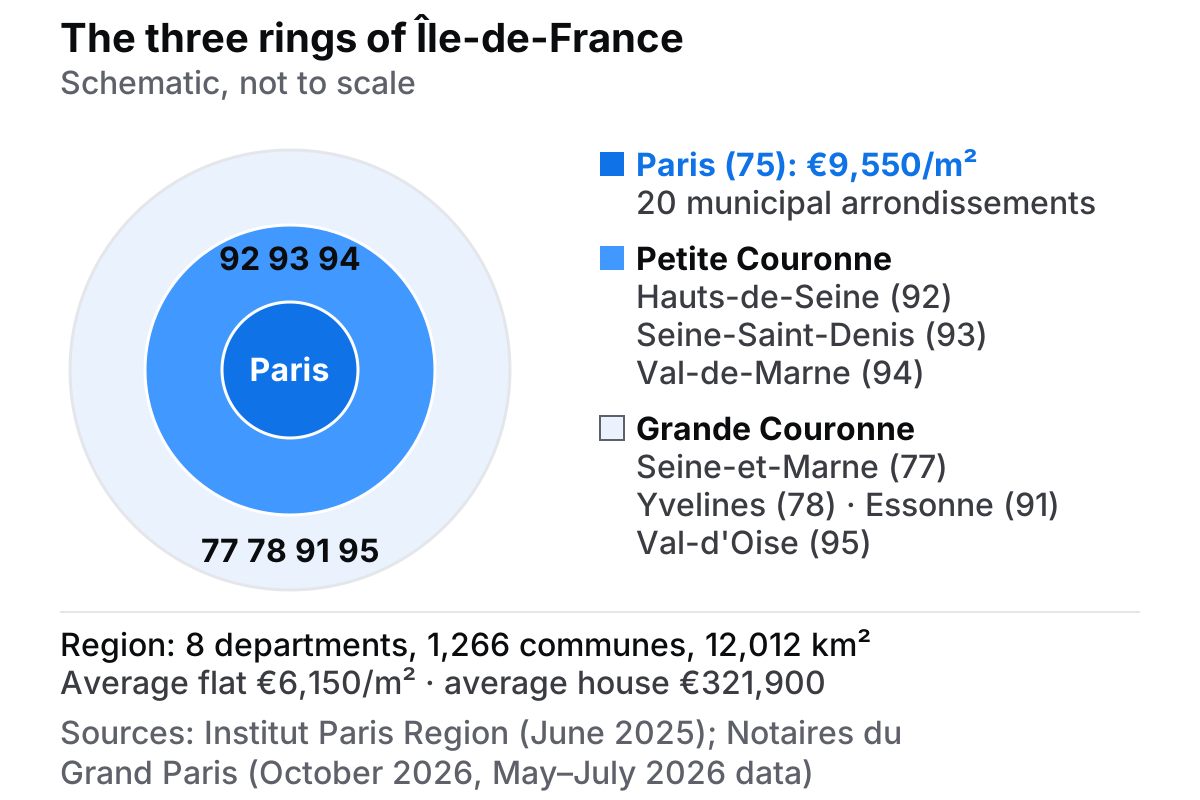
Real estate professionals and institutional investors segment Île-de-France into three distinct concentric rings centered around the French capital. At the core sits Paris proper (department 75), surrounded by the inner ring known as the Petite Couronne (comprising Hauts-de-Seine [92], Seine-Saint-Denis [93], and Val-de-Marne [94]). Beyond this lies the outer ring, or Grande Couronne, formed by Seine-et-Marne (77), Yvelines (78), Essonne (91), and Val-d’Oise (95).
According to data from the Institut Paris Region 2025–2026 key figures, this compact territory covers 12,012 km²—just 2.2% of metropolitan France’s total land area—yet contains 25 departmental arrondissements (alongside the 20 municipal arrondissements of central Paris) and 1,266 individual communes.
This geographical hierarchy directly influences real estate values and transaction liquidity. The Notaires du Grand Paris property market report (May–July 2026) recorded a return to transaction growth across the region, with 36,810 existing home sales completed over the three-month period (+5% year-on-year).
Prices have largely broad-based stabilised: existing apartments across Île-de-France averaged €6,150/m² (-0.4% YoY), while central Paris stood at €9,550/m² (-0.5% YoY). Existing houses across the regional outer communes recorded an average sale price of €321,900 (-1.2% YoY). To analyse transaction benchmarks and price per square metre distributions across individual communes, professionals rely on CASAFARI Area Insights and specialised property valuation and market study tools. Understanding these localized differences reinforces why hyper-localised data matters in real estate when underwriting acquisitions across different municipal jurisdictions.
Who lives in Île-de-France and what drives housing demand?
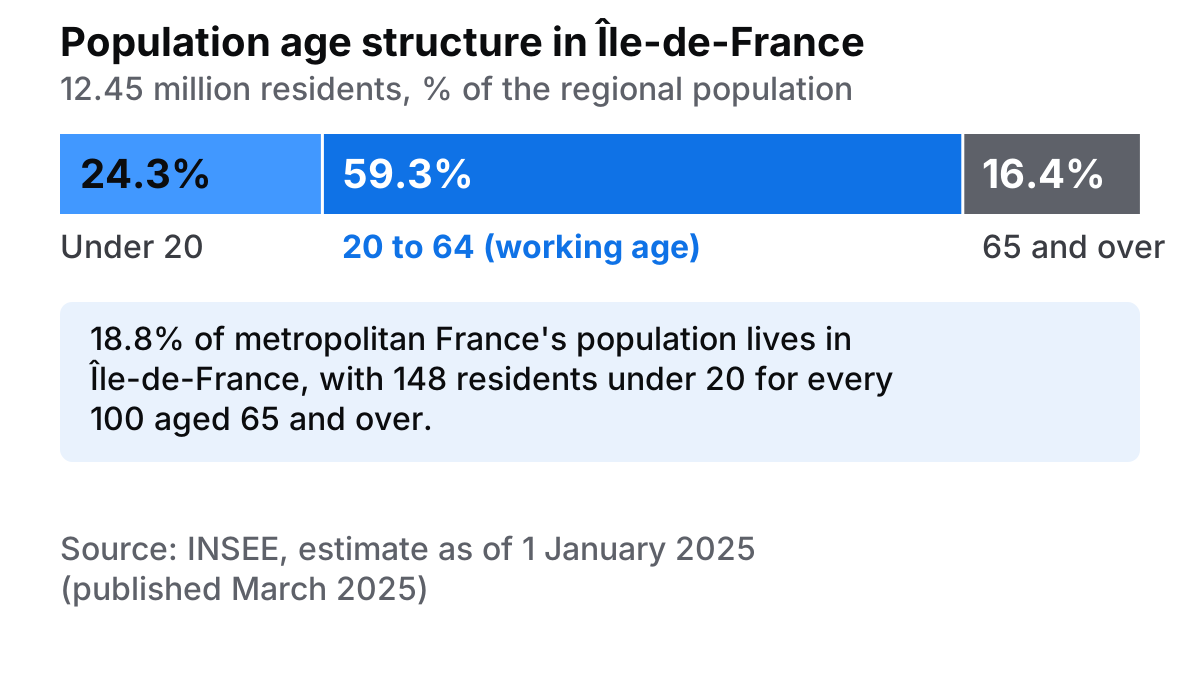
According to the INSEE 2025 demographic census data, Île-de-France reached 12.45 million inhabitants (provisionally estimated at 12.59 million as of January 2026), representing 18.8% of metropolitan France’s population.
Unlike many European metropolitan areas facing rapid population ageing, the region maintains a dynamic age demographic. INSEE figures show that 24.3% of residents are under 20 years old, 59.3% are of prime working age (20 to 64 years), and only 16.4% are aged 65 or over. This generates a youth index of 148 under-20s for every 100 residents aged 65 or older.
International diversity remains a key pillar of regional economic productivity. An INSEE study on immigrant populations in Île-de-France confirms that foreign-born immigrants constitute 20.7% of the regional population (representing nearly 40% of France’s total immigrant population). Furthermore, among residents aged 18 to 59, descendants of immigrants account for 20% of the regional cohort (1.36 million people), with primary origins spanning the Maghreb (Algeria, Morocco, Tunisia), Sub-Saharan Africa, Southern Europe (led by Portugal), and Asia.
This concentration of young, highly mobile talent—supported by corporate headquarters in La Défense and international research hubs such as Paris-Saclay—creates constant demand for both private sector rental housing and long-term family residential stock across outer suburban corridors.
Culture, green spaces and the Paris 2024 Olympic legacy
Île-de-France boasts an unprecedented concentration of cultural assets. Based on INSEE cultural statistics for Île-de-France, the region accounts for 29% of France’s performing arts venues, almost one-third of its theatres (including four of the five national theatres), over 300 cinemas operating roughly 1,200 screens, 9% of national museums (around 40 national museums, 25 of which are located in Paris), and 11% of all listed historical monuments.
Beyond urban heritage, the region offers substantial green space and sporting infrastructure. Major historic venues include the ParisLongchamp, Auteuil, Vincennes, and Saint-Cloud racecourses, alongside the Golf National in Saint-Quentin-en-Yvelines and the expansive royal forests of Fontainebleau and Rambouillet.
Urban quality has been permanently altered by the delivery of the Paris 2024 Olympic and Paralympic Games infrastructure. The APUR study on Paris 2024 Olympic venues and urban legacy details 64 major works completed under public delivery agency SOLIDEO, with 80% of public investment focused on Seine-Saint-Denis. Permanent developments include the Olympic Aquatic Centre in Saint-Denis, the Arena Porte de la Chapelle, the PRISME sports facility in Bobigny, major upgrades to venues like the Stade de France and Roland-Garros, and the conversion of the Athletes’ Village into 4,000 post-Games residential homes.
Tourism activity continues to fuel interest in residential short-stay listings. The Visit Paris Region annual tourism report recorded 49.1 million visitors in 2025 (25.9 million domestic and 23.2 million international), generating nearly €24 billion in economic activity.
However, regulations governing furnished short-term rentals have tightened significantly. As outlined in the City of Paris regulations on furnished tourist rentals, the implementation of the Le Meur Law (19 November 2024) saw Paris reduce the cap on renting out primary residences from 120 days to 90 days per calendar year, effective 1 January 2025. Furthermore, mandatory registration numbers apply across all communes by 2026, while properties requiring change-of-use authorization must meet strict energy performance ratings (minimum DPE Class F from 2025, Class E from 2028, and Class D for all short lets by 2034).
How are the Grand Paris Express and transport upgrades reshaping connectivity?
Public transport in Île-de-France is managed by Île-de-France Mobilités and comprises 16 Metro lines, 5 RER regional express rail lines (A through E), 9 Transilien suburban lines, 14 tramway lines, the Câble C1 urban cable car, and over 1,900 bus routes. Key recent milestones include the June 2024 extension of Metro Line 14 to Paris-Orly Airport and Saint-Denis Pleyel, as well as the western expansion of RER E to Nanterre-la-Folie.
According to the Grand Paris Express project timeline published by Société des grands projets, the flagship transit project is adding 200 km of automated metro lines (Lines 15, 16, 17, and 18) and 68 new stations. Opening in phases between late 2026/2027 (starting with Line 18 on the Saclay plateau) and 2031, this ring network enables direct suburb-to-suburb commuting without passing through central Paris hubs.
Surface transport infrastructure is undergoing a parallel transition. An Institut Paris Region report on cycling infrastructure confirms the region is served by 25,000 km of roads (including 700 to 800 km of motorways), 500 km of navigable waterways managing 70 ports via Haropa Port, and over 9,300 km of dedicated cycling facilities—supported by the expanding 750 km Vélo Île-de-France (VIF) network.
Long-distance and international connectivity is anchored by major high-speed rail terminals (Gare du Nord, Gare de Lyon, Gare de l’Est, Gare Montparnasse) and airports. The Groupe ADP 2025 passenger traffic figures report 106.96 million passengers across Paris-CDG (72.03 million) and Paris-Orly (34.93 million) in 2025 (+3.4% YoY), while Paris-Le Bourget handles roughly 55,000 business aviation flights annually. Low-cost airports such as Paris-Beauvais (6.56 million passengers in 2024) lie outside the Île-de-France administrative boundary in the neighbouring Oise department.
For real estate professionals, investors, and advisors evaluating commuter catchments and commercial real estate potential across Greater Paris, automated data aggregation is essential. You can explore complete listing coverage by accessing Property Sourcing across the French market or simply sign in to the CASAFARI platform to run hyper-localised market analyses.
Frequently asked questions
What are the 8 departments of Île-de-France?
Île-de-France comprises eight administrative departments covering a total area of 12,012 km² across 1,266 individual communes. At the core is the city of Paris (department 75). Surrounding Paris is the inner ring (Petite Couronne), consisting of Hauts-de-Seine (92), Seine-Saint-Denis (93), and Val-de-Marne (94). The outer ring (Grande Couronne) includes Seine-et-Marne (77), Yvelines (78), Essonne (91), and Val-d’Oise (95).
What are the short-term rental rules in Paris and Île-de-France?
Under the national Le Meur Law of 19 November 2024, the City of Paris lowered the maximum annual cap for renting out a primary residence as a furnished short let from 120 days to 90 days, effective 1 January 2025. Suburban communes retain a default 120-day limit unless local municipal councils vote to reduce it, but all communes will require mandatory registration numbers by 2026. Properties requiring official change-of-use authorization must also comply with progressive energy performance standards (minimum DPE rating F from 2025, Class E from 2028, and Class D for all short lets by 2034).
How does the Grand Paris Express affect commuting in Île-de-France?
The Grand Paris Express adds 200 km of fully automated metro lines (Lines 15, 16, 17, and 18) and 68 new stations across the Paris metropolitan region. Opening in successive stages between late 2026 and 2031, it enables direct suburb-to-suburb orbital travel without needing to transit through central Paris stations. This network dramatically reduces outer-ring commute times and unlocks dynamic growth corridors around key hubs such as Saint-Denis Pleyel, Paris-Saclay, and Orly Airport.
Which airports serve Paris and the Île-de-France region?
The region is served within its administrative borders by three primary airports operated by Groupe ADP: Paris-Charles de Gaulle (handling 72.03 million passengers in 2025), Paris-Orly (34.93 million passengers, directly connected to central Paris via Metro Line 14), and Paris-Le Bourget, Europe’s premier business aviation airport. Secondary low-cost airports frequently branded as Paris, such as Paris-Beauvais (6.56 million passengers in 2024), are located outside Île-de-France in adjacent regions.