
Ajaccio
Stunning views and fresh seafood by the Mediterranean sea.
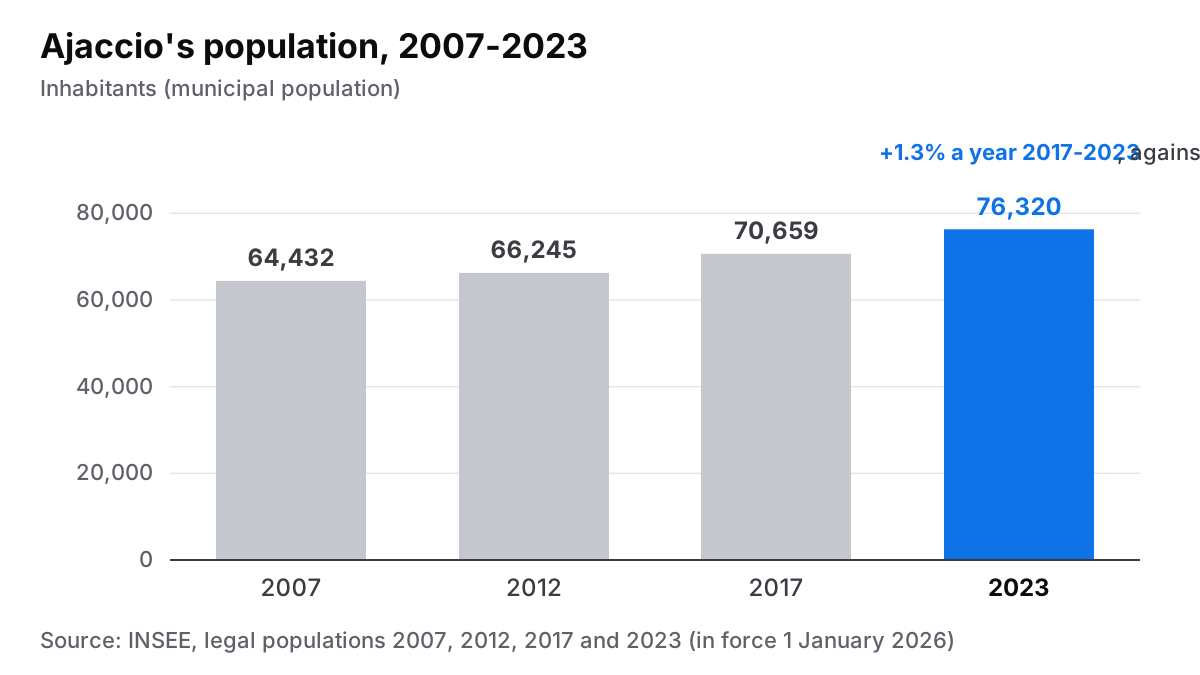
Ajaccio, the capital of Corsica and prefecture of the Corse-du-Sud department, sits on the sheltered northern shore of the Gulf of Ajaccio. Home to 76,320 inhabitants in 2023, the commune grew at an average annual rate of 1.3% between 2017 and 2023—more than three times the national average of 0.4% across France. Served by Ajaccio Napoléon Bonaparte airport and year-round ferries, the city balances public administration, maritime trade, and island tourism. Live pricing, trends, and inventory distribution are updated continuously in our live market ticker.
Where is Ajaccio, and what does the city look like on a map?
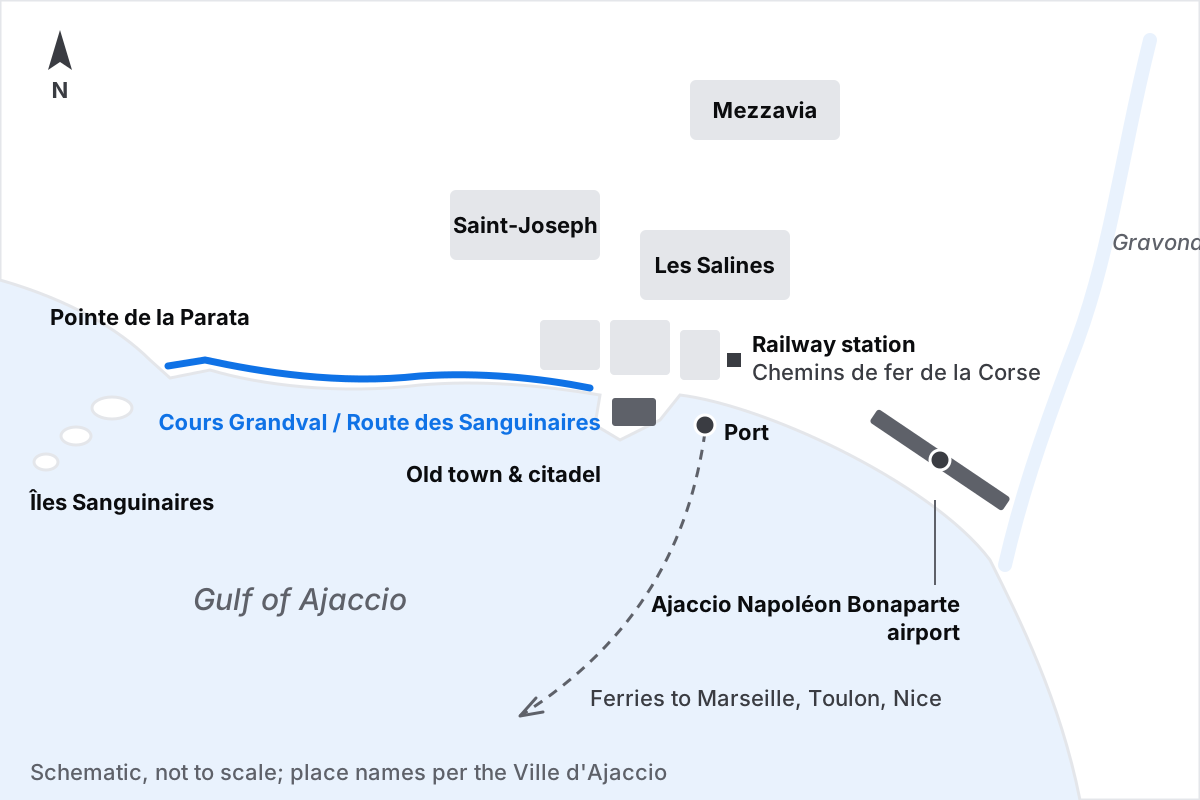
Located on Corsica’s west coast, Ajaccio spans 82 km² along the northern coastline of its namesake gulf, stretching from the mouth of the Gravona river in the east to the rocky headland of the Pointe de la Parata in the west. With a population density of 930.4 inhabitants per km² according to INSEE 2023 census figures, the commune is both the seat of the Collectivité de Corse and the administrative headquarters of the Corse-du-Sud department.
For a property buyer or estate agent, Ajaccio’s geography creates distinct micro-markets. At the centre, clustered around the harbour, lies the historic old town, anchored by the 16th-century citadel and wide avenues such as cours Napoléon and cours Grandval. To the west, the Route des Sanguinaires traces the coastline toward the Sanguinaires archipelago, lined with seaside villas and residential apartment buildings. To the north and east, expanding across the Gravona plain, lie newer residential and commercial districts including Les Salines, Saint-Joseph, and Mezzavia, which connect the city to the airport and regional road network. Ajaccio forms the core of the Communauté d’Agglomération du Pays Ajaccien (CAPA), an intercommunal body comprising 10 communes monitored through official records on BANATIC.
How fast is Ajaccio growing?
Far from being a seasonal holiday outpost, Ajaccio is one of the fastest-growing urban centres in Corsica. Historical census records from INSEE show steady population expansion: from 64,432 inhabitants in 2007, the legal population rose to 66,245 in 2012, 70,659 in 2017, and reached 76,320 in 2023 (with total legal population including temporary residents reaching 77,132).
This sustained annual growth of 1.3% reflects strong demographic fundamentals. According to the INSEE statistical dossier for Ajaccio, the share of residents aged under 15 grew from 15.2% in 2012 to 18.4% in 2023 (14,014 young people). This influx of families and working-age households is driven by Ajaccio’s status as the island’s primary administrative capital, expanding service sector employment, and ongoing migration from both mainland France and inland Corsican communities. For investors, this balanced demographic profile underpins year-round residential rental demand alongside holiday let interest. Understanding how demographic shifts influence localized housing demand is central to why hyper-local data matters in a market like Ajaccio.
What drives Ajaccio’s economy: tourism, harbour trade and administration
Ajaccio’s economic fabric combines administrative stability with coastal commerce. As the institutional heart of Corsica, regional government agencies, healthcare facilities, and judicial institutions generate a resilient base of permanent employment.
Along the harbour, maritime commercial activity and cruise travel support local business. Coastal tourism stretches across some twenty kilometres of commune shoreline, supported by daily fish and produce markets at Place Foch and the Marché d’Ajaccio. Cultural heritage adds to the city’s appeal: the Maison Bonaparte national museum (Napoleon’s birthplace), the Cathedral of Santa Maria Assunta, the 16th-century citadel, Place d’Austerlitz, and the Musée Fesch art gallery anchor the town’s identity. These year-round cultural assets make the city attractive to purchasers contemplating owning a second home on the Mediterranean. The local climate is classic Mediterranean, characterized by mild winters and warm, sun-filled summers.
The Sanguinaires and the Pointe de la Parata: Ajaccio’s natural landmark
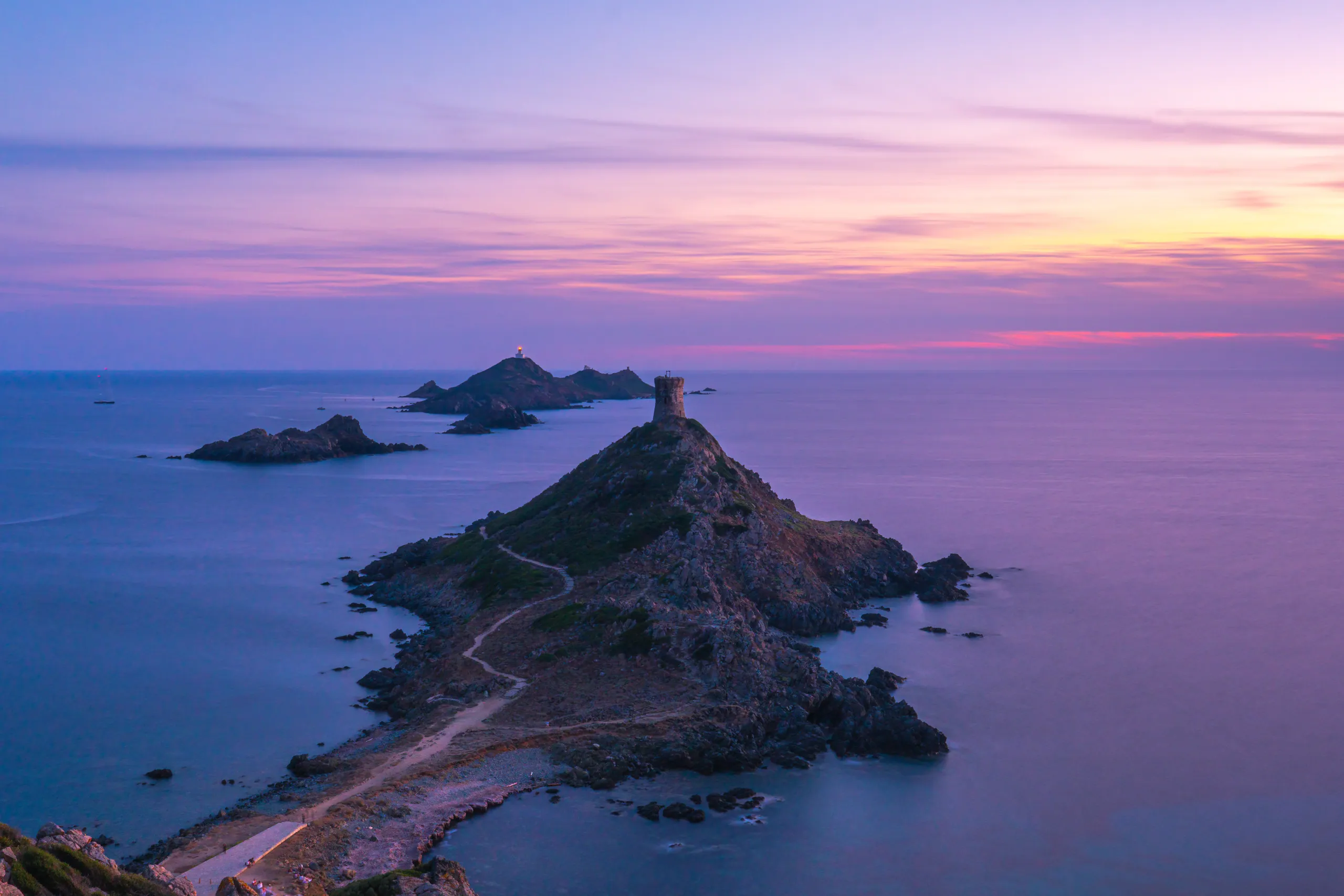
At the far western tip of the commune, the Pointe de la Parata headland overlooks the four granite islets of the Îles Sanguinaires. This natural enclave is designated as a protected coastal site, renowned for its Genoese watchtower, coastal hiking trails, and biodiversity.
For real estate buyers, the Route des Sanguinaires leading to the headland represents the city’s most prominent coastal corridor. Residential developments and standalone properties along this road offer unobstructed sea views and direct access to small coves. Water sports, scuba diving, coastal cycling, and boat trips operate along the gulf, making proximity to this corridor a central criterion for international buyers seeking prime coastal property.
Getting to and around Ajaccio from the UK and mainland France
Ajaccio is well connected to mainland France and broader European transport networks by air, sea, and rail:
- By Air: Ajaccio Napoléon Bonaparte Airport is situated approximately 20 minutes east of the city centre. Serving as the primary hub for Air Corsica, the airport provides regular daily flights to Paris, Marseille, and Nice, alongside seasonal direct connections to European destinations.
- By Sea: Commercial ferry operators Corsica Linea, La Méridionale, and Corsica Ferries operate year-round passenger and vehicle sailings connecting Ajaccio’s harbour to Marseille, Toulon, and Nice, as well as seasonal routes to Sardinia.
- By Rail: The Chemins de fer de la Corse operates a narrow-gauge railway from Ajaccio central station inland to Corte and Bastia, with connections at Ponte-Leccia towards Calvi.
- Local Mobility: Public transport within the commune is managed by the CAPA under the Muvitarra mobility brand. The local urban bus network, Muvistrada, is currently undergoing a fleet and infrastructure upgrade, including a new bus terminal hub documented on the CAPA Muvistrada modernisation portal. While urban buses and express shuttles connect the harbour and central districts, owning a car remains standard for residents living in peripheral or coastal neighbourhoods.
Taxes, short lets and residency: the rules that apply in Ajaccio
Navigating property ownership in Ajaccio requires an understanding of French tax regulations, short-term rental laws, and residency requirements:
- Property Taxes: Every real estate owner in Ajaccio pays annual property tax (taxe foncière). The residence tax (taxe d’habitation) was fully abolished for primary residences in 2023, as detailed on service-public.fr, but remains applicable to second homes (résidences secondaires).
- Furnished Holiday Lets: Property owners wishing to offer furnished short-term tourist rentals (meublés de tourisme) must declare the activity to the town hall (mairie). National rules were updated under Law no. 2024-1039 of 19 November 2024 on Légifrance, which tightened regulation and taxation for short-term lets. Buyers should verify specific local registration or change-of-use requirements directly with the Ville d’Ajaccio before launching a rental property.
- Residency for International Buyers: Non-EU citizens, including British nationals, face no restrictions when buying freehold property in France. Visa-free stays for non-EU visitors are limited to 90 days within any 180-day period across the Schengen area; stays exceeding this threshold require a long-stay visa (visa de long séjour).
To evaluate specific neighbourhood pricing trends, transaction histories, and available listings in Ajaccio, explore Area Insights for Ajaccio and the rest of Corsica. Real estate professionals seeking precise valuations can request a valuation or market study for a specific Ajaccio property, learn how to run a market analysis in CASAFARI, or consult the Area Insights developer documentation before accessing tools directly on the CASAFARI platform.
Frequently asked questions
How do I get to Ajaccio from the UK?
You can reach Ajaccio by flying into Ajaccio Napoléon Bonaparte Airport, located about 20 minutes from the city centre. Air Corsica provides regular connections via Paris, Marseille, and Nice, with additional direct seasonal flights operating from selected European hubs. Alternatively, year-round passenger ferries operated by Corsica Linea, La Méridionale, and Corsica Ferries link mainland French ports such as Marseille, Toulon, and Nice directly to Ajaccio’s harbour.
Can I let my flat in Ajaccio as a holiday rental?
Yes, but you must register a furnished holiday rental (meublé de tourisme) with the local town hall (mairie). French national regulations governing short-term lets were tightened under the law of 19 November 2024, altering tax treatment and municipal oversight. Property owners should consult the Ville d’Ajaccio regarding local registration procedures and potential change-of-use authorisations before listing their property.
What taxes does a property owner pay in Ajaccio?
All property owners in Ajaccio pay annual land tax (taxe foncière). While the residence tax (taxe d’habitation) on main residences was abolished in 2023, it remains payable on second homes, which affects many international buyers. Furthermore, rental income generated from Corsican property is subject to French income tax and social charges regardless of the owner’s primary tax residency.
Which areas of Ajaccio are best for buying a home?
The best neighbourhood depends on your lifestyle and investment goals. The historic old town and areas around cours Napoléon suit buyers looking for historic apartments, harbour views, and walkable access to amenities. The Route des Sanguinaires and cours Grandval are sought after for prime sea-view apartments and coastal villas, while eastern districts like Les Salines, Saint-Joseph, and Mezzavia offer modern residential developments and convenient road connections.