
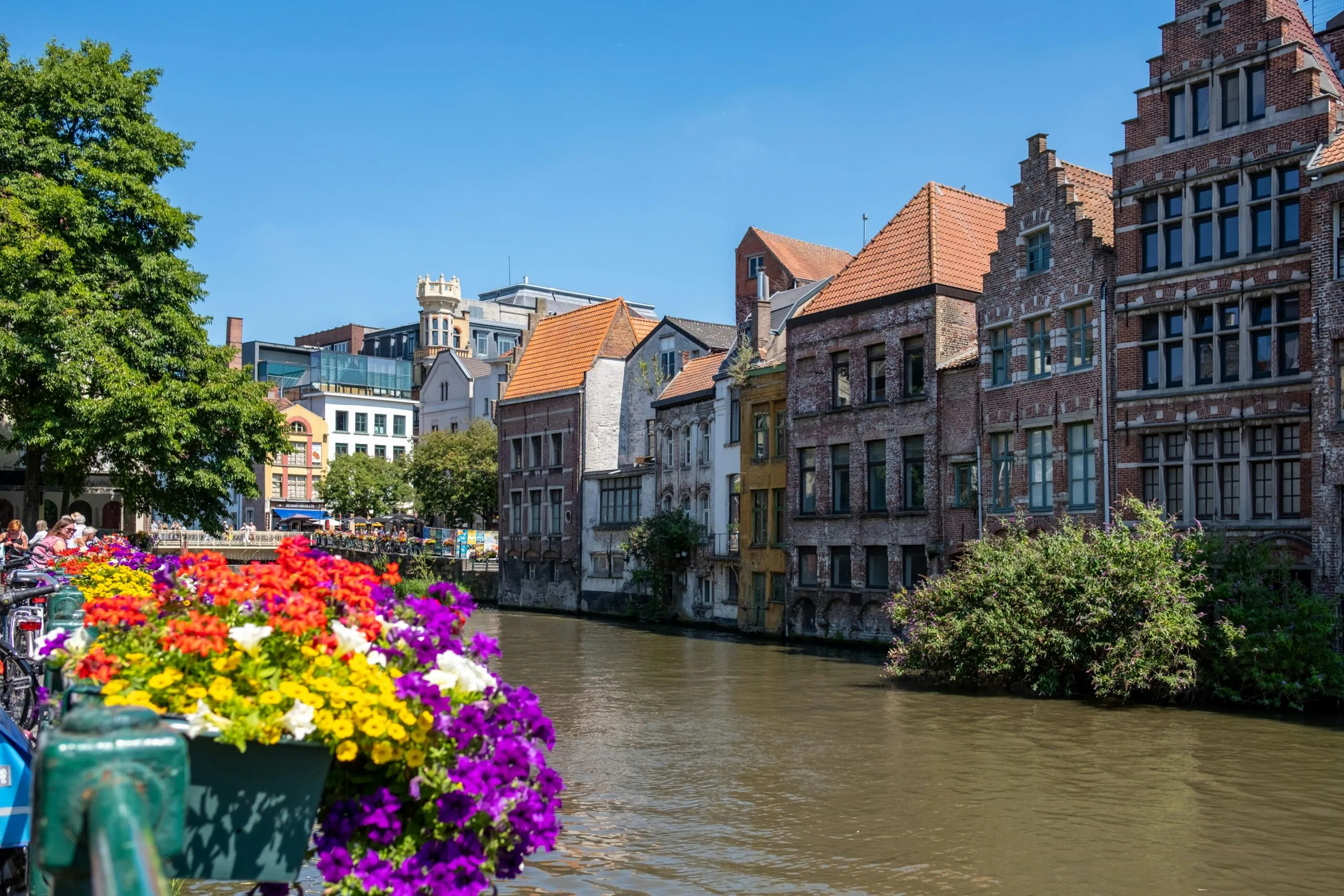
Ghent
Medieval Grandeur Meets Rebel Spirit and Modern Innovation
Situated at the confluence of the Leie and Scheldt rivers, Ghent is a thriving East Flanders university and biotech hub with an official population of 273,790 as of 1 January 2026 (Stad Gent). Driven by nearly 90,000 higher-education students and robust employment, apartment asking prices indexed by CASAFARI reached €4,796/m² in Q3 2026 (+9.0% year on year), while monthly asking rents averaged €15.2/m² (+8.6% year on year).
Where Ghent sits and how it connects to Belgium and Europe
Ghent occupies a strategic crossroads in East Flanders, linking naturally one level up to our Belgium property guide as well as neighbouring economic centres. Direct NMBS Intercity rail services from Gent-Sint-Pieters station—Belgium’s busiest transport hub outside Brussels—provide fast connections across the country, taking 28 to 36 minutes to Brussels-South (Brussel-Zuid), 22 to 28 minutes to Bruges, 56 to 63 minutes to Antwerp-Central, and 54 to 56 minutes on the fastest direct trains to Brussels Airport-Zaventem (NMBS, 2026).
Local mobility shapes property demand across the municipality. Ghent’s award-winning Circulatieplan maintains one of Europe’s largest car-free historic city centres, supported by dense tram corridors and cycle highways. Urban development is anchored by the multi-year Project Gent-Sint-Pieters station redevelopment, scheduled to run through late 2028, which includes the construction of the Sint-Pieterspoort residential and office towers in Zone A along Koningin Fabiolalaan, launched in late 2025 (Project Gent-Sint-Pieters, 2026).
What makes Ghent tick: everyday life, university energy and industrial muscle
Daily life in Ghent blends medieval heritage with contemporary urban culture. Residents gather on Saturday mornings at the Vrijdagmarkt, stroll along the stone quays of the Graslei and Korenlei, dine in the cobbled alleys of Patershol beneath the medieval Gravensteen castle, or enjoy the public library and digital agora at De Krook alongside the restored Wintercircus—the former Mahy garage, which now operates as a tech incubator, co-working space and 500-capacity underground concert venue (Sogent, 2026).
Green spaces are woven into the urban fabric, from the historic Citadelpark and the Ghent University Botanical Garden (Plantentuin) to kayaking on the canals and swimming at the Blaarmeersen sports domain. Demographically, the city continues to expand: official figures from Stad Gent recorded 273,790 residents on 1 January 2026, an increase of 1,401 inhabitants or +0.51% year on year. This population is augmented by approximately 88,000 to 92,000 unique higher-education students, including roughly 50,000 enrolled at Ghent University (UGent) and 19,600 at HOGENT (Stad Gent Higher Education Dashboard, 2025–2026).
Economic fundamentals are equally robust. Tech Lane Ghent Science Park spans 60 hectares across Campus Ardoyen and Campus Eiland Zwijnaarde, uniting more than 120 companies and 4,400 to 5,500 high-tech professionals in biotech and deep tech. Meanwhile, North Sea Port handled 128.5 million tonnes of total cargo in 2025—including over 31 million tonnes of seaborne traffic in the Ghent and Flemish section—powering an industrial network of over 550 companies and more than 100,000 direct and indirect jobs (Statistiek Vlaanderen and Trends Knack, 2025–2026).
Housing stock and neighbourhoods: where buyers and tenants look in Ghent
Ghent’s residential landscape varies sharply by district. Buyers seeking historic character and architectural distinction gravitate towards Gothic and Renaissance guildhall conversions and luxury penthouses in the Historic Centre (Kuip) and Patershol. Those with a taste for early-20th-century Art Deco architecture and grand urban villas focus on the Miljoenenkwartier near Gent-Sint-Pieters, while 19th-century terraced workers’ houses and family townhouses dominate districts like Sint-Amandsberg, Ledeberg and Dampoort.
Waterfront regeneration has opened up former industrial brownfields into sought-after quarters. At Oude Dokken, the De Nieuwe Dokken masterplan has delivered around 400 homes along Schipperskaai; in March 2026, Sogent completed 15 affordable rental apartments (Bolders Beluik) beside a new 2,850 m² neighbourhood park at the Melopee building, following the launch of the adjacent Houtdok development phase in May 2025 (Sogent, 2026).
International biotech researchers, corporate expats and medical professionals frequently target energy-efficient, turn-key apartments in Stationsbuurt-Sint-Pieters, Reep and De Krook. Domestic buyers and dual-city commuters working in Brussels or Antwerp find value in Sint-Amandsberg and the station fringe, while parents of university students and private investors look for well-connected starter flats.
Ghent property market: asking prices, rents and official closing prices
When evaluating market entry, property professionals distinguish clearly between asking prices found in portals and closing prices recorded in official notarial deeds. According to CASAFARI Area Insights (location id 543063, queried 23 October 2026), the average asking price for apartments for sale in Ghent reached €4,796/m² in Q3 2026, representing a 9.0% year-on-year increase from €4,399/m² in Q3 2025 (figures derived from indexed listings, outliers excluded).
Rental demand mirrors this upward pressure. CASAFARI Area Insights data shows that the average monthly asking rent for apartments in Ghent stood at €15.2/m² in Q3 2026, up 8.6% year on year from €14.0/m² in Q3 2025, driven by intense competition among young professionals, academic staff and students.
To ground these asking figures in transaction reality, official closing-price statistics published by Statbel (derived from registered notarial sales deeds across full-year 2025) indicate a median closing price of €305,000 for apartments (comparing with €310,000 in Q1 2025 and €306,800 in Q3 2025), €386,000 for residential houses overall, and €560,000 for detached houses (open bebouwing) (Statbel, 2025).
Taxes, EPC renovation rules and letting regulations buyers must know in 2026
Navigating the Ghent property market requires a clear understanding of Flemish and municipal regulations. Registration taxes (verkooprecht), governed by the Flemish Tax Administration (Vlaamse Belastingdienst) registration tax rules, charge a reduced rate of 2% for natural persons purchasing their sole and primary residence (enige en eigen woning), provided they register in the municipal population register at that address within three years for at least one uninterrupted year (subject to tightened enforcement rules effective 1 January 2026). Buyers of second homes, buy-to-let investments or building plots pay the standard 12% rate, and the former 1% tax reduction for major energy renovations was abolished on 1 January 2025.
Energy performance is another critical compliance factor. Under the Flanders mandatory residential EPC renovation obligation, buyers acquiring a house or apartment with an Energy Performance Certificate (EPC) rating of E or F must renovate the property to achieve at least EPC label D. Following final approval by the Flemish Government on 12 December 2025, buyers have six years from signing the notarised purchase deed to complete the required energy upgrades, and the previously scheduled post-2028 tightening path towards labels C, B and A has been scrapped (Vlaanderen.be, 2026). For further background on energy ratings, see our guide on why Energy Performance Certificates matter when selling or renting.
Short-term holiday lets and student housing are heavily regulated by Stad Gent. The city enforces a strict holiday-home freeze (vakantiewoningenstop), prohibiting the permanent conversion of apartments, studios and protected single-family houses under 220 m² into tourist accommodation. Permit-free short letting is restricted either to an ancillary activity within the host’s primary residence (occupying under 50% of floor area, max 100 m², max 3 rooms and 9 guests) or to temporary letting for a maximum of four periods of 30 consecutive days per year in larger properties. All hosts must comply with the Flemish Logiesdecreet, pay municipal tourist tax, maintain safety standards, and—from May 2026—display an official Toerisme Vlaanderen registration number on every online listing (Stad Gent, 2026).
Similarly, to protect family housing stock, Stad Gent enforces a permit freeze on new student room houses (kamerwoningen) and prohibits letting ordinary family houses or apartments to groups of students. Existing student rooms must meet stringent standards set out in the Stad Gent minimum standards for student rooms, requiring at least 12 m² for a single room, 18 m² for a double room, washbasins, smoke detectors, safe heating and secure bicycle storage. Holding a valid 10-year conformity certificate (conformiteitsattest) exempts landlords from Ghent’s municipal second-home tax; since 1 September 2026, inspections for conformity certificate applications have become fee-bearing in specific cases (Stad Gent, 2026).
How real estate professionals and investors analyse Ghent with CASAFARI
Estate agents, property developers, institutional investors and independent valuers operating in East Flanders rely on data-driven intelligence to navigate Ghent’s diverse micro-markets. Professionals use CASAFARI Area Insights to track quarterly asking price movements, rental yields, inventory levels and days on market across individual postcodes and neighbourhoods.
To source off-market opportunities or aggregate fragmented listings across Belgian portals, agents use CASAFARI Property Sourcing. For accurate asset pricing, professionals deploy our property valuation and market study tool to benchmark individual townhouses and apartments against comparable transactions while adjusting for EPC ratings and renovation condition. Data teams and enterprise prop-tech builders can query market metrics programmatically via the Area Insights API and MCP documentation in English.
For broader European investment context, read our analysis on gross rental yields across European cities in 2026. When you are ready to begin, sign in to the CASAFARI platform to access live market data and professional search tools.
Frequently asked questions
What are the registration taxes when buying property in Ghent in 2026?
Under Flemish tax rules (verkooprecht), natural persons buying their sole and primary residence (enige en eigen woning) pay a reduced registration tax of 2%. To qualify, buyers must register in the municipal population register at the property address within three years for at least one uninterrupted year, following tightened regulations introduced on 1 January 2026. Buyers of investment properties, second homes or building plots must pay the standard 12% rate, and the former 1% reduced rate for major energy renovations was abolished on 1 January 2025.
What is the EPC renovation obligation in Flanders for buyers in Ghent?
In the Flemish Region, anyone buying a residential house or apartment with an Energy Performance Certificate (EPC) rating of E or F is legally required to renovate the property to achieve at least EPC label D. Following a final decision by the Flemish Government on 12 December 2025, buyers have six years from signing the notarised purchase deed to complete these energy-saving upgrades. Furthermore, the previously planned post-2028 tightening schedule towards labels C, B and A has been officially scrapped.
Can you buy an apartment in Ghent for Airbnb or short-term holiday lets?
No, you cannot permanently convert standard apartments or houses into holiday lets in Ghent. The city enforces a strict holiday-home freeze (vakantiewoningenstop) that bans turning apartments, studios and protected single-family houses under 220 m² into permanent tourist accommodation. Without a formal planning permit, short letting is strictly limited to hosting guests within your own primary residence under specific size restrictions, or temporary letting for a maximum of four periods of 30 consecutive days per year, with mandatory Toerisme Vlaanderen registration numbers required on all advertisements from May 2026.
What are the rules for investing in student housing (koten) in Ghent?
To safeguard residential housing for families, Stad Gent enforces a permit freeze on new student room houses (kamerwoningen) and prohibits renting standard family homes or apartments to groups of students. Existing student accommodation must comply with the Flemish Housing Code, offering at least 12 m² for single rooms and 18 m² for double rooms, alongside washbasins, smoke detectors and secure cycle storage. Landlords must hold a 10-year conformity certificate (conformiteitsattest)—for which municipal inspection fees apply in certain cases as of September 2026—to qualify for an exemption from Ghent’s second-home tax.
How fast are train connections from Gent-Sint-Pieters to Brussels, Antwerp and Zaventem Airport?
From Gent-Sint-Pieters, Belgium’s busiest railway station outside Brussels, direct NMBS Intercity trains provide rapid transit across the country. Journey times range from 28 to 36 minutes to Brussels-South (Brussel-Zuid), 22 to 28 minutes to Bruges, and 56 to 63 minutes to Antwerp-Central. Direct train services to Brussels Airport-Zaventem take between 54 and 56 minutes on the fastest connections.
Which neighbourhoods in Ghent are most sought-after by buyers and tenants?
Buyers seeking historic architectural character and complete walkability focus on the car-free Historic Centre (Kuip) and medieval Patershol. High-net-worth buyers looking for grand urban villas typically target the Art Deco Miljoenenkwartier near the main station, while corporate expats and professionals favour redeveloping districts around Stationsbuurt-Sint-Pieters, Reep and De Krook. Meanwhile, families and long-term rental investors increasingly concentrate on the waterfront regeneration at Oude Dokken and well-connected residential areas such as Sint-Amandsberg, Ledeberg and Dampoort.