
Antwerp Area Guide: Living, Buying and Investing in Belgium's Port City
Europe’s Capital of Cool and Diamond Excellence
On a Saturday morning on Theaterplein, locals gather at the market before taking the tram out to Berchem or Het Zuid. For international buyers comparing European cities, Antwerp offers a resilient urban economy alongside clear property rules. Official data from Statbel shows the median attached house in the province of Antwerp reached €365,000 in the first half of 2026. Understanding Flemish registration duty—2% for a primary residence versus 12% for secondary or investment properties—is essential before searching districts using CASAFARI Area Insights.
What is it like to live in Antwerp?
Antwerp functions as a distinct city of pockets, where adjacent quarters offer markedly different architectural styles and urban rhythms. Living here combines compact, walkable urban centres with extensive green spaces and high-capacity public transit.
The city’s cultural footprint reflects its historic status as a centre of international trade and creativity. Residence in Antwerp places world-class art collections, historic architecture and contemporary design within daily reach. Fashion remains central to its modern identity, anchored by the MoMu fashion museum and prestigious training institutions. The diamond district surrounding Antwerp-Centraal station remains an international trading locus, while public squares such as Theaterplein host the popular Saturday market, known locally as the Exotic Market.
Antwerp experiences a temperate maritime climate characterized by mild summers and damp winters. Getting around is straightforward without a private car. The city features a dense cycling infrastructure supported by the Velo public bike-share network, alongside De Lijn’s extensive tram and bus routes.
As a regional transportation hub, Antwerp-Centraal provides high-speed Eurostar rail connections to Paris in approximately two hours and Amsterdam in about one hour and 15 minutes. Travel to London requires a transfer at Brussels-Midi. Brussels Airport is accessible via direct rail services taking approximately 30 to 35 minutes, while Antwerp International Airport in nearby Deurne offers regional flights.
Which neighbourhoods should buyers and visitors know?
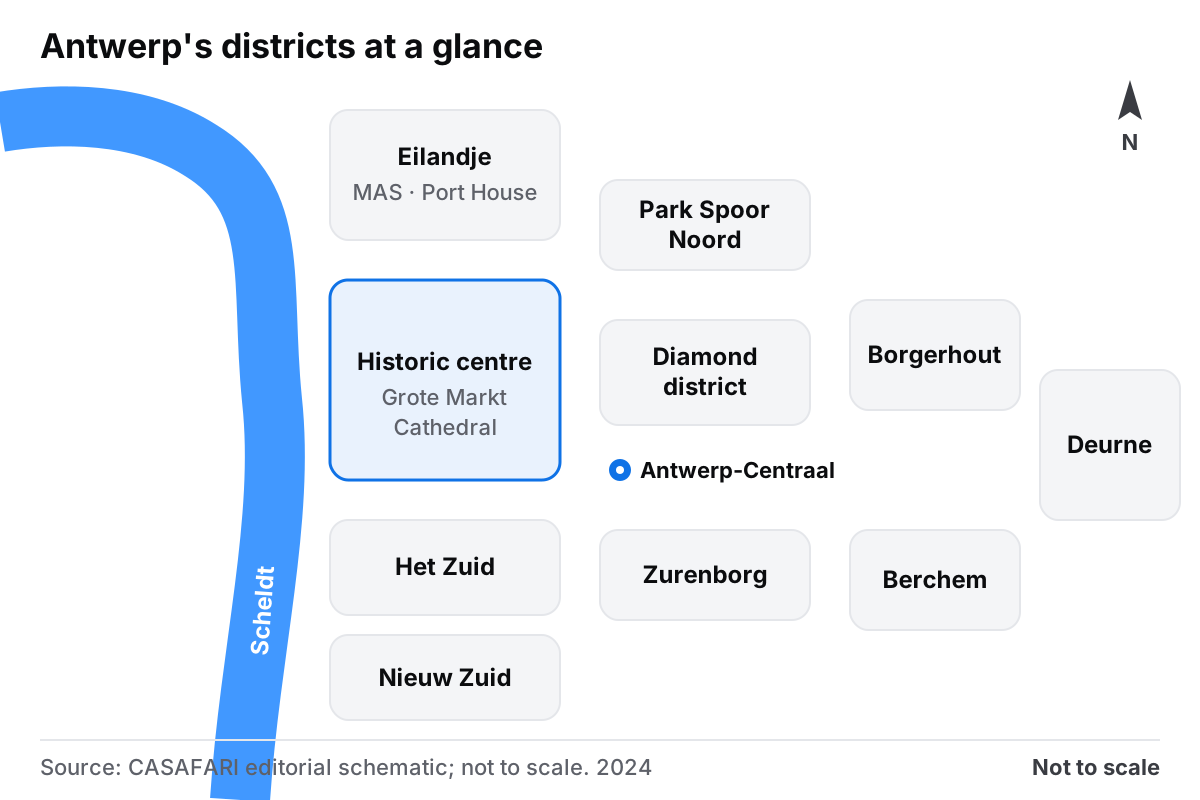
Each district in Antwerp offers a unique residential character and structural context:
- Historic Centre: Centred around the Grote Markt and the Cathedral of Our Lady, this quarter features historic townhouse architecture, Rubens masterpieces, and the Plantin-Moretus Museum, designated a UNESCO World Heritage site in 2005. Landmark developments include the Museum Aan de Stroom (MAS) and Zaha Hadid Architects’ Port House along the northern docks.
- Het Zuid: Characterised by 19th-century boulevards, fine art galleries, and the restored Royal Museum of Fine Arts Antwerp (KMSKA).
- Eilandje: The city’s former docklands, transformed into a quarter of converted maritime warehouses, modern loft apartments, and waterfront dining.
- Nieuw Zuid: A newly developed, sustainable urban expansion zone located south of the centre, designed with energy-efficient residential complexes.
- Zurenborg: Celebrated for its preserved art nouveau streetscapes surrounding Dageraadplaats.
- Borgerhout and Deurne: Accessible residential districts providing wider stock options and direct tram access to the core.
Beyond the city limits, day trips to the historic city of Ghent, the riverside village of Doel, or the border nature reserve at Kalmthoutse Heide are popular weekend destinations.
To compare real-time supply, pricing trends, and market activity across each of these districts, real estate professionals rely on CASAFARI Area Insights.
What drives Antwerp’s economy and demand for housing?
Antwerp’s property market is anchored by robust, diversified industrial and commercial fundamentals. The primary driver is the Port of Antwerp-Bruges, which serves as a central economic engine for Flanders and key employer for maritime, logistics, engineering, and chemical professionals.
Alongside port operations, the city’s commercial structure relies on its dedicated diamond quarter, a long-established fashion and creative sector, and expanding technology and life-sciences clusters. Modern flexible workspaces support start-ups and international remote teams across the inner districts.
Urban regeneration projects, exemplified by the mixed-use planning in Nieuw Zuid, continue to refresh housing stock and maintain consistent appeal for domestic and international residents.
What does the official data say about the Antwerp property market?
According to official transaction statistics published by Statbel for the first semester (S1) of 2026, house price movements in the province of Antwerp remain steady and grounded in notarised sales deeds:
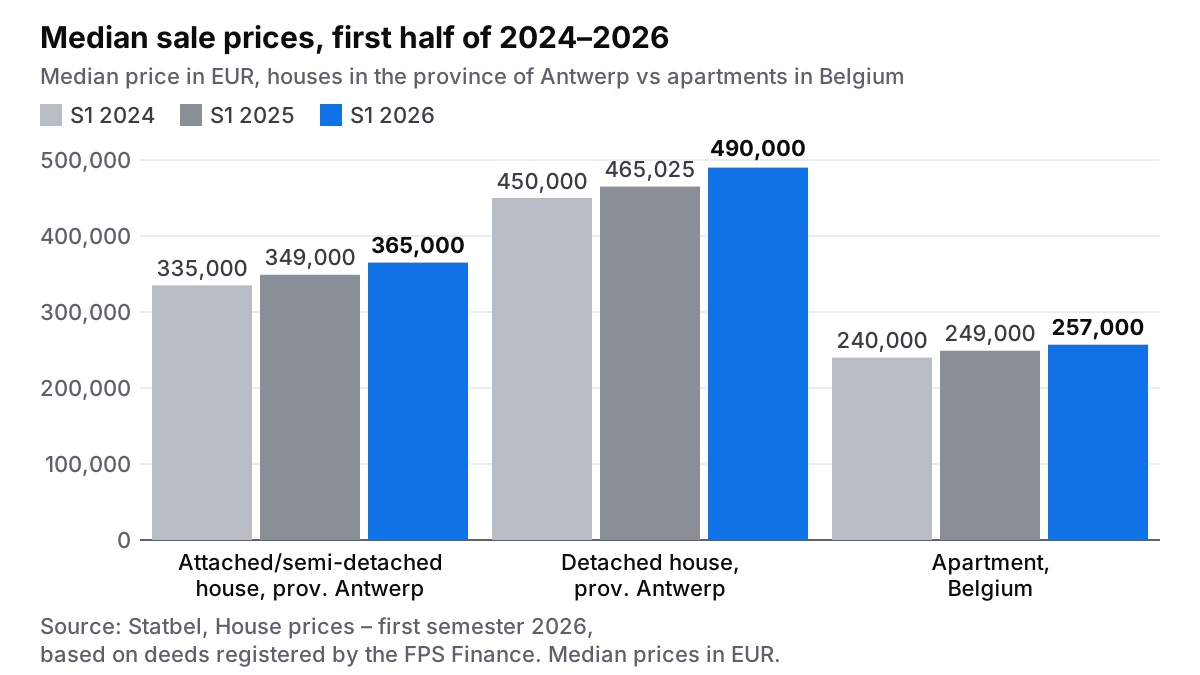
- Attached and semi-detached houses: The median sale price in the province of Antwerp reached €365,000 in S1 2026. This reflects a 4.6% increase compared to S1 2025 (€349,000) and an increase from €335,000 in S1 2024.
- Detached houses: The median sale price reached €490,000 in S1 2026 (+5.4% year-on-year from €465,025 in S1 2025 and €450,000 in S1 2024), positioning Antwerp alongside Flemish Brabant as the joint most expensive Flemish province for detached property.
- National apartment benchmark: Across Belgium, the median apartment price stood at €257,000 in S1 2026, up 3.2% from €249,000 in S1 2025 and €240,000 in S1 2024.
Because Statbel tracks provincial transactions, market participants assessing individual properties in specific urban micro-locations should review a tailored valuation and market study for specific properties or consult dedicated CASAFARI tools for property investors. Investors evaluating broader portfolio strategies can also study how to find the most profitable locations with data and understand how rental yield is calculated.
What do international buyers need to know before buying in Antwerp?
Understanding regional taxation and legal requirements is crucial when planning a purchase in Flanders:
Flemish Registration Duties (Verkooprecht)
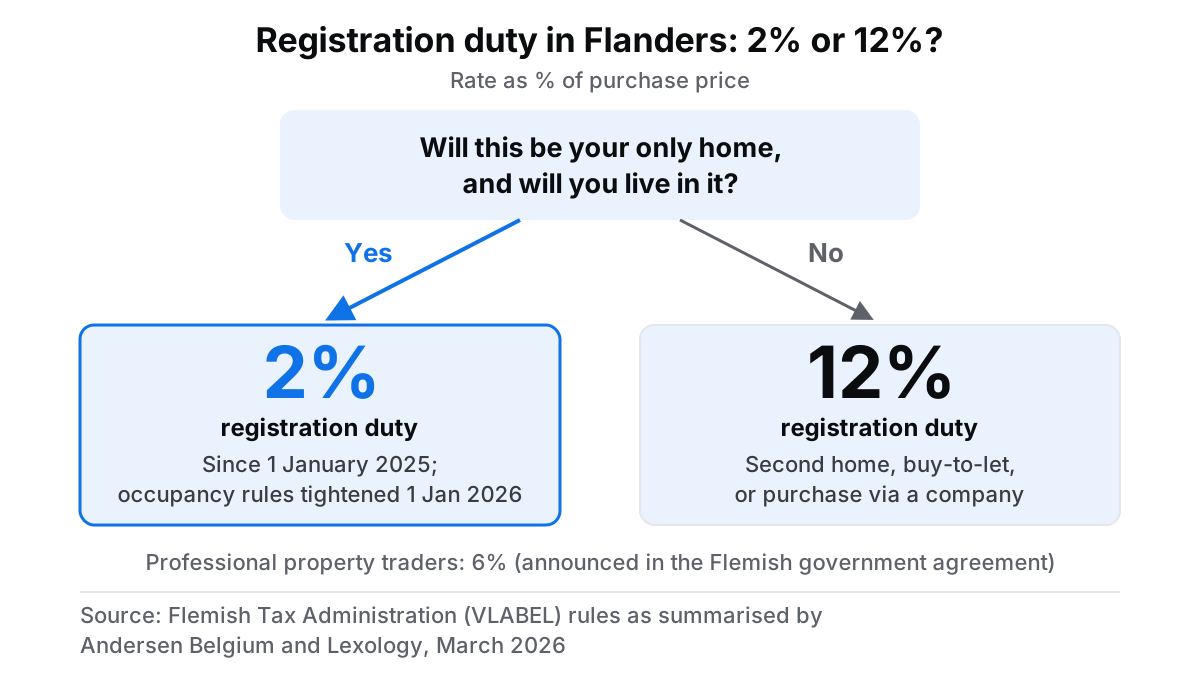
- Primary Residence (Sole Home): Buyers acquiring their sole owner-occupied property in Flanders pay a reduced registration duty of 2% (in effect since 1 January 2025).
- Secondary Properties & Investments: Second homes, buy-to-let acquisitions, and property purchased via corporate entities are subject to the standard 12% rate.
- Strict Condition Tightening: As detailed in Lexology legal analysis and Andersen Belgium’s summary of the Flemish tax rules, administrative conditions for the 2% rate were tightened on 1 January 2026, requiring strict compliance with principal residence domicile obligations.
- Professional Traders & New Builds: Purchases by professional property traders incur a 6% duty, while newly constructed properties are subject to VAT rules rather than registration duty.
Legal Context for Foreign Buyers
Belgium places no restrictions on foreign property ownership, allowing non-residents to buy property under standard notarised procedures. However, real estate ownership does not grant Belgian residency rights. UK citizens and other non-EU buyers must observe standard Schengen 90/180-day limits unless holding valid residence permits.
Short-Term Tourist Lettings
Property owners planning short-term tourist lets must comply with the Flemish tourist accommodation decree (Logiesdecreet) and local municipal guidelines established by the City of Antwerp. Registration and safety approvals must be satisfied prior to operation.
Whether comparing district trends or evaluating individual assets, accurate data forms the foundation of a successful transaction. Technical teams can reference the Area Insights API documentation in English on developers.casafari.com for data integration, or sign in to the CASAFARI platform to analyze real-time market opportunities.
Frequently asked questions
Can a UK citizen buy property in Antwerp?
Belgium imposes no nationality restrictions on real estate acquisitions, allowing UK citizens and other non-EU buyers to purchase residential or commercial property freely. The purchasing process is overseen and legally completed by a Belgian notary. However, owning real estate in Belgium does not confer residency rights, meaning UK citizens remain subject to standard Schengen area rules allowing stays of up to 90 days within any 180-day period unless a residency permit is secured.
What are the registration duties when buying a home in Flanders?
Since 1 January 2025, Flanders applies a reduced registration duty (verkooprecht) of 2% for buyers purchasing their sole, owner-occupied home. Buyers purchasing an investment flat, a second home, or acquiring property through a company pay the standard 12% rate. Requirements for the 2% reduced rate were tightened on 1 January 2026 to ensure strict principal residence compliance, while purchases made by professional property traders incur a 6% duty.
Which are the best neighbourhoods to live in Antwerp?
The ideal neighbourhood depends on your lifestyle and investment criteria. The historic centre offers walkable heritage streetscapes, Het Zuid features 19th-century boulevards and museum quarters, while Eilandje and Nieuw Zuid provide converted docklands and modern sustainable architecture. Buyers seeking classic period character often explore Zurenborg’s art nouveau streets, whereas Berchem, Borgerhout, and Deurne deliver suburban residential space with direct tram connections into the core.
Is short-term letting allowed in Antwerp?
Short-term tourist rentals in Antwerp are governed by both the Flemish tourist accommodation decree (Logiesdecreet) and municipal regulations set by the City of Antwerp. Property owners must register their accommodation and fulfill specific safety, fire, and zoning compliance standards before taking guests. Investors should also note that buy-to-let properties attract the standard 12% Flemish registration duty rather than the reduced owner-occupier rate.